

A screening clearance is an important safeguard, but it is not the whole story. If you need the NDIS worker screening check explained in plain language, this guide can help. Understanding what the check does, and what it does not do, can help workers and participants feel more confident about safe, respectful support.
Workers may be unsure who needs a check, how applications work across Australia, or what an outcome means for a role. Participants may wonder what the check can protect them from. These are reasonable questions when safety and support are involved. Here, we explain the check’s purpose and limits, who it applies to, and what workers can expect from the application and outcome process. We also cover how the national system connects with state and territory arrangements, so you can take the next step with more confidence. Screening matters, and so do dignity, choice and support that reflects each person’s needs.
Key Takeaways
- Learn how worker screening differs from provider registration and what the check is designed to safeguard.
- Understand how the NDIS worker screening check explained in this guide fits within state and territory application arrangements.
- Know why a screening outcome should be understood using current terminology, without assuming what it means for every role or support arrangement.
- See how screening works alongside respectful practice, clear boundaries and support shaped around each person.
What is an NDIS Worker Screening Check, and what does it protect?
An NDIS Worker Screening Check assesses whether a person may pose a risk to people with disability when working in a risk-assessed role. It applies to an individual worker. NDIS provider registration, by contrast, relates to an organisation and its obligations. These are separate safeguards: a provider’s registration is not a substitute for a worker’s clearance, or vice versa.
The check sits within the wider National Disability Insurance Scheme (NDIS) framework, which aims to support people with disability. Screening can help identify relevant risks, but it cannot predict or guarantee a person’s future conduct. Safe support also depends on respectful practice, clear boundaries and listening to the person receiving support.
Which roles are covered, and whether an exemption applies, depends on current rules. As requirements can change, workers and participants should use the relevant state or territory government screening information for up-to-date guidance. The NDIS worker screening check explained here is a general guide, not a replacement for checking the requirements that apply to a particular role.
Is an NDIS Worker Screening Check the same as a police check?
No. A police check generally focuses on criminal history information, while an NDIS Worker Screening Check is a broader risk assessment. It may consider criminal history, workplace misconduct, Apprehended Violence Orders and other relevant information. The checks are not interchangeable, so use current official guidance to understand what information is considered and which check a role requires.
The check is intended to assess whether relevant information indicates a risk to people with disability in a risk-assessed role. That purpose is important, but it does not replace ongoing attention to a person’s safety, choices and dignity during everyday support.
How does the NDIS Worker Screening Check process work across Australia?
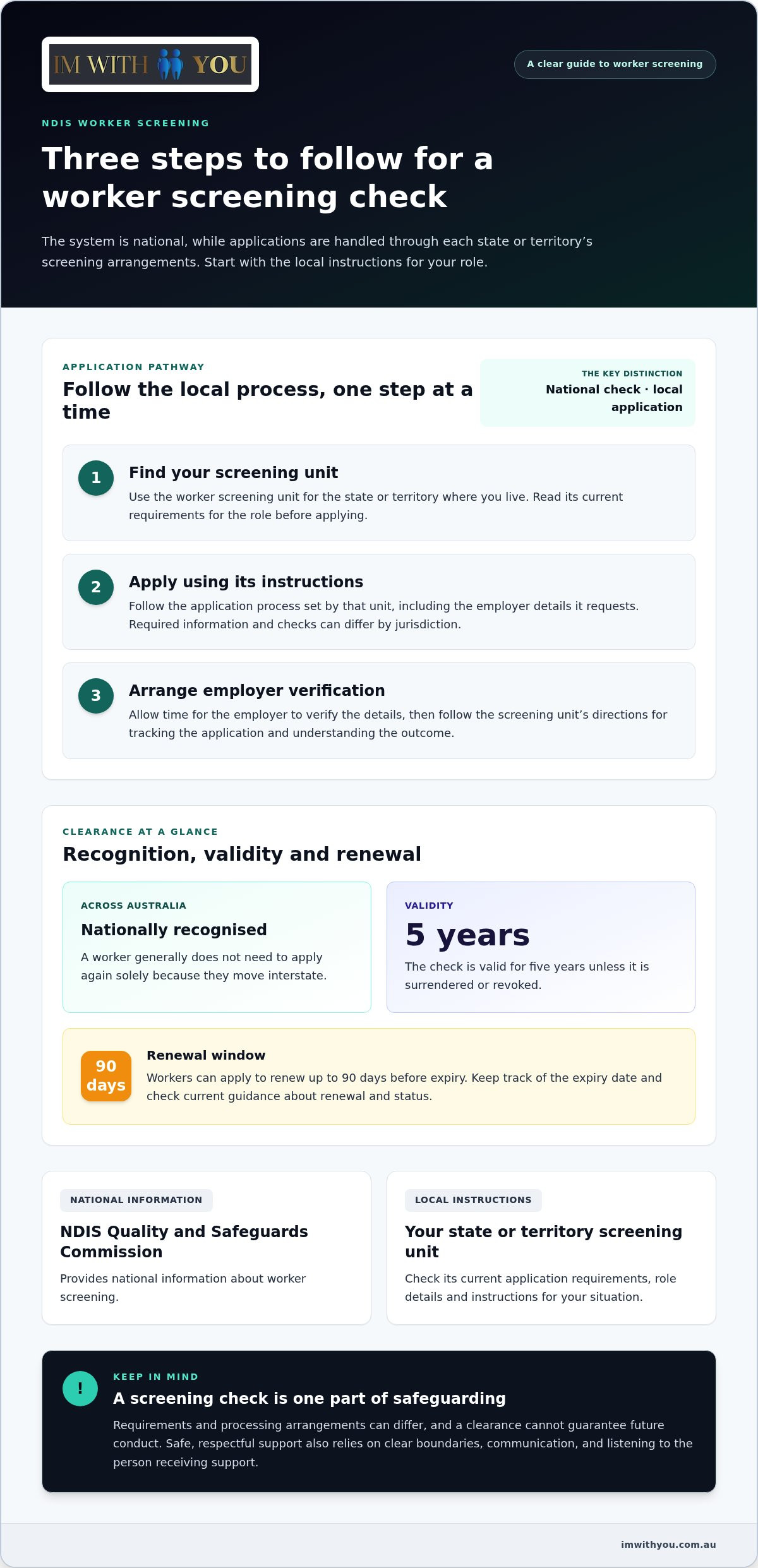
The screening system is national, but applications are managed through the relevant state or territory screening arrangements. Workers apply through the screening unit in the jurisdiction where they live. The NDIS Quality and Safeguards Commission provides national information, while the relevant screening unit’s current instructions explain the local application process.
As a starting point, an applicant should:
- Find the worker screening unit for their state or territory and read its current requirements for the role.
- Apply using the process set out by that unit, including the employer details requested.
- Arrange for the employer to verify those details, then follow the screening unit’s instructions about the application and outcome.
Use these steps as a guide, then follow the instructions for your jurisdiction. Required information, checks and processing arrangements can differ, so avoid relying on a timeframe or checklist that may not apply to your situation. Reviewing the role requirements before applying can also help you avoid submitting the wrong type of check.
What should an applicant expect when applying?
Start with the current official guidance for the state or territory where you live. Read the application requirements, prepare the employer details it asks for, and allow time for the employer to verify them. Follow the screening unit’s instructions for tracking your application and understanding the outcome. The clearest way to navigate the process is to follow the instructions for your jurisdiction rather than assume every application works the same way.
A clearance is nationally recognised, so a worker generally does not need to apply again solely because they move interstate. The check is valid for five years unless surrendered or revoked, and workers can apply to renew it up to 90 days before expiry. Keep track of the expiry date and consult official guidance about current status and renewal requirements, especially if your circumstances change.
If you’re also working through broader disability support arrangements, Im with you’s support coordination can help you explore options in a person-centred way.
What does a screening outcome mean for safe, person-centred NDIS support?
A screening outcome provides information about a worker’s check. It is not a complete measure of who they are or how they will behave in every situation, and it does not by itself explain every decision about a role or support arrangement. Workers should follow the instructions accompanying their outcome. Participants can ask for a clear explanation of what the information means for their circumstances.
For a state-specific example of how screening information is presented, the Victorian Government NDIS Worker Screening Check page outlines Victoria’s process. Requirements and guidance can differ across jurisdictions, so use the relevant official source for your location. A plain-language understanding of the check can help everyone discuss concerns without jumping to conclusions.
How can workers and participants approach screening with confidence?
Workers can take the process step by step: read the official instructions, keep relevant application information together and seek clarification from the responsible screening authority if something is unclear. Participants can ask questions about support arrangements in a way that feels comfortable. A respectful conversation focuses on practical reassurance and the person’s needs, rather than assumptions about someone’s character or an automatic employment decision.
Everyday safety also grows through clear communication, agreed boundaries and support shaped around a person’s preferences and goals. For example, a participant might explain how they like a worker to offer choices during a community activity. Agreeing on that approach helps make support more comfortable and responsive, alongside administrative checks.
Screening is one part of a wider safeguarding picture, not a guarantee of care quality. If you’re exploring support built around your priorities, Im with you’s disability supports can be a starting point for learning about person-centred assistance.
Take your next step with confidence
Understanding the NDIS worker screening check explained in this guide can help you approach disability support conversations with greater confidence. A practical next step is to think about what respectful, useful support looks like for you, including the choices, goals and boundaries you want others to understand.
Im with you provides disability support, advocacy and support coordination, with an approach centred on each person. A screening check is one part of a wider picture. Communication, trust and shared understanding also help shape meaningful support.
Explore how Im with you can walk alongside you with disability support. You deserve to feel heard as you shape support that fits your life, and you do not have to work it all out alone.
Frequently Asked Questions
Who needs an NDIS Worker Screening Check?
Workers in roles classified as risk-assessed under NDIS arrangements generally need a check, but it does not automatically apply to every person working in disability services. The role and any applicable exemption matter. Before accepting a position, compare its duties with current state or territory guidance and clarify with the employer which screening requirement applies to that role.
How long does an NDIS Worker Screening Check take?
There is no single Australia-wide processing time to rely on. The screening unit managing your application is the source for current timing information. Check its published estimate, submit details carefully and monitor your application as instructed. If timing matters for a role, discuss it with the employer rather than assuming a decision date.
Can an NDIS Worker Screening Check be used across Australia?
Yes. A clearance is nationally recognised, so moving interstate by itself does not mean you need to apply again. Keep a record of your clearance and expiry date, and provide the details through your employer’s required verification process. If your role or circumstances change, consult current official guidance to understand any relevant requirements. National recognition does not remove role-specific rules.