

For Australian families, the NDIS early childhood approach is for children younger than 9 who have developmental delay or disability. According to the National Disability Insurance Agency, the approach connects children and families with support suited to their needs. If you’re wondering what early childhood early intervention (ECEI) means, it describes timely, child- and family-centred support that can help children build skills and take part in everyday life.
It’s understandable to want clear answers when you’re concerned about your child’s development, especially if the NDIS pathway feels unfamiliar. This article explains what early childhood early intervention (ECEI) means in Australia, how the current approach works, what support may involve and how eligibility for an NDIS plan is considered. It also explains the difference between early childhood support and an NDIS plan, so you can better understand possible next steps for your family.
Key Takeaways
- Understand which children the NDIS early childhood approach is designed to support and how age can shape the pathway.
- Learn how early childhood partners can connect families with supports and help with an NDIS application when appropriate.
- See how early intervention can build everyday skills, encourage participation and support a child’s inclusion in their community.
- Explore how disability support, community participation, support coordination and advocacy can help families navigate their next steps.
What is the NDIS early childhood approach?
In Australia, the NDIS early childhood approach supports young children with developmental delay or disability and their families. According to the National Disability Insurance Agency, it is for children younger than 9.
This video introduces the NDIS framework and its early childhood pathways.
Early Childhood Intervention and Developmental Support
Early childhood intervention means support that helps children with delay or disability develop skills and participate in everyday activities. It can focus on communication, movement, learning or daily routines. The aim is to build on a child’s strengths and help carers support their progress at home and in mainstream settings.
Eligibility for Early Childhood Support
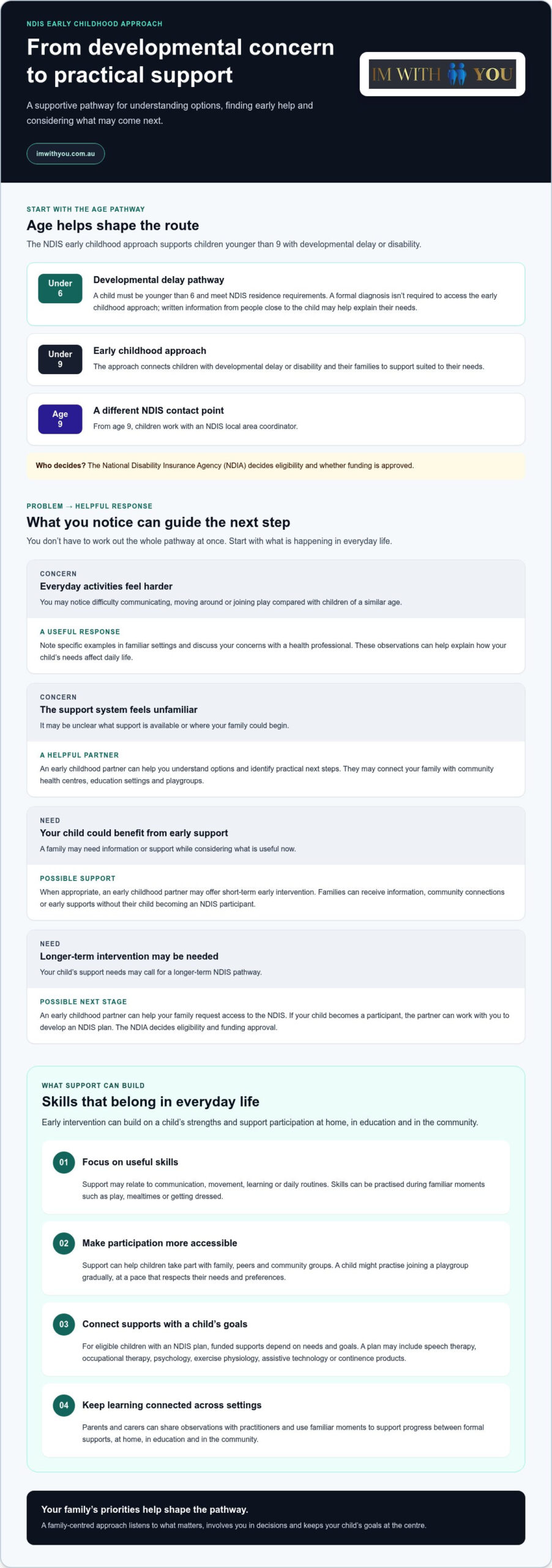
Eligibility depends on the child’s age, support needs and the NDIS pathway. For developmental delay, a child must be younger than 6 and meet NDIS residence requirements. A formal diagnosis isn’t required to access the early childhood approach; written information from people close to the child may help explain their needs. The NDIA decides eligibility and whether funding is approved.
Recognising Developmental Concerns
Developmental concerns may arise when a child finds everyday activities harder than other children of a similar age. You might notice, for example, that your child has difficulty communicating, moving around or joining play. Note what you observe in familiar settings and discuss your concerns with a health professional. Specific examples can help explain how your child’s needs affect daily life.
Understanding ECEI and the NDIS Approach
Early intervention describes support that helps with a child’s development. ECEI was the name commonly used for the former NDIS approach; the current term is the NDIS early childhood approach. Families can receive information, community connections or early supports without their child becoming an NDIS participant. There is no single cost that applies to every family. For a child with an NDIS plan, funding depends on the approved supports and available plan funding.
NDIS Early Childhood Early Intervention approach
The NDIS early childhood approach connects children and families with supports suited to their needs. It covers children younger than 9 with developmental delay or disability; from age 9, children work with an NDIS local area coordinator.
An early childhood partner can help families understand their options and identify practical next steps. They may provide information, connect you with community health centres, education settings and playgroups, or offer short-term early intervention when appropriate. A child may receive information or early supports without becoming an NDIS participant. This can help your family find useful support while considering what may be needed next.
If your child needs longer-term intervention, the partner can help your family request access to the NDIS. If your child becomes a participant, the partner can work with you to develop an NDIS plan. The National Disability Insurance Agency decides eligibility and whether funding is approved. Families can also call the NDIS on 1800 800 110 for help with an application.
When choosing an early childhood intervention provider, look for a family-centred approach that listens to your priorities and involves you in decisions. Ask how support can fit into your child’s everyday routines and connect with education or community settings. A good working relationship should make each step clear and keep your child’s goals at the centre.
For health-related needs funded through an NDIS plan, community nursing under the NDIS may be relevant to your family’s support arrangements.
Early intervention benefits for children
Early intervention can help children build skills that relate to their goals and daily routines. For example, a child might practise communicating during play, mealtimes or getting dressed. Parents and carers can use familiar moments to support learning, so new skills become part of everyday life rather than separate activities.
Support can also help children take part in activities with family, peers and community groups. If busy settings are challenging for your child, they might practise joining a playgroup gradually, with support suited to their needs. Taking part can create opportunities to connect with others and explore interests while respecting your child’s pace and preferences.
For eligible children with an NDIS plan, funded supports depend on their needs and goals. A plan may include speech therapy, occupational therapy, psychology, exercise physiology, assistive technology or continence products. The right supports can address practical barriers, such as communication needs or difficulty accessing daily activities. Families can discuss which goals matter most and what progress might look like at home, in education settings or in the community.
Early intervention can also help parents and carers understand how to support their child’s development between formal supports. Sharing observations with a practitioner can help connect strategies across home, education and community settings. The focus is on useful skills and meaningful participation, not simply completing activities.
If building practical independence is one of your child’s goals, explore capacity-building skills support as a possible part of their support journey.
Im with you: Disability Support Services
Im with you provides Disability Support Services, including practical, person-centred support with daily life and NDIS goals. If your family needs help understanding and implementing an NDIS plan, Support Coordination can help make the process clearer. Community Participation Support can assist your child to take part in social and community activities, while Disability Advocacy Services can help your family speak up about your child’s needs and choices.
These supports can be useful when you’re connecting your child’s goals with everyday routines, community participation or NDIS processes. Im with you works alongside families, listens to what matters to them and helps explore a suitable next step.
You’re welcome to visit Im with you and get in touch when you’re ready to talk.
Take the next step at your family’s pace
Understanding what early childhood early intervention (ECEI) means is a starting point. You don’t need to have every answer straight away. Begin by considering what helps your child feel comfortable, how they communicate their choices and what a supportive day looks like for your family. These reflections can help you explain your priorities in future conversations.
It’s okay to take time to consider your options and involve people your family trusts. If you’d like help thinking through the next step, I’m With You can listen and work alongside you as you explore what feels right for your circumstances.
Contact Im with you when you’re ready to talk. You can move forward at your own pace, with support beside you.
Frequently Asked Questions
Does my child need a diagnosis before I contact an early childhood partner?
No. You can contact an early childhood partner about your concerns without a formal diagnosis. Before speaking with them, consider involving another caregiver who knows your child well. Compare what you each notice in different settings, then share the priorities your family would most like to explore.
What kind of supports are funded?
NDIS-funded supports depend on your child’s needs and goals. Before a planning conversation, think about what change you hope support will help with, such as making a daily routine easier or helping your child join an activity. This gives you a practical starting point for discussing which supports may fit your priorities.
What does early childhood early intervention (ECEI) mean in Australia?
In Australia, ECEI refers to the NDIS early childhood pathway and the early support connected with it. The term can mean different things in conversation: guidance from an early childhood partner, community connections or supports funded through an NDIS plan. Clarifying what you mean can make discussions about next steps clearer.
Who is eligible for NDIS early childhood supports?
Eligibility for an NDIS plan depends on the child’s circumstances, including age, disability or developmental delay, and residence requirements. Early childhood information or support may also be available outside an NDIS plan. When discussing a particular pathway, distinguish between accessing early support and whether the NDIA approves plan funding.
What age range does the NDIS early childhood approach cover?
The approach covers children younger than 9 with developmental delay or disability. For families considering a transition to the NDIS for a child with permanent disability, the NDIA contacts families before the child’s seventh birthday when they want to transition. Thinking ahead about the child’s changing needs can help make those conversations more focused.