

What if an NDIS service agreement felt less like paperwork and more like a shared plan for the support you want? It’s understandable to feel unsure about what belongs in it, especially when fees, cancellations and NDIS terms seem hard to untangle.
Learning how to set up an NDIS service agreement can help you feel more confident discussing your preferences and agreeing on clear expectations. The agreement should reflect the support you and your provider have discussed, so you know what to expect and what to do if plans change.
In this practical guide, we’ll walk through what to discuss, what to put in writing and how to make the agreement accessible and useful. You’ll find ways to clarify responsibilities, fees, changes and cancellation terms, creating a shared record that supports your choices.
Key Takeaways
- Use the agreement to record shared expectations about supports, communication and responsibilities.
- When considering how to set up an ndis service agreement, start with the supports you want and discuss practical arrangements together.
- Read the draft at your own pace and raise questions about any terms that aren’t clear.
- Revisit the written agreement when your supports, preferences or circumstances change, and talk through what needs updating.
What is an NDIS service agreement, and what should it clarify?
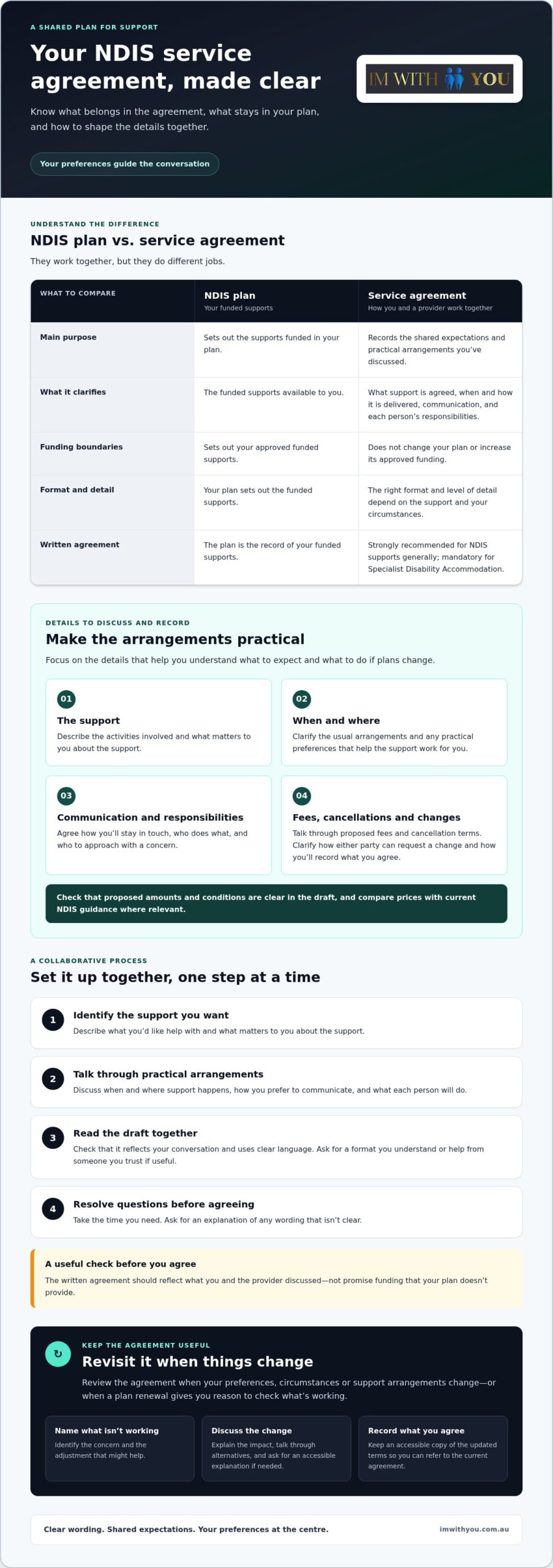
An NDIS service agreement is a written record of the shared expectations between you and a provider. It turns conversations about support into clear, practical arrangements. You can use it to describe the supports you’ve agreed on, when and how they’ll be delivered, how you’ll communicate, and what each person is responsible for. If a support or circumstance changes, the agreement can also set out how you’ll discuss and record the change.
Your NDIS plan sets out your funded supports; your service agreement records how you and a provider will work together. An agreement doesn’t change your plan or increase its approved funding. If you’re learning how to set up an ndis service agreement, keep that distinction in mind: the document should reflect agreed arrangements, not promise funding the plan doesn’t provide.
Written service agreements are strongly recommended for NDIS supports generally, while they’re mandatory for Specialist Disability Accommodation. The right level of detail depends on the support and your circumstances, so discuss what will make the arrangement clear and useful for you. For broader context about service quality and safeguards, the NDIS Quality and Safeguards Commission has a role in improving the quality and safety of NDIS services.
Does every NDIS support need the same agreement?
No single format suits every support. A regular support arrangement may need different practical details from support delivered occasionally or in a different setting. Focus on what you need to understand: what the provider will do, how you’ll stay in touch, and how you can raise questions. You can ask for the agreement in a language and format you understand, and take time to talk it through before agreeing.
How to set up an NDIS service agreement together
A clear agreement starts with a conversation, not a template. Take the process step by step, with your preferences guiding what goes into the document. If you’re working out how to set up an ndis service agreement, aim for wording that both you and the provider can understand and use.
- Identify the support you want. Describe what you’d like help with and what matters to you about the support.
- Talk through practical arrangements. Discuss when and where support happens, how you prefer to communicate, and what each person will do.
- Read the draft together. Check that it reflects your conversation and uses clear language. Ask for an accessible format or help from someone you trust if that would make it easier to review.
- Resolve questions before agreeing. Take the time you need. The official NDIS guidance on service agreements can help you understand the purpose and content of an agreement.
What details are helpful to discuss before agreeing?
Make the support description specific enough to be useful. For example, clarify the activities involved, the usual arrangements, how you’ll communicate about a change, and who to approach with a concern. Discuss how either party can request changes and how you’ll record what you agree. If there are particular communication preferences or practical arrangements that help support work for you, include those too.
Talk through any proposed fees and cancellation terms. Make sure the amounts and conditions are clear in the draft, and compare proposed prices with current NDIS guidance where relevant. Don’t feel you need to accept wording you don’t understand. If you’re still considering what matters in a support relationship, this guide to choosing an NDIS provider can help you reflect on your priorities. You can also explore support coordination and advocacy as you consider your next steps.
Reviewing and managing your NDIS service agreement over time
An agreement should keep reflecting the support you’ve discussed. Revisit it when your preferences, circumstances or support arrangements change, or when a plan renewal gives you reason to review what’s working. You don’t need to wait for a problem: a calm check-in can help you spot unclear details early and keep expectations aligned.
The steps to create and manage an NDIS service agreement include considering when an agreement may need to change. Use that guidance alongside open conversation with your provider, and write down any changes you both agree to. Keep an accessible copy so you can refer back to the current terms.
What if you want to change a term or raise a concern?
Start by identifying what isn’t working and what adjustment might help. For example, if a support time no longer suits you, explain the impact and ask to discuss alternatives. Take the time you need to understand proposed changes, request an accessible explanation, and keep a copy of the updated terms you agree on.
For agreements connected with home and living support, you may find this overview of supported independent living in the NDIS helpful as you consider what arrangements matter to you. The same collaborative approach applies: speak up, listen to each other, and make sure the written record reflects the conversation.
Understanding how to set up an ndis service agreement is a useful first step. Keeping it clear over time means returning to the conversation whenever support needs shift. If you’d like a supportive conversation about your NDIS support options, you can connect with Im with you at your own pace.
Take your next step with confidence
Your preferences deserve to stay at the centre of your support, not get lost in paperwork. As you consider how to set up an ndis service agreement, remember that you can take time to think, ask for clearer wording and make your choices heard. A thoughtful conversation can help you feel more at ease about the support relationship ahead.
At Im with you, we’re an Australian NDIS provider focused on quality care. Our support coordination, community participation and disability advocacy services can help you work towards the support and goals that matter to you.
You don’t need to have every answer before taking a first step. Explore disability support with Im with you and consider what a supportive partnership could look like for you. Your voice matters, and we’re here to walk alongside you.
Frequently Asked Questions
Do I need an NDIS service agreement for every support?
Not necessarily in the same form. Written agreements are strongly recommended for NDIS supports, but the requirements can depend on the support. Specialist Disability Accommodation has a mandatory written agreement, and the ATO requires one for GST-free supplies. As you consider how to set up an ndis service agreement, discuss what record makes sense for your support and circumstances.
Does an NDIS service agreement have to be in writing?
Written agreements are strongly recommended because they give you and the provider a clear record to refer to if details are forgotten or a question comes up. Some situations have specific written-agreement requirements, including Specialist Disability Accommodation and GST-free supplies. A written record can be particularly helpful if several people help coordinate your support or you need to revisit what was agreed.
Can I change or end an NDIS service agreement?
You can raise a proposed change or discuss ending the arrangement with the provider. Start by checking the agreement for its process, including any notice or cancellation terms, then talk through timing and how support will be affected. For example, if your routine changes, agree on the practical details before relying on a new schedule, and keep a record of what you both decide.
What should I do if I do not understand a service agreement?
Pause and ask for an explanation before agreeing to terms that are unclear. You can request plain language, an accessible format or more time to review it. A trusted family member, friend or support coordinator can help you talk through unfamiliar wording. Try asking the provider to explain a specific clause using an example of how it could affect your support.