

When a support helps your child take part at school and also addresses disability-related needs in everyday life, it can be hard to know who is responsible. That question sits at the heart of the ndis and school funding overlap. Families may be unsure who to speak with or worried their child’s needs will fall between two systems. It’s understandable to want clarity when a support may serve more than one purpose.
A helpful starting point is to describe what the support does and why it’s needed. Education systems address access and participation in learning, while the NDIS may consider disability-related supports that aren’t the education system’s responsibility. In this guide, we’ll explain the distinction and suggest practical questions and information to bring to conversations with school and NDIS contacts. We’ll also look at how support coordination or disability advocacy can help you prepare and have your voice heard. You don’t have to work through the uncertainty alone.
Key Takeaways
- The ndis and school funding overlap is about uncertainty over responsibility, not automatic evidence of double funding.
- To clarify a support’s purpose, describe the need, when it arises and how it relates to disability.
- Separate help with educational instruction from disability-related assistance, without assuming who will fund a particular support.
- Prepare clear questions for school and NDIS conversations. Support coordination or disability advocacy may help organise information and keep the person’s voice central.
NDIS and school funding overlap: why the same support can raise questions
Families may hear that a student needs support at school, then find that the school and NDIS describe their responsibilities differently. This can make the ndis and school funding overlap feel like a frustrating grey area. Here, “overlap” means it’s unclear which system may provide or fund a support. It doesn’t, by itself, mean the same support is being funded twice.
Broadly, education providers are responsible for reasonable adjustments that help students with disability access and participate in education. The NDIS may consider disability-related supports that aren’t the education system’s responsibility, with funding decisions based on the individual’s circumstances and current NDIS rules. The National Disability Insurance Scheme (NDIS) operates alongside mainstream systems, including education. Schools and education funding arrangements vary across Australian states and territories, so relevant local guidance can also matter.
Why a support’s purpose matters
Similar assistance can serve different purposes. Help with learning or curriculum is different from assistance with a disability-related daily living need, even if both happen during class. For example, personal care at school may relate to a student’s disability-related needs, while therapy may focus on functional skills across environments. Whether either support may be funded by the NDIS depends on individual circumstances and current rules.
A useful starting point: education supports learning and participation, while the NDIS may consider disability-related needs beyond the education system’s responsibility, depending on the person and current rules. Describe what the support does, rather than relying only on its name or location, to help everyone focus on the right question.
How to assess whether a school-related support may sit with the NDIS
If a support seems to belong in both places, pause before trying to label it. A clear description of the need can help the family, school and relevant NDIS contacts discuss responsibilities without assuming the outcome. The ndis and school funding overlap is easier to explore when everyone is talking about the same task and why it’s needed.
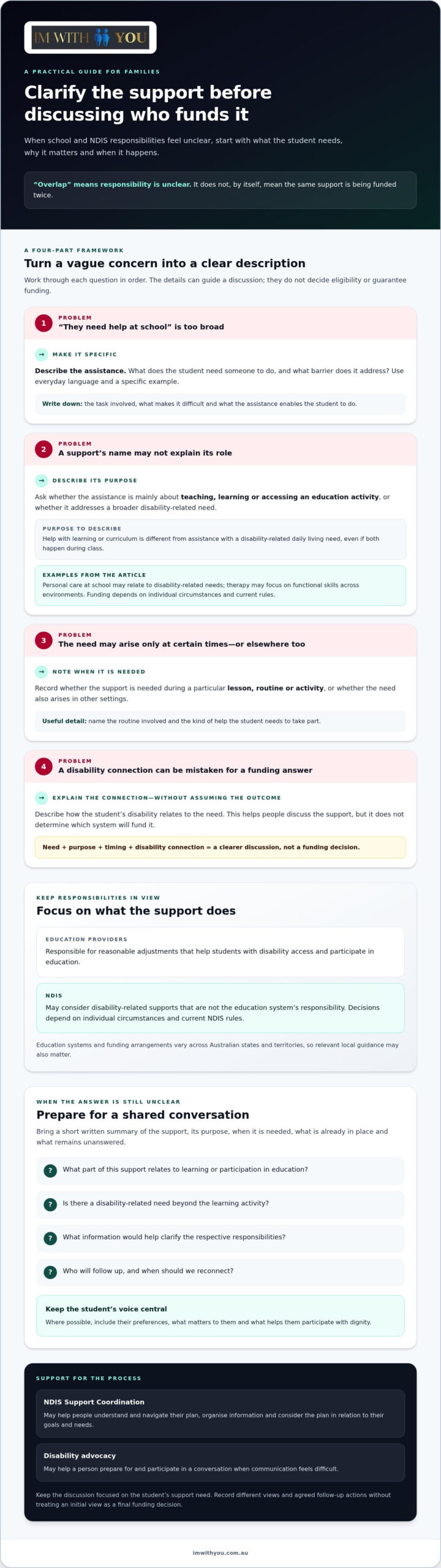
Work through these details in order:
- Describe the assistance. What does the student need someone to do, and what barrier does it address? Use everyday language and give a specific example.
- Explain its purpose. Is the assistance mainly about teaching, learning or accessing an education activity, or does it address a broader disability-related need?
- Note when it’s needed. Record whether it arises during a particular lesson, routine or activity, or in other settings too.
- Describe the disability connection. Explain how the student’s disability relates to the need, without assuming that this determines which system will fund it.
A simple framework for describing the support
Instead of writing “needs help at school,” describe the task, what makes it difficult, when help is needed and what the assistance enables the student to do. For instance, note the routine involved and the kind of help the student needs to take part. Keep the student’s preferences and perspective in the record where possible. Educational instruction and disability-related assistance can look similar in practice, so describe the function rather than relying on a support’s name.
Need, purpose, timing and disability connection: use these details to guide a discussion, not to decide eligibility or guarantee funding.
Keep relevant NDIS plan information, notes about supports already in place and unanswered questions together. A simple written summary gives you a practical reference for conversations and can help avoid repeating details. NDIS Support Coordination can support people to understand and navigate their plan as they work through these questions.
When NDIS and school responsibilities remain unclear
If you’ve spoken with the school and NDIS contacts but still don’t know who may be responsible, a shared conversation can help clarify what each contact understands, what information is missing and what the next step could be. Keep the discussion focused on the student’s support need rather than assuming one system must fund it. A calm, specific conversation makes it easier to capture different views and agree on follow-up actions.
Prepare for a collaborative conversation
Bring a short written summary of the support, its purpose and when it’s needed. Note what’s already in place and which questions remain unanswered. Wherever possible, invite the student to share what matters to them, how they prefer to receive support and what helps them participate with dignity.
- What part of this support relates to learning or participation in education?
- Is there a disability-related need beyond the learning activity?
- What information would help clarify the respective responsibilities?
- Who will follow up, and when should we reconnect?
These questions keep the discussion practical and help everyone record agreed actions without treating an initial view as a final funding decision. If communication feels difficult, disability advocacy may help the person prepare for and participate in the conversation. NDIS Support Coordination can help organise information and make sense of an NDIS plan in relation to the person’s goals and needs.
If you’d value support to work through the plan and prepare for these conversations, NDIS Support Coordination from Im with you can help. If you’re also considering provider support, the article How to Choose an NDIS Provider: A Gentle Guide to Finding Your Perfect Match can help you think through what matters to the person.
Take the next step with confidence
Families facing the ndis and school funding overlap can take the next step at a manageable pace. Before another conversation, consider what would help you feel prepared and what the student wants decision-makers to understand. Keeping their priorities at the centre can make the process feel more respectful and collaborative, even while responsibilities are being clarified.
Im with you provides NDIS Support Coordination and Disability Advocacy Services to help people navigate their plans and take part in relevant conversations. The organisation received the 2026 Australian Enterprise Award for Excellence in Disability Support and Advocacy. Support should reflect the person’s needs, voice and choices, and no one has to work through complex discussions alone.
When you’re ready, explore how Im with you can support you. Your next step can be a small one, taken with support beside you.
Frequently Asked Questions
Does the NDIS fund support provided at school?
Sometimes, if the support relates to the student’s disability and isn’t the education system’s responsibility. The NDIS doesn’t fund teaching or assistance that forms part of the educational curriculum. A support’s location alone doesn’t decide who may fund it. The NDIS and school funding overlap depends on the support’s purpose, the student’s circumstances and current funding rules.
Can a student receive NDIS support while at school?
Yes, a student may receive some NDIS-funded supports during school hours, depending on their plan and circumstances. For example, an assistive technology device used in daily life may also be useful at school. If an external therapist is involved, discuss access to the school grounds with the school, as the principal decides whether services can be delivered there during school hours.
What should I do if the school and NDIS say the support is the other system’s responsibility?
Ask each contact to explain their view in writing, including which part of the support they believe their system is responsible for and what information they need. Share the responses so the discussion stays focused on the same need. If it remains unresolved, NDIS Support Coordination or Disability Advocacy Services may help organise the information and support the student or family to take part in follow-up conversations.