

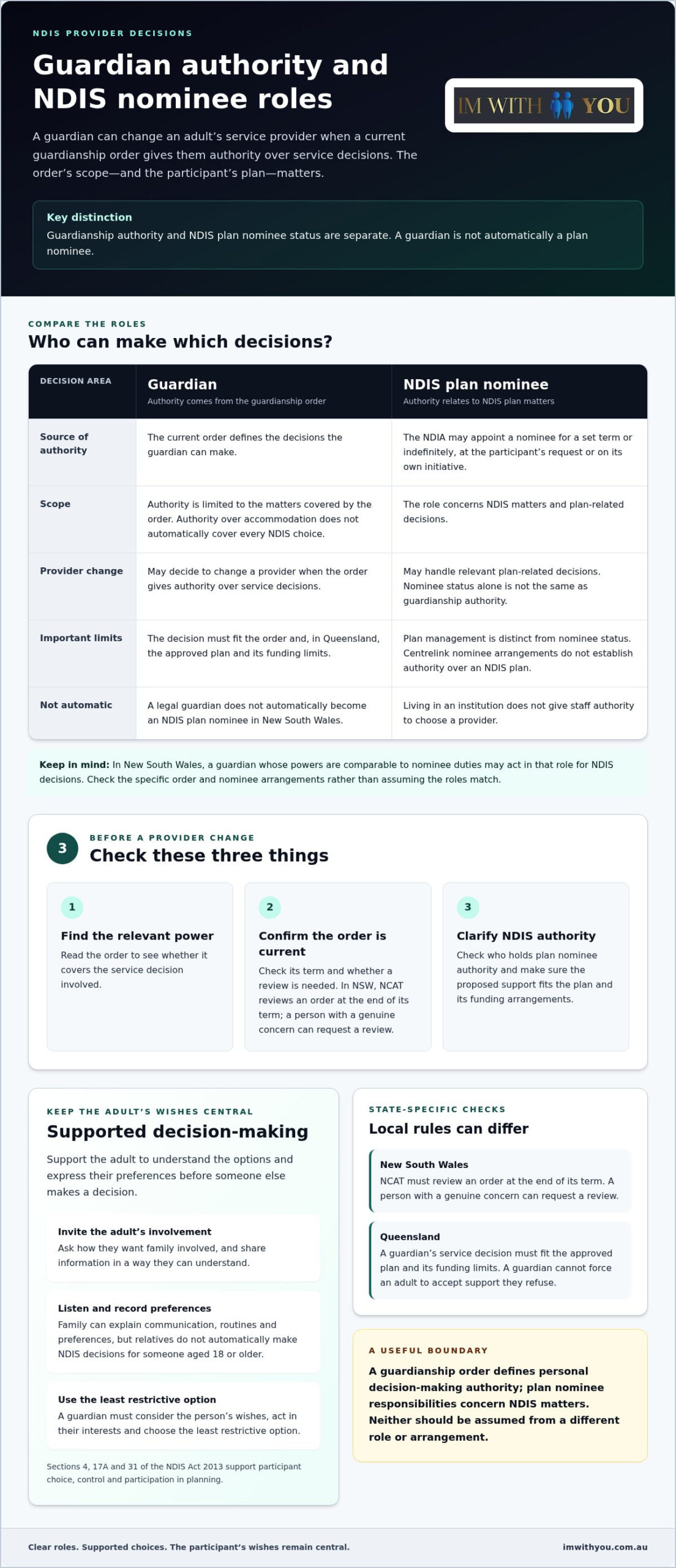
A guardian can change an adult’s NDIS service provider when the current guardianship order gives them authority over service decisions. Understanding guardianship and the NDIS also means knowing that guardianship authority and NDIS plan nominee status are separate: a guardian is not automatically a plan nominee. The order’s scope and the participant’s plan help determine who can make the decision.
It’s understandable to want clear answers when someone’s supports need to change, while keeping their wishes at the centre. This guide explains how a guardian’s authority applies to provider decisions, how supported decision-making can help an adult take part, and where to find guardianship support in your state or territory. It also clarifies the difference between a guardian and an NDIS nominee, so you can understand who may make plan-related decisions and how the participant can be involved.
Key Takeaways
- Read the guardianship order to understand which service decisions the guardian can make, and whether the authority is current.
- Separate guardianship powers from NDIS plan nominee responsibilities before making a provider change.
- Support the adult to understand options and express their preferences so their wishes stay central to decisions.
- Find guidance through the guardianship body in your state or territory when you need help understanding an order or decision-making role.
Can a guardian decide to change to a new service provider under the adult’s new NDIS plan?
A guardian can change a provider when a current guardianship order gives them authority over service decisions. The order defines the scope, and a guardian’s decision has the same legal force as the represented person’s decision. For example, authority over accommodation does not automatically extend to every NDIS choice.
To understand how guardianship and NDIS decisions connect, distinguish the guardian’s legal powers from the plan nominee role. The cost of a guardianship application depends on whether you use paid legal help, such as consulting a firm like Mohan Yildiz & Associates, while timing depends on the tribunal process and case complexity. Evidence should help the tribunal decide whether a guardian is needed and which decisions the order should cover.
Fighting Chance Australia’s webinar explains guardianship, participant rights and NDIS decision-making.
An NDIS plan nominee handles plan-related decisions for a participant aged 18 or older. The NDIA may appoint one for a set term or indefinitely, at the participant’s request or on its own initiative. It may appoint a nominee without permission if it considers one is needed. Appointment may be appropriate when the participant cannot be assisted to make decisions themselves.
In New South Wales, a legal guardian does not automatically become an NDIS plan nominee. A guardian whose powers are comparable to nominee duties may act in that role for NDIS decisions. Centrelink nominee arrangements are separate and do not establish authority over an NDIS plan. Similarly, living in an institution does not give staff the authority to choose a provider.
Plan management is distinct from guardianship and nominee status. The plan’s funding and management arrangements affect which supports can be accessed. In Queensland, a guardian’s service decision must fit the approved plan and its funding limits. A plan nominee’s responsibilities concern NDIS matters, while the guardianship order defines any broader personal decision-making authority.
Before changing providers, identify the relevant decision in the order, confirm that it is current, and clarify who holds NDIS nominee authority. In NSW, the NSW Civil and Administrative Tribunal must review an order at the end of its term. A person with a genuine concern can request a review.
Supported decision-making and less restrictive alternatives
Supported decision-making helps an adult understand their options and express their preferences before someone else makes a decision. It can preserve the person’s choice while clarifying how family, guardians and tribunals can support them.
Family Involvement and Adult Decision-Making
Family can explain an adult’s communication, routines and preferences, but relatives don’t automatically make NDIS decisions for someone aged 18 or older. Start by asking the adult how they want family involved, then share information in a way they can understand. If a guardian is appointed, they must consider the person’s wishes, act in their interests and choose the least restrictive option.
Rights in NDIS Planning
Under section 4 of the NDIS Act 2013, participants have choice and control over goals, services and plan supports, including who helps them discuss their plan. Sections 17A and 31 support participation in planning meetings. These rights matter when a participant and guardian disagree: explain the options accessibly, record the adult’s preferences, and raise concerns with the relevant tribunal. In Queensland, a guardian’s service decision must fit the approved plan and available funding; a guardian can’t force an adult to accept refused support.
Reviewing or Ending a Guardianship Order
A tribunal can review an order when circumstances or decision-making needs change. In New South Wales, the NSW Civil and Administrative Tribunal reviews an order at the end of its term, and a person with genuine concern can request a review. Explain which powers no longer fit and what support could help the adult decide. In Queensland, the Queensland Civil and Administrative Tribunal appoints the Public Guardian when no suitable person is available. Clear information about the adult’s wishes, needs and plan helps guide service decisions.
For support expressing concerns and preferences, disability advocacy support can help you prepare for conversations about decision-making.
State and Territory guardianship support
Guardianship orders and support pathways differ across Australia. Start with the tribunal or public advocate in the person’s state or territory to understand local authority and available guidance.
In New South Wales, NCAT appoints guardians for some medical and lifestyle decisions, while the Supreme Court of NSW also appoints legal guardians. In Victoria, VCAT can authorise a guardian to make specific decisions, such as where an adult lives. In Queensland, the Queensland Civil and Administrative Tribunal appoints the Public Guardian for personal decisions when an adult has impaired decision-making ability and no suitable person is available. The Office of the Public Advocate or Adult Guardian may also help people understand local options.
A Circle of Support brings together people the adult trusts to listen, share perspectives and help communicate the person’s preferences. A Microboard is a small group organised around one person’s goals and support network. Neither is a guardianship order: the adult’s voice remains central, and legal authority comes from the relevant appointment.
For older adults, age alone doesn’t determine access to aged care. A person approved for the National Disability Insurance Scheme before turning 65 can continue receiving NDIS supports or transition to aged care when needed. Some adults may be able to access aged care support at home, depending on their needs and circumstances. Aged care support is based on assessed needs, not age alone.
An NDIS Support Coordinator can help the participant understand available plan supports, organise services and communicate preferences across providers. This can make it easier to keep the person’s goals visible while family and formal decision-makers work together. Explore NDIS Support Coordination for help coordinating supports around the participant’s choices.
Im with you: Disability Support Services
Im with you can support you as you put a participant’s support choices into practice. If changing providers raises questions about coordinating services, NDIS Support Coordination can help organise supports around the person’s goals. Disability Advocacy Services can help the participant express their views, while Disability Support Services and Community Participation Support can assist with everyday support and community involvement.
These services can help when the participant, family and decision-makers need clear communication and want to keep the person’s preferences central. The right support depends on the participant’s goals and the role each person has in their decisions. Im with you works alongside you with a respectful, person-centred approach.
Contact Im with you or visit imwithyou.com.au to explore support options.
Take the next step at your own pace
Changing providers can be an opportunity to shape supports around what matters to the participant now. Before the next conversation, note what they hope will change, what they value in their current supports, and which questions remain unresolved. This gives everyone a practical starting point and keeps the person’s preferences in view.
Understanding guardianship and the NDIS can help you approach that conversation with focus while making space for the participant’s voice. You don’t have to work through every decision alone. I’m With You can help you consider the next step in a way that respects the individual’s goals and circumstances.
Start a conversation with Im with you when you’re ready to explore support options. Your next step can be a thoughtful one, taken together.
Frequently Asked Questions
How long does the decision-making process take?
The timeframe depends on the decision, the information available and whether a tribunal needs to consider an application or review. A straightforward NDIS provider choice within an existing authority may take less time than resolving unclear or disputed powers. To keep discussions focused, gather the relevant order, plan details and the participant’s views before meeting with decision-makers.
What can parents do in this situation?
Parents can help an adult compare support options, communicate preferences and prepare for NDIS discussions, with the adult’s agreement. Turning 18 means family members don’t automatically gain authority to make NDIS decisions. If the adult wants a parent to act as a plan nominee, they can ask the NDIA about appointment; the parent can also help the adult share their goals and questions.
What documentation do I need as a guardian managing NDIS funds?
A guardianship order does not automatically authorise a guardian to manage another person’s finances. Keep a copy of the current order and any separate financial management authority alongside the participant’s NDIS plan and relevant nominee correspondence. For practical record-keeping, retain service agreements, invoices and notes about support decisions. These records help distinguish financial authority from decisions about services.
What factors need to be taken into account regarding guardianship?
Consider the adult’s wishes, the specific decision they need support with, and whether assistance could help them decide for themselves. A guardian’s powers depend on the order, so match the proposed action to its wording. Also consider the least restrictive option and whether the decision aligns with the participant’s goals and approved plan. These steps help keep the adult’s interests at the centre.
What is capacity?
Capacity is a person’s ability to understand relevant information, consider what it means and communicate a decision. It relates to the particular decision, not a person’s disability diagnosis alone. For example, someone may be able to choose between support providers with accessible information and trusted assistance. Give the person time and a way to communicate that works for them before assuming they cannot decide.