

Support doesn’t have to mean handing over your choices. It can mean having someone alongside you to understand options, express what matters and decide what to do next. If you’re wondering what supported decision making NDIS support looks like in everyday life, it’s understandable to want to know how your voice stays at the centre.
Good support helps you get clear information, consider your options and communicate your own preferences. In this article, we’ll look at practical ways to work through a decision, how support differs from someone deciding for you, and how support coordination and advocacy can help you take part. You deserve time, accessible information and support that reflects what matters to you.
Key Takeaways
- With supported decision making ndis, you receive help to understand options and communicate your own choice.
- Start by clarifying the decision, then explore options and share information in a way that works for you.
- Give yourself time to think, and involve a trusted supporter if you want to.
- Person-centred support coordination can help you stay connected, explore opportunities and take part in community life.
What does supported decision making mean in the NDIS?
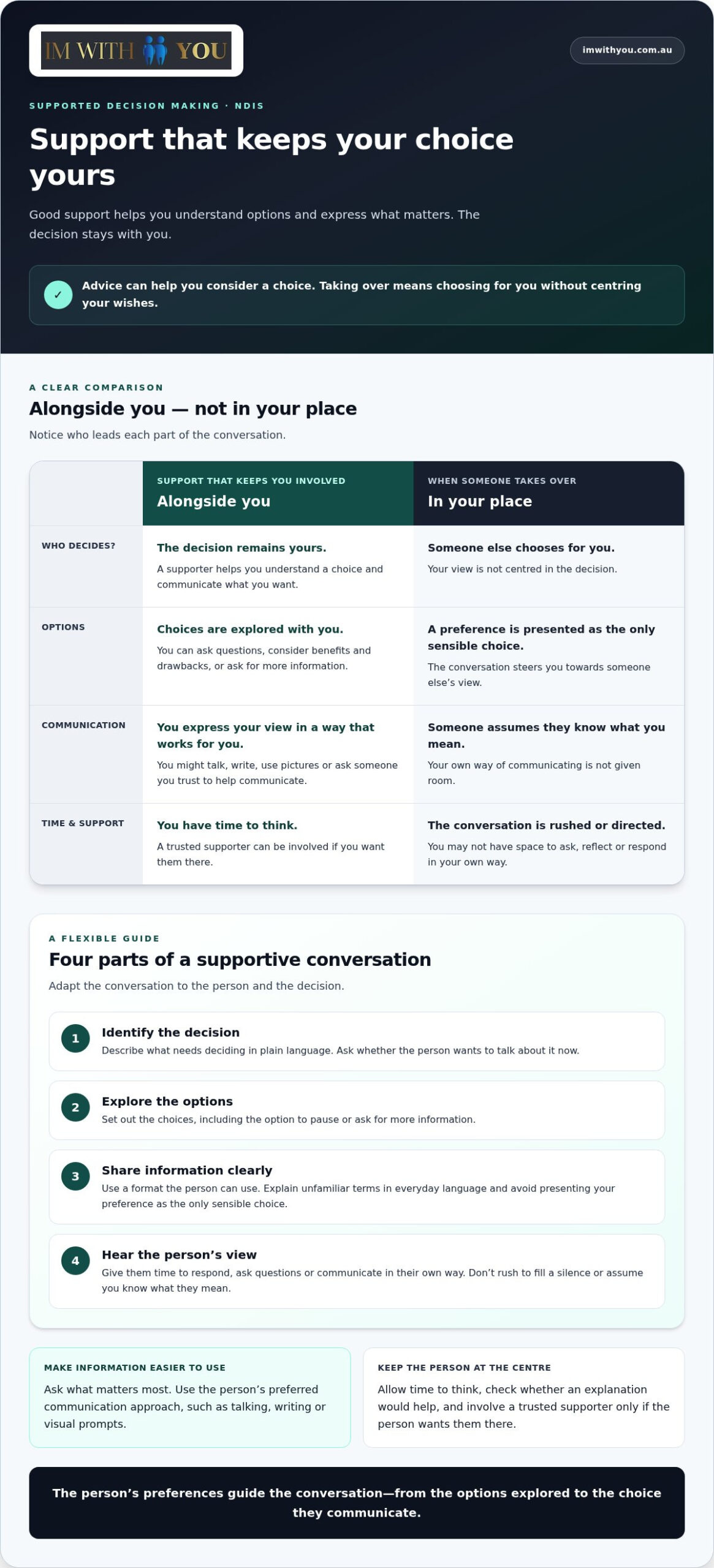
Supported decision making means getting help to understand a choice, consider information and communicate what you want. The decision remains yours. A supporter might explain options, answer questions or help you express a preference, without replacing your view with their own.
Advice can be part of support. For example, someone might explain the benefits and drawbacks of different activities, then give you time to decide which interests you. Taking over would mean choosing for you without centring your wishes. The supported decision making NDIS approach keeps your will and preferences at the heart of the conversation.
Respecting your preferences protects your dignity and makes choice meaningful.
What can supported decision making look like day to day?
It can be as straightforward as choosing what to do during the day, deciding on a routine or sharing what matters in a conversation about support. You might prefer to talk things through, look at pictures, write down options or ask someone you trust to help you communicate. These are possibilities, not steps everyone needs to follow.
The support that helps can vary with the decision and your preferences. Choosing between familiar activities may need little discussion. A more complex choice might be easier to consider if information is shared in smaller steps, you have time to think, or you talk it through with someone you trust. You can guide what works for you, while supporters stay alongside you without steering the outcome.
There’s no single right way to make a decision or express a view. What matters is having room to take part, ask questions and communicate in a way that works for you. This can help you exercise choice and control in everyday life.
How can you support an NDIS decision without taking over?
A calm, clear conversation can make a decision easier to work through. You might be considering a change to your routine or exploring an opportunity. Use the steps below as a flexible guide, adapting them to the person and the decision.
- Identify the decision. Describe what needs deciding in plain language, and ask whether the person wants to talk about it now.
- Explore the options. Set out the choices, including the option to pause or ask for more information.
- Share information. Explain relevant details in a format the person can use. Avoid presenting your own preference as the only sensible choice.
- Hear the person’s view. Give them time to respond, ask questions or communicate in their own way. Don’t rush to fill a silence or assume you know what they mean.
Let the person’s preferences guide the conversation, from the options explored to the choice they communicate. This reflects the principles described in the NDIS Supported Decision Making Policy, including supporting people to participate in decisions that affect them.
How can supporters make choices easier to understand?
Present options clearly and explain unfamiliar terms in everyday language. Ask what matters most to the person, and use their preferred communication approach, such as talking, writing or visual prompts. You can check whether the information is clear by asking, “Would it help if I explained that another way?” This keeps the exchange respectful rather than making it feel like a test.
Allow time to think, and involve a trusted supporter only if the person wants them there. In supported decision making ndis conversations, practical support should make it easier for the person to express their view, not pressure them to agree. If you’d value collaborative support, disability advocacy and support coordination from Im with you can work alongside the person’s choices.
How can person-centred NDIS support help you stay in control?
Person-centred support starts with what matters to you. Your preferences, priorities and daily goals can help shape the support you receive, whether you’re working towards a routine that suits you or looking for ways to take part in your community. Support should reflect your needs and keep you involved in decisions about your life.
Support coordination can help you stay connected, explore opportunities and engage with community. A coordinator can work alongside you to understand what matters, consider next steps and communicate your preferences. Disability advocacy can also support you to have your views heard. Neither role replaces your choices. The Supported Decision-Making in NDIS Practice Standards offers guidance on putting supported decision making into practice.
What can you discuss with a support coordinator or advocate?
You could talk about what you want help to understand, what you’d like to communicate or what would make a conversation more accessible. For instance, you might want to prepare questions before discussing a support option, or find words to explain what matters to you. You can also share how you prefer to communicate and what helps you feel heard.
Im with you offers personalised disability services, NDIS support coordination and disability advocacy. These supports can work alongside your choices and goals, helping you take part in decisions that affect you. You can start by talking through what matters most and what kind of support would be useful.
Explore personalised support with Im with you.
Take your next step with your choices at the centre
Your preferences can guide conversations about support, even as your goals or circumstances change. You don’t need to have every answer ready before you begin. Start with one thing you’d like to understand, communicate or explore, then consider what would help you feel heard. That’s a practical place to begin with supported decision making ndis.
Im with you offers person-centred disability services, support coordination and disability advocacy, delivered in person or through telehealth. The team’s work has been recognised with the 2026 Australian Enterprise Award for Excellence in Disability Support and Advocacy. These supports can sit alongside your choices as you consider a next step that reflects what matters to you.
Explore personalised support with Im with you. Your voice belongs at the heart of every decision, and you can take the next step at your own pace.
Frequently Asked Questions
Is supported decision making part of the NDIS?
Yes. The NDIA’s Supported Decision Making Policy recognises the importance of helping participants take part in decisions that affect them. This doesn’t mean every decision needs a formal meeting or a particular process. When discussing an NDIS support, you can ask for information in a format that works for you and take time to consider how it fits your goals and circumstances.
Can a support worker make decisions for me?
A support worker can help you understand information or communicate your view, but their role isn’t to choose for you. You can say if you’d like to speak privately, hear options without advice or have someone help you put your own view into words. If you feel your wishes aren’t being heard, you can raise this with someone you trust or seek advocacy support.
How can I tell someone what support I need to make a decision?
Try describing one practical thing that would help. For example: “Please explain one option at a time,” “I’d like information in writing,” or “I need time to think before I answer.” You can also say what doesn’t help, such as being asked several questions at once. In supported decision making ndis conversations, clear requests can help others adjust how they share information.
Who can help me with NDIS supported decision making?
You could involve a trusted person you choose, an NDIS support coordinator or a disability advocate. A coordinator may help you work through plan-related questions, while an advocate can support you to express your views. Im with you provides support coordination and disability advocacy. You can begin by saying what you want help to understand or communicate, and who you’d like involved.