

What if tenancy support could help you feel more confident managing a home, without providing the home itself? It’s understandable to wonder what ndis assistance with accommodation and tenancy covers, especially when housing and NDIS funding can seem closely linked. Support may help with practical tenancy tasks, depending on your goals and plan. It doesn’t automatically mean the NDIS will find you a place to live or pay your rent.
This guide explains the difference between tenancy assistance and housing, and how to explore relevant support through your NDIS plan. You’ll also find questions to ask your plan contact, support coordinator or a provider, so you can clarify what is available and make choices that suit you.
Key Takeaways
- Learn what ndis assistance with accommodation and tenancy may help with, and why it doesn’t guarantee a home or rent payment.
- Identify the tenancy tasks you’d like support with and connect them to your personal goals.
- Check your current plan and ask your relevant plan contact or the NDIA to clarify funding and support details.
- Explore whether support coordination, advocacy or capacity-building services may suit your needs, while keeping your choices at the centre.
What does NDIS assistance with accommodation and tenancy mean?
Housing tasks can feel complex, especially when you’re working out what support may fit your goals. In plain English, ndis assistance with accommodation and tenancy means practical help to work through tenancy-related tasks. You might want help understanding what you need to do or building confidence with housing responsibilities. These are examples to discuss, not a guarantee that a task is funded. Check current NDIA guidance and your plan for details.
Tenancy support can help you manage housing tasks, but it isn’t accommodation itself. It doesn’t promise a home, pay rent or secure a particular property. For general background on the National Disability Insurance Scheme (NDIS), you can read this overview. For current support and funding details, check official NDIA guidance.
This video is aimed at providers, so it may be more relevant if you’re exploring the provider side of accommodation and tenancy assistance.
How tenancy assistance differs from SIL and SDA
Tenancy assistance focuses on practical tasks connected with managing a tenancy. Supported Independent Living (SIL) relates to support with daily living, while Specialist Disability Accommodation (SDA) is a separate accommodation offering. These supports aren’t interchangeable. Check your plan and current NDIA guidance rather than assuming one includes another.
Im with you offers support coordination, advocacy and capacity-building services, but does not provide SDA. Depending on your needs, these services may help you explore options. You can also read our guide to supported independent living for more context, and ask a provider whether it delivers the specific assistance you’re seeking.
How to explore NDIS accommodation and tenancy support for your needs
Start by listing the specific tasks you’d like help with. For example, you may want support to understand tenancy paperwork, prepare for a conversation about your housing needs or build confidence handling housing responsibilities. For each task, note what you want to work towards, such as managing more independently or exploring suitable living options. This makes it easier to explain what you’re looking for and ask whether a support is relevant to your goals.
Next, review your current NDIS plan and ask your relevant plan contact or the NDIA whether the support you’re considering fits your plan. Funding and support-category details can depend on your circumstances, so don’t assume a service is covered based on its name alone. The Australian Parliament’s Quick guide to the NDIS offers helpful background. Check current NDIA guidance for up-to-date information.
List the tasks you want help with, connect them to your goals, check how they fit your plan, and confirm that a provider can deliver the support.
Questions to ask before choosing a support provider
Ask what tenancy-related tasks the provider can support, how they’ll include you in decisions, and whether the service is currently available. Be specific about the task you need help with, rather than relying on a broad service label. Confirm plan fit with your plan contact or the NDIA. For broader questions about finding the right match, see our guide to choosing an NDIS provider.
Im with you offers support coordination, advocacy and capacity-building services. These may be relevant as you explore your options, but check directly whether the specific assistance you need is available. You can ask Im with you about relevant support and discuss how your goals and choices can guide the conversation.
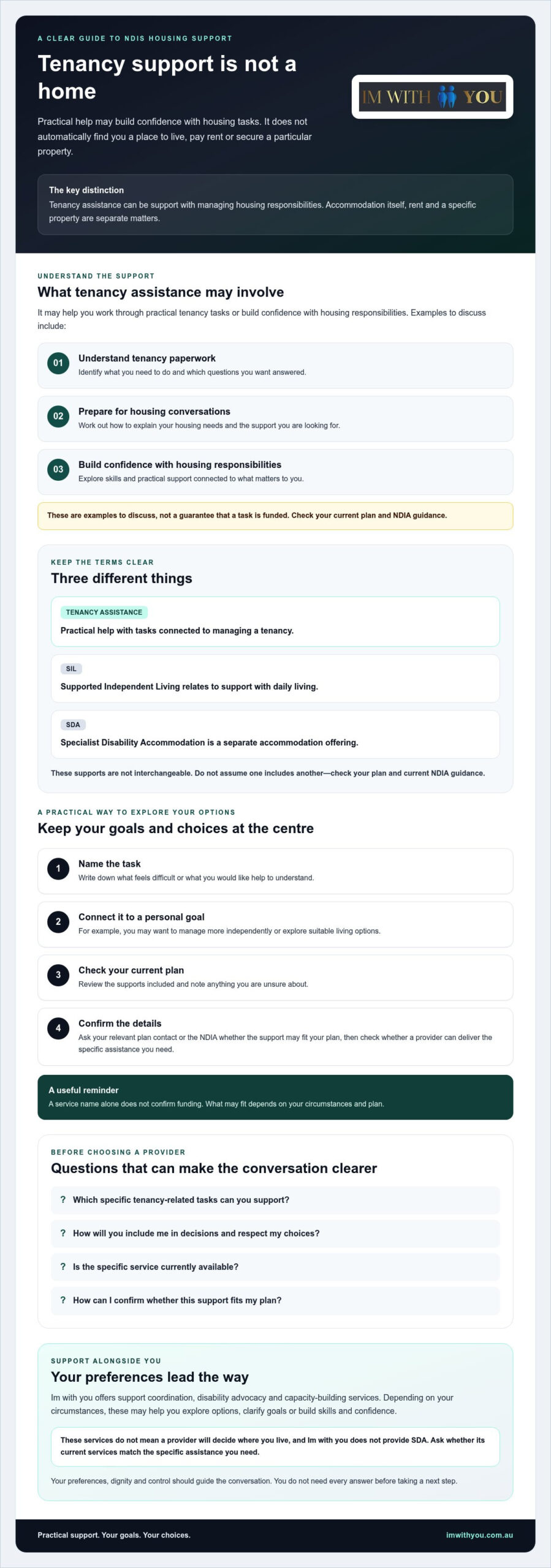
Your next steps towards person-led tenancy support
You don’t need every answer before taking a next step. A simple plan can help you move at your own pace and keep your choices at the centre:
- Note what you want help with. Write down the tenancy tasks or questions that feel difficult, and what you’d like to work towards.
- Check your current plan. Review the supports included and note anything you’re unsure about.
- Clarify your questions. Ask your relevant plan contact or the NDIA whether the support may fit your plan and what details to confirm.
- Talk with a suitable provider. Ask about the exact assistance you need, service availability and how the provider will support your choices.
The official NDIS home and living options guide can help you explore possibilities and prepare questions. Take time to consider what feels right for you.
How Im with you may walk alongside you
Im with you offers NDIS Support Coordination, Disability Advocacy Services and Capacity Building Skills. Depending on your circumstances, these services may help you explore options, clarify your goals or build skills to support greater confidence. They don’t mean a provider will decide where you live. Your preferences, dignity and control should guide the conversation.
Im with you’s services may not include the specific tenancy assistance you’re seeking, so ask whether its current services match your circumstances. You can start a conversation with Im with you to discuss what you need and whether there may be a suitable way to work together. Ask about the service and how it may fit before deciding whether to proceed.
Take your next step with confidence
Exploring ndis assistance with accommodation and tenancy starts with identifying the tasks you want help with, checking your plan and asking clear questions about support and provider fit. Practical tenancy support is different from receiving a home or rent payment. Let your goals and choices guide each next step.
Im with you offers NDIS Support Coordination, Disability Advocacy Services and Capacity Building Skills. These services may be relevant as you explore housing-related goals, but ask whether they match your circumstances and the specific support you’re seeking. You can start by explaining what you want help with and asking what support may be available.
Talk with Im with you about support that may fit your goals. You deserve to explore your options with care, clarity and control, one step at a time.
Frequently Asked Questions
What is NDIS assistance with accommodation and tenancy?
NDIS assistance with accommodation and tenancy may involve practical help with tenancy-related tasks, depending on your goals and plan. It may support you to understand responsibilities or build confidence managing housing matters. It isn’t a promise of a home, rent payment or a particular property. Check current NDIA guidance to understand how the support may apply to your circumstances.
Can the NDIS pay my rent or provide accommodation?
Don’t assume NDIS funding will pay your rent or provide a home. Tenancy-related assistance is different from accommodation itself, and any housing-related support depends on your individual circumstances and plan. If you’re unsure what a particular support may cover, check your plan and ask your relevant plan contact or the NDIA for current guidance.
Is tenancy assistance the same as Supported Independent Living?
No. Tenancy assistance concerns practical tasks connected with managing a tenancy. Supported Independent Living (SIL) relates to support with daily living. They are different supports, so don’t assume one includes the other. Check your plan and current NDIA guidance to understand what may apply to you. Specialist Disability Accommodation (SDA) is a separate accommodation offering.
How do I find out whether tenancy support is included in my NDIS plan?
Review your current plan, note the tenancy tasks you want help with, and connect them to your goals. Then ask your relevant plan contact or the NDIA to clarify whether the support fits your plan and what details to check. You can also ask a provider which specific tasks it supports and confirm service availability before making decisions.