

Latest news

NDIS Functional Capacity Assessment: A Clear Guide

Previous post
Next post
NDIS Functional Capacity Assessment: A Clear Guide

A functional capacity assessment for NDIS planning can explain how disability affects everyday activities, where support helps, and what matters to you. It may describe your strengths and goals alongside the challenges you experience. The findings can inform support planning, but they don’t guarantee a particular funding decision.

If you’re unsure what to expect or worried your abilities might be misunderstood, you’re not alone. A few practical notes can help you share a fuller picture, including how your needs vary and what support makes a difference. This guide covers what an assessment may explore, how to prepare, and how to review the report in light of your goals and other planning information.

Key Takeaways

  • A functional capacity assessment for NDIS planning can describe how you manage everyday activities and where support may help.
  • Before the assessment, reflect on your goals and note real examples of what feels manageable and when support helps.
  • Gather relevant information and prepare questions so you can share a fuller picture of your everyday experiences.
  • When you receive the report, consider whether it reflects your perspective and note any questions or differences to discuss.

What Is a Functional Capacity Assessment for the NDIS, and What Can It Show?

A functional capacity assessment looks at how you manage everyday activities and where support may help you take part in daily life. For NDIS planning, it can gather information about your abilities, participation, strengths, goals and support needs. The areas explored depend on the person and the purpose of the assessment, so the process can look different for each person.

In the context of the National Disability Insurance Scheme (NDIS), a functional capacity assessment for NDIS planning can help make day-to-day experiences clearer. For example, it may describe what helps you prepare meals, communicate with others or join community activities. The report can provide evidence for planning, but it doesn’t promise a particular NDIS decision or outcome.

How is functional capacity different from a diagnosis?

A diagnosis identifies a health condition or disability. Functional information describes how disability affects everyday activities and participation, and what support helps. Both can provide useful context, but one doesn’t replace the other.

Real-life examples can show the fuller picture. You might manage a routine independently on some days, while fatigue, a change in environment or a more demanding task makes support helpful at other times. Explain what you can do, what matters to you and when assistance makes a difference. Your strengths and goals are part of that picture too.

How to Prepare for an NDIS Functional Capacity Assessment

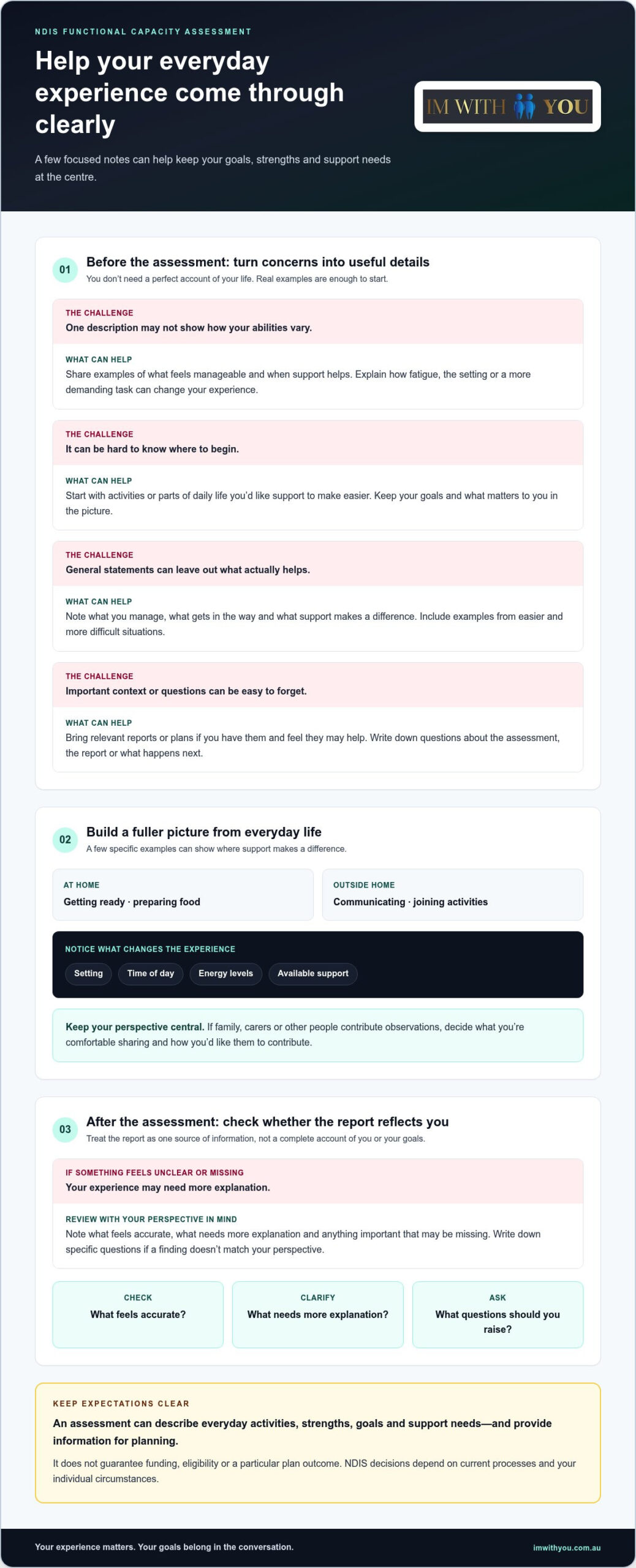
You don’t need to prepare a perfect account of your life. A few focused notes can make it easier to share what matters during a functional capacity assessment for NDIS planning.

  • Start with your goals: Identify activities or parts of daily life you’d like support to make easier.
  • Note everyday examples: Write down what you manage, what gets in the way, and what helps. Include examples of both easier and more difficult situations.
  • Gather useful information: Bring relevant reports or plans if you have them and feel they may help explain your situation.
  • Plan questions: Note anything you want to understand about the assessment, the report or what happens next.

What everyday examples and information may be useful?

Think about routines at home and activities outside it, such as getting ready, preparing food, communicating or taking part in something you enjoy. Note when a task feels manageable and when the setting, time of day, energy levels or available support changes your experience. You don’t need a detailed diary. A few specific examples can help explain where support makes a difference.

If family, carers or other people support you, they may be able to share observations where appropriate. Decide what you’re comfortable with and how you’d like them to contribute. Keep your perspective central by making clear what you want the assessment to reflect. Using person-first language and respectful communication can help keep conversations focused on you, your preferences and your goals.

For current information about the assessment, refer to the official NDIS functional capacity assessment page. If you’d like help making sense of NDIS-related questions, NDIS support coordination can help connect planning conversations with your goals and everyday needs.
NDIS Functional Capacity Assessment: A Clear Guide

What Happens After the Assessment, and How Can Its Findings Support Planning?

After the assessment, you may receive a report that brings together information gathered during the process. Depending on its scope, it may describe observations, everyday support needs and recommendations. The format and content can vary, so treat it as one source of information, not a complete account of you or your goals.

Read the findings and consider whether they reflect your experience. Note what feels accurate, what needs more explanation and whether anything important is missing. If something doesn’t match your perspective, write down specific questions to raise with the relevant people involved in your planning.

Can an assessment guarantee NDIS funding or a plan change?

No. A functional capacity assessment for NDIS planning can provide evidence for discussion, but it can’t guarantee funding, eligibility or a particular plan outcome. NDIS decisions depend on current processes and your individual circumstances. The report may help explain how support relates to daily life, but it’s only one part of the wider picture.

Use the findings as a starting point for connecting support needs with what matters to you. For example, you could discuss how support may help you work towards a personal goal, take part in your community or manage a daily routine. NDIS support coordination can help you make sense of planning questions. Disability support and occupational therapy can support day-to-day goals in different ways. Im with you offers these supports, while the assessment report itself does not promise a particular outcome.

A respectful, collaborative working relationship can make it easier to talk through next steps. Our guide to choosing an NDIS provider can help you reflect on what matters in that relationship and how your preferences can stay central.

Take Your Next Step with Confidence

A functional capacity assessment for NDIS planning can describe how daily life unfolds, what supports participation and where assistance may help. Preparing personal examples and reviewing the report from your perspective can help keep your goals and experiences at the centre. The findings can inform planning, but they don’t guarantee a funding or plan decision.

You don’t have to make sense of every next step alone. Im with you offers disability support, occupational therapy, therapeutic supports, NDIS support coordination and advocacy, with a focus on working alongside you and your priorities.

Explore how Im with you can support your goals. Your experience matters, and you can move forward one step at a time.

Frequently Asked Questions

What is a functional capacity assessment for the NDIS?

A functional capacity assessment for the NDIS gathers information about how a person manages everyday activities and where support may help. Depending on its purpose, it may explore participation, strengths, goals and support needs. The report can provide information for NDIS planning, but it’s one source of evidence and doesn’t guarantee a particular decision.

Who can complete a functional capacity assessment for the NDIS?

Occupational therapists commonly conduct functional capacity assessments, though the appropriate professional may depend on the assessment’s purpose and current NDIS guidance. Refer to the relevant NDIA information about the type of evidence needed for your circumstances. This can help clarify who may be suitable and what the assessment is intended to address.

How do I prepare for a functional capacity assessment?

Reflect on your goals, note examples from daily routines, gather relevant reports or plans if available, and write down questions you want to ask. Include what you manage as well as situations where support helps, such as a task becoming harder in a particular setting. A family member or supporter may contribute if you want them involved.

Can a functional capacity assessment guarantee more NDIS funding?

No. An assessment can provide information about your everyday support needs, but it can’t guarantee more funding, eligibility or a plan change. NDIS decisions depend on current processes and your individual circumstances. You can use the report to support a discussion about how your needs relate to your goals, while remembering that it’s one part of the wider planning picture.

Want to learn more?

Keep reading

Georgia Wright

Sales and Marketing Manager and a Support Coordinator

Georgia Wright is the Sales and Marketing Manager and a Support Coordinator at I’m With You. She helps connect people with disability and older Australians with the right supports, while also leading the organisation’s marketing and community outreach.


With a client-first approach, Georgia focuses on making the process simple and respectful — taking time to understand each person’s goals, preferences, and circumstances, then helping coordinate services that support independence, inclusion, and quality of life.


In her marketing role, Georgia works to raise awareness of I’m With You across Australia strengthening relationships with local communities and ensuring individuals and families can easily find clear, trustworthy information about available supports.


Georgia is known for her warm communication style, strong attention to detail, and commitment to helping people feel informed and supported at every step.

Mary Mitchell

Clinical Lead for Neurological Disabilities

Mary Mitchell is the Clinical Lead for Neurological Disabilities at I’m With You. She provides clinical leadership and guidance to ensure supports are safe, evidence-informed, and tailored to each person’s goals — helping clients build independence, confidence, and quality of life. With over 35 years experience as a Registered Nurse, including neurological departments and rehabilitation, Mary has a wealth of experience ensuring that our participants and clients are supported safely.


With deep experience supporting people living with neurological conditions, Mary works closely with clients, families, and support teams to understand individual needs and translate them into practical, person-centred care plans. She supports staff with training,


clinical oversight, and best-practice approaches, helping ensure consistent, high-quality support across day-to-day services.


Mary is known for her calm, compassionate approach and strong attention to detail. She is committed to empowering clients to participate in their community, maintain choice and control, and achieve meaningful outcomes in a way that feels respectful, collaborative, and sustainable.

Owen Brady

Psychosocial Recovery Coach

Owen Brady is a Psychosocial Recovery Coach at I’m With You, supporting people living with mental health challenges to build confidence, strengthen daily living skills, and work towards goals that matter to them.


Holding a Diploma of Community Services, Owen brings extensive, hands-on experience working in the community across a range of mental health settings. He takes a practical, person-centred approach — helping clients develop routines, connect with the right services, and build the supports that enable greater independence, choice, and control.


Owen is known for his calm, respectful communication style and his ability to build trust. He works alongside clients, families, and support networks to create realistic, sustainable pathways to recovery and improved wellbeing.

Sarah Ojo

Clinical Lead for Psychosocial Disabilities

Sarah Ojo is the Clinical Lead for Psychosocial Disabilities at I’m With You. With a Mental Health Nurse Practitioner qualification, she provides clinical leadership and oversight to ensure supports are safe, person-centred, and aligned with each client’s goals — helping people build stability, confidence, and quality of life.


Sarah works closely with clients, families, and support teams to understand individual needs and develop practical, strengths-based approaches that support recovery and everyday wellbeing. She also guides staff through best-practice strategies, clinical consultation, and ongoing support to maintain consistent, high-quality care.


Known for her calm, compassionate presence and clear communication, Sarah is committed to empowering clients with choice and control, reducing barriers to participation, and helping people feel respected, informed, and supported at every step.

Vanessa Tay

Occupational Therapist

Vanessa Tay is an Occupational Therapist at I’m With You, supporting people to build practical skills, increase independence, and achieve goals that improve everyday life.


Vanessa works alongside clients and their support networks to understand what matters most — whether that’s improving daily living routines, building confidence at home and in the community, or developing strategies that support safety and wellbeing. She takes a person-centred approach, creating tailored recommendations that are realistic, respectful, and aligned with each individual’s needs and preferences.


Known for her clear communication and supportive style, Vanessa is committed to helping clients strengthen their capacity, maintain choice and control, and participate more fully in the activities and communities that are important to them.

Dean Jefferson

Director and Founder

Dean Jefferson is the Director and Founder of I’m With You. He established the organisation to deliver high-quality, person-centred disability and aged care supports that help people live with greater independence, inclusion, and quality of life.


With a strong focus on dignity, choice, and respect, Dean leads the team to ensure clients and families feel heard, informed, and supported from the very first conversation. He is committed to building a service that is responsive, reliable, and grounded in real outcomes — supporting people to stay connected to their community and achieve goals that matter to them.


Under Dean’s leadership, I’m With You supports clients across Australia including rural and remote communities, with a dedicated team focused on consistent, compassionate care.

Darren Rodman

Delivery and Business Strategy Manager

Darren Rodman is the Delivery and Business Strategy Manager at I’m With You. He helps ensure services are delivered smoothly, consistently, and in line with the organisation’s commitment to high-quality, person-centred support.


With a strong focus on practical delivery and continuous improvement, Darren works closely with teams across the business to strengthen systems, streamline operations, and support sustainable growth. He brings a strategic mindset to day-to-day service delivery — helping I’m With You remain responsive to client needs while maintaining clear processes and high standards.


Darren is known for his solutions-focused approach, attention to detail, and ability to turn plans into action. He is passionate about building a strong service model that supports staff to do their best work and helps clients achieve meaningful outcomes.

Stuart Mollross

Head of Finance

Stuart Mollross is the Head of Finance at I’m With You, overseeing the organisation’s financial operations to support sustainable growth and reliable, high-quality service delivery.


Stuart works closely with leadership and teams across the business to ensure strong financial governance, clear budgeting, and efficient processes that help services run smoothly. With a practical, detail-focused approach, he supports responsible planning and decision-making so I’m With You can continue investing in the people, systems, and resources that improve client outcomes.


Known for his professionalism and calm, methodical style, Stuart is committed to maintaining transparency, accountability, and long-term stability for the organisation and the communities it supports.

Jayan Samarakoon

Head of Quality, Systems and Governance

Jayan Samarakoon is our Head of Quality, Systems and Governance.


With previous experience as an Internal Review Officer for the National Disability Insurance Scheme (NDIS), Jayan brings a deep understanding of NDIS processes, decision-making, and the evidence that supports strong auditing requirements and compliance.  He uses this knowledge to ensure that 


Jayan is known for his calm, respectful communication style and his ability to simplify complex information. He takes a practical, person-centred approach — working alongside clients to build capacity, reduce stress, and ensure supports are coordinated in a way that is sustainable, responsive, and aligned with each person’s needs and preferences.

Employee name

Employee role

About

Lorem ipsum dolor sit amet, consectetur adipiscing elit. Ut elit tellus, luctus nec ullamcorper mattis, pulvinar dapibus leo.

Experience

Lorem ipsum dolor sit amet, consectetur adipiscing elit. Ut elit tellus, luctus nec ullamcorper mattis, pulvinar dapibus leo.

Fun fact

Lorem ipsum dolor sit amet, consectetur adipiscing elit. Ut elit tellus, luctus nec ullamcorper mattis, pulvinar dapibus leo.