Latest news

Person-First Language: A Compassionate Guide to Respectful Communication

Previous post
Next post
Person-First Language: A Compassionate Guide to Respectful Communication

Have you ever paused mid-sentence, worried that the words you’re using might unintentionally strip away someone’s dignity? It’s a common feeling, especially when you’re trying to support the 610,502 active participants currently navigating the NDIS as of June 2023. We understand that the shift toward person first language can feel overwhelming when you’re faced with clinical jargon that sounds cold or detached. You want to be a source of support, not a source of offense, yet the fear of saying the wrong thing often stops meaningful conversations before they even begin.

We’re here to walk beside you as you learn to use words that empower rather than define. In this guide, you’ll discover how choosing the right language can foster true inclusion and honor the inherent worth of your loved ones or participants. We’ll break down the transition from clinical labels to respectful communication, ensuring you feel confident in your daily interactions. By the end, you’ll understand how to advocate for dignity while staying perfectly aligned with the NDIS promise of choice and control.

Key Takeaways

  • Discover why putting the individual before their diagnosis is essential for fostering a sense of dignity and belonging in every interaction.
  • Learn the gentle nuances between person first language and identity-first language so you can honor the unique preferences of the people you walk beside.
  • Explore practical ways to replace clinical terms with inclusive vocabulary that celebrates a person’s strengths and their holistic life journey.
  • Gain the confidence to ask others about their preferred language using supportive scripts designed to build trust and lower the barriers of anxiety.
  • See how choosing compassionate words reflects a promise of true companionship and social inclusion within the NDIS community.

What is Person-First Language (PFL)?

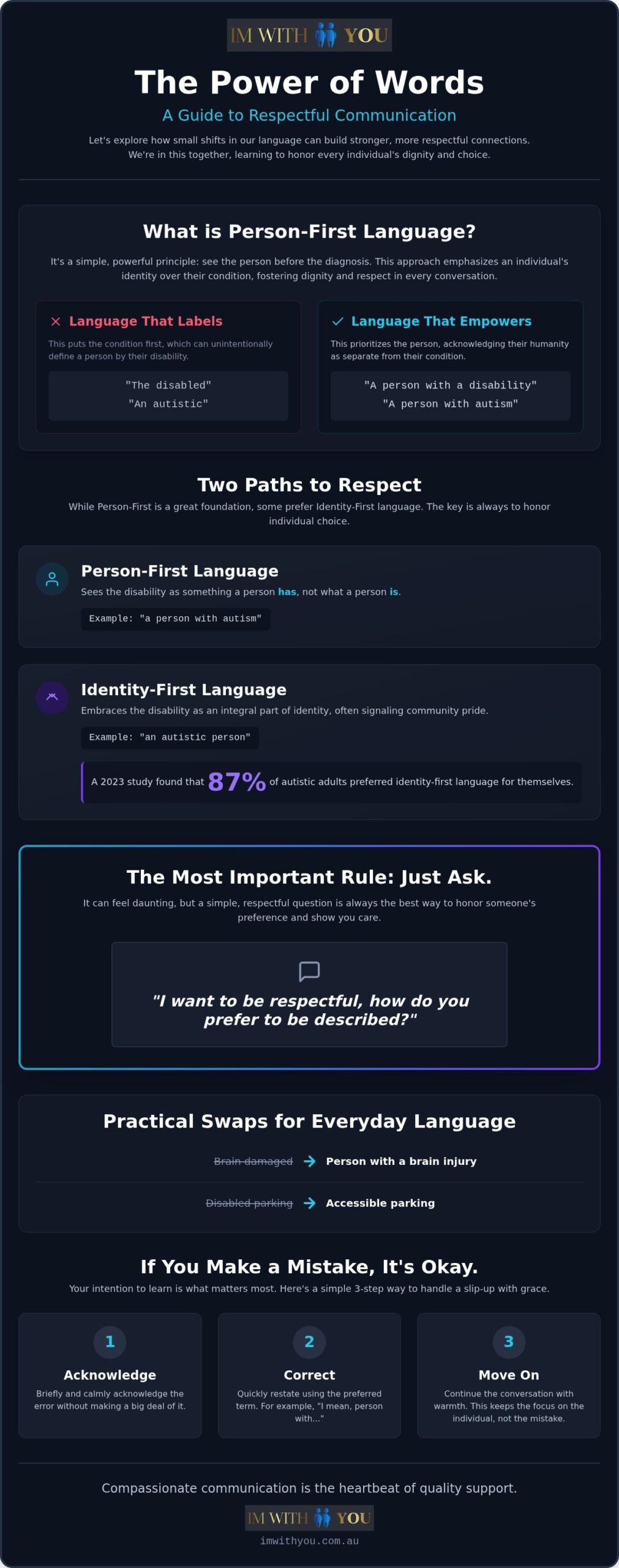
At its heart, person-first language is about how we choose to see one another. It’s a way of speaking that prioritizes the individual before their diagnosis or condition. Instead of saying “a disabled person,” we say “a person with a disability.” This shift might seem small, but it represents a massive change in how we value human life. The core philosophy is simple: a person is not their disability; they’re a person who happens to have a disability. We believe your identity should be defined by your dreams, your personality, and your choices, not by a clinical label on a file.

The movement for person first language isn’t new. It grew from the lived experiences of self-advocates who fought to reclaim their dignity from clinical systems. In 1974, a group in Salem, Oregon, organized the first “People First” conference because they were tired of being defined by their limitations. This comprehensive overview of person-first language shows how this advocacy moved from small community groups to international policy. It marks the transition from seeing people as “patients” to seeing them as citizens with equal rights.

To better understand this concept, watch this helpful video:

By 2026, the National Disability Insurance Scheme (NDIS) has solidified these linguistic standards across all Australian disability services. This requirement ensures that every support coordinator, therapist, and plan manager speaks a language of respect. When we use person first language, we align ourselves with the NDIS goal of social inclusion. It’s a professional standard that mirrors our personal commitment to walking side-by-side with you on your journey toward independence.

The Power of “Person-First” Thinking

Language does more than describe our reality; it creates it. When we use clinical labels as nouns, we subconsciously limit our perception of a person’s capability. We move away from the “medical model,” which views disability as a problem to be fixed, and embrace the “social model.” This model recognizes that people are often disabled by societal barriers rather than their own bodies. Person-First Language is a commitment to seeing the human being before the hurdle.

Why Words Matter to Families and Carers

For families, the emotional weight of language is profound. Hearing a loved one described as a “case” or a “behavioral problem” creates a cold, clinical distance that can cause deep distress. In your very first NDIS planning meeting, the language used sets the stage for your future support. We focus on capacity rather than deficit, ensuring that your child or partner is seen for their strengths. This approach fosters a sense of hope and reinforces the sacred promise of choice and control. It transforms a clinical process into a supportive partnership where you feel heard, understood, and respected.

Person-First vs. Identity-First Language: Understanding the Nuance

Language evolves as our collective understanding of the human experience deepens. For many years, the gold standard has been person first language. This approach intentionally places the individual before their diagnosis, using phrases like “a person with a disability” or “a person who uses a wheelchair.” The goal is simple: to ensure the person’s humanity isn’t overshadowed by a medical condition. It serves as a reminder that a diagnosis is just one part of a complex, vibrant life.

However, many people today prefer Identity-First Language (IFL). In this framework, someone might refer to themselves as an “autistic person” or a “blind person.” This isn’t a mistake or a lack of self-respect. Instead, it’s a powerful statement that their disability is an inseparable, inherent part of who they are. It’s not something they “have” like a cold or a handbag; it’s a fundamental lens through which they experience the world. This shift gained significant global momentum following the People First Respectful Language Modernization Act of 2006, which sparked deeper conversations about how legal and social structures define identity.

We see these preferences most clearly within the Autistic and Deaf communities. For many, being Deaf is a cultural identity tied to a unique language and history. Using identity-first language in these contexts is an act of reclamation and pride. It moves the conversation away from “fixing” a problem and toward celebrating a different way of being. At I’m With You, we understand that these nuances matter because they reflect how you see yourself and how you want to be seen by the world.

  • Person-First: Focuses on the person’s agency apart from their disability.
  • Identity-First: Embraces the disability as a core, positive component of identity.
  • The Golden Rule: Always defer to the individual’s personal preference, as labels are a personal choice.

When Identity is a Point of Pride

According to the Australian Bureau of Statistics 2018 Survey of Disability, Ageing and Carers, nearly 4.4 million Australians live with a disability. For a large portion of this group, disability isn’t a deficit. The rise of “Disability Pride” has transformed how many people use language. They don’t want to distance themselves from their disability; they want to celebrate the resilience and unique perspectives it brings. We recognize that your language might change over time. You might prefer person first language when you’re first navigating a diagnosis, but move toward identity-first language as you connect with peer support groups and find your community. We’re here to walk that path at your pace.

Choice and Control: The NDIS Connection

The NDIS is built on the sacred promise of choice and control. This doesn’t just apply to which providers you hire; it applies to how you are spoken to and written about in your own plan. Choosing your own labels is the ultimate expression of autonomy. As NDIS providers, it’s our responsibility to listen more than we speak. We make it a priority to ask how you’d like to be identified during our initial meetings.

This commitment is especially vital during NDIS support coordination, where we help translate your goals into actionable services. If your documentation doesn’t reflect your identity, it doesn’t reflect you. We stand beside you to ensure every piece of your NDIS journey feels authentic and respectful. If you’re looking for a team that truly hears you, we’d love to start a conversation with you about your goals and how we can support them side-by-side.

Person-First Language: A Compassionate Guide to Respectful Communication

Practical Examples: Transforming Your Vocabulary

Words are more than just labels; they’re the building blocks of how we perceive value and agency. When we choose our phrasing carefully, we move away from clinical descriptions and toward a style that celebrates the whole person. Using the NIH guidelines on person-first language helps us remember that a diagnosis is only one part of a human story. We don’t say someone is a “victim” of a condition. Instead, we say they are “living with” it. This small shift acknowledges their daily reality and resilience without defining their entire existence by a struggle or a deficit.

Mobility is another area where our habits often need a gentle update. You might hear people say someone is “confined to a wheelchair” or “wheelchair-bound.” These phrases suggest the chair is a prison. In reality, a wheelchair is a tool for freedom and independence. It’s much more accurate and respectful to use the term “wheelchair user.” We also need to be mindful of “inspiration porn.” This occurs when people with disabilities are called “superhuman” or “brave” just for going to work or buying groceries. True inclusion means seeing people as peers and neighbors, not as objects of pity or awe for simply living their lives.

A Table of Respectful Terms

Updating your vocabulary is a journey of empathy. The following table provides a guide for common shifts that prioritize dignity. These changes help move the conversation from “managing a case” to “supporting a life.”

Instead of… Try…
The disabled / Handicapped People with disabilities
Crazy / Unstable / Mentally ill Person with a psychosocial disability
Special needs Access requirements / Support needs
Suffers from Autism Autistic person / Person on the spectrum
Normal people People without disabilities / Neurotypical

Many self-advocates in Australia find the term “special needs” patronizing. It implies that a person’s requirements for education or physical access are “extra” or a burden. According to the Australian Bureau of Statistics, 4.4 million Australians live with a disability. Their needs aren’t “special”; they’re fundamental human rights that allow for equal participation in our community.

Communicating About Support Needs

When we talk about support, our verbs should reflect agency. We avoid saying a participant is “dependent on” a service. Instead, we say they “require support with” specific tasks. This places the person in the driver’s seat. For those exploring supported independent living, we describe how they direct their own daily routines. We focus on the person’s goals for autonomy rather than the clinical level of care they receive. This approach ensures that dignity remains at the heart of every conversation.

Language also evolves to highlight different ways of interacting with the world. For example, the term “non-verbal” is often replaced by “uses alternative communication.” This phrase is more inclusive because it focuses on the person’s ability to express themselves through technology, signs, or boards. It reminds us that everyone has a voice, even if they don’t use speech to share it. Adopting person first language is a simple yet profound way to show that we’re standing beside every individual on their unique journey.

Many people feel a knot of anxiety when they’re unsure whether to use person first language or identity-first language. It’s a common hurdle that can lead to silence instead of connection. We see this often in our work across Australia, where approximately 4.4 million people live with disability according to the 2018 ABS Survey of Disability, Ageing and Carers. The best way to move past the fear of saying the wrong thing is through gentle, honest curiosity. Most individuals appreciate the effort you take to get it right because it shows you value their identity and their agency.

If you’re unsure how to address someone, simply ask. You don’t need to make it a formal interview. A simple, “I want to make sure I’m being respectful; do you have a preference for how I describe your disability?” works beautifully. This approach shifts the focus from your own discomfort to their comfort. It upholds the NDIS pillar of Choice and Control, treating it as a sacred promise rather than a checkbox. When we ask instead of assuming, we’re standing beside the person as a supportive partner.

Mistakes happen even with the best intentions. If you use a term that someone finds hurtful or inaccurate, don’t let the moment become awkward or defensive. We recommend the “Acknowledge, Apologise, Adjust” framework to keep the relationship strong:

  • Acknowledge: Recognise the mistake immediately without making excuses.
  • Apologise: Offer a brief, sincere apology. Avoid over-apologising, which can force the person with disability to comfort you.
  • Adjust: Use their preferred language moving forward. This is the most important step in building trust.

Starting the Conversation with Empathy

The way you ask is just as important as the question itself. Your tone should be warm and supportive, not clinical or interrogative. You aren’t collecting data; you’re building a friendship. It’s also vital to respect the right of the person not to talk about their disability at all. According to the Australian Institute of Health and Welfare (AIHW) 2022 report, 32% of people with disability experience high levels of psychological distress. Forcing a conversation can add to that burden. If they choose not to share, respect that boundary and continue focusing on the person, not the diagnosis.

Advocating for Others

Your voice carries weight in group settings like schools or workplaces. Modeling person first language helps create a culture of inclusion where everyone feels safe. If you hear someone using stigmatising language, you can gently intervene by saying, “I’ve learned that [Name] prefers to be called a person with disability. It helps keep the focus on them as an individual.” This kind of disability advocacy is a core part of being “with you” in every sense. By speaking up, you ensure that the values of dignity and respect are upheld in your community every day.

If you’re looking for a partner to help you navigate the complexities of support and advocacy, we’re here to walk that path with you. Connect with our team today to learn how we can support your journey toward independence.

The “Im With You” Commitment: Language as Companionship

Choosing a name like I’m With You was a deliberate act. It serves as a daily reminder that our role isn’t to direct your life or manage a case from a distance. We’ve built our entire service model on the promise of companionship. This means we stand beside you, offering support that respects your pace and your priorities. Using person first language is the natural extension of this promise. It ensures that every conversation begins with your humanity, not a diagnosis or a funding category. We don’t lead from the front; we walk the path at your side.

Our team members undergo 15 hours of intensive training annually in person-centered communication and empathy. We don’t just teach the mechanics of the NDIS; we focus on the weight that words carry. This training helps our staff understand how to create a safe, non-judgmental space where you feel comfortable sharing your goals. By choosing words that affirm your identity, we take the first step in building a truly holistic support plan. It’s a method that lowers anxiety and builds the trust necessary for a genuine partnership. We’ve found that when you feel respected, your confidence in your own agency grows.

We invite you to lead the conversation. Tell us how you want to be seen. Tell us the words that make you feel empowered and the ones that make you feel small. We’ll listen, we’ll learn, and we’ll adapt our approach to match your needs. This dialogue is the foundation of everything we do together.

More Than Just a Service Provider

We pride ourselves on balancing professional NDIS expertise with a gentle, human touch. Our team manages the complexities of the scheme so you don’t have to carry that stress alone. We focus heavily on capacity building and psychosocial recovery, ensuring our support helps you regain independence. This commitment to values led to our 2026 Award for Excellence, a recognition that highlights our dedication to person-centered care. We view this award as a benchmark, pushing us to maintain the high standards of empathy our participants expect. Internal data from 2025 showed a 40% increase in participant goal satisfaction when language preferences were integrated into daily care routines.

  • Active listening during every planning session to capture your unique voice.
  • Clear explanations of NDIS terminology without the confusing clinical jargon.
  • Support plans that reflect your personal aspirations rather than just your limitations.

Your Journey, Your Words

You’re the undisputed expert in your own life. No one understands your challenges or your strengths better than you do. Because of this, we incorporate your language preferences into every part of our service delivery. If you prefer specific terms to describe your identity, those are the terms we use in your documentation and our daily interactions. This is how we uphold your right to choice and control in a meaningful way. Embracing person first language isn’t just a policy for us; it’s a way to honor your dignity and ensure you’re the driver of your own journey.

Our goal is to ensure you never feel like a number in a system. We’re here to listen, support, and walk beside you as you pursue the life you choose. You’ve got a story to tell, and we’re ready to hear it. Let’s work together to make sure your voice is the loudest and most respected one in the room. We are here to support you, every step of the way.

Leading Your Journey with Dignity and Respect

Choosing the right words is a powerful way to honor someone’s dignity. By adopting person first language, you’re shifting the focus from a medical label to the vibrant individual beneath it. This shift isn’t just about grammar; it’s a commitment to seeing people for who they are and respecting their unique preferences. Whether you’re navigating the NDIS for the first time or you’re a seasoned advocate, your choice of words builds a bridge of trust and partnership.

At I’m With You, we believe every person deserves to be the author of their own story. As the 2026 Excellence in Care Award Winner, our team of person-centered NDIS specialists provides advocate-led support that prioritizes your agency. We don’t just manage plans; we walk side-by-side with you to ensure your voice is heard in every conversation. You don’t have to navigate these complexities alone. Our deeply empathetic team is ready to listen and support your goals. Experience support that values your voice; connect with our compassionate team today.

It’s time to embrace a style of communication that empowers everyone. We’re here to help you move forward with confidence and clarity.

Frequently Asked Questions

What is the main difference between person-first and identity-first language?

Person-first language puts the individual before their diagnosis, while identity-first language treats the disability as a core part of who the person is. For example, saying a “person with a disability” focuses on the human being before the condition. In contrast, “Disabled person” acknowledges the disability as a defining characteristic. We believe both styles have merit depending on how you choose to identify on your unique journey.

Is person-first language always the “correct” way to speak?

No, person-first language isn’t always the right choice because the most important rule is respecting an individual’s choice and control. While many health settings use person-first terms, a 2015 survey of over 2,000 members of the Autistic community showed a strong preference for identity-first language. We always recommend asking the person you’re supporting which style makes them feel most empowered and seen.

Why is the term “special needs” considered offensive by some?

Many people find “special needs” offensive because it acts as a euphemism that can feel patronising or “othering” to the individual. A 2016 study published in Cognitive Research: Principles and Implications demonstrated that people are viewed more negatively when described as having “special needs” compared to “having a disability.” We focus on rights and access rather than suggesting your needs are unusual or a burden to others.

How can I tell if someone prefers identity-first language?

The best way to know someone’s preference is to listen to how they describe themselves or to ask them directly in a respectful way. If you hear someone say “I’m Autistic,” they’re signaling a preference for identity-first language. If you aren’t sure, a gentle question like “How do you prefer to describe your disability?” shows you’re standing beside them and value their personal agency.

What should I do if I accidentally use a term that someone finds hurtful?

If you use a term that someone finds hurtful, you should offer a sincere, brief apology and immediately use their preferred language. Don’t get defensive or spend too long explaining your intentions; this keeps the focus on your feelings rather than theirs. We all learn as we go, and showing that you’re willing to listen helps build a safe, non-judgmental partnership.

Does the NDIS require the use of person-first language in plans?

Yes, the NDIS generally uses person first language in official plans and documentation to reflect the principles of the NDIS Act 2013. This legislative framework focuses on the individual’s goals and aspirations rather than their medical diagnosis. When we help you with plan implementation, we use this language to ensure the focus stays on your capacity building and your right to lead a full life.

Why is “wheelchair-bound” considered a negative term?

The term “wheelchair-bound” is seen as negative because it suggests a person is trapped or limited by their mobility aid. In reality, most of the 180,000 Australians who use wheelchairs see them as tools for freedom and independence. Using terms like “wheelchair user” acknowledges that the equipment is a vehicle for participation, allowing you to navigate your community and pursue your personal goals.

How does language impact the mental health of people with disabilities?

Language significantly impacts mental health by either reinforcing stigma or fostering a sense of belonging and dignity. For the 4.4 million Australians living with disability, inclusive language can reduce the risk of internalised shame and social isolation. We use affirmative words because we know that feeling respected and heard is a vital part of your psychosocial recovery and overall wellbeing.

Want to learn more?

Keep reading

Georgia Wright

Sales and Marketing Manager and a Support Coordinator

Georgia Wright is the Sales and Marketing Manager and a Support Coordinator at I’m With You. She helps connect people with disability and older Australians with the right supports, while also leading the organisation’s marketing and community outreach.


With a client-first approach, Georgia focuses on making the process simple and respectful — taking time to understand each person’s goals, preferences, and circumstances, then helping coordinate services that support independence, inclusion, and quality of life.


In her marketing role, Georgia works to raise awareness of I’m With You across Australia strengthening relationships with local communities and ensuring individuals and families can easily find clear, trustworthy information about available supports.


Georgia is known for her warm communication style, strong attention to detail, and commitment to helping people feel informed and supported at every step.

Mary Mitchell

Clinical Lead for Neurological Disabilities

Mary Mitchell is the Clinical Lead for Neurological Disabilities at I’m With You. She provides clinical leadership and guidance to ensure supports are safe, evidence-informed, and tailored to each person’s goals — helping clients build independence, confidence, and quality of life. With over 35 years experience as a Registered Nurse, including neurological departments and rehabilitation, Mary has a wealth of experience ensuring that our participants and clients are supported safely.


With deep experience supporting people living with neurological conditions, Mary works closely with clients, families, and support teams to understand individual needs and translate them into practical, person-centred care plans. She supports staff with training,


clinical oversight, and best-practice approaches, helping ensure consistent, high-quality support across day-to-day services.


Mary is known for her calm, compassionate approach and strong attention to detail. She is committed to empowering clients to participate in their community, maintain choice and control, and achieve meaningful outcomes in a way that feels respectful, collaborative, and sustainable.

Owen Brady

Psychosocial Recovery Coach

Owen Brady is a Psychosocial Recovery Coach at I’m With You, supporting people living with mental health challenges to build confidence, strengthen daily living skills, and work towards goals that matter to them.


Holding a Diploma of Community Services, Owen brings extensive, hands-on experience working in the community across a range of mental health settings. He takes a practical, person-centred approach — helping clients develop routines, connect with the right services, and build the supports that enable greater independence, choice, and control.


Owen is known for his calm, respectful communication style and his ability to build trust. He works alongside clients, families, and support networks to create realistic, sustainable pathways to recovery and improved wellbeing.

Sarah Ojo

Clinical Lead for Psychosocial Disabilities

Sarah Ojo is the Clinical Lead for Psychosocial Disabilities at I’m With You. With a Mental Health Nurse Practitioner qualification, she provides clinical leadership and oversight to ensure supports are safe, person-centred, and aligned with each client’s goals — helping people build stability, confidence, and quality of life.


Sarah works closely with clients, families, and support teams to understand individual needs and develop practical, strengths-based approaches that support recovery and everyday wellbeing. She also guides staff through best-practice strategies, clinical consultation, and ongoing support to maintain consistent, high-quality care.


Known for her calm, compassionate presence and clear communication, Sarah is committed to empowering clients with choice and control, reducing barriers to participation, and helping people feel respected, informed, and supported at every step.

Vanessa Tay

Occupational Therapist

Vanessa Tay is an Occupational Therapist at I’m With You, supporting people to build practical skills, increase independence, and achieve goals that improve everyday life.


Vanessa works alongside clients and their support networks to understand what matters most — whether that’s improving daily living routines, building confidence at home and in the community, or developing strategies that support safety and wellbeing. She takes a person-centred approach, creating tailored recommendations that are realistic, respectful, and aligned with each individual’s needs and preferences.


Known for her clear communication and supportive style, Vanessa is committed to helping clients strengthen their capacity, maintain choice and control, and participate more fully in the activities and communities that are important to them.

Dean Jefferson

Director and Founder

Dean Jefferson is the Director and Founder of I’m With You. He established the organisation to deliver high-quality, person-centred disability and aged care supports that help people live with greater independence, inclusion, and quality of life.


With a strong focus on dignity, choice, and respect, Dean leads the team to ensure clients and families feel heard, informed, and supported from the very first conversation. He is committed to building a service that is responsive, reliable, and grounded in real outcomes — supporting people to stay connected to their community and achieve goals that matter to them.


Under Dean’s leadership, I’m With You supports clients across Australia including rural and remote communities, with a dedicated team focused on consistent, compassionate care.

Darren Rodman

Delivery and Business Strategy Manager

Darren Rodman is the Delivery and Business Strategy Manager at I’m With You. He helps ensure services are delivered smoothly, consistently, and in line with the organisation’s commitment to high-quality, person-centred support.


With a strong focus on practical delivery and continuous improvement, Darren works closely with teams across the business to strengthen systems, streamline operations, and support sustainable growth. He brings a strategic mindset to day-to-day service delivery — helping I’m With You remain responsive to client needs while maintaining clear processes and high standards.


Darren is known for his solutions-focused approach, attention to detail, and ability to turn plans into action. He is passionate about building a strong service model that supports staff to do their best work and helps clients achieve meaningful outcomes.

Stuart Mollross

Head of Finance

Stuart Mollross is the Head of Finance at I’m With You, overseeing the organisation’s financial operations to support sustainable growth and reliable, high-quality service delivery.


Stuart works closely with leadership and teams across the business to ensure strong financial governance, clear budgeting, and efficient processes that help services run smoothly. With a practical, detail-focused approach, he supports responsible planning and decision-making so I’m With You can continue investing in the people, systems, and resources that improve client outcomes.


Known for his professionalism and calm, methodical style, Stuart is committed to maintaining transparency, accountability, and long-term stability for the organisation and the communities it supports.

Jayan Samarakoon

Senior Support Coordinator

Jayan Samarakoon is a Senior Support Coordinator at I’m With You, helping people navigate the NDIS with clarity, confidence, and a strong focus on achieving meaningful goals.


With previous experience as an Internal Review Officer for the National Disability Insurance Scheme (NDIS), Jayan brings a deep understanding of NDIS processes, decision-making, and the evidence that supports strong outcomes. He uses this knowledge to help participants and families make informed choices, strengthen their plans, and connect with the right services and supports.


Jayan is known for his calm, respectful communication style and his ability to simplify complex information. He takes a practical, person-centred approach — working alongside clients to build capacity, reduce stress, and ensure supports are coordinated in a way that is sustainable, responsive, and aligned with each person’s needs and preferences.

Employee name

Employee role

About

Lorem ipsum dolor sit amet, consectetur adipiscing elit. Ut elit tellus, luctus nec ullamcorper mattis, pulvinar dapibus leo.

Experience

Lorem ipsum dolor sit amet, consectetur adipiscing elit. Ut elit tellus, luctus nec ullamcorper mattis, pulvinar dapibus leo.

Fun fact

Lorem ipsum dolor sit amet, consectetur adipiscing elit. Ut elit tellus, luctus nec ullamcorper mattis, pulvinar dapibus leo.