

What if the support system stopped asking you to choose which part of your health matters most today? You’ve likely spent years feeling caught in the middle, repeating your story to uncoordinated providers while worrying you’ll fall through the cracks between sectors. Accessing ndis support for dual diagnosis shouldn’t feel like a constant battle against a fragmented system. I’m with you in that frustration, and I want you to know that your whole self deserves a team that understands how your conditions interact.
This guide shows you how to build a management strategy that honours your complete identity. You’ll learn how to navigate the 2026 shift toward functional capacity assessments while creating a single, coordinated support plan. We’ll explore practical ways to assemble a team that offers steady companionship and specialized expertise, ensuring you never have to manage the peaks and valleys of your journey alone.
We’ve designed this guide to help you move away from fragmented care and toward a management strategy that honours your whole self. Here is what we’ll explore together:
- How to view the intersection of your disability and mental health as a unique journey that requires a single, person-centered approach.
- Practical steps for gathering evidence to access ndis support for dual diagnosis, ensuring your specific functional needs and episodic challenges are clearly understood.
- The way a Support Coordinator serves as your dedicated bridge between sectors, ensuring I’m with you so you don’t have to manage multiple specialists alone.
Understanding Dual Diagnosis in the NDIS Landscape
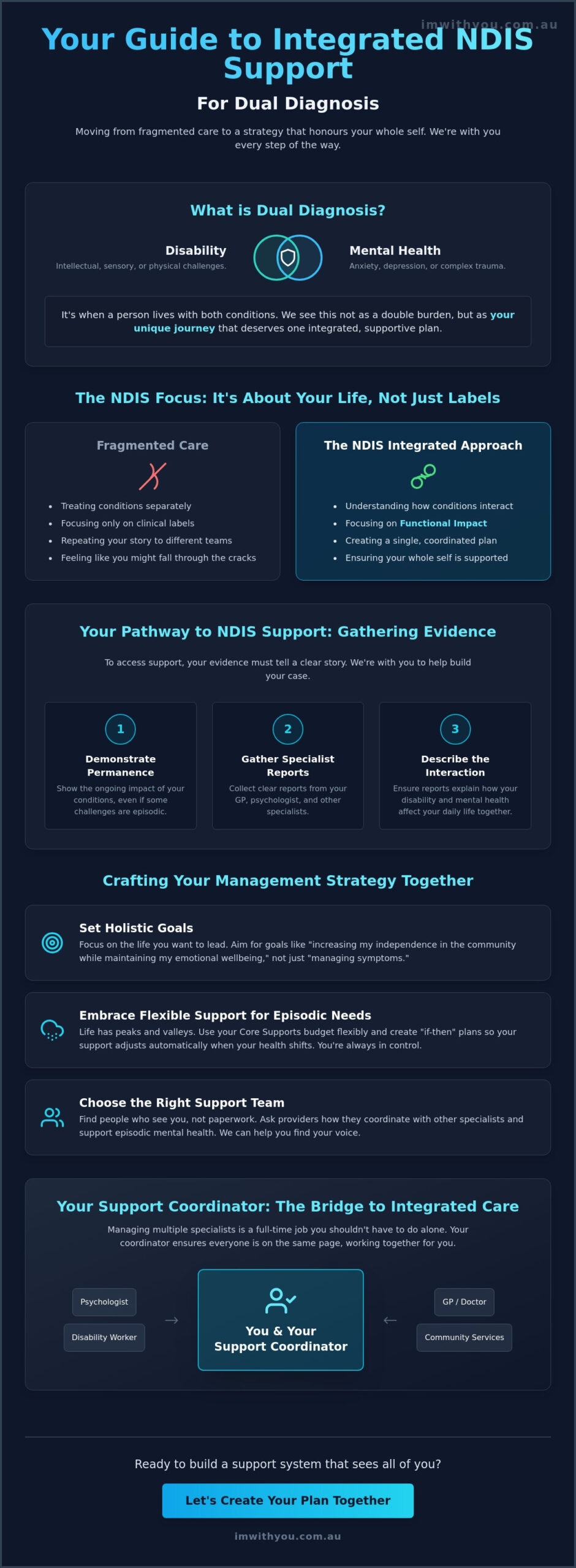
Dual diagnosis happens when a person lives with both a disability and a mental health condition at the same time. This might involve an intellectual, sensory, or physical disability alongside challenges like anxiety, depression, or complex trauma. When you seek Understanding Dual Diagnosis, you’ll see it’s a complex intersection that requires a specialized approach. At I’m with you, we don’t see this as a “double burden.” Instead, we view it as your unique journey that deserves warm, specialized advocacy and integrated care.
The NDIS uses the term Psychosocial Disability to describe the functional impact of mental health conditions on your life. Effectively, ndis support for dual diagnosis means looking at how these conditions work together rather than treating them as separate boxes to check. Dual diagnosis is a co-occurring reality that requires a unified support approach.
To better understand this concept, watch this helpful video:
The Importance of Functional Impact
The NDIS focuses less on your specific diagnosis and more on how your conditions affect your everyday life. We understand that the overlap can be tricky. For instance, you might find understanding intellectual disability helpful when seeing how cognitive and emotional needs intertwine. Functional impact includes things like having trouble with social connection, managing your personal care, or feeling overwhelmed by daily tasks. Your plan should reflect these real-world challenges rather than just clinical labels.
Person-First Language in Dual Diagnosis
We believe that the words we use matter deeply for your dignity and self-worth. Using person-first language helps us remember that you are a person with goals and dreams, not a “case” to be managed or a list of symptoms. You are the expert in your own life. Our role is to walk alongside you. We want to ensure you feel empowered to lead your own ndis support for dual diagnosis journey with confidence and clarity.
Navigating NDIS Eligibility and Management Strategies
Applying for support can feel like a mountain to climb. I’m with you throughout this process, especially when you’re trying to show how your conditions overlap. To access ndis support for dual diagnosis, your evidence must demonstrate that your conditions are permanent or likely to be permanent. Even with episodic mental health challenges, the NDIS looks for evidence that the impairment’s impact is ongoing. You’ll need reports from your GP, psychologist, or specialists that describe how your disability and mental health interact to affect your daily life.
When setting your NDIS goals, try to think about your whole self. Instead of just “managing symptoms,” you might set a goal to “increase my independence in the community while maintaining my emotional wellbeing.” Working with organizations like the Mental Health Coordinating Council can provide insights into how community supports are structured. This holistic approach ensures your plan isn’t just a list of clinical needs but a roadmap for the life you want to lead.
Managing Episodic Needs with Flexibility
Life isn’t always a straight line. Sometimes you’ll need more help than others. You can use your Core Supports budget flexibly to upscale help during difficult periods. If things feel overwhelming, communicate early with your team. A good management strategy involves having “if-then” plans in place so your support adjusts automatically when your health shifts. This flexibility keeps you safe and supported without needing to request a plan review every time things change.
Choosing the Right Support Team
Finding a team that understands both sides of your diagnosis is vital. You want people who see the person, not the paperwork. When you’re learning how to choose an NDIS provider, look for those who offer a gentle, human touch. Ask them: “How do you coordinate with my other specialists?” or “What is your experience with episodic mental health?” If you’re feeling stuck, our Disability Advocacy Services can help you find your voice during these choices.
The Role of Support Coordination in Dual Diagnosis
Managing multiple specialists can feel like a full-time job. Between psychologists, doctors, and disability workers, it’s easy to feel overwhelmed by the sheer volume of appointments. NDIS Support Coordination acts as the vital bridge between these different sectors. When you access ndis support for dual diagnosis, your coordinator ensures that everyone is on the same page. I’m with you in these conversations, making sure your mental health needs and disability supports work in harmony rather than in competition.
This collaborative effort involves you, your family, and our dedicated team. As of April 2026, there are 65,827 NDIS participants with a psychosocial disability, and many of these individuals face the same complexities you do. As highlighted in the MS Australia Submission on Psychosocial Disabilities, an integrated response is necessary to prevent people from falling through the gaps between sectors. Our focus is on capacity building. We want to help you develop the skills and confidence to become the leading expert in your own life and care.
Advocacy and Capacity Building
A trusted advocate makes sure your voice remains the loudest in the room during planning meetings. We focus on helping you develop management strategies at a pace that feels safe for you. I’m with you as a steady companion, providing the reassurance needed to try new things and navigate complex systems. Over time, you’ll gain the tools to handle your own supports with more independence, but we’ll always be here to walk alongside you whenever things get tough.
Community Participation and Joy
Support is about more than just clinical management. It’s about finding joy and belonging. Social goals are just as important as physical ones in a dual diagnosis plan because connection is a powerful part of healing. You can explore what are leisure activities to discover new ways to connect with your community and build meaningful relationships. We believe that true wellbeing comes from a life filled with purpose, friendship, and genuine social inclusion.
Embracing Your Path to Integrated Wellness
You deserve a support system that sees you as a whole person; not a series of disconnected symptoms. By focusing on functional impact and choosing a team that values person-first language, you can build a plan that truly reflects your personal goals. Your management strategy should be flexible enough to handle the episodic nature of mental health while providing steady disability support. Accessing ndis support for dual diagnosis is ultimately about creating a collaborative partnership that honours your unique journey and your right to a full life.
As the recipient of the 2026 Award for Excellence in Disability Support, our team provides expert NDIS Support Coordination and compassionate advocacy tailored for complex needs. Let’s walk this journey together; contact I’m with you for compassionate NDIS support.
You don’t have to navigate these systems alone. I’m with you every step of the way as you build a life filled with connection, joy, and the dignity you deserve. Your future is full of possibility, and we are ready to help you reach it.
Common Questions About Dual Diagnosis Support
Can I get NDIS support if my mental health condition is episodic?
Yes, you can access support even if your symptoms fluctuate. The NDIS recognizes that many conditions are episodic but still result in a permanent impairment that requires long-term help. We look at how your daily life is affected over a long period rather than just on a single day. I’m with you to ensure your plan includes the flexibility to upscale support when things feel particularly heavy.
What evidence do I need for a dual diagnosis NDIS application?
You need detailed reports from your health professionals that show the combined functional impact of your conditions. This evidence must explain how your disability and mental health interact to create barriers in areas like self-care or social connection. Providing clear documentation is essential for accessing ndis support for dual diagnosis. I’m with you during this evidence-gathering phase to ensure your story is told accurately and with the dignity you deserve.
Does the NDIS fund medical treatment for my mental health?
No, the NDIS doesn’t fund clinical or medical treatments like psychiatrist sessions, medications, or hospital care. The mainstream health system remains responsible for these medical services. However, the NDIS funds the functional supports that help you manage your daily responsibilities and participate in your community. We help you coordinate these two different systems so that your medical care and disability supports feel like one unified journey.
How does Support Coordination help with complex needs?
Support Coordination acts as a steady companion to help you organize multiple providers into a single, cohesive team. When managing complex needs, it’s easy to feel like you’re repeating your story to too many people. Your coordinator manages these connections, ensuring your ndis support for dual diagnosis is streamlined and effective. Our goal is capacity building; we help you gain the skills to lead your own support team with confidence and clarity.