

A mental health diagnosis alone doesn’t show how support needs shape everyday life. The NDIS mental health toolkit helps you explore practical supports, understand how daily-life impacts relate to eligibility, and gather information for planning. NDIS and mental wellbeing strategies focus on functional goals, not replacing clinical treatment.
It can be hard to tell where health treatment ends and disability-related support begins, especially when wellbeing affects routines, relationships or community participation. This guide explains what the toolkit covers, which daily-life impacts matter for eligibility, and how to shape wellbeing goals around activities and independence. You’ll have a clearer way to consider your options and next steps, at your own pace.
Key Takeaways
- Use the NDIS mental health toolkit to explore practical supports, self-advocacy and ways to manage everyday life.
- Understand how the permanence of a mental health condition and its impact on daily functioning relate to NDIS access.
- Shape wellbeing goals around meaningful daily activities, independence and community participation.
- Learn when support coordination or disability advocacy may help you make sense of your options and move forward.
What does the NDIS mental health toolkit do?
The toolkit explains how psychosocial disability can affect daily activities and community participation. It helps connect NDIS supports to functional challenges, rather than clinical treatment.
Psychosocial Recovery Coaching
Psychosocial recovery coaching helps participants manage everyday activities and work towards community participation. It can be useful when psychosocial disability makes routines, relationships or social involvement harder to manage. The NDIS funds functional supports, while Medicare and the health system cover clinical mental health treatment. NDIS providers should deliver supports linked to disability-related functional needs and the participant’s goals.
For children and adolescents, psychological support may use play therapy, visual tools, developmentally tailored CBT or mindfulness, parent coaching, and collaboration with teachers and practitioners.
Psychology Access and Funding
Psychology and counselling funding depends on the plan, its goals and how the support relates to disability-related functional impacts. These supports generally fall under Capacity Building categories such as Improved Daily Living and Improved Relationships; there is no single funding amount for every participant. NDIA-managed plans require registered psychologists or counsellors. Self-managed participants can choose any psychologist or counsellor and pay directly, while plan-managed participants can use registered or unregistered providers, with payments handled by the plan manager.
Psychology may help build daily living skills, independence, social connection, emotional regulation and coping strategies. The toolkit also helps participants understand how to find services for funded supports.
Finding and Addressing Support Gaps
The NDIS does not fund treatment for mental illness, and standard gym memberships are generally treated as day-to-day living costs. Support for physical wellbeing needs to relate to the person’s condition and meet the reasonable and necessary test. The toolkit provides information about finding providers; a support coordinator can help discuss suitable options.
If a support is declined or no longer meets your needs, connect your request to its functional impact and your NDIS goals. Participants can request a plan review when circumstances change. Describe what has changed in daily life and where current supports fall short.
Eligibility when mental health affects daily life
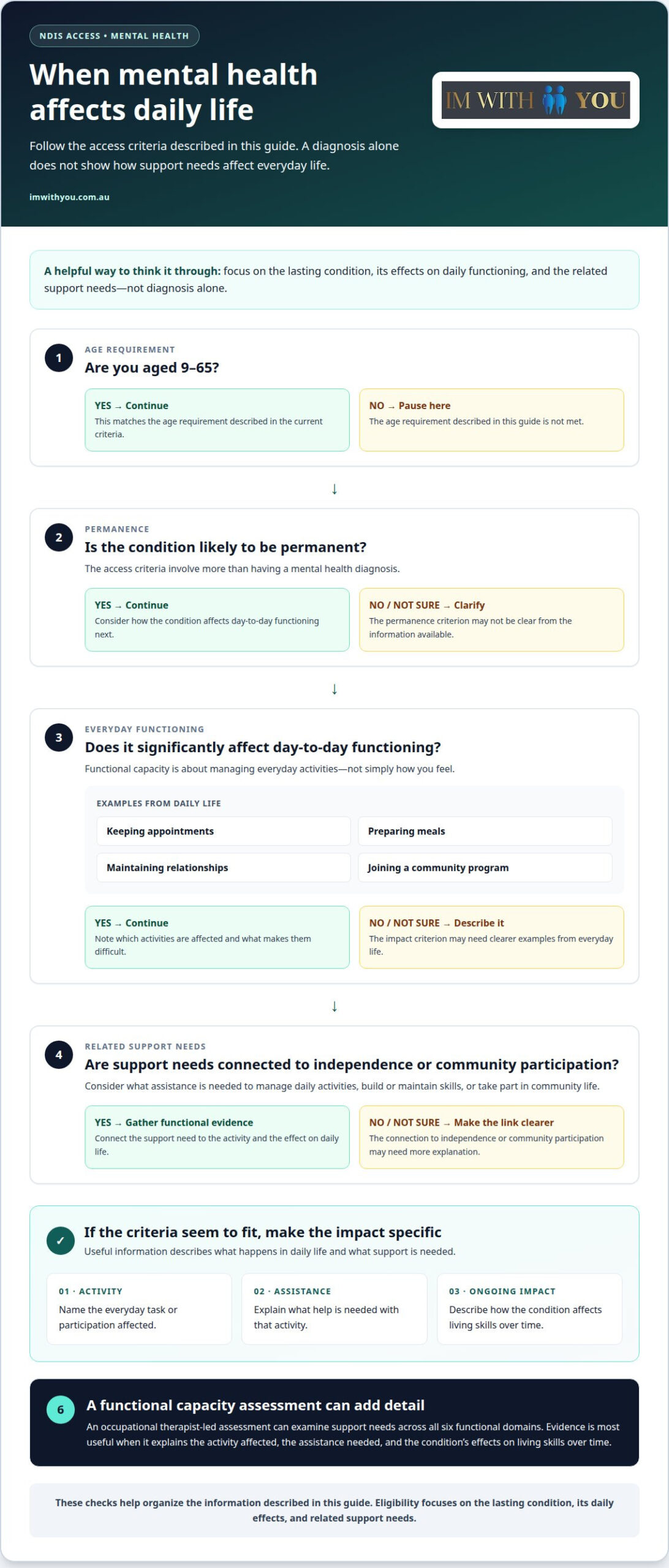
In Australia, NDIS access for mental health-related support involves more than a diagnosis. The condition must be likely to be permanent and significantly affect day-to-day functioning. The person must also have support needs connected to independence or community participation. Applicants must be aged 9-65 to meet the age requirement described in the current criteria.
Functional capacity describes how a person manages everyday activities, not simply how they feel. For example, psychosocial disability may make it difficult to keep appointments, prepare meals, maintain relationships or take part in a community program. An occupational therapist-led functional capacity assessment can examine support needs across all six functional domains. Evidence is most useful when it describes the activity affected, the assistance needed and how the condition affects living skills over time.
Daily living assistance may help a person build or maintain skills for routines and community involvement. The right support depends on its functional impact and the person’s goals. A practical routine might schedule meals, therapy and rest to create predictability during recovery. Breaking a large task into smaller steps can also make it easier to start and finish.
Mindfulness, deep breathing and short breaks are practical relaxation techniques to try during the day. For instance, someone feeling overwhelmed before an appointment might pause for slow breaths, then prepare one item at a time. These strategies can support emotional wellbeing, but they don’t establish NDIS eligibility by themselves. Eligibility focuses on the lasting condition, its daily effects and the person’s related support needs.
Writing functional wellbeing goals
Strong NDIS goals describe what you want to do in daily life, not just a diagnosis or treatment. For someone with psychosocial disability, a goal might focus on managing a morning routine, attending appointments or joining a community activity. Thoughtful NDIS and mental wellbeing strategies can connect personal priorities with practical outcomes and greater independence.
Before a planning meeting, identify the activity that feels difficult, the support that could help and the change you hope to make. Keep the goal personal and specific. For example, “I want to build confidence travelling to a community group” explains a functional aim more clearly than “I want better mental health”.
- Activity: Name the everyday task or community participation you want to work towards.
- Barrier: Explain how your disability affects that activity, such as difficulty planning or managing stress.
- Outcome: Describe what greater capacity or independence would look like in practice.
Link each requested support to that outcome. If you’re seeking therapy, explain how it would build skills for daily activities rather than provide clinical treatment for a mental health condition. An occupational therapist’s or psychologist’s report can help connect the proposed support with a functional outcome.
Goals can show how NDIS and mental wellbeing strategies may help you take part in relationships, routines or community life. Bring examples of what happens now, what assistance helps and what you hope to do more independently. These details can help you understand whether a requested support aligns with your goals.
Explore occupational therapy support to connect your goals with functional outcomes.
Im with you
Im with you can help you connect everyday support needs with your NDIS goals. If coordinating supports, joining community activities or speaking up about your needs feels difficult, NDIS Support Coordination, Community Participation Support and Disability Advocacy Services can help you move forward with greater clarity and choice.
Support can focus on practical priorities, such as building a routine, taking part in community life or communicating what matters to you. The right next step depends on the support you want to explore and how it relates to your goals. You don’t have to work through these questions alone.
For a supportive conversation about your NDIS goals and possible next steps, contact Im with you.
Take Your Next Step With Confidence
Your next step can begin with one practical priority: the part of daily life where you’d value more choice or support. Keeping that priority central can help you discuss your needs in a way that feels personal and manageable. Thoughtful NDIS and mental wellbeing strategies can support the conversation while keeping your aspirations in focus.
I’m With You offers Disability Support Services, Community Participation Support and NDIS Support Coordination. These supports can help you explore ways to take part in everyday life and work towards goals that matter to you. Begin with a conversation about what you want to change and the support you’re considering.
Contact Im with you to discuss a next step that feels right for you. You deserve support that respects your choices, and you can move forward at your own pace.
Frequently Asked Questions
How do I get started?
Start by noting the daily activities where you need support and what would make them easier. If you’re applying, use the mental health toolkit to organise supporting information about your needs. If you already have a plan, identify which goals and funded supports relate to the help you’re seeking. A support coordinator can help you understand how to put those supports into practice.
What Is Stress Management in the NDIS?
In the NDIS context, stress management means building practical capacity for daily life when disability-related challenges affect functioning. For example, a participant might develop coping strategies to prepare for appointments or take part in a community activity. NDIS supports relate to functional impacts and goals, rather than replacing clinical treatment for a mental health condition.
How can NDIS funding support mental wellbeing in Australia?
NDIS funding can support goals that build independence, everyday skills and social connection when these relate to disability. A participant might use a funded support to practise planning an outing or managing a daily task. Available funding depends on the supports approved in the individual’s plan and how they relate to the person’s functional needs and goals.
Which mental health supports and therapies can the NDIS fund?
Depending on the plan and its goals, supports may include psychology, counselling, behaviour therapy or coaching. They need to relate to disability’s functional impact, such as developing coping skills for everyday activities or improving social connection. The NDIS funds functional supports, not treatment for mental illness itself; clinical treatment remains part of the health system.
How do I access NDIS psychosocial disability supports?
Explain how your psychosocial disability affects daily activities, independence and community participation, and gather supporting documentation that describes those impacts. If you’re already an NDIS participant, connect the support you’re seeking to your plan goals and needs. Funding decisions depend on the person’s individual circumstances and support needs. If your circumstances change, you can request a plan review to consider adjustments to your supports.