

When you’re first navigating the world of disability support for a loved one, it’s easy to feel overwhelmed. The medical terms can be confusing, the future can seem uncertain, and just knowing where to start can be the biggest challenge of all. We understand that a diagnosis of an intellectual disability brings a wave of questions and deep emotions. We want you to know you are not alone in this journey, and you don’t have to figure it out by yourself.
That’s why we’ve created this gentle guide. We’re here to walk side-by-side with you, offering clear, compassionate answers that cut through the complexity. In the following sections, we’ll explore what an intellectual disability means in simple terms, focusing on the unique strengths and incredible potential of your loved one. We will also help light the path forward, showing you the supportive resources available here in Australia and how you can take the first steps with confidence and hope.
Key Takeaways
- Understand that an intellectual disability is about an individual’s unique pace of learning, not a limit on their potential for a happy, connected life.
- View the diagnostic process as a positive step-a key that unlocks the door to tailored support and greater understanding for your family.
- Discover how to focus on individual strengths and build a supportive community to help your loved one achieve their goals.
- Learn to navigate conversations about causes and signs with compassion, always keeping your loved one’s wellbeing at the centre.
What is an Intellectual Disability? A Gentle Explanation
When you first hear the term, it can feel overwhelming. But at its heart, an intellectual disability is simply a different way of learning, developing, and experiencing the world. It means a person might take longer to learn new skills or need more support to navigate daily life. While the clinical answer to What is intellectual disability? involves specific criteria, we find it more helpful to think of it as someone needing a different kind of map to find their way. It’s a part of who they are, but it never defines their entire identity, their capacity for joy, or the unique gifts they bring to the world.
The Two Core Areas: Learning and Daily Living
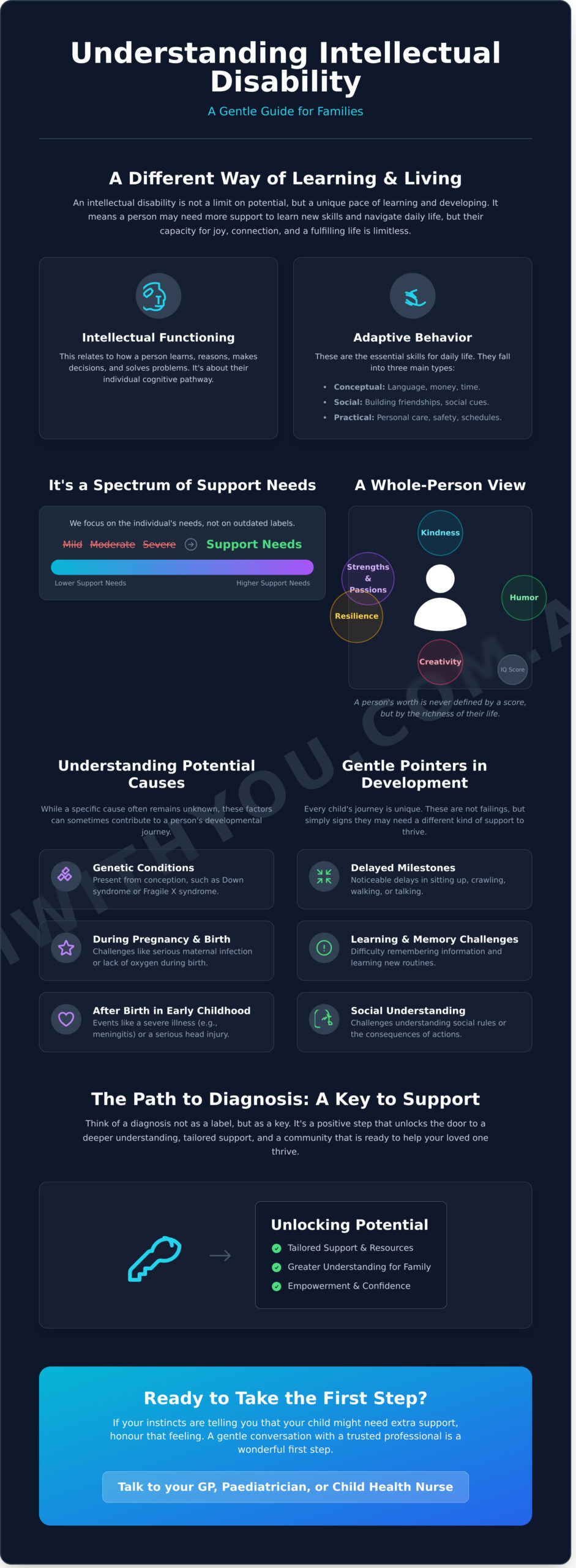
A diagnosis of an intellectual disability looks at two key areas. The first is intellectual functioning, which is about how a person learns, reasons, and solves problems. The second is adaptive behaviour, which covers the practical, social, and conceptual skills needed for everyday living. These are the skills that help us all connect and thrive, such as:
- Building friendships and understanding social cues.
- Managing money and a personal schedule.
- Looking after personal care and safety.
It’s a Spectrum, Not a Single Story
Just like any group of people, every person with an intellectual disability is unique. There is no single story. This journey is a spectrum, and the main difference lies in the level of support a person needs to live their best life. Instead of focusing on labels like ‘mild’ or ‘severe,’ we prefer to talk about ‘support needs.’ This person-centred approach helps us see the individual and tailor support that truly empowers them and honours their independence.
Moving Beyond IQ: A Whole-Person View
For a long time, an IQ score was the main focus. We now understand it’s just one small piece of a much larger, more beautiful puzzle. A number cannot capture a person’s kindness, their artistic talent, their sense of humour, or their resilience. At Im with you, we look at the whole person. We celebrate their strengths and passions, because we know that a person’s worth is never defined by a score, but by the richness of their life and their potential for happiness.
Understanding the Causes and Signs with Compassion
If you are exploring your child’s development, you may find yourself searching for a ‘why’. We want to reassure you that for many people with an intellectual disability, a specific cause is never found. What truly matters is not the reason, but the unconditional love and support your child deserves. We are with you on this journey, ready to help you understand the possibilities with compassion.
Potential Causes: A Look at the Possibilities
While the exact cause often remains unknown, understanding the possibilities can sometimes provide families with clarity. These factors are generally grouped into three main periods:
- Genetic conditions: Sometimes, an intellectual disability is part of a genetic condition present from conception, such as Down syndrome or Fragile X syndrome.
- During pregnancy and birth: Challenges during this critical time, like a serious maternal infection, substance use, or a lack of oxygen during birth, can affect a baby’s brain development.
- After birth: In early childhood, a severe illness like meningitis, a serious head injury, or exposure to toxins can also be a contributing factor.
Early Signs in a Child’s Development
Every child’s journey is unique, and they all reach milestones in their own time. However, you may notice certain differences in your child’s developmental pathway. These are not failings, but simply pointers that they may need a different kind of support to thrive. Some of these can include:
- Noticeable delays in major milestones like sitting up, crawling, walking, or talking.
- Challenges with remembering information and learning new routines.
- Difficulty understanding and following social rules or grasping the consequences of their actions.
When to Seek Gentle Guidance
If your instincts are telling you that your child might need extra support, it is always okay to honour that feeling. A gentle conversation with a trusted professional, like your GP, a paediatrician, or a local child health nurse, is a wonderful first step. This isn’t about seeking a label; it’s about gathering information to empower both you and your child. This conversation can help you understand your child’s unique needs and the formal process of Diagnosing intellectual disability, which is always centred on finding the right supports. You are your child’s greatest advocate, and we are right here beside you.
The Path to Diagnosis: Finding Clarity and Opening Doors
Stepping onto the path of a formal diagnosis can feel overwhelming, but we want you to see it differently. Think of it not as a label, but as a key-a way to unlock a deeper understanding of your loved one and open the door to tailored, meaningful support. This is the moment where uncertainty begins to fade, replaced by a clear, actionable plan for the journey ahead. You are taking a brave and vital step toward empowerment.
What Does an Assessment Involve?
The assessment process is a gentle and comprehensive way for professionals, like a paediatrician or psychologist, to build a holistic picture of your loved one’s strengths and challenges. It typically involves two key areas:
- Intellectual Functioning: This often includes activities and questions (sometimes called an IQ test) that look at skills like reasoning, problem-solving, and learning.
- Adaptive Behaviour: Through conversations and observations, the professional will assess practical, everyday life skills-from communication and social interactions to personal care and safety.
Understanding the Formal Criteria
For a formal diagnosis of an intellectual disability, professionals look for three specific criteria. According to leading resources like the American Psychiatric Association’s guide on What is an Intellectual Disability?, these are significant limitations in both intellectual functioning and adaptive behaviour. The third crucial criterion is that these challenges must be present before the age of 18, which confirms the condition is developmental in nature.
After the Diagnosis: What Comes Next?
Receiving a diagnosis can bring a wave of mixed emotions-from relief at having an answer to grief for the future you imagined. Please know that all of these feelings are valid. Take a moment to breathe. This is not an end, but the beginning of a new, supported chapter. Now, you can start building a dedicated support team and creating a plan. For families in Australia, this is often the point where you can access the National Disability Insurance Scheme (NDIS) to fund the support your loved one needs to thrive.
You don’t have to navigate this next step alone. We’re with you, ready to help you understand the NDIS and build a life filled with choice, control, and opportunity. Learn more about how we can walk this path beside you at imwithyou.com.au.
Building a Fulfilling Life: Support, Strengths, and Connection
A diagnosis of an intellectual disability is simply one part of a person’s story. The chapters that follow are about discovering strengths, building connections, and creating a life filled with purpose and happiness. The focus shifts from what a person can’t do to celebrating everything they can. It’s a journey toward independence and community inclusion, and it’s one you don’t have to walk alone.
The Power of Early Intervention and Lifelong Learning
Providing the right support from an early age helps build a strong foundation for the future. Early intervention therapies are designed to develop crucial life skills, foster confidence, and enhance communication. These supports can include:
- Speech Therapy to improve communication and social skills.
- Occupational Therapy to develop skills for daily living and independence.
- Positive Behaviour Support to understand needs and build positive coping strategies.
But learning doesn’t have an age limit. Growth, skill-building, and discovering new passions are part of a lifelong journey that we are honoured to support at every stage.
Navigating the NDIS in Australia
The National Disability Insurance Scheme (NDIS) is a government-funded system designed to empower people with a permanent and significant disability. Its purpose is to give you genuine choice and control over the support you receive. Your NDIS plan is built around your personal goals, whether that’s learning to cook, finding a job, or joining a local sports team. Key funding areas like ‘capacity building’ focus on developing new skills, while ‘core supports’ provide assistance with daily activities.
Your Support Team: We’re With You
An NDIS plan is a powerful roadmap, and a dedicated support provider helps turn that map into a reality. Our support workers are more than just helpers; they are companions and mentors who can assist with daily tasks, provide transport, and help you connect with your community. We work side-by-side with you to bring your plan to life, ensuring every support is tailored to your unique goals and aspirations. Finding the right team is crucial. We’re here to walk the journey with you.
Your Journey Forward: You Are Not Alone
Navigating the path of an intellectual disability begins with gentle understanding and compassion. Remember that a diagnosis is not a definition, but a doorway to finding the right support and celebrating unique strengths. A rich, fulfilling life filled with connection and joy is not just a possibility-it’s a beautiful reality waiting to unfold when the right support system is in place.
You never have to walk this path by yourself. At I’m With You, our compassionate, award-winning team is here to walk alongside you and your family. We are deeply committed to providing high-quality NDIS care that honours your personal goals. Putting your choice and control first is our promise, ensuring the support you receive is truly your own.
When you’re ready, we’re here. Let’s talk about your journey. We’re here to listen and support you. You have a dedicated partner in us, every step of the way.
Frequently Asked Questions About Intellectual Disability
Is intellectual disability a form of mental illness?
This is a common question, and we understand the confusion. No, an intellectual disability is not a form of mental illness. It is a lifelong developmental condition that affects a person’s ability to learn and perform daily life skills. While someone can have both an intellectual disability and a mental health condition, they are treated and supported in different ways. Our focus is on providing holistic support for the whole person.
What is the difference between an intellectual disability and a learning disability?
While both affect learning, they are distinct. An intellectual disability involves broad limitations in both intellectual functioning (like reasoning) and adaptive behaviours (like social or practical skills). A learning disability, such as dyslexia, affects a specific area of learning, while the person’s overall intellectual ability is typically in the average range. Understanding this difference helps in finding the right, tailored support for your loved one.
Can a person with an intellectual disability live an independent and happy life?
Absolutely. A fulfilling and independent life is a goal we passionately support. With person-centred support that focuses on strengths and aspirations, individuals can live in homes of their choosing, have meaningful relationships, and engage in work and community life. We believe in empowering every person to have choice and control over their journey, and we are with you to help make that a reality.
How can I best support my family member who has an intellectual disability?
Your support is a beautiful and powerful part of their journey. You can help by focusing on their abilities, encouraging their independence, and advocating for their goals. Listening to what they want and respecting their choices is key. Remember, you are not alone in this. We are here to stand beside your family, offering guidance and helping you connect with the right resources and community supports.
Does an intellectual disability get worse over time?
No, an intellectual disability is not a progressive or degenerative condition, so it does not get worse. It is a lifelong condition, but with the right support and opportunities, a person can continue to learn, develop new skills, and grow throughout their entire life. Our approach is always focused on capacity building and celebrating every step of progress, no matter how small it may seem.
What kind of support can the NDIS provide for someone with an intellectual disability?
The NDIS can provide a wide range of life-changing supports tailored to an individual’s goals. This can include funding for support workers to assist with daily tasks, therapies for skill development (capacity building), assistive technology to enhance independence, and support to participate in community activities. We are with you to help navigate the NDIS and build a plan that truly supports a rich and meaningful life.