

What if the paperwork for your next plan review felt less like a hurdle and more like a bridge to the life you’ve been dreaming of? It’s completely understandable if you feel exhausted by the administrative side of support, or if you worry that your personal aspirations might get lost when setting occupational therapy goals for ndis. I’m with you in those moments of frustration. You aren’t just a number in a system; you’re an individual with unique strengths and a vision for your future that deserves to be heard.
I want to help you take the stress out of this process by showing you how to transform your daily needs into clear, NDIS-ready milestones that protect your funding and unlock the therapeutic supports you need to thrive. We’ll walk through the steps to build a collaborative roadmap that focuses on your independence, giving you the confidence to advocate for yourself with ease. By the end of this guide, you’ll have the tools to turn vague intentions into powerful statements of purpose that truly support your journey.
Key Takeaways
- Learn how to transform your personal aspirations into a clear roadmap for independence, ensuring your milestones remain deeply personal while meeting system requirements.
- Discover a gentle approach to the SMART framework to help you craft occupational therapy goals for ndis that are easily understood and funded.
- Explore practical examples that show you how to refine your daily wishes into clear, actionable goals that protect your access to essential support.
- Find out how a collaborative partnership makes managing your journey feel like a steady conversation, reminding you that I’m with you every step of the way.
Understanding Occupational Therapy Goals for NDIS Success
Setting occupational therapy goals for ndis can feel like trying to learn a new language while you’re already feeling exhausted. I’ve seen how the pressure to get the wording “just right” can make you feel more like a file number than a person. I want you to know that you aren’t alone in this. Your goals aren’t just boxes to tick for a planner. They serve as the vital connection between the challenges you face today and the independence you’re building for tomorrow.
To understand how these milestones work, it helps to look at the broader definition of occupational therapy. It’s about supporting your ability to participate in the activities that give your life meaning, from making a cup of tea to joining a local club. When we set these goals together, we ensure they meet the “reasonable and necessary” criteria required for funding while remaining deeply personal to your life. I’m with you as we translate your daily aspirations into a clear, supportive plan of action.
To better understand how these services support your independence, watch this helpful video:
How OT Goals Connect to Your NDIS Funding
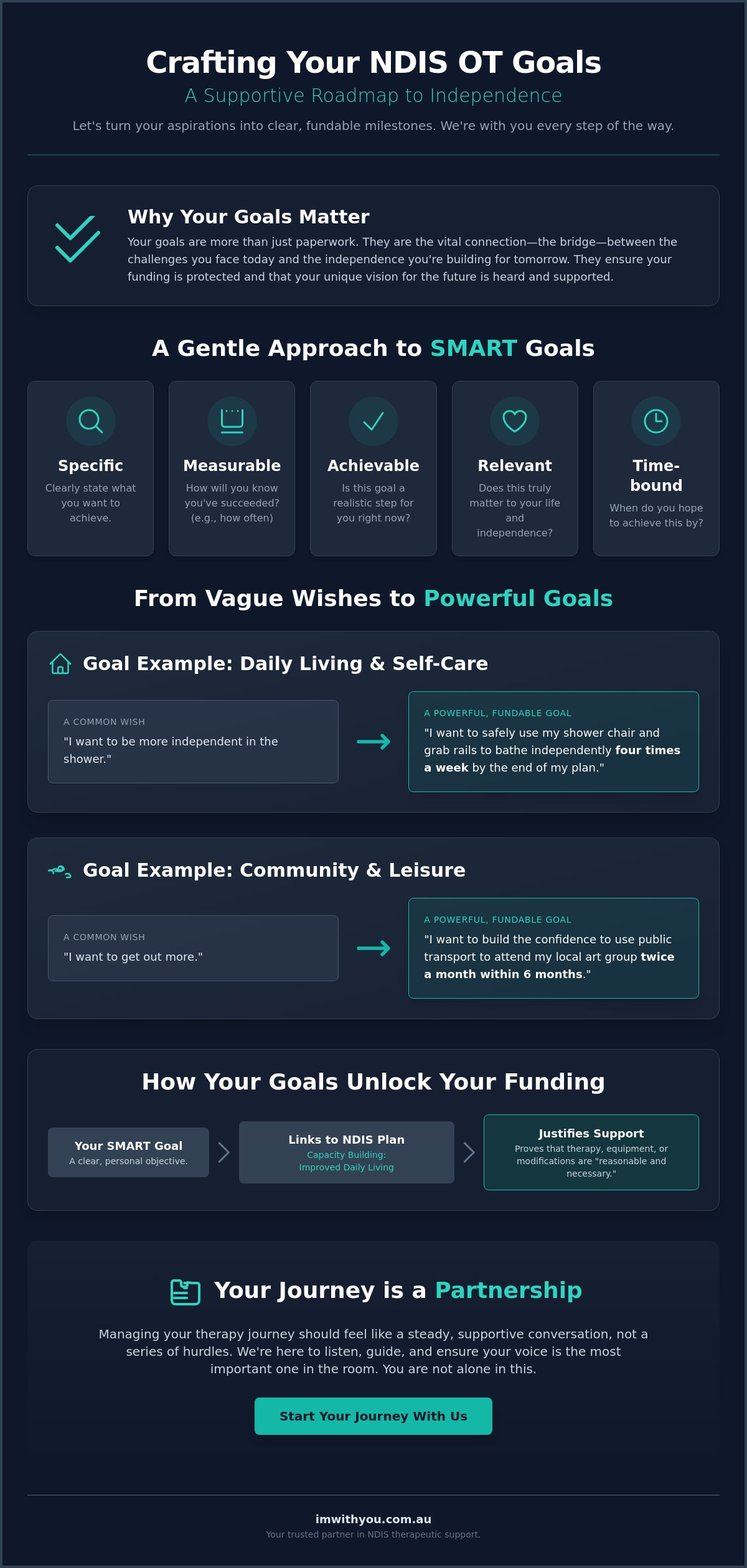
Most occupational therapy falls under the “Capacity Building” section of your plan, specifically within the “Improved Daily Living” category. This budget is designed to help you learn new skills or find new ways to complete tasks that matter to you. When you have specific occupational therapy goals for ndis in place, it becomes much easier to justify why you might need specialized equipment or changes to your home.
By using person-first language, we ensure the NDIS sees you as a whole person rather than just a list of support needs. Clear goals prove that a piece of assistive technology isn’t just a gadget. It’s a key to your community participation and personal growth. This strategic approach helps you manage your plan effectively while keeping the focus on your dignity and unique strengths.
Practical Examples: Turning Aspirations into SMART Goals
Transforming a personal hope into a funded milestone doesn’t have to feel like a clinical chore. I’m with you as we look at how to frame your needs so the system understands them perfectly. When we write occupational therapy goals for ndis, we use a gentle version of the SMART framework. This simply means making your goals specific, measurable, and relevant to your daily life. It’s a way to give your dreams a clear structure that the NDIA can easily support.
Refining a vague wish into a structured goal makes a world of difference for your funding. For instance, instead of saying “I want to be more independent,” we might say, “I want to safely use my shower chair and grab rails to bathe independently four times a week by the end of my plan.” This clarity shows exactly how the support helps you grow. Your therapist acts as a steady companion in this process, helping you find the right words to describe your journey without losing the heart of what you want to achieve.
Example Goals for Daily Living and Self-Care
Daily routines are the foundation of your independence. A meaningful goal might look like this: “I want to be able to prepare a simple meal independently using adaptive kitchen tools within 6 months.” This isn’t just about cooking; it’s about the dignity of self-sufficiency and the joy of creating something for yourself. We focus on the “why” because your personal growth is the heart of every therapy session. To manage this effectively, try celebrating small wins, like using a new adaptive tool for the first time, to keep your momentum high.
Example Goals for Community Participation and Leisure
Connection to others is just as important as physical independence. You might set a goal like: “I want to build the confidence to use public transport to attend my local art group twice a week.” We recognize that finding joy in leisure activities is a valid and vital NDIS outcome. These moments of connection are what make life vibrant. If you’re looking for a partner to help you navigate these milestones, you can explore our therapeutic supports designed to walk alongside you every step of the way.
Managing Your Therapy Journey: A Partnership for Independence
Managing your therapy shouldn’t feel like a series of administrative hurdles. I view the process of refining occupational therapy goals for ndis as a steady, unhurried conversation between us. It’s a partnership where your voice is the most important one in the room. A trusted NDIS provider doesn’t just provide services; they act as a dedicated advocate to ensure your plan truly reflects your life. I’m with you during every review and every milestone, providing the reliable support you deserve.
Regular progress reports are a vital part of this journey. These documents use evidence to tell the story of your growth, making it much easier to secure future funding. We focus on your strengths and the tangible ways your independence is increasing. This evidence-based approach protects your supports while keeping the focus on your personal dignity and long-term aspirations.
Preparing for Your NDIS Plan Review
As your plan review approaches, we’ll work together to gather evidence of your progress. We look at the small wins that prove your occupational therapy goals for ndis are being met in your daily life. I also encourage you to work closely with your support coordinator. This ensures every part of your team is aligned with your evolving needs. If your life changes, your goals should change too. We make sure your documentation is ready to show exactly why your current or new supports are reasonable and necessary for your continued growth.
The Role of Advocacy in Goal Management
True partnership means empowering you to speak up. If a goal we set six months ago no longer feels relevant or achievable, it’s okay to pivot. You have the right to change your mind as you discover what works best for you. I want to ensure your voice is the loudest when discussing your care and your future. My commitment to you is patient and focused on what you can do, rather than your limitations. Together, we manage your journey with a focus on your agency, your rights, and your well-being.
Embracing Your Future with Confidence
You now have the tools to transform your personal dreams into clear, actionable occupational therapy goals for ndis. We’ve explored how a collaborative partnership and a gentle approach to goal-setting can turn the administrative side of the NDIS into a supportive roadmap for your independence. By focusing on what you can achieve and gathering the right evidence, you can enter your next plan review feeling empowered and heard. I’m with you as you navigate these steps, ensuring your dignity and personal growth always remain the priority.
As a National NDIS Service Provider awarded for Excellence in 2026, we’re dedicated to providing expert support coordination and advocacy that puts you first. You don’t have to manage these complex systems alone. Connect with a compassionate partner who understands your journey; let’s achieve your goals together. It’s your life, and I’m here to help you live it with the joy and connection you deserve. Your brighter, more independent future is waiting, and I’m so proud to walk this path beside you.
Frequently Asked Questions
How many goals should I have in my NDIS plan for occupational therapy?
There isn’t a strict limit, but most plans focus on two or three broad goals that allow for flexibility. It’s better to have a few meaningful outcomes rather than a long list that feels overwhelming. I’m with you as you prioritize what matters most to your independence. Your OT will help break these down into smaller, manageable steps within your therapy sessions to ensure you feel steady progress throughout the year.
Can my OT goals be changed once my NDIS plan has started?
Yes, you can absolutely refine your approach to achieving your aspirations as your needs change. While the high-level goals in your NDIS plan are usually set until your next review, the specific occupational therapy goals for ndis that you work on with your provider remain flexible. I’m with you in making sure your therapy stays relevant. If a particular task becomes too easy or no longer fits your life, we simply adjust our focus together.
What happens if I don’t meet my OT goals within the plan period?
It’s perfectly okay if you don’t reach every milestone by the end of your plan period. Progress isn’t always a straight line; the NDIS understands that some skills take longer to build than others. I’m with you in documenting your journey honestly. Your OT will write a report explaining the progress you’ve made and why continued support is necessary. This evidence helps ensure your funding remains stable for the next stage of your growth.
Does the NDIS fund the equipment my OT recommends to reach my goals?
The NDIS generally funds assistive technology and equipment if it’s clearly linked to your occupational therapy goals for ndis and meets the “reasonable and necessary” criteria. Your OT plays a vital role here by providing the clinical evidence needed for these requests. Whether it’s a specialized kitchen tool or a mobility aid, we’ll work together to show how this equipment builds your capacity and supports your dignity in everyday life.