
What if your four walls did more than just provide shelter, and actually became the foundation for your independence? For many of the 23,000 Australians currently funded for SDA according to recent NDIS reports, a home is a tool for empowerment rather than just a place to sleep. We know that the NDIS process often feels like a heavy weight, especially when you’re trying to untangle the difference between your housing and your daily support services. It’s easy to feel overwhelmed by the technical requirements while you’re simply searching for a place to call your own.
This specialist disability accommodation (sda) guide is designed to walk beside you through that complexity. We’ve created this resource to help you move from confusion to confidence, ensuring you have the tools to secure a home tailored to your unique life. We’ll explore the four distinct design categories, the essential evidence required for your application, and the practical steps to turn your housing goals into a reality. You deserve a space that reflects your strengths, and we’re here to help you find it.
Key Takeaways
- Understand the essential difference between SDA and SIL, clarifying how your physical home and your support team work together to sustain your lifestyle.
- Explore the four distinct design categories to identify which specialized environment best meets your unique physical or sensory needs for long-term comfort.
- Use this specialist disability accommodation (sda) guide to navigate the funding process with confidence, understanding the critical evidence required from your Occupational Therapist.
- Discover how a compassionate NDIS provider can walk beside you, offering the support coordination needed to bridge the gap between eligibility and moving in.
- Learn how to reclaim your choice and control by transforming a complex application journey into a clear path toward a home that honors your dignity.
Understanding Specialist Disability Accommodation (SDA)
Finding a place to call your own is one of the most significant steps toward independence. Specialist Disability Accommodation, or SDA, refers to housing designed specifically for people who live with extreme functional impairment or very high support needs. It’s vital to understand that SDA funding through the National Disability Insurance Scheme (NDIS) covers the cost of the physical building itself. It doesn’t pay for your support workers or daily personal care. Instead, it provides a specialized environment that makes those supports more effective and less intrusive.
The core goal is to create a forever home. By using smart technology and accessible architecture, these homes reduce the constant need for person-to-person support. This design-led approach fosters social inclusion, giving you the freedom to move through your day with greater autonomy. We believe your home should be a sanctuary that grows with you, providing a stable foundation for the life you want to lead.
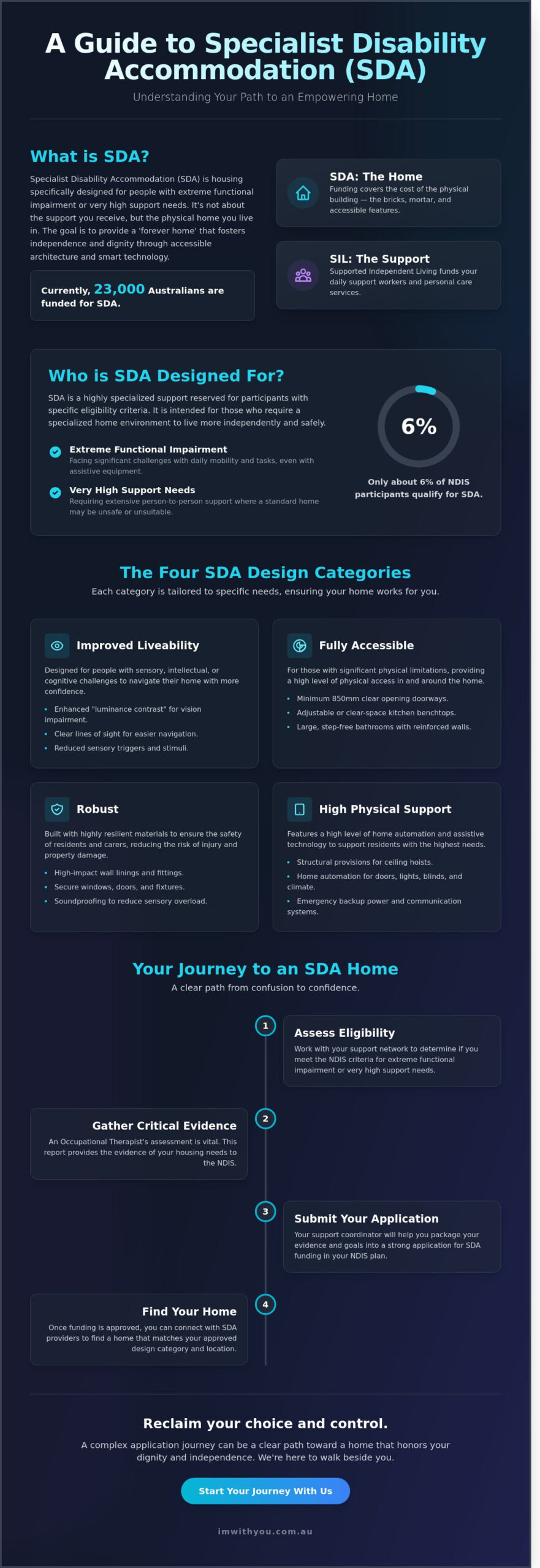
To help you understand how these homes empower residents, this specialist disability accommodation (sda) guide provides a clear visual overview:
Who is SDA Designed For?
SDA isn’t a standard solution for every participant. It’s a highly specialized support reserved for a small group. As of June 2023, NDIS data indicates that only about 6% of participants qualify for this specific funding. You might be eligible if you have an extreme functional impairment, which means you face significant challenges with daily tasks like moving around your home, even when using equipment. It’s also designed for those with very high support needs where a standard home might be failing to keep you safe or is making it difficult for your team to support you properly.
The Importance of Choice and Control in Housing
We view housing as a fundamental human right and a pillar of dignity. Having Choice and Control over where you live is a sacred promise that ensures your environment works for you, not the other way around. The right home does more than provide shelter; it supports your physical safety and plays a massive role in your psychosocial recovery. You should never feel like you’re compromising on the feeling of being at home. We’re here to walk beside you as you explore these options, ensuring this specialist disability accommodation (sda) guide helps you find a space where you feel truly empowered.
The Four SDA Design Categories: Which One Fits Your Life?
Finding the right home is about more than just four walls; it’s about creating a space where you feel safe, seen, and empowered. Every new build today follows the NDIS Design Standard, a framework introduced in 2019 to ensure that every home meets high benchmarks for quality and safety. This specialist disability accommodation (sda) guide is designed to help you identify which of the four specific categories aligns with your unique daily needs. These designs focus on your strengths, reducing the need for constant, intrusive support by making the environment work for you.
From Improved Liveability to Fully Accessible
Improved Liveability homes are thoughtfully designed for people who find sensory environments challenging. We focus on subtle but impactful changes like enhanced “luminance contrast” to help those with vision impairment or an intellectual disability navigate their home with confidence. These spaces reduce sensory triggers and provide clear lines of sight, making it easier to move around independently.
For those with significant physical limitations, the Fully Accessible category provides a high level of physical access. You’ll find practical features that make a world of difference, such as:
- Doorways with a minimum clear opening of 850mm to accommodate wheelchairs.
- Kitchens with adjustable bench heights or clear space underneath for easy access.
- Large, step-free bathrooms with reinforced walls for future grab rail installation.
You can find more technical details on these requirements in the official NDIS guide to SDA.
Robust and High Physical Support Categories
The Robust category prioritizes resilience and safety for both you and your support team. These houses use high-impact wall linings, laminated glass, and soundproofing to create a calm sanctuary. The goal is to ensure the space remains beautiful and welcoming while standing up to heavy use. It’s about providing a secure environment where you can feel at peace without the home feeling clinical or restrictive.
High Physical Support represents the most advanced level of environmental assistance. These homes are built to handle complex needs while maintaining a warm, non-clinical aesthetic. Key features often include:
- Structural provisions for ceiling hoists that can support up to 250kg.
- Emergency power backups that last for at least 2 hours to protect life-sustaining equipment.
- Advanced home automation for doors, lights, and climate control.
Choosing the right category is a vital step in your journey toward independence. We want to ensure you have the tools to live your life on your terms, surrounded by comfort and dignity. If you’re feeling unsure about which path is right for you, we can explore your housing goals together to find the perfect fit.
SDA vs. SIL: Clearing the Confusion
We often meet participants and families who feel overwhelmed by the alphabet soup of NDIS acronyms. One of the most frequent points of confusion involves the difference between SDA and SIL. While they often go hand-in-hand, they represent two very different parts of your life. This specialist disability accommodation (sda) guide is here to help you distinguish between the house you live in and the support you receive inside it.
Think of SDA as the “Bricks and Mortar.” It refers to the physical building, including specialized designs like reinforced walls, wide doorways, or high-level physical access features. SIL, or Supported Independent Living, refers to the “People.” These are the support workers who help you with personal care, cooking meals, or taking medication. The NDIS funds these separately to ensure you have true choice and control. You shouldn’t have to move houses just because you want to change your support provider.
Bricks and Mortar vs. Person-to-Person Support
The NDIS structures your funding into different categories to protect your independence. SDA falls under Capital Supports. This is a long-term investment in the physical home itself. In contrast, SIL is funded through your Core Supports. It covers the cost of the human assistance you need to live as independently as possible. If you’re curious about the specifics of daily care, our gentle guide to SIL offers a deeper look into how these support hours work.
This separation is a vital safeguard for your rights. According to the National Disability Services, keeping housing and support separate prevents “tied” service models that once limited participant agency. You have the freedom to hire a different support team while staying in the same home. This ensures that your living situation remains stable, even if your support needs or preferences change over time.
Can You Have Both SDA and SIL?
Yes, most people who qualify for specialized housing also receive support to manage their daily routines. In fact, NDIS data from the June 2023 quarterly report shows that a vast majority of SDA residents also utilize SIL funding to achieve a holistic living environment. These two supports work like a partnership. Your SDA provider ensures the ceiling hoists and automated systems are functional, while your SIL team provides the hands-on help to use those features safely.
Success in your new home relies on healthy coordination between these two parties. We recommend establishing a clear communication plan early on. When your housing provider and your support team work in harmony, it creates a seamless experience that focuses on your goals. We’re here to walk beside you as you use this specialist disability accommodation (sda) guide to build a life that feels safe, supported, and entirely yours.
The Journey to SDA Funding: A Step-by-Step Guide
Securing funding for your new home is a journey that requires both patience and a clear, evidence-based roadmap. We understand that the administrative side of the NDIS can feel heavy, but you don’t have to carry that weight alone. This specialist disability accommodation (sda) guide is designed to help you gather the right support to show the NDIA exactly why a specific home is essential for your independence. We’ll walk through the technical requirements together, ensuring your voice remains the most important part of the application.
Your Occupational Therapist (OT) acts as your primary professional advocate during this time. They conduct a Functional Capacity Assessment (FCA), which is the most critical piece of evidence you’ll provide. The NDIA evaluates this assessment against two main benchmarks: “Reasonable and Necessary” and “Value for Money.” According to the NDIS Quarterly Report from June 2024, there are now 23,223 participants with SDA funding in their plans. This data shows that while the criteria are strict, the path to a specialized home is achievable when your evidence clearly demonstrates how the housing will reduce your long-term support costs and improve your daily life.
Gathering the Right Evidence
To build a strong case for the NDIA, you’ll need a comprehensive portfolio of documents. We recommend focusing on these essential items:
- OT Assessments: Detailed reports that explain your physical and functional needs.
- Housing Preference Forms: Documents that outline where you want to live and who you want to live with.
- Medical Histories: Supportive evidence from your GP or specialists that confirms your long-term requirements.
The way these reports are written can change everything. Using person-first language ensures the NDIA sees you as an individual with goals and aspirations, rather than just a set of clinical symptoms. This respectful approach keeps your dignity and agency at the center of the application process.
Navigating the NDIA Review Process
Once you submit your housing request, the NDIA Home and Living panel begins their review. This stage often involves a waiting period that can last 60 to 90 days, depending on the complexity of your needs. Delays often occur if the panel requires more specific data on how a particular SDA design category, such as High Physical Support or Robust, will specifically improve your safety. If you receive a “no” or a request for more information, don’t feel discouraged. It’s often just a sign that the panel needs more clarity. We stay proactive during this time, helping you gather the extra details needed to turn a “not yet” into a “yes.”
If you’re feeling overwhelmed by the funding process, connect with us at I’m With You so we can explore your housing options side-by-side.
Finding Your Home: How We Walk Beside You
Finding the right place to live is one of the most significant milestones in any person’s life. We understand that the path to securing SDA often feels like a mountain of confusing paperwork and bureaucratic red tape. Choosing a compassionate NDIS provider makes all the difference during this time. We aren’t just here to tick boxes on an application. Our team walks beside you through the emotional weight of moving, providing a steady hand when things feel uncertain. This specialist disability accommodation (sda) guide serves as a reminder that you have a partner in this journey who values your peace of mind as much as your physical comfort.
The transition to a new home involves more than just logistics. It requires a deep understanding of your personal goals and the specific supports you need to thrive. We take the time to listen to your story, ensuring the housing pathway we build together reflects your actual life, not just a set of clinical requirements. By standing with you through every NDIS challenge, we help lower the barriers of stress and anxiety that often accompany these big life changes.
Advocacy and Support Coordination
NDIS correspondence can be incredibly dense and difficult to interpret. We help you break down complex housing offers and letters so you understand exactly what’s being proposed for your future. Our role involves connecting you with reputable SDA developers and providers across Australia who share our values of dignity and quality. We focus on ensuring your Choice and Control remains the central focus of the search. Whether it’s requesting a specific modification to a kitchen or exploring a different suburb to be closer to family, we stand by your side to make sure your voice is heard and respected.
A Holistic Approach to Your New Life
A house only truly becomes a home when it supports your lifestyle and your passions. We take a broad view of your move, ensuring your transition doesn’t interrupt your community participation or your favorite leisure activities. Our dedication to this person-centered care earned us a 2026 excellence award, which motivates us to keep raising the bar for every participant we support. We believe that specialist disability accommodation (sda) guide principles should always lead back to your happiness and independence.
You deserve a space that reflects who you are and what you love. You don’t have to navigate these complex pathways by yourself. We’re here to help you turn the key to a brighter, more empowered future. Let’s find the home that fits your life, together.
Step Into a Life of Independence and Dignity
Finding the right home is about more than just bricks and mortar; it’s about reclaiming your independence. This specialist disability accommodation (sda) guide highlights how understanding the four design categories and the distinction between SDA and SIL can transform your daily living experience. You deserve a space that reflects your unique needs and honors your fundamental right to Choice and Control. Navigating the NDIS landscape often feels overwhelming, but you don’t have to manage these complexities alone. Our team is here to simplify the steps and advocate for your vision of a perfect home.
As recipients of the 2026 Award for Excellence in Disability Support, we bring proven expertise to every partnership. Our expert NDIS Support Coordination team provides person-centered advocacy that puts your goals first. We’ve seen how the right environment fosters growth, and we’re committed to helping you secure the funding and housing you deserve. We’ll handle the technical details so you can focus on the excitement of your new chapter. Let us walk beside you on your SDA journey; connect with our team today. You have a bright future ahead, and we’re honored to help you reach it.
Frequently Asked Questions
Is SDA the same as a group home?
No, SDA is not the same as a group home. While group homes often involve shared living with four to six people, Specialist Disability Accommodation refers specifically to the physical building designed for high support needs. You can live in an SDA property alone, with friends, or with family. We focus on your choice and control, ensuring your home feels like a sanctuary rather than a facility.
Can I live with my partner or family in an SDA property?
Yes, you can absolutely live with your partner or family members in an SDA property. The NDIS Quality and Safeguards Commission guidelines and the 2020 SDA Rules allow for mixed residency so you don’t have to live apart from your loved ones. You’ll still receive your funded supports while sharing your home with the people who matter most. We’re here to walk beside you as you navigate these tenancy agreements.
How much rent do I have to pay in Specialist Disability Accommodation?
You’ll typically pay a Reasonable Rent Contribution which is capped at 25% of your basic Disability Support Pension plus any Commonwealth Rent Assistance you receive. According to the NDIS Pricing Arrangements, this ensures your specialist disability accommodation (sda) guide leads to an affordable home. For a single person on a full pension in 2024, this amount is roughly A$390 per fortnight, though exact figures depend on your specific pension rate.
What happens if my NDIS plan doesn’t include SDA funding yet?
You’ll need to request a plan reassessment with the NDIA to include SDA funding if it’s not already there. This process requires gathering specific evidence, including a housing report from an Occupational Therapist. We’ll stand with you during this journey, helping you coordinate the three to five key documents required to prove your eligibility for high physical support or other design categories.
Can I choose my own furniture and decor in an SDA home?
Yes, you have full control over the furniture and decor in your private spaces. Since this is your long term home, we encourage you to bring your own style to the living areas and bedrooms. While the provider supplies the structural fixtures and assistive technology, the personal touches belong to you. Your home should reflect your personality and help you feel empowered every single day.
What is the “Robust” design category specifically used for?
The Robust design category is specifically built to be resilient and reduce the risk of injury for participants with complex behavioral needs. These homes feature high impact wall linings, laminated glass, and soundproofing to create a calm environment. Statistics from the NDIA show that 12% of SDA participants fall into this category. It’s about providing a safe space that withstands heavy use while remaining warm and welcoming.
How long does the SDA application process usually take?
The application process typically takes between 3 and 9 months from the initial assessment to moving in. This timeline includes roughly 4 to 6 weeks for your Occupational Therapist to complete a housing report and several months for the NDIA to process the funding request. We stay by your side throughout this wait, providing regular updates and emotional support as you move toward your new front door.
Do I need a new Occupational Therapist assessment for SDA?
Yes, you’ll need a current Occupational Therapist assessment specifically tailored to SDA housing needs. A standard functional capacity assessment isn’t enough; the NDIA requires a detailed Home and Living report that justifies why you need a specific design category. This report must be completed by a qualified OT, typically involving 10 to 15 hours of clinical observation and documentation to ensure your specialist disability accommodation (sda) guide is successful.