

Last Tuesday, a participant named Sarah sat at her kitchen table with a fresh NDIS plan, feeling a familiar knot of anxiety as she tried to understand what is capacity building funding ndis and how it would actually change her day-to-day life. It’s completely normal to feel overwhelmed by the complex language used in these official documents. As of June 2023, over 610,000 Australians receive support through the NDIS, yet many still find this terminology a major barrier to their progress. You want to make the right choices for your future, but the fear of misusing your budget can feel like a heavy weight.
We believe you deserve to feel confident and in control of your journey. This guide explains how this specific funding works and how you can use it to grow your skills and independence. We’re here to walk side-by-side with you as we explore the nine support categories together. You’ll gain the clarity needed to choose the right providers and reach your personal goals with peace of mind. Let’s turn that confusion into a clear path forward.
Key Takeaways
- Discover how Capacity Building funding shifts the focus from basic care to personal empowerment, helping you gain the skills needed for greater independence.
- Gain clarity on what is capacity building funding ndis by exploring the nine specific categories that align your budget with your unique life goals.
- Learn the essential rules for spending your budget wisely, ensuring every support meets the “Reasonable and Necessary” criteria for your journey.
- Explore practical, real-world examples of how this funding can be used for therapy and social participation to overcome challenges like intellectual disability.
- Understand the value of having a dedicated partner by your side to help navigate your plan and turn your personal aspirations into reality.
Understanding NDIS Capacity Building Funding: The Budget for Your Future
When you first look at your NDIS plan, the various categories might feel a little overwhelming. We want to help you understand exactly what is capacity building funding ndis and how it serves as a foundation for your independence. Unlike other parts of your budget that focus on immediate needs, this category is your dedicated “learning and growth” fund. It represents a fundamental shift in how disability support works in Australia. Instead of just providing “care” that manages your day-to-day life, this funding focuses on empowerment. It’s about giving you the tools, skills, and confidence to do more for yourself over time.
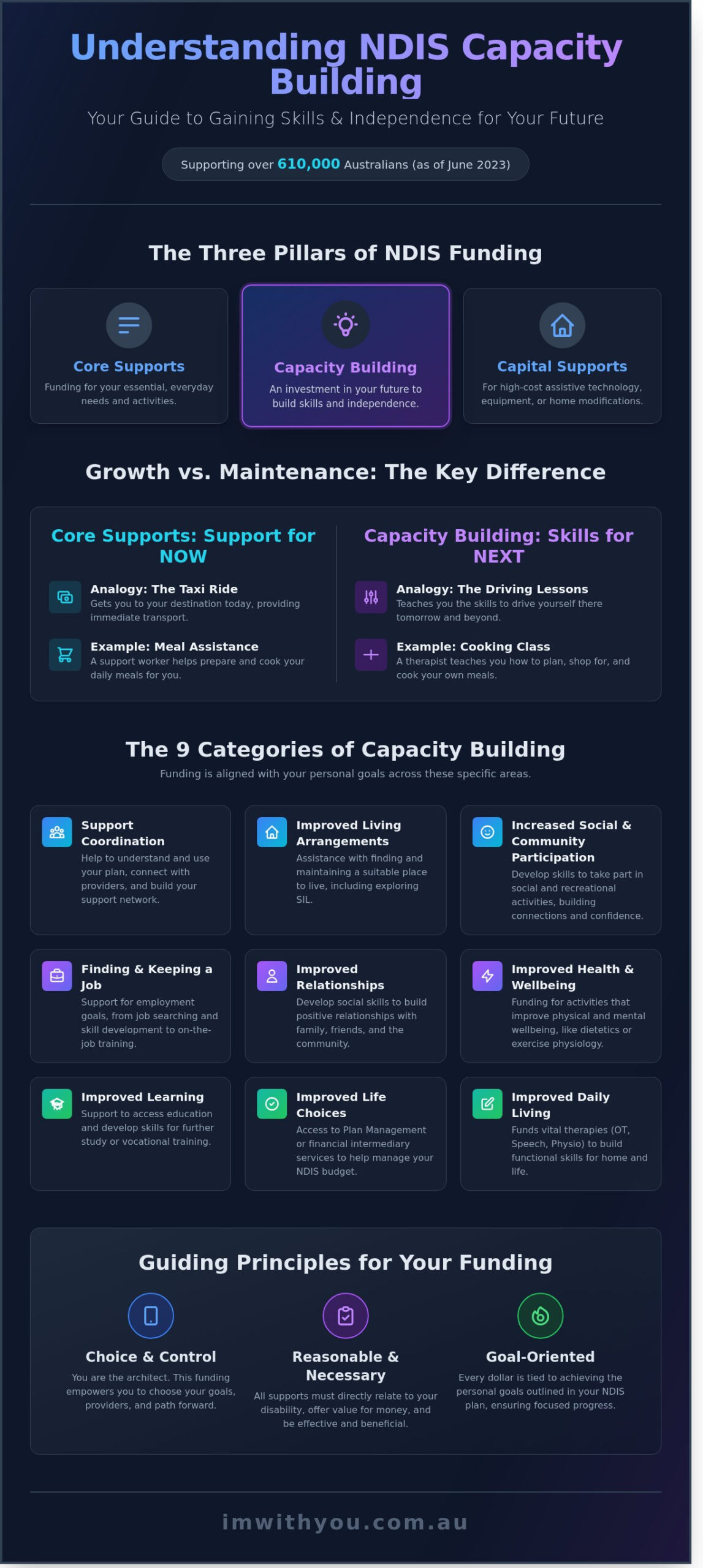
The NDIS framework divides supports into three main pillars. Core Supports handle your everyday help, while Capital Supports cover expensive equipment or home modifications. Capacity Building is different. It’s the investment the NDIS makes in your potential. At the heart of this funding is the principle of Choice and Control. This isn’t just a regulatory term; it’s a promise that you have the right to decide how you grow and who walks alongside you on that path. You aren’t just a passive recipient of services. You’re the architect of your own future.
Why Capacity Building Matters for Your Journey
This funding matters because it looks beyond the status quo. While other supports keep you safe and comfortable today, capacity building helps you move toward your long-term goals. We see the psychological benefits of this every day. When you learn to manage your own budget, find a job, or improve your communication, your self-reliance grows. This creates a deep sense of community connection and personal dignity.
We believe this process works best as a partnership. It involves you, your family, and a trusted NDIS provider working together. By focusing on your strengths rather than your limitations, we help you build a life where you feel capable and heard. This funding isn’t about fixing something that’s broken. It’s about nurturing the skills you already have and discovering new ones you haven’t tried yet.
Growth vs. Maintenance: Capacity Building vs. Core Supports
To understand what is capacity building funding ndis, it helps to distinguish it from Core Supports. A simple way to remember the difference is that Core is for “now,” while Capacity Building is for “next.” Think of it like transportation. Core Supports are the taxi ride that gets you to your destination today. Capacity Building is the driving lessons that allow you to get yourself there tomorrow. One maintains your current quality of life; the other expands what’s possible for your future.
These two budgets work side-by-side to support a holistic life. While your Core funding might pay for someone to help you cook a meal, your Capacity Building funding might pay for a nutritionist or a support worker to teach you how to meal prep independently. This dual approach ensures your immediate needs are met while you’re busy building the life you want. It’s a steady, rhythmic progression toward a version of yourself that feels more independent every single day.
The Nine Categories of Capacity Building: A Detailed Breakdown
Understanding what is capacity building funding ndis requires a look at the specific buckets of support available to you. There are nine distinct categories in total. You won’t necessarily see all nine in your individual plan. We focus only on the areas that align with your personal goals. Each category is purpose-led; the funding is tied directly to the outcomes you want to achieve for your future. Most of these names start with the word “Improved.” This is intentional. It signals a journey of growth and the development of new skills over time.
Categories for Daily Life and Independence
Improved Daily Living is the most frequent category we see in plans. It funds vital therapies like Occupational Therapy, Speech Pathology, or Physiotherapy. These professionals work with you to build functional skills for your home life. Improved Living Arrangements helps you find and maintain a safe place to live. This can include exploring Supported Independent Living if that fits your needs. Improved Life Choices is another essential area. It provides funding for plan management so you can have an expert handle the financial admin while you focus on your progress.
Categories for Community and Social Connection
Connection is at the heart of a fulfilling life. Increased Social and Community Participation helps you build the confidence to join local clubs or groups. Improved Relationships focuses on specialist behavioral intervention and social skills development. This support helps you navigate complex social world interactions with more ease and less stress. Improved Health and Wellbeing covers services like exercise physiology and dietetics. These supports are strictly for managing the impact of your disability on your physical health and stamina.
Categories for Education and Employment
Finding and Keeping a Job is about your career path. It covers counseling and workplace assistance to help you thrive in your chosen role. Improved Learning supports your transition from school into higher education like TAFE or university. Support Coordination is the final piece of the puzzle. This funding provides you with a dedicated expert. They help you understand what is capacity building funding ndis in the context of your specific life and connect you with the right providers. If you feel unsure about which categories apply to you, you can always reach out to us for a bit of clarity and a friendly chat.
Flexibility and Spending Rules: How to Use Your Budget Wisely
Understanding how to use your budget can feel like learning a new language. We want to make sure you feel confident when you start using these funds. Unlike your Core supports budget, which often acts like one big flexible pot of money, capacity building funds are usually category-locked. This means if you have A$2,000 for “Improved Living Arrangements,” you cannot simply use it for “Increased Social and Community Participation” without a formal plan change. Knowing what is capacity building funding ndis requires recognizing these boundaries so you can plan your year effectively.
Can I Move My Funding Around?
The short answer is usually no. The NDIS allocates these funds to specific skill-building areas based on your goals. If you find your needs change mid-year, you might feel stuck. We recommend speaking with a Support Coordinator if you have one. They act as your navigator, helping you request a plan review or a variation if a category runs low. It’s a process that takes time, so checking your balance every month helps prevent surprises. We’ll stand beside you to help monitor these totals so you don’t run out of support when you need it most.
What Does “Reasonable and Necessary” Mean for Capacity Building?
Every cent you spend must meet the “Reasonable and Necessary” criteria defined in Section 34 of the NDIS Act 2013. This isn’t just red tape; it’s a way to ensure the funding truly supports your independence. Ask yourself these questions before making a purchase:
- Is this directly related to my disability?
- Does this help me reach the goals listed in my NDIS plan?
- Is it value for money compared to other options?
- Is this something a person without a disability would usually pay for themselves?
The NDIS won’t fund items that are the responsibility of the health system or schools. For example, they won’t pay for a private tutor to help with standard homework, but they might fund a therapist to help you develop the social skills needed to thrive in a classroom. We’re here to help you distinguish between a luxury and a genuine tool for your growth.
How you manage your plan also changes your experience. If you’re self-managed or plan-managed, you have the freedom to use providers who aren’t NDIS-registered. This opens up many local community options. If your budget is NDIA-managed, you must use registered providers. Regardless of your management style, keep every invoice and receipt. The NDIS requires you to hold onto these records for five years. It’s a simple habit that protects your journey and keeps your what is capacity building funding ndis supports transparent and secure.
Turning Goals into Reality: Practical Ways to Spend Your Funding
Understanding what is capacity building funding ndis is easiest when we look at how it transforms a typical week. This part of your plan isn’t about someone doing things for you. It’s about giving you the tools to do them yourself. For a person living with an intellectual disability, this might mean hiring a mentor to practice catching the bus or learning how to budget for groceries. These aren’t just chores; they’re the building blocks of a self-directed life. We see this funding as an investment in your potential, allowing you to move at your own pace while reaching for new milestones.
Therapeutic supports play a massive role in this category. When you work with a physiotherapist to improve your balance or a psychologist to build social confidence, you’re gaining physical and emotional autonomy. We believe in a “Person-First” approach. This means your providers should focus on your strengths and personality first, rather than just your NDIS category. You aren’t a case to be managed. You’re a person with a vision for your future, and your funding should reflect that dignity. By selecting providers who respect your agency, you ensure that every dollar spent brings you closer to the life you want to lead.
Case Study: Moving Toward Independence
Let’s look at Sarah, a young woman who dreamed of leaving her family home. She used her “Improved Living Arrangements” funding to search for a flat that suited her needs. To make the move successful, she also tapped into her “Improved Daily Living” budget. She hired an Occupational Therapist who conducted a thorough assessment of her new kitchen. They installed lower benchtops and tactile labels on the stove. This A$2,500 investment meant Sarah could cook her own meals safely. The pride she felt during her first housewarming dinner was incredible. We walked with her through the stress of the move, providing that steady “with you” support that turns a house into a home. This is the heart of what is capacity building funding ndis; it’s the practical help that leads to a sense of true achievement.
Using Support Coordination to Unlock Your Plan
Support Coordination is frequently the first “Capacity Building” support people use, and for good reason. The NDIS system can feel like a maze. A coordinator acts as your translator and guide. They help you find the right therapists and community groups that actually fit your life and values. They don’t just make phone calls for you; they show you how to do it. The ultimate goal is for you to gain the skills to eventually coordinate your own life. It’s about moving from feeling overwhelmed to feeling empowered. It’s a collaborative process where you’re always in the driver’s seat, but you have a navigator right there with you. If you’re ready to start this journey, reach out to us today to see how we can support your growth.
Navigating Your Capacity Building Journey with a Trusted Partner
Understanding what is capacity building funding ndis is just the first step toward a more independent future. While the NDIS rules can feel like a complex puzzle, you don’t have to solve them alone. At I’m With You, we make a simple promise: we stand beside you during every stage of your plan implementation. We believe that your funding is more than just a budget; it’s a set of keys designed to unlock your potential. You don’t need to master the technical jargon or the legislative frameworks overnight. Our role is to provide the professional expertise that lets you focus on being the expert in your own life.
We see our partnership as a collaboration where your voice always takes center stage. Whether you’re looking to build skills for work, improve your health, or connect with your local community, we provide the steady support needed to make those goals a reality. We’re here to translate the paperwork into tangible progress, ensuring that your journey feels safe, clear, and empowering.
How We Support Your Growth
Our services are carefully designed to align with the core NDIS categories of Social Participation, Advocacy, and Therapy. We believe that how we communicate is just as important as the support we provide. Our team practices Respectful Communication to ensure that every interaction honors your dignity and agency. This person-centered approach is at the heart of everything we do.
We help you translate your abstract NDIS goals into a practical, weekly schedule of meaningful activity. This might include finding local groups that match your interests or coordinating with therapists to build your physical independence. Our commitment to quality is reflected in our 2026 award for excellence in disability service provision, which serves as a marker of the high standard of care you can expect from us. We don’t just manage services; we support a life well-lived.
Next Steps: Starting Your Capacity Building Journey
If you’re feeling overwhelmed by the details of what is capacity building funding ndis, take a deep breath. You can start your journey with three simple steps:
- Review your goals: Look at what you want to achieve in the next twelve months.
- Check your budget: Identify which capacity building categories are included in your current plan.
- Reach out for a chat: Connect with us to discuss how we can walk this path together.
It’s important to remember that Choice and Control is your fundamental right. We are here to help you exercise that right with confidence. You have the strengths and the vision for your own future; we are simply the steady companion who helps you navigate the landscape. We’re with you, every step of the way, as you grow into the person you want to be.
Embrace the Future You’re Building Today
Capacity building is more than just a line item in your plan; it’s a bridge to the life you want to lead. By understanding what is capacity building funding ndis, you can unlock nine specific categories designed to boost your skills and independence. Whether you’re focusing on increased social participation or finding a stable home, these funds offer the flexibility to turn your personal goals into a tangible reality. You have the right to use this budget to gain confidence and exercise true choice and control over your daily life.
Navigating these rules can feel heavy. You don’t have to carry that weight alone. At I’m With You, we bring our expert support coordination and advocacy to your side, ensuring your plan reflects your unique heart and heritage. As winners of the 2026 Award for Excellence in Disability Support, we’re committed to a person-centered approach that honors your voice above all else. We’ll help you navigate the NDIS landscape with the warmth and care you deserve. Let’s walk this path together; contact Im With You for NDIS support that puts you first.
Your potential is limitless, and we’re here to walk beside you every step of the way.
Frequently Asked Questions
Can I use Capacity Building funding for everyday groceries or rent?
No, you cannot use your Capacity Building budget for everyday groceries, rent, or utility bills. The NDIS classifies these as “day-to-day living costs” that everyone incurs, regardless of their disability. Under Section 34 of the NDIS Act 2013, funding must be used for supports that are specific to your disability and help you reach your goals. We’re here to help you identify which skills you can build to manage these costs more independently over time.
What happens if I don’t spend all my Capacity Building budget before my plan ends?
Any funds you don’t use before your plan end date will expire and won’t roll over into your new plan. NDIS plans typically run for 12 or 24 months, so it’s important to start your therapies and training early. We walk side-by-side with you to monitor your budget, ensuring you have the choice and control to use your funding on the supports you need before the period ends.
Is Support Coordination included in every NDIS plan under Capacity Building?
No, Support Coordination is only included if the NDIS decides it’s a reasonable and necessary support for your specific situation. According to the NDIS Quarterly Report from December 2023, approximately 43 percent of participants have this support in their plans. If it isn’t in your plan, we can help you explore how to request it during your next plan meeting so you have a dedicated guide to help you navigate the system.
Can I use my Improved Daily Living budget to pay for a support worker to take me to the shops?
You generally cannot use Improved Daily Living funds for a support worker to drive you to the shops, as this is a Core Support activity. Understanding what is capacity building funding ndis means seeing it as a tool for growth rather than daily assistance. You might use this budget for an Occupational Therapist to teach you how to navigate the shops independently, focusing on your long-term empowerment rather than just completing a task.
What is the difference between a Plan Manager and a Support Coordinator?
A Plan Manager focuses on the financial side of your plan, like paying your invoices and tracking your spending, while a Support Coordinator helps you find and connect with the right providers. Both roles are funded under the Capacity Building category to give you more choice and control. Think of the Plan Manager as your personal accountant and the Support Coordinator as your knowledgeable guide who stands beside you as you build your support team.
How do I get more Capacity Building funding if my needs change mid-plan?
If your circumstances change significantly, you can request a plan variation or a full reassessment from the NDIA. The NDIS Participant Service Guarantee aims to complete these variations within 21 days of a decision to change the plan. We’re here to help you gather the evidence, such as new therapist reports, to show why additional funding is necessary for your journey toward independence.
Do I need a quote from a provider before I can use my Capacity Building funds?
You don’t usually need a formal quote for standard therapy sessions, but it’s often required for specialized assessments or high-cost items. Clarifying what is capacity building funding ndis involves knowing that some categories, like Finding and Keeping a Job, might require a service agreement first. We recommend setting up these agreements early so both you and your provider are clear on the costs and the support you’ll receive.
Can Capacity Building funding be used for travel or transport costs?
This funding can cover the time a professional therapist spends traveling to see you, but it doesn’t cover your own taxi fares or fuel. The NDIS Pricing Guide 2023-24 allows providers to claim up to 30 minutes of travel time in metropolitan areas to reach your home. This ensures that expert support can come directly to you, making it easier to work on your goals in a space where you feel safe and supported.