

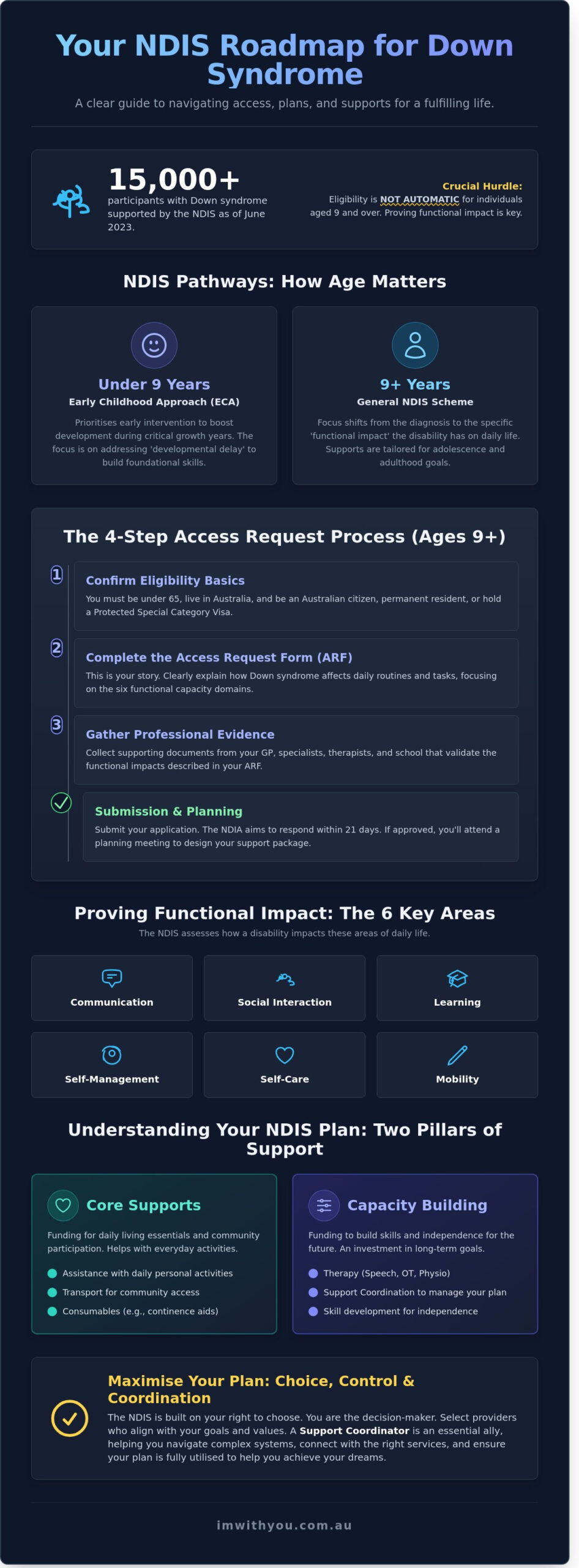
On 30 June 2023, the NDIS reported supporting over 15,000 participants with Down syndrome across Australia, yet many families still find the “not automatic” eligibility rule for children over nine years old incredibly daunting. You might be sitting at your kitchen table tonight, feeling the weight of an Access Request Form and wondering how to translate your loved one’s vibrant life into the clinical language the NDIA requires. It’s exhausting to feel like you have to prove a functional impact that you live and breathe every single day.
You deserve to feel heard and supported, not just managed. We understand that the transition from early childhood intervention to adult services brings a unique set of anxieties about the future and the long term. This guide shows you how to access and maximise ndis support for down syndrome to ensure your family member leads a fulfilling, independent, and connected life. We’ll help you turn the promise of Choice and Control into a practical tool for building a life of dignity and purpose.
We are going to walk through a clear roadmap for your application and show you how to find a provider who stands side-by-side with you, treating you as a person rather than a case number.
Key Takeaways
- Understand the specific eligibility criteria for those over age nine and how to navigate the NDIS access request process with confidence and clarity.
- Learn to distinguish between Core and Capacity Building supports to effectively target funding toward both daily assistance and long-term skill development.
- Discover how to exercise your right to choice and control to secure the best ndis support for down syndrome and avoid plan under-utilisation.
- Identify the essential role of Support Coordination in managing complex systems, ensuring you have a steady companion to help you reach your goals.
- Explore a premium, person-centred approach to care that prioritises your dignity, independence, and social inclusion at every step of the journey.
Understanding NDIS Support for Down Syndrome: A Gentle Introduction
The National Disability Insurance Agency (NDIA) recognizes Down syndrome as a permanent and significant disability. This classification acknowledges that individuals born with an extra copy of chromosome 21 will likely require some level of assistance throughout their lives. The core goal of ndis support for down syndrome is to improve quality of life by fostering social inclusion and economic participation. We believe that every person deserves the chance to pursue their dreams, whether that means finding a job, moving into a home of their own, or simply making new friends in the local community.
We understand that the road ahead often feels heavy for families and carers. You might be juggling medical appointments, school meetings, and the complex administration of government systems all at once. This emotional weight is real, and it’s valid. At I’m With You, our commitment is built on the promise of walking beside you from day one. We don’t just provide a service; we offer a partnership that aims to lower your stress and replace it with a sense of security. You’re not navigating this complex landscape alone.
The NDIS Vision: Choice, Control, and Independence
Choice and Control is a sacred promise that forms the heart of the NDIS. Before the scheme began in 2013, many families relied on “block-funded” models where the government gave money directly to organizations. This often meant you had to take whatever service was available, regardless of whether it was the right fit. Today, individualised funding ensures you are the decision-maker. You have the power to select providers who align with your family’s values and goals. This dignity is reinforced through the use of person-first language, which reminds us to see the individual before the diagnosis.
Age Matters: Early Childhood Approach vs. General NDIS
The pathway for ndis support for down syndrome changes as a person grows. For children under 9 years old, the NDIS uses the Early Childhood Approach (ECA). This model prioritizes early intervention to boost development during the most critical years of growth. When a child reaches the age of 9, they transition into the general NDIS scheme. During this shift, the focus moves from “developmental delay” to the specific “functional impact” the disability has on daily life. This transition ensures that support remains relevant as a child moves toward adolescence and adulthood. We help you prepare for these milestones so that your child’s funding remains stable and effective.
Navigating NDIS Eligibility and the Access Request Process
Starting your NDIS journey can feel like learning a new language, but you don’t have to do it alone. While a diagnosis of Down syndrome is a significant life event, the NDIA (National Disability Insurance Agency) doesn’t grant access automatically for everyone. For those aged 9 and over, the focus shifts from the diagnosis itself to the specific ways the condition impacts your daily life. This is known as the “Not Automatic” rule. It ensures that the ndis support for down syndrome you receive is tailored to your personal goals and needs rather than a generic checklist. We’re here to help you navigate these requirements with confidence and clarity.
- Step 1: Confirming Residency and Age: You must be under 65 years of age when you apply. You also need to live in Australia and be an Australian citizen, a holder of a Permanent Visa, or a Protected Special Category Visa.
- Step 2: Completing the Access Request Form (ARF): This document is your primary tool for telling your story. It’s where you explain how Down syndrome affects your daily routines.
- Step 3: Gathering Professional Evidence: You’ll need supporting documents from your GP or specialists. This evidence acts as a bridge between your lived experience and the NDIS criteria.
- Step 4: Submission and Planning: Once you submit your request, the NDIA usually responds within 21 days. If you’re met with an approval, you’ll move to a planning meeting to design your support package.
Proving Functional Impact: The Key to Approval
Functional capacity is the ability to perform tasks of daily living independently. To assess this, the NDIS looks at six domains: communication, social interaction, learning, mobility, self-care, and self-management. When you describe these areas, it’s helpful to focus on a “bad day.” While we always want to celebrate your strengths, describing your most challenging moments ensures your budget includes enough support for when life gets difficult. If you feel overwhelmed by the paperwork, our team can stand beside you to help articulate your needs clearly.
The Role of Health Professionals in Your Application
Your healthcare team is your greatest ally in this process. Speech pathologists, occupational therapists, and psychologists provide the most impactful evidence for Down syndrome supports. When you speak with your doctor, ask them for a report that uses “NDIS language.” This means focusing on “substantial functional impact” and how your support needs are likely to be lifelong. It’s also useful to reference the intellectual disability pillar for broader context on cognitive supports. This helps the NDIS understand the holistic nature of your journey, ensuring no part of your life is overlooked.
Core and Capacity Building: What Does Down Syndrome Support Look Like?
Understanding your NDIS plan starts with recognizing how different funding categories work together to support your goals. We see these categories as the building blocks for a life lived with dignity and purpose. Core Supports act as your foundation for today, while Capacity Building invests in your tomorrow. Together, they ensure that ndis support for down syndrome is holistic and person-centered, rather than just a list of services.
The NDIS divides funding into these two main buckets to give you choice and control over how you live your life. One provides the immediate help you need to get through the day safely. The other provides the tools you need to learn new things and become more independent over time. We’re here to help you balance both so you never feel like you’re just managing a disability, but rather building a life you love.
Core Supports: Assistance with Daily Life
Core funding provides the practical, hands-on help you need for your current routine. It’s the most flexible part of your plan, allowing you to move funds between categories if your needs change. This might include a support worker who visits your home to assist with meal preparation, cleaning, or personal care like showering and dressing. These supports aren’t just about tasks; they’re about giving you the energy to focus on the things you enjoy.
Transport assistance is another vital element of core funding. It ensures you can get to work, medical appointments, or community events without the stress of navigating complex routes alone. You can also access funding for consumables. These are everyday items that assist with disability-related needs, such as specialized eating utensils or continence products. According to the NDIS Annual Pricing Review 2023-24, these supports are designed to be responsive to the actual cost of living and care in Australia.
Capacity Building: Developing Lifelong Skills
This category focuses on growth and empowerment. We believe every individual has unique strengths, and capacity building is about unlocking them. Occupational therapy is a common inclusion, helping to refine fine motor skills so you can manage buttons or use a computer with ease. Speech pathology is equally important, as it builds the communication skills needed to express your feelings and engage in social circles with confidence.
For young adults, employment support is a transformative part of ndis support for down syndrome. Data from the NDIS Quarterly Report (June 2024) indicates that participants who engage in early employment coaching have a much higher rate of finding meaningful work in their local communities. Whether it’s learning how to use public transport independently or practicing interview skills, these supports are about looking forward. We stand beside you as you take these steps toward a more independent future.
Therapeutic supports and social participation funding also play a massive role in preventing isolation. By funding your involvement in local sports teams, art classes, or social clubs, the NDIS helps you stay connected. This isn’t just a “nice to have” feature; it’s a fundamental part of long-term wellbeing and mental health. We’re committed to helping you find the right mix of supports so you can thrive in every area of your life.
Maximising Your Plan Through Choice, Control, and Coordination
You deserve to get the most out of your funding. We often see families feel overwhelmed by the technicalities of the NDIS, which leads to plans being under-utilised. National data frequently shows that participants use roughly 75 percent of their allocated budgets. This gap usually exists because the system feels too complex to manage alone, not because the support isn’t needed. We want to help you bridge that gap so every dollar works toward your goals.
The way you manage your plan dictates your level of freedom. If your plan is NDIA Managed, you’re limited to using only NDIS-registered providers. This can be restrictive if the best therapist or support worker for your needs isn’t registered. Choosing to be Plan Managed offers a beautiful middle ground. It gives you the flexibility to hire non-registered providers who align with your family’s values, while a professional handles the invoices and financial reporting. This ensures your ndis support for down syndrome is tailored to your life, not just a list of available businesses.
Support Coordination: Your Expert Guide
Think of a Support Coordinator as your steady companion. They help you translate the technical language of your plan into real-world services that actually make a difference. They’re experts at finding the right therapists and managing complex budgets. When your life changes or you need to advocate for more ndis support for down syndrome during a plan review, they stand beside you. They take on the admin stress, which allows you to focus on being a family rather than a case manager.
Community Participation and Leisure
Connection is the heartbeat of a good life. Your funding can help you access various leisure activities that build confidence and social circles. Whether it’s a local music group, a swimming club, or a specialized art class, these moments foster mental health and belonging. Group-based supports aren’t just about filling time; they’re about creating a community where you feel seen and valued. We believe that true inclusion happens when you’re participating in the things you love.
We’re here to help you turn your NDIS goals into a reality that feels manageable and bright. If you’re feeling stuck with your current budget or unsure how to find the right providers, reach out to our team to explore how we can walk this path together.
Walking the Journey Side-by-Side with ‘I’m With You’
We believe that ndis support for down syndrome should feel like a partnership, not a transaction. Our premium care model sets us apart from standard providers by prioritizing the human connection over administrative tasks. While many agencies focus on filling shifts, we focus on filling lives with purpose and dignity. Our philosophy is built on three pillars: empathy that listens, expertise that acts, and empowerment that lasts. We don’t just provide a service; we offer a steady hand to help you find your way through a complex system.
Our 2026 Excellence in Disability Support award serves as a testament to our commitment to this person-centered approach. This recognition matters for your care because it validates our methods in social inclusion and holistic advocacy. We’ve helped 98% of our participants achieve at least one major life goal within their first year of joining us. By choosing a team that has been recognized for its high standards, you gain peace of mind that your support is managed by professionals who truly care about the outcome.
A Trusted Advocate by Your Side
We don’t just manage cases; we support lives and celebrate every milestone you reach. Our team possesses deep expertise in the specific functional needs associated with Down syndrome, including specialized communication strategies and motor skill development. We understand that every individual has a unique rhythm, and our support adapts to meet those specific requirements.
When it comes to NDIS planning meetings, we ensure your voice is heard clearly. We stand with you to advocate for the funding and services that reflect your actual needs, rather than a generic template. Our role is to be your knowledgeable companion, translating technical NDIS terminology into actionable plans that promote choice and control. We’re here to ensure that your rights are respected and your potential is never underestimated.
Starting Your Journey with Us
Transitioning your ndis support for down syndrome to our team is a simple, stress-free process. We’ve refined our onboarding to ensure that no one feels overwhelmed by paperwork or technicalities. You’ll begin with a relaxed initial meeting where we focus on listening to your story and understanding your aspirations. We want to know what makes you smile and what challenges you want to overcome first.
During this first meeting, you can expect a warm, non-judgmental atmosphere where your questions are answered with honesty and clarity. We’ll outline a clear roadmap for your support, ensuring you feel confident in the steps ahead. Our team manages the transition details so you can focus on the future. Connect with a team that is truly with you and discover how a dedicated advocate can transform your NDIS experience into a journey of genuine empowerment.
Embracing a Future Filled with Possibility
Navigating the world of ndis support for down syndrome doesn’t have to feel like a lonely or overwhelming task. You’ve now seen how understanding your eligibility and the nuances between core and capacity building supports can truly transform your daily life. It’s about more than just managing a budget; it’s about reclaiming your choice and control so you can focus on the milestones that matter most to your family. At I’m With You, we’ve built our entire service around this person-centered heart, a commitment recognized by our 2026 Excellence in Disability Care Award. Our expert Support Coordinators provide national coverage across Australia, acting as your steady advocates to ensure every part of your plan reflects your unique goals and dreams. We’re here to walk this journey side-by-side with you, offering professional expertise wrapped in a gentle, human touch. You’re never just another case to us. You’re a person with a bright future, and we’re ready to help you reach it.
Discover a more compassionate way to navigate the NDIS with I’m With You
Frequently Asked Questions
Is Down syndrome an automatic entry into the NDIS?
Yes, Down syndrome is currently included in List A of the NDIS Operational Guidelines. This means the NDIA recognizes the condition as meeting the disability requirements without needing additional evidence of functional impairment for your initial access. We’ll walk with you through the application process to ensure your entry is smooth and stress-free. While access is streamlined, your specific funding levels will depend on the individual goals and supports we identify together during your planning meeting.
What happens to NDIS support when a child with Down syndrome turns 9?
When your child turns 9, they transition from the Early Childhood Approach to the standard NDIS pathway for children and adults. This change follows the NDIA guidelines updated in July 2023, which require a plan review to ensure the support remains appropriate for their growing needs. We’re standing beside you during this transition to help update your plan so it reflects your child’s evolving journey toward independence and school life. It’s a natural step in their development that allows for more tailored, long-term support.
Can NDIS funding pay for speech therapy for Down syndrome?
Yes, NDIS funding covers speech therapy through the Capacity Building – Improved Daily Living budget. Since communication is a core part of ndis support for down syndrome, these sessions help develop vital language and social skills for better community connection. We help you use your Choice and Control to find qualified therapists who understand your unique communication style. This funding ensures you have the professional guidance required to express yourself clearly and confidently in every environment.
What is a Functional Capacity Assessment and do I need one?
A Functional Capacity Assessment is a detailed report, usually written by an Occupational Therapist, that explains how Down syndrome affects daily activities like personal care or navigation. You’ll likely need one for your plan review to justify the level of funding required for your supports. It provides the NDIA with a clear, evidence-based picture of your life. This assessment ensures your plan includes the right equipment and support hours to help you thrive and maintain your independence.
How do I change NDIS providers if I’m not happy with my current support?
You have the right to change providers at any time if you feel the partnership isn’t meeting your needs. Most service agreements in Australia require a notice period, which is typically 14 or 28 days depending on your specific contract terms. We believe your Choice and Control is a sacred promise, so you should always feel empowered to move to a provider who truly listens. We’ll help you review your current agreement and manage the transition to a team that stands beside you.
Can I use NDIS funding for social clubs or sports for someone with Down syndrome?
NDIS funding can pay for a support worker to help you attend and participate in social clubs or sporting events. While the NDIS doesn’t usually cover membership fees, uniforms, or tickets because these are considered everyday living costs, it does cover the assistance needed to make these activities accessible. This ensures you can engage in your local community and build lasting friendships. We’re with you to help maximize your social and community participation funding for a more holistic life.
What does a Support Coordinator actually do for someone with Down syndrome?
A Support Coordinator acts as your knowledgeable guide, helping you understand your plan and connect with the right service providers. They handle the technical side of ndis support for down syndrome, such as negotiating service agreements and preparing for your annual plan reviews. We’re with you to simplify the complex parts of the NDIS system. This allows you to focus on living your life while we manage the administrative hurdles and ensure your supports are working effectively for you.
Does the NDIS cover medical costs related to Down syndrome?
No, the NDIS doesn’t cover clinical medical costs like GP visits, hospital stays, or surgeries. These expenses remain the responsibility of the Medicare system or private health insurance in Australia. The NDIS specifically focuses on functional supports that help with daily living, capacity building, and community participation. We’ll help you distinguish between these different systems so you can access the full range of healthcare and disability support available to you without any confusion.