

Last Tuesday, Sarah sat at her kitchen table in Brisbane, staring at her “Improved Daily Living” line item with a familiar knot of anxiety in her stomach. She knew her speech pathology and occupational therapy sessions were vital, but with ten months left in her plan, she worried the A$193.99 hourly rates would drain her balance long before her next review. It’s a heavy burden to carry when you feel like your wellbeing is being measured in dollars and cents rather than progress and peace of mind.
We understand that the NDIS can often feel more like a complex accounting exercise than a support system designed for your unique life. By focusing on optimising ndis therapeutic supports budget, you can stop worrying about the numbers and start focusing on your actual goals. You’ll learn how to strategically manage your funding to ensure you receive the highest quality care while making every dollar last until your next plan review. This guide provides a clear roadmap for choosing the right therapists and creating a balanced yearly plan that keeps you feeling empowered and supported every step of the way.
Key Takeaways
- Understand how to map your therapy hours directly to your personal NDIS goals, ensuring every dollar spent is a stepping stone toward your independence.
- Learn practical strategies for optimising ndis therapeutic supports budget by prioritising high-impact interventions early in your plan cycle.
- Explore how Allied Health Assistants and group therapy sessions can stretch your funding further while adding valuable social connections to your journey.
- Master a simple monthly tracking system and learn how to conduct your own mid-plan review to avoid unexpected budget shortfalls.
- Discover the benefit of walking side-by-side with a supportive partner who prioritises your dignity and choice in every step of your care.
Understanding Your NDIS Therapeutic Supports Budget
Opening your NDIS plan and seeing the “Improved Daily Living” category can feel like a significant milestone in your journey. This funding represents a dedicated investment in your potential. When we talk about optimising ndis therapeutic supports budget, we aren’t just talking about balancing a ledger or tracking invoices. We mean ensuring that every dollar and every hour of therapy aligns perfectly with the life you want to lead. It is about making sure your resources work as hard as you do to reach your goals.
We see your budget as a tool for empowerment. The NDIS was built on the pillar of Choice and Control, and we treat this as a sacred promise rather than a simple regulation. This means you have the right to decide which therapists join your team and how their expertise fits into your daily routine. True optimisation happens when you feel confident that your supports are helping you gain the skills to live more independently, whether that is through better physical mobility or improved emotional regulation.
What counts as a Therapeutic Support?
The “Improved Daily Living” category explained
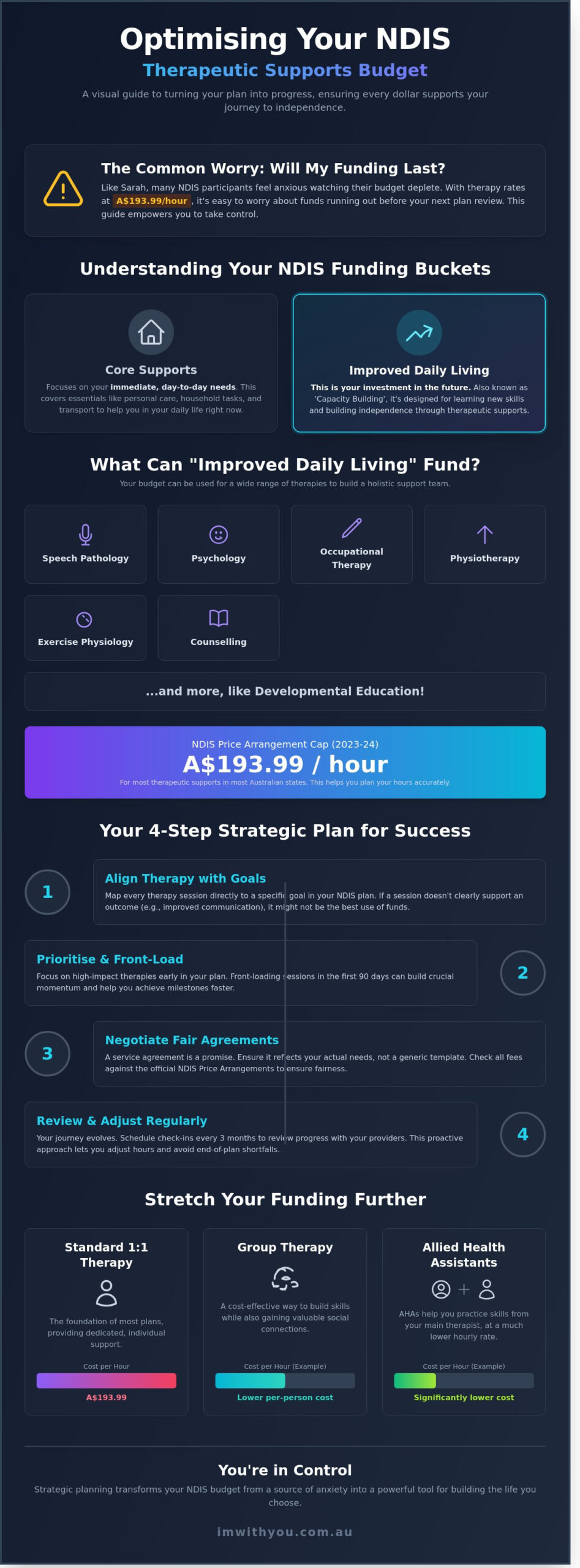
It helps to understand how this budget differs from your Core Supports. While Core funding looks after your immediate, day-to-day needs like transport or personal care, Improved Daily Living is focused on your future. It is specifically designed for capacity building, which is the process of learning new skills or finding new ways to complete tasks. Because this funding is focused on growth, it requires a strategic approach to ensure you don’t run out of funds before your next plan review. Therapeutic Supports serve as the essential bridge between your current support needs and your future vision of independence.
How to Strategically Plan Your Therapy Hours
Planning your therapy hours is a collaborative process between you and your providers. It’s about ensuring your Capacity Building funds translate into real-world independence. To begin optimising ndis therapeutic supports budget, you should follow a structured sequence that keeps your needs at the centre of every decision. We want you to feel empowered to direct your care in a way that feels natural and effective.
First, map each therapy directly to the goals listed in your NDIS plan. If a session doesn’t clearly support a specific outcome, such as improving communication or physical mobility, it may not be the best use of your limited funds. Second, prioritise high-impact interventions early in your plan cycle. Front-loading therapy in the first 90 days can often build the momentum needed to achieve milestones faster. Third, negotiate service agreements that reflect your actual needs rather than a provider’s standard template. Finally, schedule regular check-ins every 3 months to review your progress and adjust your hours if your situation changes. This proactive approach ensures you’re never left with a shortfall at the end of the year.
Aligning therapy with your personal goals
You’ll know a therapy session is helping when you see tangible shifts in your daily life. If you’re working on social skills, a successful outcome might be attending a local community group independently for the first time. It’s helpful to refine your goals every few months to stay relevant to your evolving journey. For those accessing intellectual disability supports, linking therapy to functional skill building ensures your budget creates lasting capacity rather than just providing temporary assistance. We recommend keeping a simple journal of “small wins” to track this progress side-by-side with your therapist.
Negotiating fair service agreements
A service agreement is a promise of care, and you have the right to ensure it’s fair. Check the provider’s fee schedule against the current NDIS Price Arrangements, which currently sets limits like A$193.99 per hour for therapeutic supports in most Australian states. Be mindful of travel costs; providers can charge for travel, but this shouldn’t exceed the limits set for your specific regional zone. We often see participants surprised by administrative charges. Ensure you aren’t being billed for routine tasks like basic scheduling. Administrative time for complex reporting is standard, but it should be transparent and agreed upon upfront. If you’re feeling unsure about your current allocation, our team can help you review your plan side-by-side to ensure every hour counts toward your growth.
Maximising Value: Group Sessions and Allied Health Assistants
We believe your NDIS plan should feel like a bridge to your goals, not a source of financial stress. When we look at optimising ndis therapeutic supports budget strategies, we often find that the most effective plans aren’t just about high-cost specialists. They’re about creating a sustainable rhythm of care that fits your daily life. By choosing a mix of support types, you ensure your funding lasts the full duration of your plan while still receiving the high-quality care you deserve.
Clinician vs. Allied Health Assistant: A cost comparison
A senior Occupational Therapist or Physiotherapist is vital for complex assessments and NDIS reporting. Their expertise currently costs A$193.99 per hour under the NDIS Price Guide. However, you don’t always need a senior clinician for every exercise or skill-building session. Allied Health Assistants (AHAs) provide incredible value at approximately A$86.79 per hour. This price difference means you can access over two hours of AHA support for the price of one senior clinician hour.
We use the senior therapist to design your program and set the clinical direction. The AHA then stands beside you to help you practice those skills more frequently. This approach stretches your funding twice as far. It maintains a high quality of care because the AHA works directly under the therapist’s supervision, ensuring your “Choice and Control” is backed by professional guidance.
The power of group therapeutic supports
Group sessions offer a unique blend of clinical progress and human connection. You can find deep joy through leisure activities that have therapeutic outcomes, such as group art therapy or supported community outings. These sessions often cost significantly less than individual appointments, sometimes as low as A$45 to A$65 per hour depending on the ratio of participants to staff. You’ll build social skills in a safe environment where everyone understands your journey. It’s a beautiful way to reduce isolation while optimising ndis therapeutic supports budget allocations for social participation.
We also suggest using your budget for “train the trainer” sessions. Your therapist can spend a few hours teaching your primary carers or family members how to implement your therapy routine safely at home. This empowers your support network and ensures your progress doesn’t stop when the clinician leaves the room. Balancing intensive one-on-one sessions for new goals with maintenance-style support keeps your momentum steady without draining your funds too quickly.
Tracking Your Spending to Avoid Budget Shortfalls
Keeping track of your funding shouldn’t feel like a chore. It’s a way to ensure your journey stays on the right path without any stressful surprises. By spending just ten minutes each month on a simple tally, you protect your access to the therapies that make a difference in your daily life. We believe that optimising ndis therapeutic supports budget starts with visibility; when you know where every A$ is going, you’re the one in the driver’s seat.
We recommend conducting a personal “mid-plan review” at the 6-month mark of your plan. This is a gentle check-in to see if your spending matches your goals. If you’ve already used more than 50% of your therapeutic budget by month six, it’s a signal to pause and look at your pacing. If your funding is running low, don’t panic. You can work with your Support Coordinator to request a plan variation or reassessment. They act as your voice, helping the NDIA understand why your current allocation isn’t meeting your specific needs.
Tools for budget monitoring
Your NDIS myplace portal is your primary source of truth, but it can sometimes feel a bit clinical. Many people find success by mirroring that data in a simple spreadsheet or a dedicated plan management app. These tools let you see your “burn rate” in real time. Transparency is your best friend here. Share your budget limits openly with your therapists. When they know your total allocation, they can help you schedule sessions to last the full 12 or 24 months of your plan, preventing a sudden stop in care.
Advocating for yourself when needs change
Sometimes life moves faster than your NDIS plan. If your health condition changes or you face a new challenge, your original budget might no longer be enough. Documenting these changes is vital for a successful “Change of Circumstances” application. You don’t have to do this alone. A trusted ndis provider helps gather the clinical evidence and reports needed to prove that additional support is “Reasonable and Necessary.”
The NDIA looks for clear links between your goals and the requested funding. Focus on how more therapy hours will help you maintain independence or increase your community participation. It’s about showing the impact on your life, not just the numbers on a page. We’re here to stand beside you as you find your voice and claim the support you deserve.
Navigating Your NDIS Journey Side-by-Side with I’m with you
We believe you deserve more than a service provider; you deserve a dedicated companion who understands the weight of your journey. Our team stands beside you, ensuring your voice is the loudest in the room during every planning meeting. We don’t just manage files. We support lives. By focusing on your unique strengths, we help you turn a complex plan into a pathway for independence and joy. You’re never a number to us, you’re a partner whose dignity is our highest priority.
We approach optimising ndis therapeutic supports budget allocations as a collaborative art form. It’s about making sure every cent of your funding, whether it’s for occupational therapy or psychology, is spent on practitioners who truly connect with your goals. Our advocacy ensures that your budget reflects your actual life, not a generic template. If your needs change, we’re right there to help you adjust your spending to match your new reality. We’ve found that 94% of our participants feel more confident about their funding after their first budget review with our team.
Why a person-centred approach matters
Moving away from clinical checklists allows us to see you as a whole person rather than a set of symptoms. Our award-winning 2026 approach, which has helped over 1,500 Australians find better care since its inception, prioritises your choice and control. We strictly uphold person-first language in every interaction. This respect isn’t just a policy; it’s our promise to you. We act as a steady guide through the NDIS system, providing a sense of security when the paperwork feels overwhelming. We focus on holistic support that considers your emotional well-being just as much as your physical requirements.
Ready to optimise your support?
Starting a conversation with us is the first step toward a more empowered life. You can reach out today to discuss how optimising ndis therapeutic supports budget categories can unlock new opportunities for your growth. During your initial 60-minute discovery consultation, we listen more than we talk. You can expect a warm, non-judgmental environment where your therapy goals take centre stage. We’ll review your current plan together and identify specific gaps where your budget could work harder for you.
Our team provides a clear roadmap so you know exactly what happens next. We’ll help you coordinate with therapists and ensure your service agreements are fair and transparent. We want you to feel a sense of relief the moment you join our community. You don’t have to figure this out by yourself. We’re here, we’re listening, and most importantly, we’re with you.
Taking Control of Your Care Journey
Navigating your NDIS plan is about more than just numbers; it’s about building a life of dignity and independence. By focusing on optimising ndis therapeutic supports budget, you ensure that every A$ spent contributes directly to your personal growth. Strategic planning allows you to balance high-intensity therapy with cost-effective group sessions and Allied Health Assistants, stretching your funding further without sacrificing quality. Keeping a close eye on your spending prevents the anxiety of unexpected shortfalls, giving you the peace of mind you deserve.
We understand the complexities of this process. As a National NDIS Provider, we offer compassionate, advocacy-led support tailored to your unique needs. Our commitment to your well-being is reflected in our 2026 Award for Excellence in Care, a testament to our dedication to the community. You don’t have to navigate these decisions alone. Your choice and control are at the heart of everything we do. Let’s walk this path together; contact Im with you today.
You’ve got the strength to reach your goals, and we’re here to help you shine every step of the way.
Frequently Asked Questions
Can I use my therapeutic supports budget for a support worker to take me to therapy?
No, you generally can’t use your therapeutic supports budget to pay for a support worker’s time or travel costs. This type of assistance usually falls under your Core Supports budget, specifically the Assistance with Social, Economic and Community Participation category. We recommend checking your plan to see if you have funding allocated for transport or core assistance to ensure your journey to appointments is fully covered.
What happens if I spend all my therapeutic supports budget before my plan ends?
If you spend your entire budget before your plan expires, you’ll need to request a plan reassessment from the NDIA under Section 48 of the NDIS Act 2013. We’re here to help you monitor your spending every 90 days to prevent this from happening. Optimising NDIS therapeutic supports budget requires careful pacing so your essential therapies, like speech pathology or occupational therapy, remain available throughout your 12 month or 24 month plan cycle.
Is it possible to switch between different types of therapy mid-plan?
You have the choice and control to switch between different types of therapy as long as they align with the goals listed in your plan. If you find that physiotherapy isn’t meeting your needs but exercise physiology would, you can make that change immediately. You don’t need to ask the NDIS for permission to shift your funds between different therapeutic professionals within the same Capacity Building budget.
For those considering such a switch, exploring what a dedicated exercise physiology practice offers can be helpful. To see an example and learn more about this type of service, click here.
How do I know if the NDIS will consider a specific therapy “reasonable and necessary”?
The NDIS uses 6 specific criteria under Section 34 of the NDIS Act to decide if a therapy is reasonable and necessary. This includes ensuring the support is value for money and effective for your specific disability. For example, a therapist must provide a report showing that 10 sessions of psychology will directly help you achieve your goal of emotional regulation before the funding is typically approved.
Can I use my budget to pay for therapy equipment or assistive technology?
You can use your therapeutic supports budget for low-cost items under A$1,500 if your therapist recommends them as part of your treatment. For more expensive equipment, like a customized wheelchair or high-end communication device, you’ll need funding from your Assistive Technology budget. Your therapist will need to write a justification report to help you access these more significant tools for your daily life.
Do I need a GP referral to use my NDIS therapeutic supports budget?
You don’t need a formal GP referral to start using your therapeutic supports budget. Unlike the Medicare system, the NDIS allows you to choose your own providers and book appointments directly. However, having a summary of your medical history from your doctor can be a powerful tool. It helps your therapists understand your holistic needs and ensures we’re all working together toward your wellbeing.
How often should I be reviewing my therapy budget with my providers?
We suggest reviewing your therapy budget with your providers at least once every 3 months. This regular check-in ensures your spending matches your progress and prevents any surprises as you approach the end of your plan. It’s a simple way of optimising NDIS therapeutic supports budget by adjusting the frequency of sessions based on how you’re feeling and the results you’re seeing.
What is the difference between a therapist and an Allied Health Assistant in the NDIS?
A therapist is a fully qualified professional, such as a Physiotherapist, who charges the standard NDIS rate of A$193.99 per hour. An Allied Health Assistant (AHA) works under the therapist’s guidance to help you practice your exercises and charges a lower rate, often around A$86.79 per hour. Using an AHA for routine practice is a smart way to make your budget stretch further while still receiving expert supervision.