

What if the right support worker is about more than the certificates they hold? If you’re wondering what qualifications should a support worker have, it’s sensible to ask. Formal training and relevant checks matter, but requirements can vary by role, and a qualification alone won’t tell you whether someone will listen to your preferences and treat you with respect.
This guide will help you understand the difference between formal qualifications, practical experience and person-centred skills. We’ll also cover the checks and role-specific training you can ask about in Australia, along with questions that can help you feel more confident discussing your support needs with a provider. You deserve support that feels safe, respectful and right for you.
Key Takeaways
- When considering what qualifications should a support worker have, start with the support tasks and setting, as relevant training can vary by role.
- Describe the support you need, then ask how the provider checks a worker’s training, experience and any screening relevant to the role.
- Look beyond certificates: notice whether the worker communicates clearly, listens to your preferences and respects your choices.
- Share your routines, boundaries and goals with the provider, and pay attention to how they respond when discussing the support that may suit you.
What qualifications should a support worker have in Australia?
It’s reasonable to ask about a worker’s training and experience. You’re choosing someone to support everyday life, so you deserve clear answers about whether their preparation fits the agreed tasks. Support workers may assist with personal routines, household tasks or community participation. The role’s scope can vary, much like the broader work of Direct Support Professionals (DSPs), which focuses on supporting people’s independence.
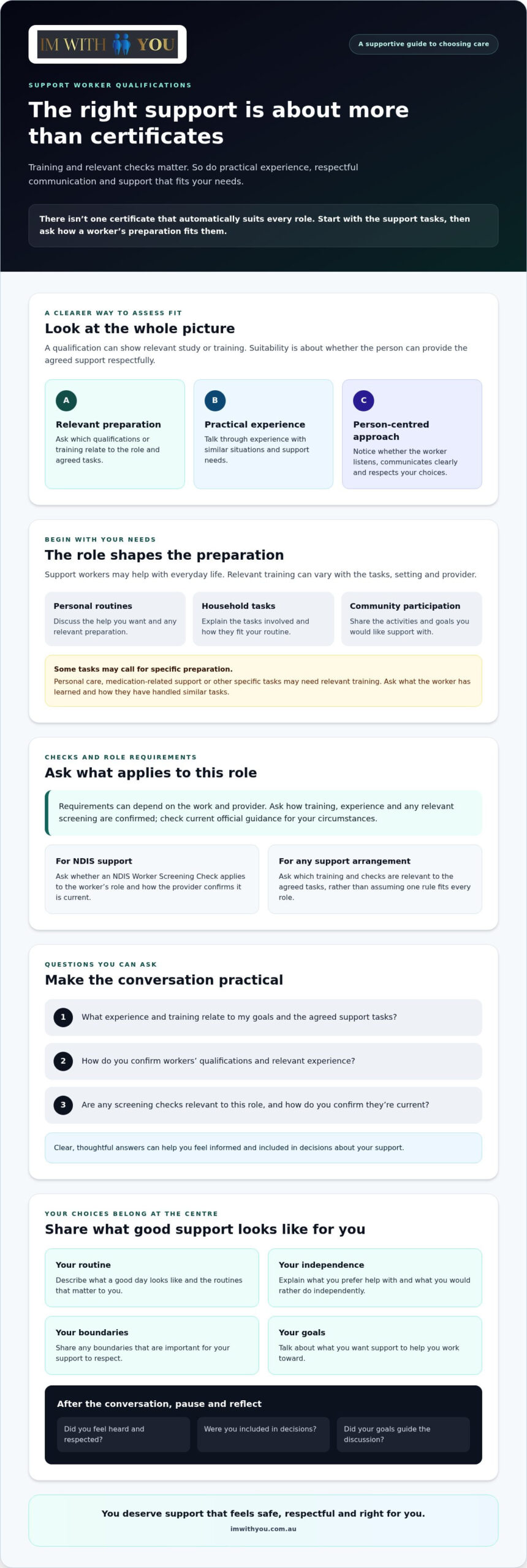
So, what qualifications should a support worker have? There isn’t one certificate that automatically suits every role. Relevant preparation can depend on the support tasks, setting and provider. Ask which qualifications or training apply to the support you’re considering, and check current official guidance for any requirements relevant to that role.
This video offers additional context about NDIS values and safeguards:
Is a formal certificate always required?
No single qualification should be treated as a universal measure of suitability. Formal study can build knowledge, while practical experience can help a worker respond to real situations. Respectful communication matters too: a worker should listen to your preferences and support your choices. Ask the provider how it confirms any role-specific requirements, training and experience, rather than relying on a certificate title alone.
A qualification shows relevant study or training; suitability means having the preparation, practical capability and approach to carry out the agreed support respectfully. That distinction can help you discuss what matters for your circumstances, without feeling you need to assess credentials on your own.
How to assess a support worker’s training, checks and practical skills
Start with the support you want, not a list of certificates. Describe the tasks involved, ask what training relates to them, then talk through the worker’s practical experience. This helps you assess whether their preparation fits your goals, rather than assuming one qualification covers every situation.
For example, personal care, medication-related support or other specific tasks may call for relevant preparation. Ask what the worker has learned and how they’ve handled similar tasks, while remembering that requirements can depend on the role and provider. If medication is part of the agreed support, this guide to the six rights of medication administration offers useful background for your discussion.
What questions can I ask before support begins?
You can ask direct, practical questions. For example:
- What experience and training relate to my goals and the agreed support tasks?
- How do you confirm workers’ qualifications and relevant experience?
- Are any screening checks relevant to this role, and how do you confirm they’re current?
For NDIS support, ask whether an NDIS Worker Screening Check applies to the worker’s role. Requirements depend on the work and provider, so check current official guidance for your circumstances rather than assuming the same rule applies to everyone.
Notice how clearly the provider answers, too. A thoughtful explanation can help you feel informed and included in decisions about your support. If you’re exploring options, you can discuss disability support with Im with you and explain what matters to you.
Choose a support worker who respects your goals, preferences and dignity
Qualifications and checks can help you understand a worker’s preparation, but they’re only part of choosing support. Pay attention to how the person communicates, whether they follow through on agreed arrangements, and how they respond to your choices. Feeling comfortable asking questions and expressing preferences matters too.
Before support begins, share what a good day looks like for you. You might explain your usual routine, what you prefer help with, what you’d rather do independently, and any boundaries that are important to you. Notice whether the provider listens carefully, asks thoughtful questions and explains how your preferences can inform the agreed support.
How can I tell whether a support worker is the right fit?
After a conversation, reflect: did you feel heard and respected? Were you included in decisions, and did the discussion leave room for your goals to guide the support? You don’t need to have every answer straight away. It’s reasonable to ask for clarification or raise a concern if something doesn’t feel right.
The way a provider speaks with you can offer clues about the relationship they aim to build. Respectful language should recognise you as a person with your own choices, strengths and priorities. You can read more about broader questions to consider in this guide to choosing an NDIS provider.
If you’re still asking what qualifications should a support worker have, keep your own needs at the centre of the conversation. Im with you provides disability support, community participation and advocacy across Australia. If you’d like to explore what may suit you, you can talk with Im with you about support at your own pace.
Take the next step towards support that feels right
Choosing a support worker isn’t about finding one certificate that answers every question. The right preparation depends on the agreed support, and a good decision also considers practical experience, clear communication and respect for your choices. You’re entitled to explain what matters to you and ask how support can align with your goals.
If you’re still asking what qualifications should a support worker have, use that question to start an open conversation about the tasks, relevant training and the kind of relationship you want. Im with you provides disability support and advocacy nationally across Australia, and you can explore whether its support may suit your circumstances.
Talk with Im with you about support that fits your goals. You can take the conversation at your own pace, with your preferences at the centre.
Frequently Asked Questions
Do support workers in Australia need a formal qualification?
There isn’t one qualification to assume applies to every support worker or task. Relevant training can depend on the role, the support being provided and current requirements. Ask the provider what preparation is relevant to your agreed support and how it confirms credentials. If you’re unsure whether a particular qualification is required, check current official guidance before relying on that claim.
Is a Certificate III required to work as a support worker?
Don’t assume a Certificate III is mandatory for every support worker role. Qualification expectations may depend on the employer, duties and current rules. If you’re asking what qualifications should a support worker have for your circumstances, ask which training relates to the support you need. Request clarification from the provider or an official source before treating a particular certificate as a requirement.
What checks should I ask about when choosing a support worker?
Ask how the provider confirms a worker’s identity and relevant experience, and whether screening applies to their role. Requirements can vary with the circumstances and current rules, so a general checklist shouldn’t be treated as legal advice. You can also ask how the provider supports safe, respectful and consistent care, and where to find reliable information about any role-specific checks.
What personal qualities should a support worker have?
Look for someone who listens, communicates clearly and respects your choices, privacy and boundaries. Reliability and a willingness to understand your goals matter too. A certificate can’t tell you everything about the working relationship. Notice whether you feel comfortable asking questions, sharing your preferences and helping shape how support works for you. It’s reasonable to expect the conversation to feel respectful and collaborative.