

Independence is rarely a solo achievement; it’s a collaborative masterpiece. When you’re managing the complexities of a disability, the world can feel incredibly small and isolating. I’ve seen how easy it’s to become skeptical about whether long-term support can truly make a difference in your daily life. However, the legacy of helen keller reminds us that even the deepest silence and darkness can be transformed through the right partnership. She didn’t just overcome her circumstances; she redefined what’s possible for millions. Her journey isn’t just a story from the past; it’s a living blueprint for how we approach advocacy and capacity building today.
I’m with you in this journey, and I want to help you see that your path to empowerment doesn’t have to be a lonely one. This article explores how Keller’s transition from isolation to global advocacy provides a clear roadmap for modern disability support. We’ll look at the vital role of dedicated companionship, find practical parallels for your own NDIS support journey, and see how expert advocacy continues to change outcomes in 2026. From her 1904 graduation to the newest digital accessibility standards—a field where specialist consultancies like IntegraSense provide expert guidance—her story offers a steady hand to guide us toward a more inclusive future.
Key Takeaways
- Learn how the historic journey of helen keller from isolation to earning her degree in 1904 proves that tailored communication is the foundation of true independence.
- Discover how dedicated advocacy and steady companionship can dismantle social myths and open new doors to meaningful community participation.
- Find practical management strategies for handling a new diagnosis or plan transition by focusing on capacity building as a long-term roadmap.
- Understand the power of a person-centered support network and how it can turn overwhelming challenges into a shared path toward dignity and growth.
- I’m with you as you explore these lessons to ensure you feel supported and empowered while navigating the complexities of your own support journey.
The Life of Helen Keller: From Isolation to Connection
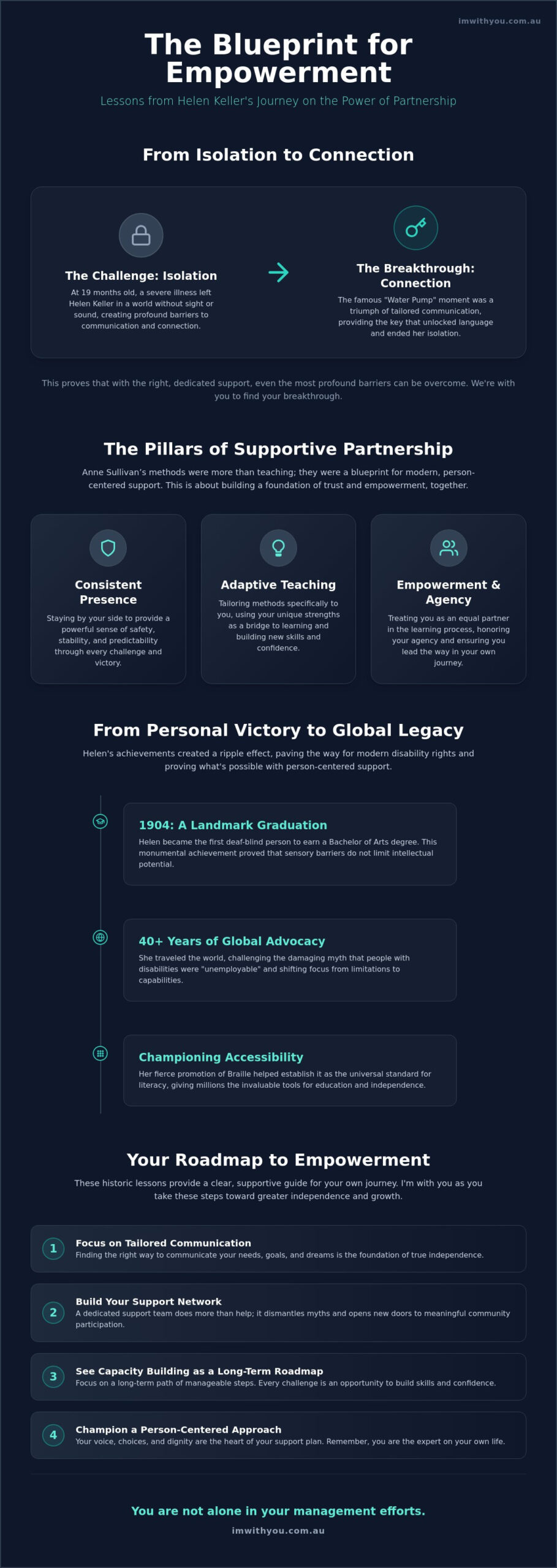
Most people know helen keller as a historical icon, but her life is a profound testament to what happens when specialized expertise meets human connection. She made history in 1904 as the first deaf-blind person to earn a Bachelor of Arts degree. This achievement didn’t happen in a vacuum. It was the result of a partnership that began with the famous “Water Pump” moment. While some call it a miracle, I see it as a triumph of tailored communication. It was the exact moment when the barrier of isolation was breached by a companion who refused to give up.
To better understand this breakthrough, watch this helpful video:
The Early Years and the Breakthrough
At just 19 months old, a severe illness left Helen without sight or hearing. For a long time, her world was a confusing puzzle. When we look back at her story, it’s helpful to use person-first language to honor her agency rather than focusing solely on her diagnosis. You can find a comprehensive biographical overview of her early struggles and triumphs that shows how she navigated these challenges. At “Im with you,” I believe no one should have to live in silence or isolation. I’m with you in the belief that every person deserves to be heard and understood.
The Power of Dedicated Companionship
Anne Sullivan was much more than a teacher; she was a lifelong companion. Her specialized industry expertise allowed her to lower the barriers that kept helen keller from learning. Sullivan’s approach was defined by several key elements:
- Consistent Presence: She stayed by Helen’s side for decades, providing a sense of safety and predictability.
- Adaptive Teaching: She tailored her methods to Helen’s specific sensory needs, using touch as a bridge to language.
- Empowerment: She focused on Helen’s agency, treating her as a partner in the learning process rather than a patient.
This mirrors how modern disability support services function today. We provide that same steady guidance and capacity building to help you reach your own milestones. Sullivan’s dedication proves that with the right partner, the “impossible” becomes a series of manageable steps.
Helen Keller’s Advocacy: A Blueprint for Modern Disability Rights
The advocacy of helen keller didn’t stop at her own doorstep. She spent over 40 years traveling the world to challenge the damaging myth that people with disabilities were “unemployable.” Through her tireless efforts and global tours, she shifted the public focus from what people couldn’t do to what they could achieve with the right support. Much of Helen Keller’s advocacy work with the American Federation for the Blind was centered on creating a world where accessibility wasn’t a luxury but a right. Just as she fought to open doors for others, I’m with you in every step of your own advocacy journey.
Breaking Barriers in Education and Employment
In 1904, she graduated cum laude from Radcliffe College. This wasn’t just a personal victory; it was a landmark for capacity building. It proved that sensory barriers don’t limit intellectual potential. She became a fierce proponent of Braille, helping to establish it as the universal standard for literacy and accessibility. Her success showed the world that with specialized tools, individuals can thrive in higher education and the workforce. It dismantled the idea that disability meant a lack of productivity.
Today, these specialized tools have evolved to include high-quality optical aids. For many Australians, Australian Made Vision offers the precision lenses necessary to overcome visual barriers and maintain independence in their daily lives.
From Historical Activism to Modern Advocacy
Today, her legacy is woven into the very fabric of systems like the NDIS. We’ve moved away from institutionalization toward models that prioritize individual agency. This includes a better understanding intellectual disability and sensory impairments, allowing for more nuanced support than ever before. Her activism paved the way for the modern right to supported independent living, ensuring that people can live with dignity in their own communities. If you’re looking for guidance on how these rights apply to your situation, I’m here to help you explore your advocacy options. We believe your voice matters just as much now as hers did then.
Empowerment Strategies: Management Lessons from Keller’s Journey
Managing a new diagnosis or a complex plan transition can feel like standing at the edge of a deep, quiet woods. It’s natural to feel a sense of overwhelm. However, the life of helen keller shows us that the right management strategy can light the way forward. Her success wasn’t just about her grit; it was about the deliberate capacity building she engaged in every day. By focusing on long-term independence rather than short-term management, you can start to see yourself as the primary advocate for your own quality of life.
Much of her early progress was rooted in her education at Perkins School for the Blind, where she first learned that her voice had power. When we look at her journey, we see a roadmap for handling today’s responsibilities with a positive, strength-based perspective.
Building a Support Network That Works
Creating a support network that actually works for you is a vital first step in your management journey. I’ve found that the most effective networks follow a clear, collaborative path:
- Identify your “Anne Sullivan”: Look for NDIS Support Coordination that truly understands your unique goals and walks beside you as a steady companion.
- Focus on communication: Whether it’s Braille, AAC, or simple sign, having the right tools reduces the frustration of being misunderstood and keeps your agency at the center.
- Prioritize joy: Don’t forget to include leisure activities and community participation in your plan. These aren’t just extras; they are the heart of social inclusion.
Resilience and Management in Daily Life
Resilience is the ability to adapt your support strategies when your circumstances or needs change. During difficult NDIS reviews, I encourage you to stay focused on your personal growth and the partnerships that empower you. It’s about looking at what’s possible rather than what’s missing. I’m with you as you navigate these complex systems, providing the specialized expertise you need to feel secure.
You’re the author of your own story. helen keller proved that even when the world seems silent, a person can write a legacy that changes how we all see disability. We’re simply here to be your steady companions as you write your next chapter.
Embrace Your Path to Empowerment
The story of helen keller isn’t just a historical record; it’s a living invitation to redefine what’s possible in your own life. We’ve explored how the right partnership can break through the deepest isolation and how dedicated advocacy transforms society’s expectations. By focusing on capacity building and choosing a support network that truly understands your goals, you’re doing more than just managing a plan. You’re authoring a future defined by dignity, connection, and growth.
I’m with you as you navigate these important steps. As a national NDIS provider and 2026 Excellence Award winner, I’m committed to providing the person-centered advocacy and support you deserve. You don’t have to face the complexities of the support system alone. Whether you’re refining your coordination or looking for new ways to engage with your community, I’m here to walk alongside you as a steady companion.
Let’s turn your personal goals into shared milestones. You have the inherent strength to lead your journey, and I have the specialized expertise to ensure you feel secure every step of the way. Find a companion for your journey with our Disability Support Services.
Frequently Asked Questions
How did Helen Keller communicate if she was both deaf and blind?
Helen primarily used tactile sign language to bridge the gap of her sensory impairments. This involved a specialized method where a companion finger-spelled words directly into her palm. She also became proficient in Braille and Tadoma, which is the process of feeling the vibrations of a person’s speech. I’m with you in the belief that finding the right communication tools is the first step toward reclaiming your independence and reducing daily frustration.
What was Helen Keller’s greatest achievement for the disability community?
Her most significant achievement was shifting the global narrative from pity to empowerment. By becoming the first deaf-blind person to earn a Bachelor of Arts degree in 1904, helen keller proved that sensory impairments don’t limit intellectual capacity. She spent over 40 years advocating for accessibility and employment rights. Her work laid the foundation for the modern belief that everyone deserves a seat at the table in their community.
How did Anne Sullivan help Helen Keller learn her first word?
Anne used a method of physical association to help Helen understand that everything has a name. During the famous “Water Pump” moment, she held Helen’s hand under a stream of cold water while spelling the letters W-A-T-E-R into her other palm. This breakthrough transformed a simple sensation into a meaningful concept. It highlights the importance of having a steady companion who uses specialized expertise to unlock your unique potential.
Is Helen Keller’s story still relevant for NDIS participants today?
Her story is incredibly relevant because it highlights the transformative power of capacity building and person-centered support. Her life proves that with the right advocacy, barriers to education and community participation can be dismantled. I’m with you in every step of your NDIS journey, ensuring you have the steady guidance needed to reach your milestones. helen keller and her legacy remind us that every individual has the right to lead an empowered life.