

What if taking a break wasn’t just a luxury for you, but a vital part of your loved one’s journey toward independence? I know the guilt of needing a rest often feels just as heavy as the burnout itself. It’s especially hard when you’re anxious about finding the right ndis respite care support worker who truly understands your family’s unique needs. You might feel overwhelmed by the 2026 pricing updates or confused by the shift toward unbundled costs. Im with you, and I want you to know that you don’t have to carry this weight alone.
I’ve created this guide to help you move through the steps of securing Short Term Accommodation (STA) funding while ensuring your loved one receives the warm, dignified care they deserve. We’ll explore how to meet the “reasonable and necessary” requirements and how specialized support coordination can simplify the path forward. You’ll gain a clear roadmap to turn a period of rest into a positive growth opportunity for everyone in your home.
Key Takeaways
- Learn how Short Term Accommodation (STA) acts as a restorative circuit breaker to sustain your home care arrangement for the long term.
- Discover the step-by-step management strategy for requesting respite funding, including the vital role of carer impact statements in your NDIS plan meeting.
- Find out how to choose an ndis respite care support worker who aligns with your family’s values through person-first language and clear safety standards.
- Explore how NDIS Support Coordination can simplify the process of unlocking funding and navigating the 2026 pricing arrangements.
- Understand the 28-day standard limit for STA and how advocacy services can support you if your current plan feels insufficient.
Understanding Short Term Accommodation and Your Eligibility
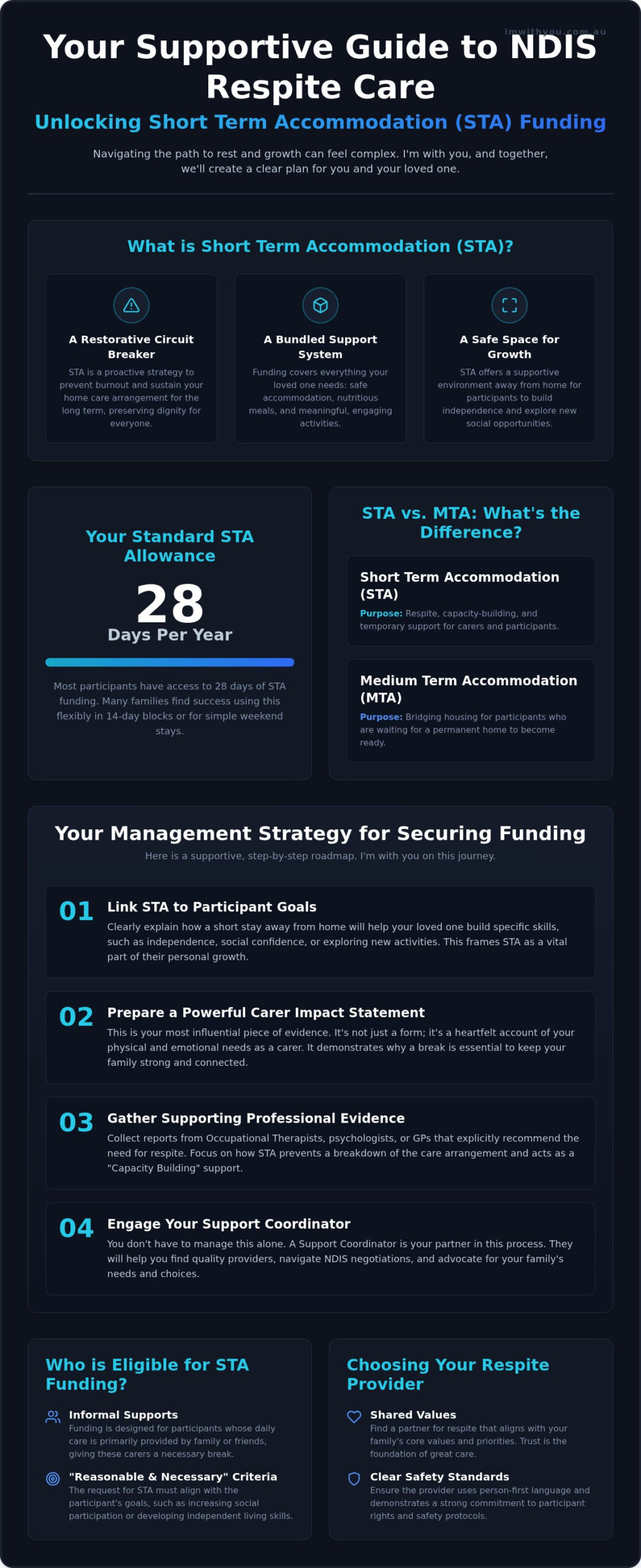
Short Term Accommodation (STA) isn’t just a clinical service; it’s a bundled support that creates a safe space away from home. This funding covers your accommodation, nutritious meals, and meaningful activities in a supportive environment. I’m with you in recognizing that choosing to use respite isn’t a sign of struggle. It’s a proactive management strategy that preserves the dignity of both the participant and the carer. By acting as a “circuit breaker,” STA helps maintain your home care arrangement for the long term.
Under the National Disability Insurance Scheme (NDIS), most participants have a standard limit of 28 days of STA funding per year. Families often find success by using these days in 14-day blocks or simple weekend stays. During this time, a dedicated ndis respite care support worker ensures that your loved one is safe, engaged, and supported in their daily routines.
To help you feel confident in the standards of care and participant rights you should expect, watch this helpful video:
Who is eligible for Short Term Respite?
To access this funding, the NDIS looks for “informal supports” like family or friends who provide the majority of daily care. The goal is to give these carers a necessary break to prevent exhaustion and burnout. Eligibility also hinges on the “Reasonable and Necessary” criteria. We focus on how respite helps meet personal goals, such as social participation and exploring what are leisure activities in a new, stimulating environment.
STA vs. Medium Term Accommodation (MTA)
It’s easy to confuse these terms, but their purposes are quite different. STA is focused on respite, capacity building, and temporary support. In contrast, Medium Term Accommodation (MTA) is bridging housing for those waiting for a permanent home, such as Specialist Disability Accommodation. Selecting the right category is vital for your budget management. It ensures you don’t face funding shortfalls when you and your family most need a break.
Practical Steps to Accessing STA Funding in Your Plan
Securing the right funding often feels like a steep climb; I’m with you as you prepare for this journey. To get Short Term Accommodation (STA) into your plan, you’ll need to present a clear management strategy during your NDIS plan meeting or reassessment. Start by identifying how respite directly supports your loved one’s specific goals. For instance, for a participant with an intellectual disability, STA can be a powerful tool for building independence and social confidence away from the family home. You should also refer to the NDIS operational guidelines for STA to ensure your request aligns with the current “Reasonable and Necessary” standards.
The most influential piece of evidence you can provide is a ‘carer impact statement’. This document isn’t just about administrative facts; it’s a heartfelt account of your physical and emotional needs. It demonstrates why a break is essential to keep your family strong and connected. If you feel your current plan doesn’t reflect these needs, our advocacy services can help bridge the gap between your daily reality and NDIS approval.
Preparing Evidence for the NDIS
Gathering the right paperwork is a vital part of the process. You’ll need supporting reports from Occupational Therapists, psychologists, or GPs that explicitly mention the need for respite. A successful application focuses on how respite prevents a total breakdown of the primary caregiving relationship. When you frame STA as a “Capacity Building” opportunity, the NDIS is more likely to fund it as a way for the participant to develop new skills under the care of a dedicated ndis respite care support worker.
The Role of Support Coordination and Advocacy
You don’t have to manage the administrative burden alone. Support Coordination is a key resource that helps you identify high-quality respite providers who match your family’s values. Your coordinator acts as a steady companion, advocating for your dignity and choice during funding negotiations. They ensure that every hour of support is used effectively to give you peace of mind while your loved one enjoys a positive, growth-focused experience.
Choosing Your NDIS Respite Care Support Worker and Provider
Finding the right partner for respite is a deeply personal task that requires trust and shared values. I’m with you in wanting the absolute best for your loved one. When you explore how to choose an NDIS provider, look for organizations that prioritize empathy and transparency. Using person-first language during your initial interviews helps set a tone of mutual respect. It ensures your ndis respite care support worker sees the individual’s personality and strengths before their disability. You can also refer to the NDIS Short-Term Accommodation Guideline to understand the service standards you should expect from any reputable provider.
Organizing a “meet and greet” is a vital management strategy to lower anxiety. This session allows the participant to bond with their support worker in a familiar setting before the stay begins. It turns a potentially scary transition into a collaborative partnership between your family and the care team.
What to Look for in a Quality Respite Stay
A high-quality stay should offer more than just basic supervision. Prioritize providers who facilitate meaningful engagement and activities that align with the participant’s interests. Safety is the foundation of a good experience. Ensure the provider follows strict protocols, including the six rights of medication administration. This level of clinical expertise provides the peace of mind you need to truly recharge while you’re away.
Managing the Transition and Continuity of Care
To ensure a smooth transition, create a detailed “care profile” for the provider. This document should outline daily routines, communication styles, and specific preferences. It helps the ndis respite care support worker maintain a sense of continuity and safety. Always focus on the participant’s agency. When they choose their own activities and outings, the stay feels like a joyful holiday rather than a clinical requirement. This positive focus makes future respite stays something to look forward to for everyone involved.
Embracing a Sustainable Path for Your Family
Accessing Short Term Accommodation is a powerful way to protect your well-being and foster independence for your loved one. By preparing strong evidence and finding a compassionate ndis respite care support worker, you’re building a foundation for long-term health and happiness. I’m with you in the belief that every carer deserves a moment to breathe and every participant deserves a chance to explore new horizons in a safe, supportive environment.
For carers who choose to use their respite period for a well-deserved trip abroad, you can check out Always Mobile for affordable international eSIM data plans to stay connected while you recharge.
Navigating plan reviews or seeking the right funding can feel daunting, but you don’t have to do it alone. As specialists in NDIS Support Coordination and Advocacy, we provide the expert guidance needed to simplify the most complex systems. Having been awarded for Excellence in care in 2026, we’re dedicated to person-centered support for families across Australia. Let us walk alongside you; explore our NDIS Support Coordination and Advocacy services today.
You’ve already taken the hardest step by seeking information. Now, let’s work together to turn that knowledge into a restorative reality for your home. You’re doing an incredible job, and a little support can make all the difference.
Frequently Asked Questions
Is Short Term Accommodation (STA) the same as respite care?
Short Term Accommodation (STA) is the official term used by the NDIS to describe what many families traditionally call respite care. While the names differ, the purpose is identical: providing a supportive environment away from home for a participant. This bundled funding covers your accommodation, meals, and the care provided by an ndis respite care support worker. I’m with you in making sure you feel confident using the right terminology during your plan meetings.
Can I use my Core Supports budget for STA if it is not specifically listed in my plan?
You can often use your Core Supports budget for STA even if it isn’t explicitly named as a line item in your plan. The NDIS designed Core funding to be flexible so you can manage your supports as your needs change. As long as the stay is “reasonable and necessary” and helps you achieve your stated goals, you can allocate your budget here. I’m with you in navigating these flexible options to ensure your family gets the rest you need.
What happens if I need more than 28 days of respite in a single year?
While the standard limit is 28 days per year, you can request additional funding if your situation is particularly complex. The NDIS may approve more days if there is a documented risk of a primary caregiving relationship breaking down without extra support. You’ll need strong evidence from your therapists or doctors to justify this extension. I’m with you in advocating for the extra care you need to keep your home environment stable and safe.
Does the NDIS pay for my travel costs to and from the short term accommodation?
The NDIS typically doesn’t cover the cost of a participant’s travel to and from the STA facility within the bundled rate. These costs are usually considered an everyday living expense that you’d need to manage yourself. However, if your ndis respite care support worker needs to travel with you to provide care, some transport funding in your plan might apply. It’s always best to check your specific plan details or speak with your support coordinator to clarify your transport budget.