

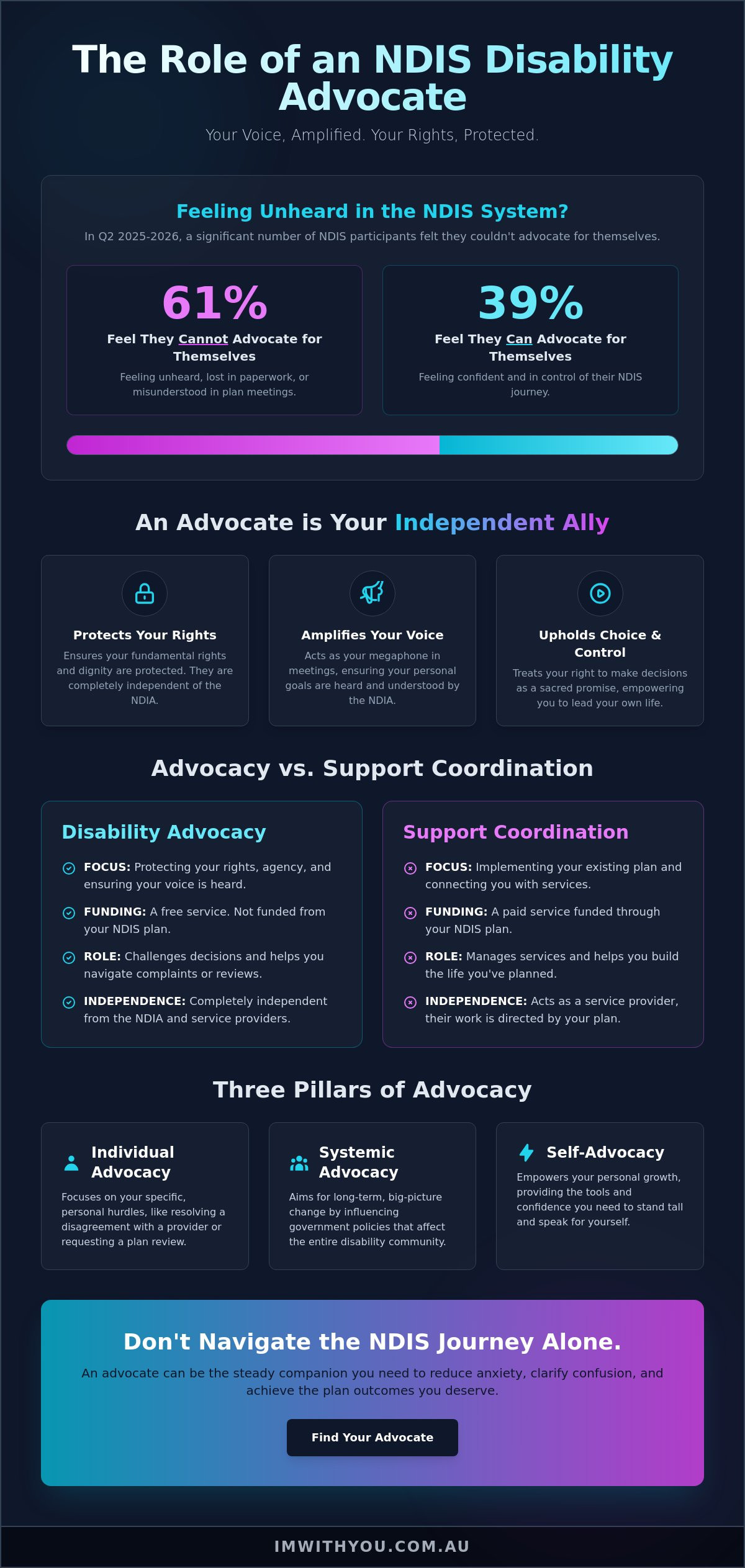
Did you know that in the second quarter of 2025-2026, only 39% of NDIS participants aged 15 to 64 felt they could advocate for themselves? This means more than 60% of people are left feeling unheard or lost in a sea of complex paperwork. It’s exhausting to constantly push for the support you deserve while trying to keep up with major changes like the NDIS Amendment Act 2026. We understand that the pressure of a plan meeting can feel heavy, especially when you’re worried your goals might be misunderstood by the NDIA.
In this article, you’ll discover how the role of an ndis disability advocate empowers you to navigate these hurdles with confidence. We’ll show you how an independent advocate ensures your rights are protected and your Choice and Control remains a sacred promise rather than just a policy term. We’re going to explore how an advocate stands side-by-side with you to reduce meeting anxiety, explain the latest 2025-2026 pricing arrangements, and help you achieve the successful plan outcomes you need to live your life your way.
Key Takeaways
- Understand how an independent advocate stands beside you to ensure your voice is always heard and your fundamental rights are protected.
- Discover the role of an ndis disability advocate in representing your personal goals during planning meetings and reviews to ensure your plan is fair.
- Learn the vital difference between support coordination, which helps implement your plan, and advocacy, which is a free service focused on your agency.
- Identify how to choose a supportive partner who values your Choice and Control and only takes action with your explicit permission.
What is the Role of an NDIS Disability Advocate?
The role of an ndis disability advocate is to be the steady companion who ensures your voice never gets lost in the noise of bureaucracy. Think of them as a professional partner who stands beside you, solely focused on your needs and wishes. Unlike government officials, advocates are completely independent of the NDIA and the NDIS Quality and Safeguards Commission. This independence is vital because it removes any conflict of interest, allowing your advocate to challenge decisions or speak up against service providers without hesitation. With 19.4% of people in New South Wales living with a disability, the need for clear, person-centered support is a reality for many families. Understanding the landscape of Disability in Australia helps us see why having a dedicated ally is so essential for protecting your dignity.
To better understand this concept, watch this helpful video:
At its heart, advocacy is about balance. The NDIS system can often feel like it’s built around processes rather than people. Your advocate’s core mission is to flip that script. They work to ensure you remain the primary decision-maker in your own life, upholding your right to Choice and Control. We treat Choice and Control as a sacred promise. An advocate is the guardian of that promise, helping you handle difficult situations while keeping your goals front and center. They don’t take over your life; they empower you to lead it.
The Different Types of Advocacy
Advocacy isn’t a one-size-fits-all service. Individual advocacy focuses on your specific hurdles, such as resolving a disagreement with a provider or requesting a plan review. Systemic advocacy aims for long-term change by influencing government policies that affect the whole community. Self-advocacy is about your personal growth. It provides the tools and confidence you need to stand tall and speak your truth. Regardless of the type, the goal remains the same: keeping you at the heart of every decision made about your support.
How an Advocate Supports Your NDIS Journey
The NDIS journey often feels like a puzzle where the pieces don’t quite fit. An advocate helps you see the whole picture by explaining your rights under the NDIS Act and international human rights standards. This knowledge is your foundation. It’s much easier to stand your ground when you understand the legal protections designed to keep you safe. A key part of the role of an ndis disability advocate is ensuring that your personal goals aren’t just listed on paper but are truly heard during planning meetings. They act as your megaphone, making sure the NDIA sees the person behind the participant number.
They also help decode the technical jargon that can feel so alienating. By using person-first language, they ensure the conversation remains about your life and your strengths. If you’re unhappy with a service, they’ll walk beside you through the NDIS Commission’s complaint process. It’s helpful to understand the distinction of Advocacy vs. Support Coordination when you’re deciding what kind of help you need. While a coordinator manages your services, an advocate protects your agency within the system. If you feel stuck, you can always reach out to find a companion for your journey.
Practical Help in Difficult Moments
The role of an ndis disability advocate shines brightest during the most stressful times. Sometimes, the simple act of writing a letter to the NDIA feels like an impossible task when you’re already exhausted. Your advocate can take that weight off your shoulders by drafting correspondence that clearly states your needs. They might help you explore supported independent living ndis options if your current home no longer meets your needs. During administrative hearings or internal reviews, they provide a calm, non-judgmental presence. This steady support helps lower the barriers of anxiety, allowing you to focus on your future with clarity and hope.
Advocacy vs. Support Coordination: Understanding the Difference
It’s natural to feel confused about who does what when you’re building your support network. While both roles are here to help, they serve very different masters. Support Coordination is a service funded directly through your NDIS plan. Following the 2025-2026 Pricing Arrangements and Price Limits (PAPL), Level 1 Support Coordination rates increased by 3.95% on July 1, 2025. Because the NDIS pays for this service, a coordinator’s primary job is to help you implement your existing plan and connect with services. They are the architects who help you build the life you’ve planned.
The role of an ndis disability advocate is fundamentally different because it is free for you and funded externally. This total independence means they can challenge the NDIA or providers directly without any conflict of interest. While your coordinator manages the practical day-to-day details, your advocate acts as the guardian of your rights. They ensure the plan itself is fair and that the system respects your dignity. Both roles work together to create a holistic support network where your practical needs and your legal rights are equally prioritized. If you need help balancing these supports, we are here to stand with you.
When to Call a Support Coordinator
You should reach out to your coordinator when you need help with the “how” of your plan. They are experts at finding the right ndis provider options to fit your lifestyle. If you need to manage your budget or coordinate between different therapists, they’ll handle those connections. They make sure the funding in your plan translates into real-world support that helps you reach your goals.
When to Call an Advocate
An advocate is the right person to call when you feel the system isn’t listening. If you believe your intellectual disability is being misunderstood or undervalued by the NDIA, an advocate will help you articulate your needs. They are your best ally if you’re being treated unfairly by a provider or if you need to appeal a funding decision that limits your Choice and Control. They don’t just manage a plan; they protect your life.
Finding the Right Advocate to Stand With You
Choosing a partner for your NDIS journey is a deeply personal step that requires trust and mutual respect. You deserve an ally who listens to your story first and only takes action when you give your explicit permission. A vital part of the role of an ndis disability advocate involves having a professional grasp of NDIS standards and the Quality and Safeguards Commission. With the Integrity and Safeguarding Act 2026 strengthening the Commission’s powers as of April 9, 2026, your advocate must stay current to protect your interests effectively. We believe this relationship should always feel like a true partnership where someone walks side-by-side with you through every challenge.
A great advocate treats your Choice and Control as a sacred promise, ensuring you’re never pushed into decisions that don’t feel right. They provide the steady, human touch that makes the system feel less like a machine and more like a support network. By prioritizing your agency, they help you build the confidence to lead your own life while they handle the complex administrative weight in the background. It’s about finding a calm, capable friend who happens to be an expert in the field.
Where to Search for Advocacy Services
Finding local support is easier when you use the right tools. The Australian Government’s Disability Advocacy Finder is an excellent place to start your search for organizations in your area. We recommend checking if the organization is funded under the National Disability Advocacy Programme (NDAP), as these services are specifically designed to be independent and free of charge. These providers are experts at ensuring the NDIS serves the person, not just the process.
Our Commitment to Your Voice
At I’m With You, we believe every participant deserves to be heard and respected in every interaction. While we provide direct support to help you live your best life, we always encourage and facilitate access to independent advocacy whenever you feel your voice needs more strength. We aren’t here to lead from the front, but to walk beside you. Let us support your journey; connect with our compassionate team today.
Take Charge of Your NDIS Journey Today
You now understand that the role of an ndis disability advocate is to ensure your voice is never ignored during plan reviews or difficult meetings. By distinguishing advocacy from support coordination, you can build a team that truly protects your rights while managing your day-to-day services. Remember that your agency and dignity are the most important parts of this process. Finding an ally who listens first allows you to navigate the 2026 legislative changes with total confidence and peace of mind.
At I’m With You, we’re dedicated to walking side-by-side with you. Having been awarded for Excellence in Disability Support in 2026, our team provides national coverage across Australia with a deep commitment to your Choice and Control. We treat your independence as a sacred promise rather than a simple requirement. Discover how I’m With You stands beside you in your NDIS journey. Your future belongs to you, and we’re honored to support your path toward a life full of possibility, strength, and respect.
Frequently Asked Questions
Is a disability advocate free for NDIS participants?
Yes, independent disability advocates are free for you to use. They receive their funding through the National Disability Advocacy Programme (NDAP) or state government grants rather than your individual NDIS plan. This structure ensures they remain completely independent from the NDIA. You don’t have to worry about your core or capacity building budget being reduced to pay for their time. It’s a service designed to keep you at the center of every decision.
Can an advocate help me with my NDIS plan review?
Absolutely, an advocate can stand beside you during your NDIS plan review to ensure your goals are accurately captured. They help you prepare your evidence and can speak on your behalf if you feel overwhelmed during the meeting. Since the NDIS Amendment Act 2026 introduced new operational changes on May 6, 2026, having a companion who understands these rules helps you navigate the process with much less anxiety and better results.
What is the difference between a disability advocate and a lawyer?
An advocate focuses on supporting your voice and rights in daily NDIS interactions, while a lawyer provides formal legal representation in a court or tribunal. The role of an ndis disability advocate is to walk alongside you during planning and complaints to ensure your Choice and Control is respected. They help resolve issues through conversation and negotiation. Lawyers usually step in only for complex legal disputes or formal Administrative Review Tribunal hearings.
Can I change my disability advocate if I am not happy?
Yes, you have the right to change your advocate at any time if the partnership doesn’t feel right. Your Choice and Control is a sacred promise that extends to every person who supports you on your journey. If you don’t feel heard or respected, you can contact a different advocacy organization. Most people find that a successful journey starts with an advocate who truly understands their unique perspective and strengths.
Will having an advocate affect my NDIS funding?
Having an advocate will not reduce your NDIS funding because their services are funded separately from your individual plan. In fact, the role of an ndis disability advocate often helps you achieve better funding outcomes by ensuring the NDIA fully understands your functional capacity. They make sure the “reasonable and necessary” criteria are applied fairly to your specific life situation, ensuring you get the support you actually need to thrive.