

Imagine standing at the primary school gates, watching your child’s backpack bob up and down as they walk toward their first classroom. It’s a moment filled with immense pride, but for many families, it’s also clouded by the quiet worry that their child might not have everything they need to thrive. Navigating ndis transition to school support often feels like trying to read a map written in a different language while the clock is ticking toward that first bell.
We understand that the weight of complex jargon and the pressure to distinguish between school and NDIS responsibilities can feel heavy. You want your child to belong, not just attend, and it’s natural to feel protective of their experience. We’re here to promise that you don’t have to figure this out alone. This guide provides a clear, step-by-step path to help you gain the clarity and confidence you deserve.
We’ll walk through the latest November 24, 2025, pricing updates, explain how to use capacity building supports in the classroom, and share a timeline that ensures your child is supported from day one. Let’s start this new chapter together, side by side.
Key Takeaways
- Learn how the Early Childhood Approach (ECA) provides a gentle bridge for children under nine, ensuring they have the foundational skills needed for a confident start.
- Discover how to align your Support Coordinator, school staff, and therapists into a unified team that walks beside you every step of the way.
- Master the timeline for your ndis transition to school support by starting the planning process 12 months early to ensure every piece of evidence is ready for the first day.
- Identify specific ways to use NDIS funding for assistive technology and social capacity building that help your child form meaningful connections with their new classmates.
Understanding the NDIS Framework for School Transition
Starting primary school is one of the most significant milestones in your child’s life. We believe that ndis transition to school support acts as a vital bridge, connecting the specialized early intervention your child has received with the new environment of a formal classroom. This framework, governed by the National Disability Insurance Scheme (NDIS), ensures your child has the right tools to participate alongside their peers from day one.
For children under 9 years old, the Early Childhood Approach (ECA) remains the primary pathway for support. This approach focuses on intervention that builds your child’s functional capacity before they even step through the school gates. It’s a common misconception that NDIS funding stops once the school bell rings. In reality, your plan evolves to meet new challenges. It focuses on “reasonable and necessary” supports that address your child’s specific disability needs rather than their educational requirements, which are managed by the school system.
Watching how others have navigated this shift can offer great peace of mind. To better understand this concept, watch this helpful video:
The distinction between school and NDIS responsibilities is often where families feel the most confusion. While the school system is responsible for teachers, curriculum adjustments, and physical accessibility, the NDIS provides the personal supports your child needs to access that education. Under the Pricing Arrangements and Price Limits 2025-26, which took effect on 24 November 2025, these supports are clearly categorized to help you manage your budget effectively. Knowing how to use ndis transition to school support ensures no gap exists between home and the classroom.
Capacity Building vs. Core Supports for Schooling
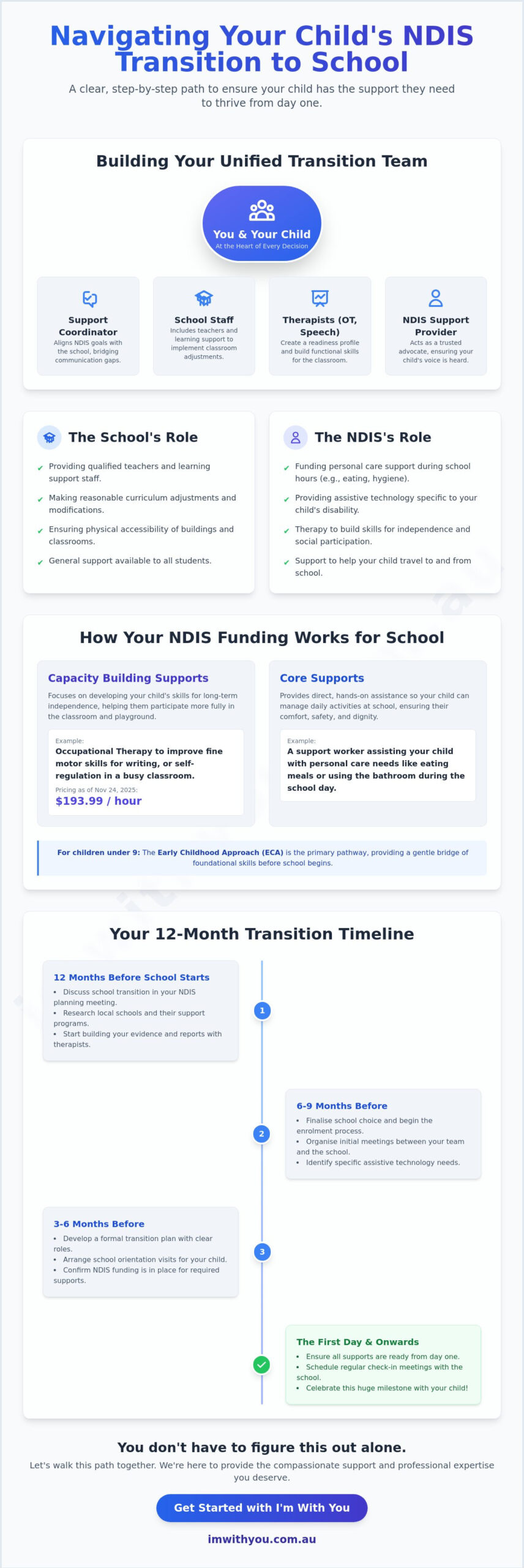
Capacity Building funding is often the heart of a successful school transition. It pays for professionals, such as Occupational Therapists at the $193.99 hourly rate, who help your child develop skills like self-regulation or fine motor control for writing. These are the skills that empower your child to be independent in their new environment. Core Supports focus on direct assistance. If your child needs help with personal care, such as eating or hygiene during school hours, Core funding provides the support worker necessary to ensure their dignity and comfort throughout the day.
Building Your Transition Team: Who Walks Beside You?
Transitioning to primary school doesn’t happen in a vacuum. It’s a collaborative process where you hold the map and we provide the compass. Your team includes your family, school staff, NDIS partners, and your chosen support provider. This collective effort ensures that your child’s ndis transition to school support isn’t just a series of meetings, but a holistic wrap-around service that centers on your child’s happiness. We believe that when everyone works together, the path becomes much smoother for your little one.
Early communication with your Support Coordinator is the first step toward aligning your child’s NDIS goals with the realities of the classroom. They help bridge the gap between the NDIS and schools, ensuring everyone understands where one responsibility ends and another begins. Therapists like Occupational Therapists and Speech Pathologists also play a critical role. They create a school readiness profile that highlights your child’s strengths. This profile identifies where they might need a little extra help to feel confident in a busy playground or a quiet library.
Remember, you have total Choice and Control over who joins this circle. You decide which experts align with your family’s values and your child’s personality. If you’re feeling unsure about the next steps, reaching out to a compassionate support partner can provide the steady guidance you need to feel secure.
The Role of an NDIS Support Provider
A dedicated provider like I’m With You brings a gentle, human touch to what can sometimes feel like a clinical process. We don’t just manage boxes on a form; we act as a trusted advocate to ensure your child’s voice is heard by the school. Our role is to stand beside you, offering the professional expertise and emotional reassurance that lowers the barriers of stress during this big life change.
Collaborating with Early Childhood Partners
Your journey often starts with an Early Childhood Approach (ECA) partner who helps manage plans for children under age 9. During your initial planning meeting, it’s vital to speak openly about your school transition goals so they can allocate the right funding. The partnership between ECA partners and private providers is a collaborative ecosystem where shared expertise creates a stronger safety net for your child.
How to Create a Personalised Transition Plan
Starting the journey toward big school is a marathon, not a sprint. We recommend beginning your preparations at least 12 months before the first day of school. This lead time allows you to breathe and ensures your ndis transition to school support is robust and ready. It’s about gathering a library of evidence. You’ll need current medical reports, therapist assessments, and the official ‘Transition to School Statement’ to paint a clear picture of your child’s needs for both the NDIS and the education department.
Setting SMART goals in your NDIS plan is crucial during this phase. These goals should target school-based independence, such as opening a lunchbox or following three-step instructions. While it might seem early to think so far ahead, these foundational steps are part of the long-term journey of building skills for employment and independence later in life. Every small win in the playground is a step toward a more autonomous future. We want to ensure your child isn’t just surviving the classroom but thriving within it.
Step-by-Step: The 12-Month Countdown
Months 12-9: Look closely at your current NDIS plan. Does it have enough capacity building funding for school-readiness? This is the time to request a plan review if your goals need to shift toward the classroom environment.
Months 9-6: Start visiting potential schools. If your child has an intellectual disability, share their profile early. This transparency helps the school prepare their own support structures well in advance of the first term.
Months 3-0: Focus on the final logistics. Confirm your personal care supports and finalize any specialized transport arrangements. Organize orientation visits that focus on your child’s sensory needs, such as finding the quietest spot in the library or the loudest part of the playground. If you’re feeling overwhelmed by the timeline, we can help you organize your transition plan today.
Leveraging NDIS Supports for Long-Term School Success
The first day of school is a beautiful milestone, but it’s only the beginning of a much larger adventure. We see the ndis transition to school support process as an ongoing journey of capacity building rather than a one-off event. Long-term success involves more than just getting through the classroom door; it’s about ensuring your child feels a deep sense of belonging and social inclusion. By using community participation supports, your child can build the social skills and confidence needed to form lasting friendships on the playground.
Assistive technology also plays a vital role in keeping your child engaged with their learning. Whether it’s specialized seating or communication software, NDIS funding can provide the tools that make the curriculum accessible. Because your child will grow and change rapidly during these early years, regular plan reviews are essential. We recommend a formal check-in every 12 months to ensure your supports align with your child’s evolving goals and classroom needs. At I’m With You, we pride ourselves on being a steady companion throughout this entire primary school journey, standing beside you as new challenges and triumphs emerge.
Promoting Independence and Dignity
Creating a truly supportive environment starts with the way we communicate. Encouraging the use of person-first language at school ensures that staff and peers see your child’s unique personality before their disability. This respect for identity goes hand-in-hand with capacity building for daily life. We focus on helping your child master self-care skills, such as dressing for physical education or managing their own mealtime. These small acts of independence foster the dignity and self-esteem your child needs to thrive in a busy school setting.
Ongoing Advocacy and Support Coordination
The first term of school often brings a mix of excitement and unexpected hurdles. We stay “with you” through these initial months to ensure your NDIS supports and school adjustments work in perfect harmony. It’s common for families to feel like they’re caught between two different systems, but our advocacy ensures these services don’t operate in silos. We help facilitate communication between your therapists and teachers, making sure everyone is on the same page to support your child’s holistic growth and happiness.
Walking Toward the School Gates Together
The path toward primary school is filled with both excitement and big questions. We’ve explored how understanding the NDIS framework and starting your 12-month countdown can turn uncertainty into a clear, manageable plan. By building a team of experts and focusing on your child’s social inclusion, you ensure they have the tools to thrive. Your child’s ndis transition to school support is more than just a plan; it’s a promise of independence and belonging.
At I’m With You, we bring our 2026 Award for Excellence in Disability Care to every conversation. Our expert NDIS Support Coordination and compassionate, person-centered advocacy are designed to lower your stress and keep the focus on your child’s joy. You don’t have to navigate these complex systems alone. Let us walk beside you on your child’s school journey—contact our team today. We’re here to help you turn that first day into a beautiful, confident start for your whole family.
Frequently Asked Questions
What NDIS funding categories can I use for school transition?
You can primarily use the “Improved Daily Living” and “Assistance with Daily Life” categories for your ndis transition to school support. “Improved Daily Living” covers the professional therapists who build your child’s skills, while “Assistance with Daily Life” handles personal care needs. These categories ensure your child has the functional independence required to navigate a busy school environment while keeping their dignity intact.
Does the NDIS pay for support workers to be in the classroom with my child?
The NDIS typically doesn’t fund support workers for educational tasks, as this falls under the responsibility of the state education system. However, the NDIS may fund a support worker for non-educational personal care tasks, such as specialized feeding or toileting, that the school isn’t required to provide. It’s a delicate balance that ensures your child receives holistic care without duplicating services already provided by the school.
When should I start talking to my NDIS coordinator about starting school?
We recommend starting the conversation with your NDIS coordinator at least 12 months before the first term begins. This 365 day lead time is essential for scheduling plan reviews and collecting the necessary therapist reports. Starting early ensures your funding is locked in well before orientation days, giving you the peace of mind to focus on your child’s emotional readiness rather than paperwork.
What happens if my child’s NDIS plan doesn’t have enough funding for school support?
If your current plan lacks the necessary funds for school-based needs, you can submit a “Change of Circumstances” application to the NDIA. You’ll need to provide evidence from your child’s therapists showing that the transition to school creates a new, significant need for support. We can stand beside you during this process to help gather the documentation required to demonstrate why these additional supports are reasonable and necessary.
Can NDIS funding be used for school uniforms or specialized stationery?
NDIS funding can’t be used for everyday costs like school uniforms, standard stationery, or tuition fees. These are considered general parental expenses that every family in Australia must meet. However, the NDIS may fund specialized assistive technology, such as modified keyboards or sensory tools, if they’re directly related to your child’s disability and aren’t something a school would typically provide for all students.