

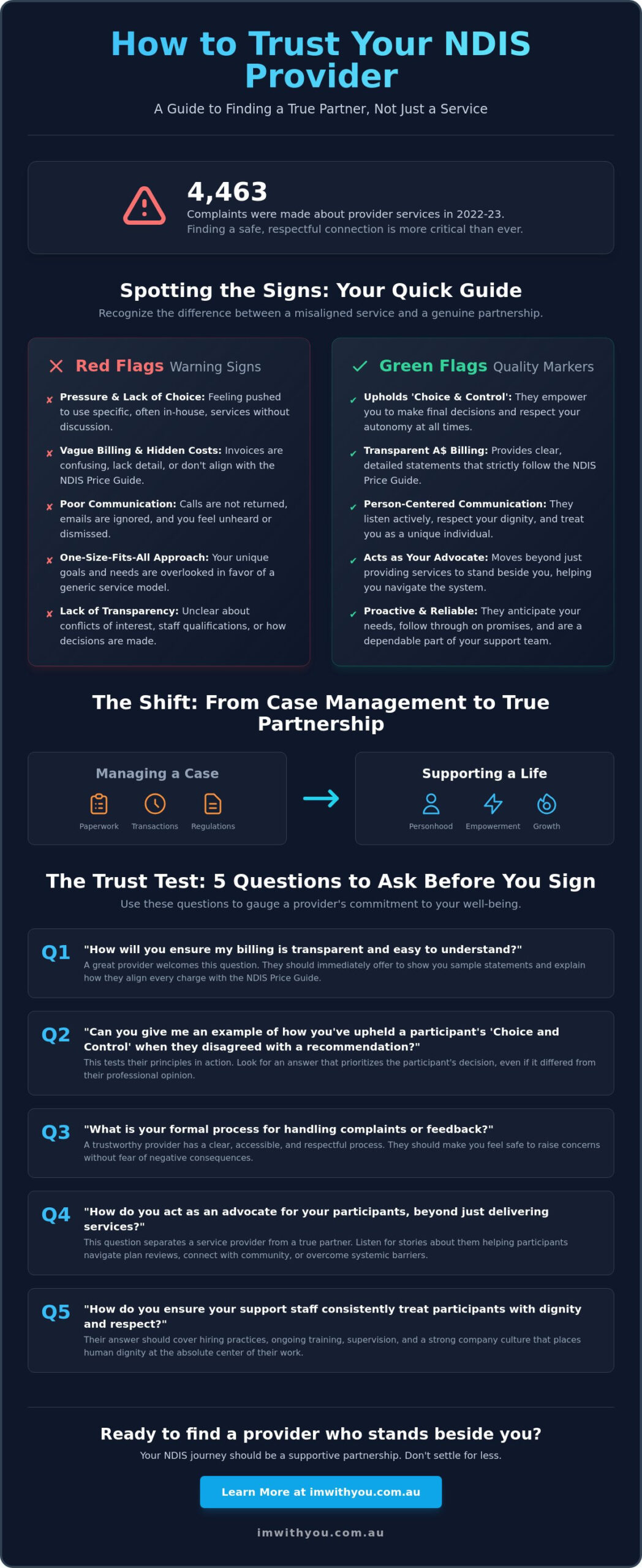
What if your NDIS journey felt less like a series of administrative hurdles and more like a shared path with a friend who truly hears you? You likely believe that your plan should empower you, yet the reality of managing complex regulations often leads to a fear of exploitation or being treated as a case number. According to the NDIS Quality and Safeguards Commission 2022-23 annual report, there were 4,463 complaints made regarding provider services, which highlights why finding a safe connection is so vital. Learning how to trust your ndis provider is about more than just checking a box; it’s about reclaiming your sense of security and dignity.
We’re here to help you move past the anxiety of being overcharged or ignored. You’ll learn how to identify genuine, person-centered care, spot red flags before they become problems, and establish a partnership that treats Choice and Control as a sacred promise. This guide provides a practical checklist for vetting providers so you can build a long-term relationship based on mutual respect and unwavering support. We’re standing beside you to ensure you never have to manage these challenges alone.
Key Takeaways
- Understand how the 2026 integrity reforms are reshaping the NDIS and why genuine trust is built on much more than just a registration number.
- Identify the “green flags” of quality care, from transparent A$ billing practices to communication that truly honors your personhood and dignity.
- Recognize the warning signs of a misaligned partnership, including pressure to use specific services or a lack of clarity around conflicts of interest.
- Discover how to trust your ndis provider using five empowering questions that put your Choice and Control at the heart of every conversation.
- Learn why the best providers move beyond “managing a case” to stand beside you as a dedicated advocate for the life you want to lead.
Understanding the Foundation of Trust in the NDIS Landscape
Navigating the world of disability support can feel like a heavy weight to carry alone. You want to feel safe, heard, and respected while you pursue your goals. Understanding the NDIS Landscape is the first step in recognizing how the system has evolved since its 2013 inception to prioritize your safety. With the rollout of the 2026 integrity reforms, there is a renewed focus on ensuring every participant feels secure. Learning how to trust your ndis provider starts with knowing that the system is finally catching up to your need for transparency and genuine connection.
To better understand how a professional partnership should look, watch this helpful video from NDIS Australia:
Trust is far more than a registration number from the NDIS Quality and Safeguards Commission. While compliance is a baseline, true trust is built through consistent, person-centered actions. The Australian Government’s Fraud Fusion Taskforce, backed by a A$126 million investment, now works tirelessly to protect your funding from misuse. This high-level protection allows you to focus on the relationship at the heart of your plan. We believe the bond between you and your provider is the most important part of the scheme. It’s the difference between receiving a service and experiencing a partnership where someone is truly standing beside you.
The 2026 NDIS Framework: What Has Changed?
The 2026 planning changes have introduced a more transparent way to view your budget and provider interactions. These updates make “Choice and Control” more than just a phrase; they turn it into a reality where you have the final say. The Commission now monitors provider behavior with greater precision, ensuring that those who don’t meet high ethical standards are held accountable. This creates a safer environment for you to explore your independence with confidence.
Why Trusting Your Provider Impacts Your Outcomes
When you find a provider you can rely on, your capacity-building goals become much easier to reach. A safe partnership lifts the administrative burden that often exhausts families and carers, allowing everyone to breathe a little easier. It moves the conversation away from managing a case toward supporting a life. We see this journey as a holistic path where trust acts as the foundation for every success, ensuring you never have to navigate the complexities of the scheme without a steady companion by your side. Knowing how to trust your ndis provider means you can finally shift your energy from worry to growth.
Green Flags: How to Spot a Quality-Driven NDIS Provider
Finding a provider who feels like a true companion involves more than just checking a list of services. It’s about finding a partner who respects your agency and prioritizes your safety. When you are learning how to trust your ndis provider, you should look for specific “green flags” that signal a culture of transparency and care. These indicators show that a provider isn’t just managing a plan; they are supporting a life with the dignity you deserve.
Transparency in Plan Management and Billing
Trust is built on clarity, especially regarding your funding. A quality-driven provider adheres strictly to the NDIS Price Guide, ensuring every dollar in your plan is used effectively to support your goals. You should receive regular, detailed statements that break down exactly what supports were delivered and at what cost. This transparency prevents “bill shock” and ensures you remain in the driver’s seat of your budget.
A trustworthy partner will take the time to explain every line item on your invoice. They don’t shy away from questions about A$ rates or service hours. Instead, they view these conversations as an opportunity to empower you. If a provider cannot clearly explain how their billing aligns with the NDIS Quality and Safeguards Commission standards, it is a sign they may not be the right fit for a long-term partnership.
- Detailed Statements: Monthly reports that show hours used and remaining funds.
- Rate Consistency: All charges match the current NDIS Price Guide limits.
- Open Communication: A dedicated contact person who answers billing queries within 48 hours.
A Culture of Empathy and Advocacy
The best providers view themselves as your advocate. They use person-first language and see your strengths rather than your limitations. This approach was highlighted during the 2026 Excellence in Disability Support Awards, where providers were recognized for moving beyond clinical care toward holistic companionship. When a provider stands beside you, they ensure your voice is heard in every meeting and every decision.
This commitment to advocacy is a core part of how to choose an ndis provider who aligns with your values. You can spot this culture by observing how staff interact with you. Do they listen more than they speak? Do they treat your Service Agreement as a sacred promise of “Choice and Control”? A clear, easy-to-read agreement should outline your rights and the provider’s responsibilities without using confusing legal jargon.
Safety is also verified through action. A quality provider maintains rigorous worker screening compliance, ensuring all staff have current NDIS Worker Screening Checks, which must be cleared every five years. They invest in ongoing training, focusing on psychosocial recovery and inclusive communication. If you’re looking for a partner who prioritizes your safety and growth, our team is ready to walk with you on this journey. Understanding how to trust your ndis provider becomes much easier when you see these consistent patterns of professional and compassionate behavior.
Red Flags: Warning Signs of a Misaligned Partnership
Trust is the foundation of every support relationship, but it isn’t something you should have to give blindly. We want you to feel confident in your choices, which means knowing how to spot when a provider’s interests don’t align with your goals. Learning how to trust your ndis provider involves listening to your intuition when a situation feels uncomfortable or restrictive. While most people in this sector are driven by heart, some businesses might prioritize their growth over your personal journey.
One of the most significant warning signs is a lack of transparency. If a provider gives vague responses when you ask about their staff’s NDIS Worker Screening Checks or their specific safety protocols, they’re failing a basic test of accountability. You deserve clear, direct answers. You can always verify a company’s official standing by using the NDIS Provider Finder tool to see if they’re registered and meeting quality standards. Another serious red flag is financial inconsistency. If you notice your plan budget is being charged for supports that didn’t happen, or if invoices are consistently “padded” with extra time, your provider isn’t acting with integrity.
Guilt-Tripping and the Illusion of Choice
Your NDIS plan belongs to you. No provider should ever make you feel like you owe them your loyalty or that you’re “difficult” for asking questions. We believe Choice and Control is a sacred promise, not just a policy term. If a provider uses guilt to keep you from exploring other options, they’re overstepping. They might suggest that your progress will stall or that finding a new team is too hard. These are pressure tactics. A trustworthy partner will always support your right to move on. They’ll facilitate a smooth transition and provide professional handover notes because they care more about your success than their own bottom line.
The Danger of “Bundled” Services Without Disclosure
It’s common for larger organizations to offer multiple types of support, like combining Support Coordination with daily living assistance. However, this creates a potential conflict of interest. If your coordinator only recommends therapists from their own company, your world becomes very small. You have the right to ask for a clear, written disclosure of how they manage these conflicts. If they can’t explain how they keep your interests separate from their business interests, it’s a sign of a misaligned partnership. Understanding how to trust your ndis provider means ensuring they’re opening doors for you, not just keeping you within their own four walls. If you feel pressured to accept a “bundle” that doesn’t fit, remember that independent advocacy services are available to help you reclaim your voice and your agency.
The Trust Test: 5 Questions to Ask Before You Sign
Trust isn’t something that happens instantly. It’s a bridge built brick by brick through honest conversations and transparent actions. When you’re learning how to trust your ndis provider, the questions you ask during your first meeting act as a vital safety check. We believe you deserve clear, unhurried answers that make you feel seen and heard.
- How do you ensure my Choice and Control is respected every day? A provider should explain how they empower you to make decisions about your daily routine, rather than just following a pre-set schedule.
- Can you walk me through your billing process and how I can track my spending? You should have total visibility over your NDIS budget. Ask if they provide monthly statements that show exactly how many A$ have been claimed.
- What is your process for handling feedback or a formal complaint? A safe partner welcomes your voice. They should have a clear, documented path for resolving issues that doesn’t make you feel “difficult” for speaking up.
- How do you support your staff to deliver person-centered care? Quality support starts with how a company treats its team. Ask about their training and how they match staff members to your unique personality and goals.
- How will you work side-by-side with my other support team members? Your journey involves various professionals. Your provider needs to communicate effectively with your Support Coordinator, OT, or family to ensure everyone is pulling in the same direction.
Evaluating the “First Meeting” Experience
The dynamic of your first meeting tells you a lot about the future of the partnership. Pay attention to the balance of the conversation. Do they listen more than they talk? A provider who spends the whole time talking about their awards or size might be focused on their own growth rather than your empowerment. Notice if they are using person first language naturally. This isn’t just about being polite; it’s a sign they see you as a person first, not a diagnosis. A support consultation should feel like a warm invitation to collaborate, not a high-pressure sales pitch.
Reviewing the Service Agreement for Fairness
The Service Agreement is a tool to protect your rights, not just a legal formality. When you’re figuring out how to trust your ndis provider, look closely at the fine print regarding notice periods. Most fair agreements in the Australian market allow for a 14-day or 28-day cancellation period. If a provider tries to lock you in for several months with no way out, that’s a red flag.
Ensure the document lists your specific life goals, like “attending a local art class” or “building cooking skills,” rather than just generic NDIS line items. You should never feel rushed to sign. A trustworthy advocate will encourage you to take the document home, read it over a cup of tea, or discuss it with a friend before committing. Your peace of mind is worth the wait.
If you’re looking for a partner who values your agency and walks beside you every step of the way, we’d love to start a conversation with you.
Why Partnership and Advocacy are the Ultimate Trust Markers
Trust isn’t just about a signed service agreement or a list of qualifications. It is the quiet confidence that someone truly has your back when things get difficult. When you are looking at how to trust your ndis provider, you should look for a team that moves beyond simply managing a case. True support means supporting a life in all its complexity. We call this the “With You” philosophy. It means standing beside you during every challenge, whether it’s a complex plan review or a small daily hurdle.
Award-winning providers lead the Australian disability sector because they prioritize safety and quality above administrative ease. These organizations often exceed the minimum standards set by the NDIS Quality and Safeguards Commission. Recent data suggests that providers who engage in active partnership models see higher levels of participant satisfaction and better long-term outcomes. This level of excellence creates a foundation of mutual respect where your voice is the loudest in the room. Taking the next step in your journey involves finding a team that views you as an equal partner rather than a number in a system.
The Role of Compassion in NDIS Support
Compassion acts as a safety net. When a support worker approaches you with genuine empathy, it creates a space where you feel safe to speak up about what’s working and what isn’t. A provider who takes the time to learn your history and your goals is better equipped to help you thrive. This is especially vital when seeking intellectual disability support, as it requires a deep understanding of unique communication styles and personal needs. We believe that when we know your story, we can provide care that feels personal, safe, and deeply reassuring.
Your Right to a Safe and Joyful Life
You deserve a life filled with connection and purpose. Trust is the gateway that allows you to explore new leisure activities and build meaningful community ties. A trusted advocate doesn’t just provide care; they help you navigate NDIS plan implementations and reviews with confidence. They ensure you receive every bit of funding you’re entitled to under Australian regulations, acting as a steady companion through the bureaucracy.
Choosing a partner is a big decision, and you should always prioritize your peace of mind. If a provider makes you feel heard, respected, and safe, you’ve found a partnership that will help you reach your full potential. Learning how to trust your ndis provider starts with listening to your intuition. Choose a team that promises to walk every step of the journey with you, ensuring you never have to face the complexities of the NDIS alone.
Walking Forward with Confidence and Care
Choosing a partner for your NDIS journey is a deeply personal decision that shapes your daily life. You now know that true quality shows up in the green flags of transparency and the way a provider honors your right to choice and control. By asking the five essential trust questions, you protect your peace of mind and ensure your goals remain the priority. Understanding how to trust your ndis provider isn’t just about ticking boxes; it’s about finding a team that stands beside you through every challenge.
At I’m With You, we’ve built our national support model on a foundation of advocacy and person-centered care. Our commitment to this approach was recognized with the 2026 Award for Excellence in NDIS Care, proving that professional expertise and human warmth can go hand in hand. We’re ready to help you navigate the complexities of the NDIS with a transparent, holistic focus. Experience the “With You” difference; connect with our award-winning team today. You deserve a partner who values your independence as much as you do.
Frequently Asked Questions
How can I check if an NDIS provider is officially registered and in good standing?
You can verify a provider’s status by searching the NDIS Quality and Safeguards Commission’s Provider Register. This online tool allows you to search by name or ABN to see if they meet the 2018 NDIS Practice Standards. It also shows if the provider has had any compliance notices or bans issued against them. We recommend checking this list before your first meeting to ensure your safety and peace of mind.
What should I do if I suspect my NDIS provider is overcharging my plan?
If you notice charges higher than the 2023-24 NDIS Pricing Arrangements and Price Limits, you should speak with your provider immediately to ask for a line-item breakdown. If the issue remains unresolved, you can report the overcharging to the NDIS Quality and Safeguards Commission on 1800 035 544. Learning how to trust your ndis provider involves feeling confident that every cent of your funding is being used honestly to support your goals.
Can I change my NDIS provider if I no longer trust them, and how long does it take?
You have the right to end a service agreement at any time if you feel the partnership is no longer working for you. Most service agreements include a notice period which is typically 14 or 28 days. Once this period ends, you can transition to a new provider. We will stand beside you during this change to ensure your supports continue without interruption while you find a better fit.
Is it a conflict of interest if my provider also offers Support Coordination?
A conflict of interest may exist if a provider suggests their own services over others, but the NDIS allows this as long as they manage the conflict according to strict rules. Under the NDIS Code of Conduct, providers must tell you about any potential conflicts and prioritize your choice and control. You should always feel free to explore other organizations to ensure you’re getting the best possible support for your unique journey.
What are the most common “red flags” to watch for during an initial NDIS consultation?
Watch for providers who pressure you to sign a service agreement during the first meeting or fail to provide a clear quote based on the NDIS Price Guide. Another red flag is a provider who talks more about their business than your personal goals. Trust is built on listening. If a provider doesn’t ask about your aspirations or ignores your preferences, they may not be the right companion for your NDIS journey.
How does the NDIS Quality and Safeguards Commission protect participants from fraud?
The NDIS Commission protects you by enforcing the NDIS Code of Conduct and the 2018 Practice Standards. They have the power to investigate complaints, issue fines, and ban providers who do not meet safety requirements. By regulating the market, they ensure that every participant has a pathway to justice if a provider acts dishonestly. This oversight helps you feel more secure as you learn how to trust your ndis provider.
What is the Fraud Fusion Taskforce, and how does it impact my choice of provider?
The Fraud Fusion Taskforce is a A$126 million federal initiative launched in 2022 that brings together 16 government agencies to detect and stop NDIS fraud. This taskforce makes it harder for dishonest providers to operate within the scheme. Knowing this group is actively monitoring the system adds an extra layer of protection to your choice, ensuring only ethical providers remain available to support your life.
Does a provider need to be award-winning to be considered trustworthy?
A provider does not need industry awards to be a safe and reliable partner for you. While accolades are nice, they don’t replace the daily commitment to empathy and person-centered care. You should value a provider’s history of compliance with the NDIS Commission and their willingness to walk side-by-side with you. Real trust comes from feeling heard and seeing your goals achieved, not from a trophy on a shelf.