

The desire to connect is a deeply human one. Yet, have you ever found yourself hesitating, unsure how to start a conversation with someone who is deafblind? This uncertainty, often rooted in a fear of social awkwardness or feeling overwhelmed, can build a wall where we truly want to build a bridge. We understand this feeling, and we know it often begins with the fundamental question: how do deaf and blind people communicate? The world of tactile signing and assistive technology can seem complex, but we want you to know you’re not alone on this journey of discovery.
We’re with you, and in this guide, we will gently walk you through the rich and varied ways the deafblind community in Australia connects. Together, we’ll explore everything from hands-on signing to incredible new technologies. Our promise is that you will leave not just with knowledge, but with confidence. You’ll discover that communication is a beautiful spectrum and feel empowered with practical, simple ways to begin a conversation, fostering the meaningful connection you’ve been hoping for with empathy and clarity.
Key Takeaways
- Discover that deafblind communication is a deeply personal journey, with methods tailored to each individual’s unique experience with sight and hearing.
- Learn about the power of touch-based methods like tactile signing, where conversations unfold through feeling the shapes and movements of signs.
- Explore how modern assistive technology, such as refreshable Braille displays, is creating new pathways for connection and independence.
- We’ll guide you through simple, respectful steps for your first interaction, so you can confidently understand how do deaf and blind people communicate and connect with clarity.
Understanding the Spectrum of Deafblind Communication
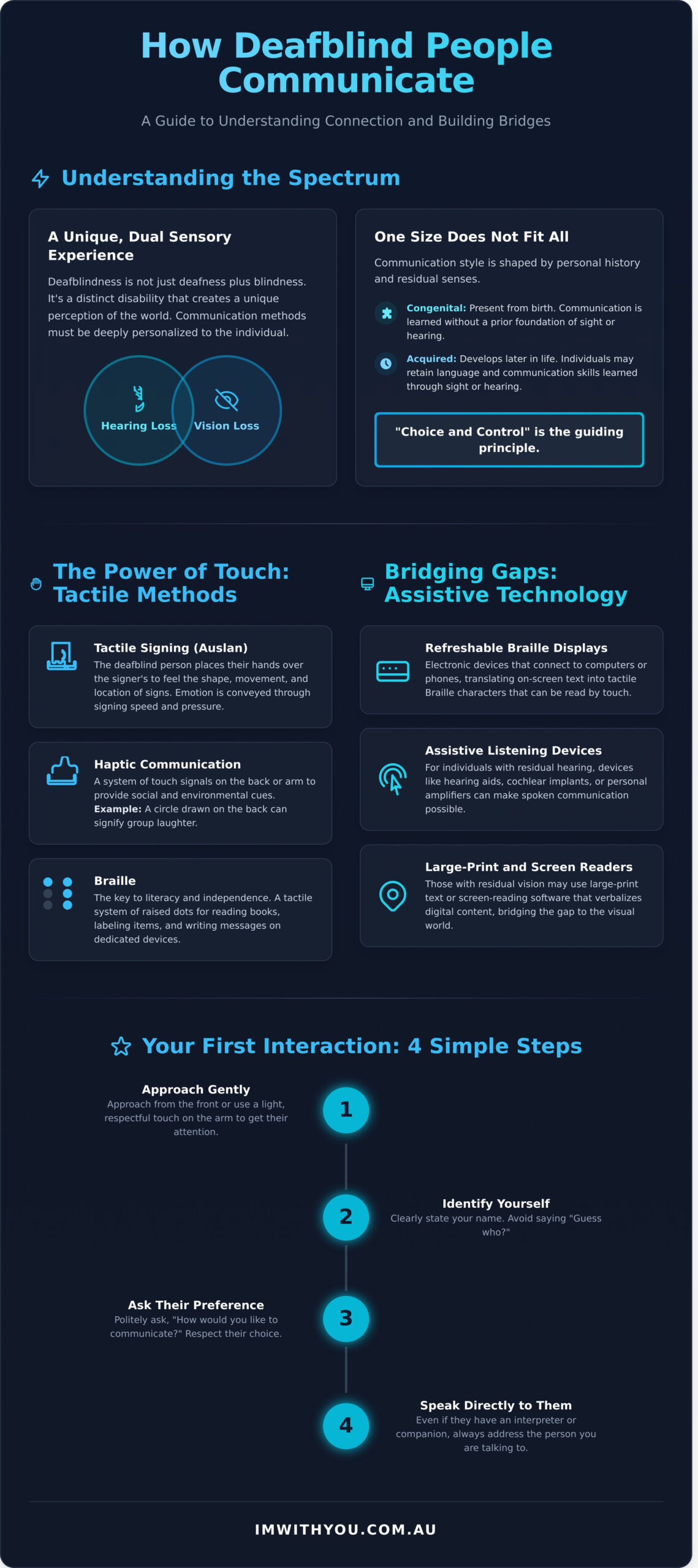
When we begin to explore how do deaf and blind people communicate, it’s important to first understand that deafblindness is a unique, dual sensory disability. It is not simply deafness and blindness added together; it creates a distinct experience of the world that requires a deeply personalised approach to connection. The methods used are as individual as the people themselves, often shaped by whether they have any remaining (or “residual”) sight or hearing and when they first experienced sensory loss.
To see how this looks in a real conversation, this video offers a beautiful and insightful perspective:
At its heart, deafblind communication is a multi-sensory bridge built on trust and adapted tools. For some, this might mean using their residual vision to read large-print text or lip-read up close. For others, it could involve using their residual hearing with the help of assistive listening devices. Every person’s sensory landscape is different, and honouring that is the first step toward meaningful interaction.
Why One Size Does Not Fit All
Your journey is unique, and so is your communication style. A person with congenital deafblindness (present from birth) will have a different communication foundation than someone with acquired deafblindness, who may have established language through sight or hearing before losing it. This is why the NDIS principle of “Choice and Control” is more than just a guideline to us—it’s a promise. You are the expert in your own life, and we are here to support you in choosing the methods and environments, from lighting to background noise, that feel right for you.
The Diversity of the Australian Deafblind Community
The Australian deafblind community is incredibly diverse, with each person bringing their own life experiences and communication preferences to their NDIS journey. This diversity is a key aspect of what’s covered in any comprehensive overview of deafblindness and is why modern disability support has moved toward person-centered models. At I’m With You, we see communication not as a separate skill but as a vital part of holistic life support. We stand beside you to ensure your voice is heard, your choices are respected, and your connections to the world are strong and fulfilling.
Tactile Methods: The Power of Touch and Sign
When sight and hearing are limited, the world of touch opens up, offering rich, detailed, and deeply personal ways to connect. For many deafblind Australians, tactile communication is not just a method; it’s a language of its own, built on trust and physical presence. Understanding how do deaf and blind people communicate through touch is a journey into a world of incredible adaptability and human connection. We’re with you to explore these powerful methods.
Auslan and Tactile Sign Language
For those fluent in Auslan (Australian Sign Language), the transition to a tactile form is a natural one. Instead of watching signs, the deafblind person places their hands lightly over the signer’s hands to feel the shape, movement, and location of each sign. This is often called hand-over-hand signing. The “signing space” becomes smaller and more contained, bringing the conversation into a shared, intimate frame. While facial expressions are central to visual Auslan, in tactile signing, the emotional tone is beautifully conveyed through the speed and pressure of the signs.
Alongside formal signing, haptic communication provides vital social and environmental context. This is a simple yet profound system of touch signals given on a person’s back or arm. For example, a gentle tap on the shoulder might mean someone has entered the room, while a circle drawn on the back could signify laughter from the group. These signals help a deafblind person feel fully included in the moment.
Braille and Palm Writing
Braille is the key to literacy, learning, and independence. This tactile system of raised dots allows deafblind individuals to read books, label items, and write their own messages using devices like a Braille display. Accessing these tools is a critical part of empowerment, and dedicated initiatives like the iCanConnect assistive technology program exist to provide people with the equipment and training they need to stay connected. It’s a powerful tool that supports a person’s fundamental right to choice and control.
For quick and simple interactions, especially with the wider community, palm writing is invaluable. By carefully tracing block letters onto a person’s palm, anyone can convey a short message. Another common method is the Deafblind Alphabet, where each letter is indicated by touching a different part of the hand, offering a faster alternative to tracing full letters for those who know the system.
Technology and Modern Assistive Tools
In today’s connected world, technology has beautifully transformed the answer to ‘how do deaf and blind people communicate?‘ It has opened up incredible pathways to independence, connection, and safety, allowing individuals to engage with the world on their own terms. We believe in harnessing these tools to support your journey, ensuring you feel empowered and heard every step of the way.
Modern assistive technology acts as a seamless bridge between different sensory worlds. These tools are designed not just for function, but for fostering a deeper sense of autonomy and confidence in daily life. At I’m With You, we can help you explore how these resources can be integrated into your NDIS plan to support your goals.
- Refreshable Braille Displays: These remarkable devices connect to smartphones and computers, translating digital text from emails, websites, or messages into tactile Braille that can be read by touch.
- Screen Readers and Voice-to-Text Software: Software like JAWS or VoiceOver reads on-screen text aloud, while voice-to-text apps convert spoken words into written messages, facilitating fluid conversations.
- Vibratory Alerts and Environmental Sensors: For home safety and awareness, devices can provide tactile alerts for a doorbell, a crying baby, or a smoke alarm, offering invaluable peace of mind.
Digital Communication and Social Media
Staying connected with loved ones and community is vital. Accessibility features built into apps like FaceTime, combined with community-led practices like writing descriptive Alt-text for images, ensure social media is a more welcoming space. Your smartphone can become a powerful, portable communicator, linking to Braille displays and other tools to make digital interaction immediate and meaningful.
The Role of Communication Interpreters
Beyond technology, human connection remains central. A communication guide, sometimes called a Support Guide, does more than just interpret language during social or medical appointments; they provide environmental context and sighted guidance. This is a perfect example of using your NDIS funding to exercise your Choice and Control, ensuring you have the right professional support, with you, when you need it most.
Practical Tips for Connecting: Your First Interaction
Stepping into a conversation with someone who is deafblind can feel new, but it’s an opportunity for a truly present and meaningful connection. The key is to approach with warmth, respect, and a willingness to adapt. Knowing the fundamentals of how do deaf and blind people communicate can transform a moment of uncertainty into a bridge of understanding. Your patience and gentle approach create a safe space where communication can flourish.
Before you dive into a deep conversation, remember these foundational steps to build immediate trust and rapport:
- Always identify yourself. A gentle touch on the upper arm followed by your name lets the person know you are there and who you are.
- Ask about their preference. Simply ask, “How do you prefer to communicate?” This small question honours their expertise and places their choice and control at the centre of the interaction.
- Be patient. Tactile communication methods take more time. Allow space for the message to be received and processed without rushing. Your unhurried presence is a powerful form of support.
- Stay focused and direct. Use clear language and avoid turning or looking away while speaking or signing, as this can disrupt the flow of information for those using residual senses.
Etiquette and a Sensitive Approach
Navigating the practicalities of an interaction with grace shows you care. When initiating contact, a light, respectful touch on the upper arm or shoulder is usually best, as it’s a neutral and non-startling way to get someone’s attention. If you are guiding them, offer your elbow and let them hold on to you. This “Sighted Guide” technique allows them to feel your movements as you walk a half-step ahead. Most importantly, if you don’t understand something, be honest. Never pretend—simply ask for clarification. This honesty builds trust far more than guessing ever could.
Creating a Supportive Environment
The right setting can make a world of difference. A quiet space with minimal background noise helps reduce sensory overload and allows for better focus. For individuals with some residual vision, good, high-contrast lighting is essential. Position yourself where your face or hands are clearly visible within their field of vision. Being fully present—putting away your phone and giving your undivided attention—shows that you value the person and the conversation you are sharing. This supportive atmosphere is a cornerstone of effective communication.
Understanding how do deaf and blind people communicate is a journey of empathy and learning. It’s about seeing the person, not the disability, and adapting with an open heart. At I’m With You, we believe every connection matters. If you’re exploring ways to build capacity for social and community participation, we are here to walk beside you.
Empowering Independence through NDIS Support
The journey to finding the right communication methods is deeply personal, and navigating the National Disability Insurance Scheme (NDIS) to fund them can feel complex. But you don’t have to do it alone. With a supportive partner, your NDIS plan becomes a powerful tool for fostering connection and independence. A dedicated Support Coordinator can help you translate your needs into clear goals, connecting you with the right training, technology, and therapeutic supports.
At I’m With You, our commitment is to walk this path beside you. We help build your capacity for self-advocacy, transitioning our support from ‘doing for’ you to ‘doing with’ you. This partnership ensures you feel confident and empowered to make decisions about your communication and your life.
Accessing Communication Aids via NDIS
Understanding how do deaf and blind people communicate is the first step; the next is securing the right tools through your NDIS plan. Your funding can be used to access a range of supports that build your communication skills and independence.
- Assistive Technology (AT): This funding category can cover essential equipment, from screen readers and digital magnifiers to braille displays and alternative communication (AAC) devices. We help you get the right assessments to justify these vital tools.
- Communication Goals: In your plan review, we help you articulate clear goals around communication. This ensures your funding is allocated specifically for therapies, training, and technology that support how you connect with the world.
- Therapeutic Supports: Funding can be used for specialists like Occupational Therapists or Speech Pathologists who provide training on new communication modalities and technologies, ensuring you can use them effectively.
Why Choose a Supportive Partner Like I’m With You?
Our person-centered approach puts you at the heart of every decision. We are committed to disability advocacy and are striving for excellence in all we do. We listen to your unique needs and help you maintain complete choice and control over your supports, ensuring your communication methods reflect your identity and preferences. We believe that meaningful connection is a fundamental right, not just a service.
If you’re ready to explore how we can support your journey toward greater connection, we’re here to listen. Connect with us today to learn more about how we can stand with you.
Embracing Connection, Together
The journey of communication is beautifully diverse, and connection is always within reach. Understanding how do deaf and blind people communicate reveals a rich world of tactile signing, innovative assistive technologies, and profound human resilience. These methods are not just tools; they are bridges to independence, community, and meaningful relationships.
Navigating the NDIS to fund these vital supports can feel overwhelming, but you don’t have to walk this path alone. At I’m With You, we are specialists in NDIS Support Coordination and Advocacy, providing compassionate, person-centered care. As a provider Awarded for Excellence in Disability Support 2026, our promise is to stand with you, championing your right to choice and control every step of the way.
Your voice deserves to be heard. Let us walk beside you on your NDIS journey—contact our team today.
Frequently Asked Questions
Can someone who is both deaf and blind lead an independent life?
Absolutely. With the right personalised support and assistive technology, people who are deafblind can lead rich, independent lives. It’s a journey of building skills and confidence, from navigating their community to managing a household. The NDIS can fund training and tools that empower individuals, placing choice and control firmly in their hands. We believe in focusing on strengths and possibilities, helping you build the life you envision for yourself, side-by-side with our support.
How do you tell someone who is deafblind that you are leaving the room?
Always communicate your departure to avoid causing anxiety. A simple, pre-agreed tactile sign is best. For example, you can gently trace an “X” on their back or hand. This clear signal lets them know you are leaving and that they are alone, providing a sense of security and respect. It’s a small gesture of consideration that makes a world of difference in building trust and ensuring they feel safe and informed in their environment.
Is Braille the only way deafblind people read?
While Braille is a vital tool, it’s not the only option. An individual’s preferred method depends on their unique journey with sight and hearing loss. Some may use large-print materials if they have residual vision, while others use screen readers that send audio to bone-conduction headphones. Technology like refreshable braille displays also connects to computers and phones. It’s all about finding the right tools to support an individual’s choice, control, and independence.
What is the most common way for a deafblind person to communicate in Australia?
In Australia, tactile signing is one of the most common communication methods. This often involves tactile Auslan (Australian Sign Language), where the deafblind person places their hands over the signer’s to feel the signs. Tactile fingerspelling, where words are spelled out onto the person’s hand, is also widely used. The specific method is always a personal choice, tailored to what feels most comfortable and effective for the individual’s communication needs and preferences.
How can I learn tactile signing or fingerspelling?
Learning is a wonderful way to build connection. Organisations like Deafblind Australia and Able Australia offer fantastic resources, workshops, and courses. You can also connect with local Deaf societies, which often provide classes in Auslan that can be adapted to tactile methods. Starting this journey shows a deep commitment to inclusive communication, and we are with you in supporting every step toward more meaningful connections within the community.
What role does an NDIS Support Coordinator play in communication?
Your NDIS Support Coordinator is your partner in navigating the system to build your communication capacity. We walk alongside you to identify your specific needs and goals. We then help you find and fund the right supports in your NDIS plan, such as communication devices, interpreter services, or training in tactile Auslan. Our goal is to ensure your plan truly reflects your choices, empowering you to connect with the world in the way you want.
Are there apps that help deaf and blind people communicate with others?
Yes, technology offers incredible tools that support how do deaf and blind people communicate. Screen readers like VoiceOver (Apple) and TalkBack (Android) read text aloud or output to a braille display. Specialised apps can connect users to live interpreters, while others convert text to braille. These innovations open up new pathways for connection, helping individuals to communicate more easily and maintain their independence in a digital world.
What should I do if I meet a deafblind person in public and want to help?
The best approach is always one of respect and patience. If you believe someone needs assistance, approach them and gently touch their arm or shoulder to get their attention. You can then offer help clearly. Never assume help is needed or grab them without permission. Allowing them to accept or decline your offer honours their independence and dignity, creating a safe and positive interaction for everyone involved.