

A lower NDIS plan doesn’t always mean every support has been reduced in the same way. That’s an important part of why NDIS plans are cut: overall budgets and support categories can change when plans are created, reassessed or renewed.
It’s understandable to feel unsure about what you can keep in place after a funding change. The impact depends on how your plan’s budget and supports change. A reduction in one category may affect your day-to-day choices differently from a change in another.
This article explains how plan changes can affect your budget, why funding may shift between support categories, and what a focus on social and community participation could mean for your supports. It also explains how clear goals and evidence can help show what matters in your life.
Key Takeaways
- Understand why plan budgets can change as plans are created, reassessed or renewed, and how your goals and support needs shape the outcome.
- Learn how funding resets may affect different support categories, so you can better understand where a change in your plan comes from.
- See what reduced social and community participation funding could mean for activities and support that help you stay connected.
- Explore how clear goals and supporting evidence can help communicate your needs, with support coordination and advocacy available when you need a hand.
How funding changes affect participant budgets
NDIS budgets can change as your needs, progress and use of supports change. We can look at what may affect your budget and how to prepare.
Changing Needs and Participant Progress
Funding changes can reflect how your needs and independence develop over time. The NDIA considers your progress and use of supports when it creates, reassesses or renews your plan. For example, if you become able to use public transport independently, you may need less funding for that support. Clear, current goals also matter because they connect your funding with your daily life and participation.
If your needs increase or change, evidence about how supports help can explain why your budget should continue or change. Keeping your goals aligned with your current circumstances can help make your plan more relevant.
Timing and Eligibility Changes
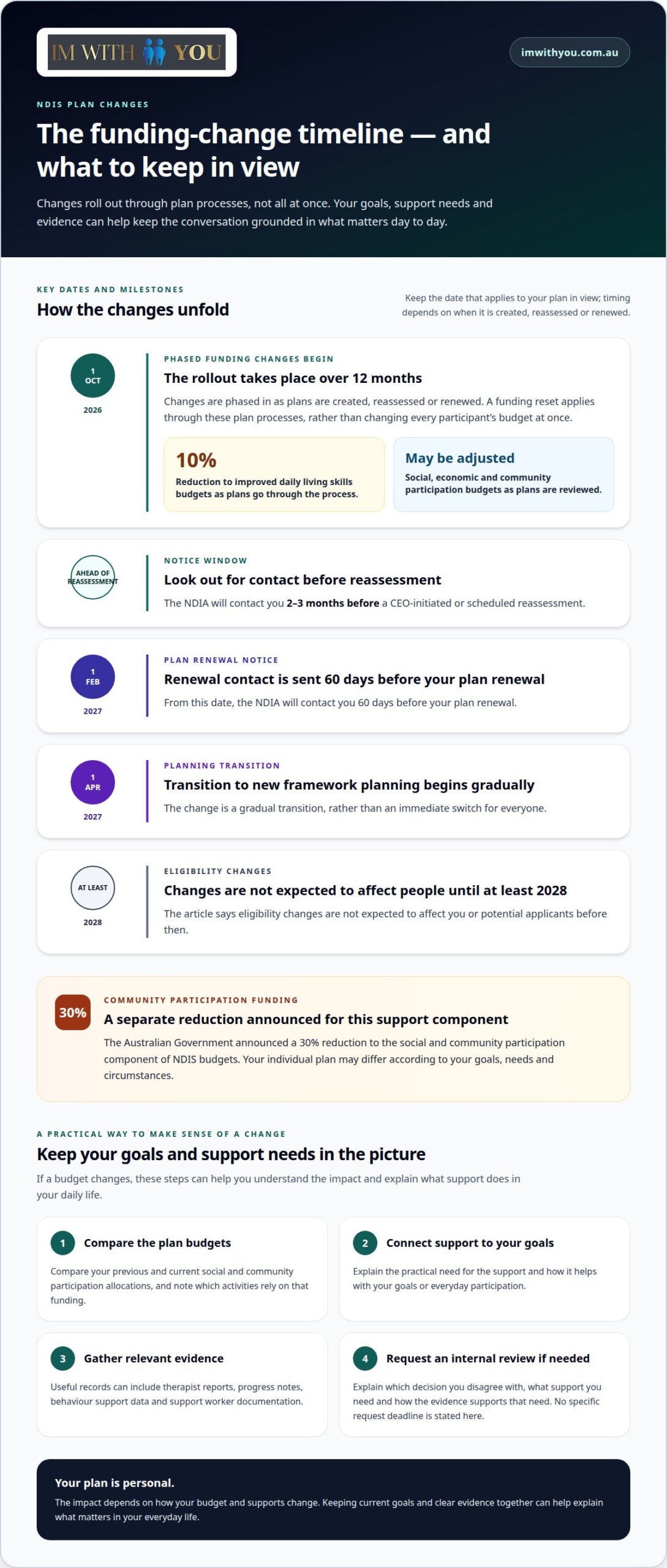
From 1 October 2026, funding changes are phased in over 12 months as plans are created, reassessed or renewed. The NDIA will contact you 2-3 months before a CEO-initiated or scheduled reassessment. From 1 February 2027, it will contact you 60 days before your plan renewal.
You gradually transition to new framework planning from 1 April 2027. Eligibility changes are not expected to affect you or potential applicants until at least 2028. These dates matter because a funding reset applies through plan processes, rather than changing every participant’s budget at once. Keeping track of the dates can help you prepare.
Funding Rules and Review Requests
NDIS funding is shaped by your goals, needs, progress and use of supports. If your plan doesn’t reflect your needs, you can request an internal review and provide supporting evidence, such as progress notes or therapist reports. Submit your request promptly and explain which decision needs review; the available facts here do not give a specific deadline. We’re with you as you gather the information and explain your concerns.
In Australia, disability advocacy organisations can help you communicate your needs, while community legal centres provide legal assistance. Ask about free support when you contact them.
Funding being shifted between support categories
Funding changes can reduce one support category while leaving other budgets to meet different needs. From 1 October 2026, as plans are created, reassessed or renewed, improved daily living skills budgets are reduced by 10%. Social, economic and community participation budgets may be adjusted as plans are reviewed. These resets can affect your plan’s balance, rather than simply moving the same amount between categories.
Your funding may be allocated differently across categories, including Capacity Building or Social and Community Participation. The right allocation depends on your goals and the supports you need to work towards them. For example, as you build daily living skills, you may need a different mix of supports as your capacity increases. A reduction can also reflect changed needs or progress, but your goals and evidence help show whether your plan still fits.
NDIS funding decisions consider whether a support relates to your disability needs and helps address your goals or everyday participation. You can make a request clearer by explaining the practical need for the support and providing evidence of its role. Useful records include therapist reports, progress notes, behaviour support data and support worker documentation. Together, these can show your needs, changes over time and the effect of reduced support.
If a funding decision doesn’t reflect your current needs, you can request an internal review and provide supporting evidence. Explain which decision you disagree with, what support you need and how the evidence supports that need. Keep relevant records together, including updated reports and notes about support outcomes. This gives the reviewer clear information to consider, especially when your goals, needs or participation have changed.
Cuts to social and community participation budgets
The Australian Government announced a 30% reduction to the social and community participation component of NDIS budgets. This change affects funding that supports community connection and participation, so let’s look at what it may mean for you. A reduction in this category may affect how you organise activities and support around your goals. The practical impact depends on your plan’s budget and how you use it.
These are average figures, not a prediction of your individual budget. Your plan may differ according to your goals, needs and circumstances.
If you rely on funded support to join community activities, a lower allocation may mean reconsidering how that support fits into your routine. We can start by asking not only how much funding changed, but what participation your budget needs to support. A clear picture of the activities you value and the assistance involved can help you understand the effect of a reduction.
To understand a plan change, compare your previous and current social and community participation allocations, then consider which activities rely on that funding. If the revised amount doesn’t reflect your needs, you can challenge the decision through an internal review and provide supporting evidence. For help keeping community participation central to your support planning, explore community participation support.
Im with you
Im with you can support you as you make sense of NDIS plan changes and consider what they mean for your supports. Through NDIS Support Coordination, we can help you understand your plan and coordinate supports around your goals. Our Disability Advocacy Services can help you communicate your needs when a funding decision doesn’t seem to reflect your circumstances.
If reduced community participation funding affects how you stay connected, Community Participation Support and Disability Support Services can help you work towards meaningful daily activities. The right support depends on what you want to achieve and the assistance your plan can fund. You don’t have to untangle every change on your own. Contact Im with you to discuss support that fits your situation.
Take your next step with confidence
Understanding why NDIS plans are cut can help you prepare for conversations about the supports that matter in your daily life. Keep your goals and support needs at the centre of those conversations, and make sure your preferences are heard as you consider what comes next.
I’m With You can walk alongside you through NDIS Support Coordination, Disability Support Services and Community Participation Support. These services can help you understand your options, coordinate assistance around your goals and stay connected with your community. You deserve to feel informed and included as you work through plan changes.
Contact Im with you to talk about support for your situation. We’re here to help you take the next step at your own pace.
Frequently Asked Questions
What changes will be made?
Changes are being phased in through plan creation, reassessment and renewal, with new framework planning beginning gradually on 1 April 2027. Selected support categories are affected, so you may see a different amount available for particular supports rather than the same reduction across your whole plan. We can review each category separately to understand how your plan has changed.
What happens next?
The NDIA will contact you 2-3 months before a CEO-initiated or scheduled reassessment, and 60 days before plan renewal. If you request an unscheduled reassessment, the NDIA has 90 days to decide whether it will proceed. If your plan hasn’t been created or reassessed since 1 October 2026, it will be renewed by 30 September 2027.
Why are NDIS plans being reduced or cut in Australia?
A key policy reason is to slow scheme spending growth as the number of participants has risen beyond the level the scheme was designed for. At the time of the announcement, the NDIS had more than 760,000 participants, compared with 410,000 it was designed for. This policy-wide pressure helps explain why plans may be cut, but your individual plan change also relates to your needs and supports.
What changes to NDIS eligibility and funding rules have been announced?
Eligibility changes for participants and potential applicants are not expected until at least 2028. Separately, a variation pathway applies to eligible participants with high support needs requiring NDIS-funded disability supports throughout the day and night. The stated budget threshold is $215,030 before the funding reset, and you can apply for a variation within 90 days after it’s applied if you’re eligible.
How do NDIS plan reassessments and evidence requirements affect funding?
At reassessment, evidence can help show how a support relates to your current needs and plan goals. For example, a therapist’s report could explain why an everyday task still requires assistance, while dated support notes could show how often you use help. We can connect each piece of evidence to the support requested so the relationship between your needs and proposed funding is clear.