

The right home support isn’t necessarily the option with the most hours. NDIS nursing support at home depends on the complexity of care, clinical risk and goals in the participant’s plan. Nursing may cover clinically required tasks such as wound or catheter care, while support workers assist with daily living and community routines. The key is matching the support to what needs to happen safely and consistently at home.
It’s understandable if the distinction feels difficult to weigh, especially when clinical tasks sit alongside everyday support. This guide compares the options so you can identify which needs call for nursing, which fit disability support, and how the two can work together around a person’s priorities. We’ll look at care complexity, risk and practical tasks, then offer a decision guide to help you identify a suitable next step.
Key Takeaways
- Compare support options by the complexity of care, clinical risk and goals in the participant’s NDIS plan.
- Recognise when tasks such as wound or catheter care may call for clinical nursing support.
- Separate clinical care needs from everyday assistance with routines, household tasks and community access.
- Use the decision guide to clarify what support may help at home and where disability support services can fit.
Choosing support based on clinical risk and care complexity
Match support to the clinical tasks, level of risk and goals in the participant’s NDIS plan. A practical comparison also considers worker screening, role boundaries and how care routines are documented.
Eligibility for Funded Nursing Support
According to the Australian Bureau of Statistics, the NDIS largely supports people under 65 with permanent and significant disability. Age and disability are part of the wider eligibility picture, while a nursing support choice also needs to align with the participant’s plan goals and disability-related needs.
To consider whether home nursing is reasonable and necessary, identify the task, its connection to disability, its clinical complexity and the goal it supports. For example, a recurring clinical task differs from help with a morning routine, even when both happen at home.
Overnight, Continuous, and Emergency Support
Overnight or continuous nursing involves planned care across extended periods, unlike a scheduled visit for a defined task. Consider the timing and complexity of clinical needs, then compare them with the plan’s goals. Emergency support addresses an immediate crisis, so it is different from arranging ongoing home care.
NDIS funding for overnight or continuous nursing depends on how the support relates to the participant’s goals and care needs. It should not be treated as emergency response coverage.
Worker screening and compliance also matter. Include current screening, clear role boundaries, documented care instructions and escalation steps in the comparison. These details help distinguish clinical duties from everyday assistance.
| Option | Clinical risk | Care complexity | Best fit |
|---|---|---|---|
| Home nursing | Clinical tasks or monitoring | Skilled, planned care | Disability-related nursing needs |
| Support worker | Everyday assistance | Daily routines | Personal or household support |
| Combined support | Clinical and daily needs | Different tasks across the day | Coordinated care routines |
Choose the option, or combination, that best matches the clinical task, risk level and plan goals.
Nursing tasks such as wound and catheter care
Home nursing may include wound or catheter care when clinically required. To request nursing support in a plan or review, describe the task, its connection to disability and how it supports the participant’s goals.
Wound and Catheter Care
A nurse may provide wound or catheter care when the task is clinically required. These are clinical tasks, unlike everyday assistance such as help with dressing or household routines. Describe the care needed and its place in the person’s regular routine. According to Sydney Children’s Hospitals Network, the NDIS funds disability-related health supports when they are a regular part of daily life and result from disability.
Clinical Monitoring and Care Planning
Clinical monitoring helps organise care around a person’s changing needs. A care plan can record the task, relevant observations, instructions and steps for raising concerns. For example, a wound care plan can set out what the nurse does and which changes should be reported. This differs from a one-off nursing task because it supports consistent care over time.
Specialist nursing care may be relevant when a person’s clinical tasks are complex or require coordinated planning. Describe the specific tasks and how they relate to disability. Clear information helps connect the requested support with the participant’s daily life and plan goals.
NDIS respite care is a separate consideration from wound or catheter care. Explain what support the participant needs during respite, including any nursing tasks that remain part of their routine. This helps distinguish clinical care from other assistance and show how the support fits into everyday life.
When choosing NDIS support in Australia, the decision usually depends on care complexity, clinical risk and the goals in the participant’s plan. Explain how the requested nursing tasks relate to those considerations, describing the care needed and its connection to the participant’s goals.
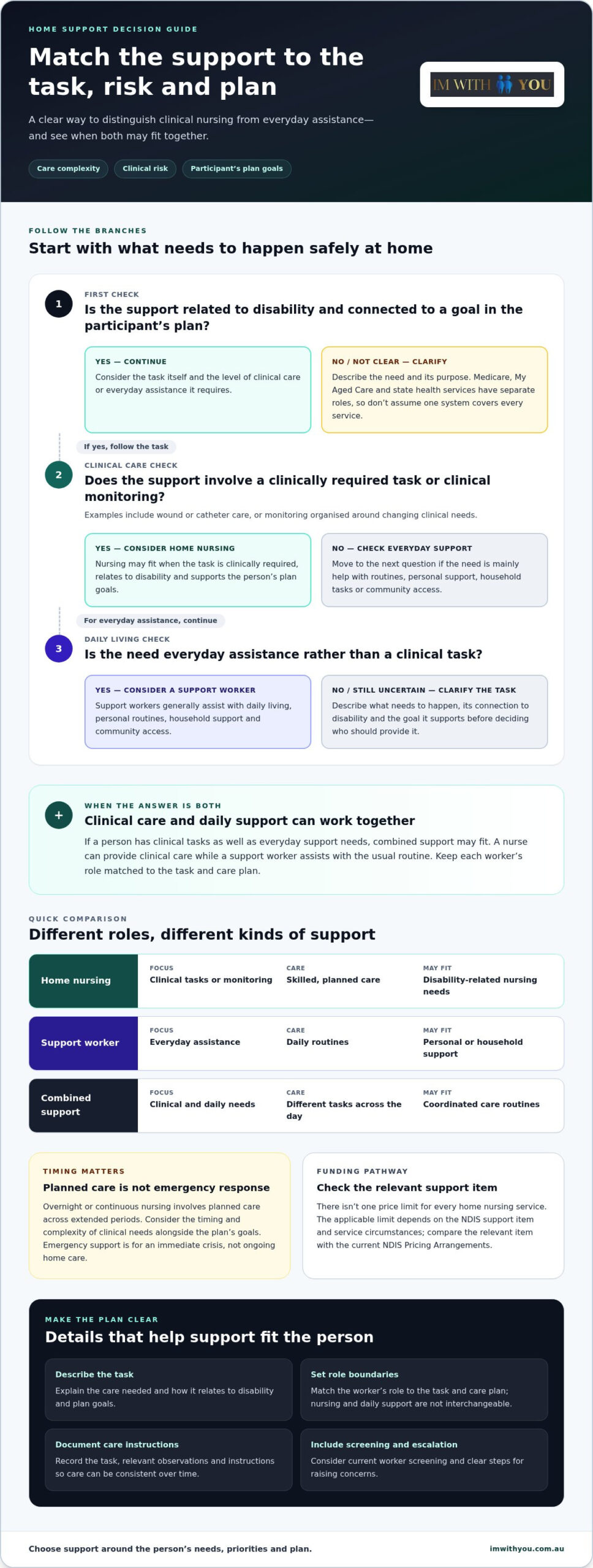
NDIS nursing and support services
Home nursing and daily support address different needs, though both can contribute to a person’s routine. The funding pathway depends on the support’s purpose and its relationship to disability.
NDIS Nursing vs Other Health Services
NDIS home nursing relates to disability-related health support that forms part of daily life. Sydney Children’s Hospitals Network explains that the NDIS funds these supports when they result from disability and are regular parts of a participant’s daily life. Medicare, My Aged Care and state health services have separate roles, so identify the need and relevant funding pathway rather than assuming one system covers every service.
Nurses and Support Workers for Nursing Tasks
Registered nurses and enrolled nurses provide nursing care suited to their role and the person’s needs. Support workers generally assist with daily living, personal routines, household support and community access. For example, a nurse may provide clinical care, while a support worker helps someone follow their usual routine. Match the worker’s role to the task and care plan, rather than treating the roles as interchangeable.
Nursing Service Price Limits
There isn’t one price limit that applies to every home nursing service. The applicable limit depends on the relevant NDIS support item and service circumstances. To understand the limit for a planned service, identify the item that describes the nursing support, then compare it with the current NDIS Pricing Arrangements. Avoid applying a rate for one support item to a different nursing task.
Home-Based NDIS Nursing Supports
Home nursing may include clinically required wound or catheter care, along with related clinical support. To find registered nursing providers, search the NDIS provider directory by nursing support and your state or territory, or consider dedicated providers like Adva Care for tailored community and home nursing support. Choose based on the person’s clinical needs and plan. Support workers can complement nursing with daily living assistance, but these roles serve different purposes.
Im with you: Disability Support Services
Im with you can help you connect your NDIS goals with practical disability support, community participation and plan coordination. If you are weighing clinical nursing against everyday assistance, its Disability Support Services can support daily routines, while Community Participation Support can help you work towards taking part in community life.
NDIS Support Coordination can help you understand and organise supports around your plan. Disability Advocacy Services may also help you communicate your preferences and have your voice heard. These supports can be useful when clarifying what matters most, coordinating daily assistance or preparing to discuss your needs.
You can take the next step at your own pace. Contact Im with you or visit imwithyou.com.au to explore support that fits your goals.
Take a clear next step towards support at home
As you consider NDIS nursing support at home, focus on what you want the support to make possible. Write down the tasks that matter most, what a good day looks like and how support could help you maintain your routines and independence. This gives you a practical starting point for a conversation about your needs and priorities.
You don’t need to have every detail settled before taking that step. If you’d like support thinking through your options and goals, contact Im with you to start a conversation.
Your needs and preferences can guide the way forward, one manageable step at a time.
Frequently Asked Questions
What qualifications and registration must an NDIS nurse or provider have?
Ask which nurse will deliver the care, what qualification they hold and what registration applies to their role. Request the provider’s process for checking credentials, maintaining competence and arranging clinical oversight. Also clarify who to contact if the usual nurse is unavailable. These questions help you understand the care arrangement without assuming provider registration alone explains a worker’s clinical qualifications.
What are the risks, safeguards, and complaints process for NDIS nursing support at home?
Risks can include unclear care instructions, missed changes in health or confusion about who performs a task. Agree on written instructions, responsibilities, escalation steps and how concerns will be recorded. If something feels wrong, raise it promptly with the provider and describe the task, date and impact. Ask about the provider’s complaints process and how unresolved concerns can be escalated.