

A support plan should reflect the life a person wants to build, not just the help they need today. A Participant Support Plan isn’t an official NDIS document; it’s a practical guide to the person’s strengths, preferences, support needs, personal goals and the strategies that can help them work towards those goals. Knowing what to include in a support plan makes it easier to turn priorities into clear, useful steps.
A plan should feel personal and manageable, not like another form to fill out. This guide explains how to develop goals together, describe skill-building support and keep the plan relevant as needs and preferences change. It also clarifies how a Participant Support Plan differs from a care plan, so you can decide what information belongs in each.
Key Takeaways
- Keep the plan practical: capture the person’s preferences, strengths, communication needs and the support strategies that work for them.
- Set personal goals together, then break each one into manageable steps that build skills and independence.
- Make outcomes meaningful by linking support to everyday priorities, relationships and community participation.
- Revisit the plan as goals, needs or preferences change, and distinguish its day-to-day guidance from a care plan’s service details.
What is a Participant Support Plan?
A Participant Support Plan is a practical guide to someone’s preferences, strengths, disability-related support needs and goals. It isn’t an official NDIS document, and the participant, a Support Coordinator, carer or trusted person can help prepare it. In Australia, review it regularly and whenever needs, goals or preferences change. For Support at Home, care partners review each care plan with the participant at least once every 12 months, and when requested or circumstances change.
Include emergency steps for cancelled support, illness or other emergencies, along with known triggers and changes to routines or the environment that can reduce risk. Record what helps the person feel safe while supporting their independence.
Document the relevant funding arrangement, such as whether the participant is self-managed or plan-managed. For Support at Home, the care plan should align the individualised budget with agreed needs and services.
- Invite the participant to lead. Ask how they want to communicate, who they want involved and what helps them feel comfortable. Use communication aids or devices where helpful, and give someone time to share preferences in their own way.
- Write guidance for new supporters. Record communication preferences, preferred worker characteristics, sensory sensitivities and daily routines. For example, note which approach helps during a transition or in a busy environment.
- Make the plan useful during a change. Share relevant guidance when a new support worker starts, services change or a review approaches. Keep the working document concise, accessible to involved supporters and focused on information they need.
- Review the strategies, not just the dates. Note what has helped, what hasn’t and whether new strategies need documenting and evaluating. Update the plan after a change in needs, preferences or support.
- Keep related plans clear. If a formal Behaviour Support Plan or Seizure Management Plan exists, note its availability and who holds it. This helps supporters find the right guidance without copying every detail.
Personal goals and skill development
Build each goal around what the participant wants to do, learn or experience. A Participant Support Plan can translate those priorities into practical steps that support progress and choice.
Deciding what to include in a support plan starts with the participant’s preferences. Use the steps below to make each goal meaningful and workable.
-
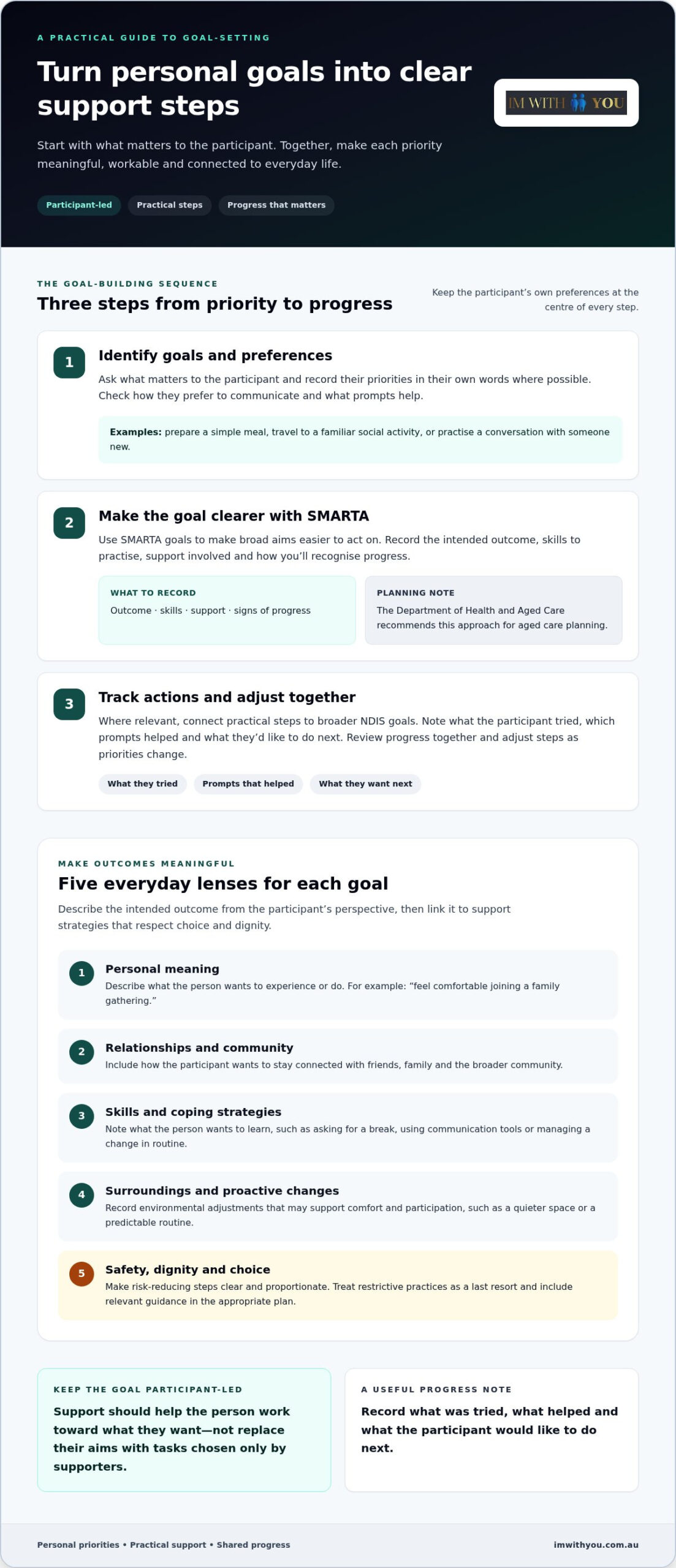
Identify participant goals and preferences
Ask the participant what matters to them, then record their priorities in their own words where possible. A goal might be preparing a simple meal, travelling to a familiar social activity or practising a conversation with someone new. Check how they prefer to communicate and what prompts help. Don’t replace their aims with tasks chosen only by supporters. Let their preferences guide each step.
-
Set SMARTA goals
Use SMARTA goals to make broad aims clearer and easier to act on. The Department of Health and Aged Care recommends this approach for aged care planning. Record the intended outcome, skills to practise, support involved and how you’ll recognise progress. For example, exploring a community activity might involve identifying an option the participant chooses and agreeing what support they’d like to take part. Keep the goal meaningful to them.
-
Track NDIS goals and progress
Where relevant, connect practical steps to the participant’s broader NDIS goals, then document actions and progress in plain language. Note what they tried, which prompts helped and what they’d like to do next. Progress might mean feeling more confident, practising a skill with less assistance or choosing a new direction. Review the notes together and adjust the steps as priorities change. This helps make progress visible.
A useful way to think about what to include in a support plan is to link each goal with a next step the participant values. For help with everyday skill-building, explore capacity-building support.
What are the key goals and outcomes in a support plan?
Choose outcomes that matter in the participant’s everyday life, then link each one to clear support strategies. A useful plan considers quality of life, skills, relationships, surroundings and safety together.
- Describe the outcome from the participant’s perspective. Write what they want to experience or do, not only what supporters will provide. For example, “feel comfortable joining a family gathering” gives a clearer direction than “attend social activities.” This keeps the intended outcome personal and recognisable to the participant.
- Connect support to relationships and community. Include ways the person wants to stay connected with friends, family and the broader community. A strategy could involve choosing an activity with a trusted person or identifying support that makes participation feel more accessible—such as joining live online adult workshops through Lila Joy Seminars to build social confidence. Make the participant’s own interests the guide.
- Identify skills and coping strategies to practise. Note what the person wants to learn and what support helps them build confidence. This could include practising a preferred way to ask for a break, use communication tools or manage a change in routine. Describe the supporter’s role without taking over choices the participant can make.
- Consider surroundings and proactive changes. Record environmental adjustments that may support comfort and participation. For example, a quieter space or a predictable routine may help someone engage in an activity. Include strategies that anticipate stress, alongside agreed responses if distress arises.
- Make safety strategies clear and proportionate. Describe steps that reduce risk while protecting dignity and choice. If restrictive practices may be used, treat them as a last resort and include relevant guidance in the appropriate plan. Review outcomes with the participant, noting what supports wellbeing and what needs to change.
Use these outcomes to guide practical next steps and put support goals into practice.
Im with you: Disability Support Services
Im with you provides Disability Support Services to help people put their support needs and personal priorities into practice. Community Participation Support can help make community involvement part of the support journey, while NDIS Support Coordination helps coordinate supports. Disability Advocacy Services can support people who want their voice and preferences heard.
These services may be helpful when you are shaping a plan around everyday life, building skills or working through support decisions. The starting point is the person: what matters to them, what they want to work towards and what support feels right. You don’t have to work through those questions alone. Contact Im with you to talk about support that fits your goals.
Take the next step at your own pace
A useful next step is to choose one priority the participant wants to work on now. Write down the first action, who will support it and what would help the process feel comfortable. This gives everyone a clear place to begin without trying to address everything at once.
As you decide what to include in a support plan, keep the participant’s voice at its centre. Invite them to say what feels helpful, what they’d like to change and when they want to revisit the plan. Small, shared decisions can make the document more personal and easier to use in everyday life.
If you’d like support to explore your next steps, contact Im with you. You can move forward one conversation at a time, with the participant’s priorities leading the way.
Frequently Asked Questions
What steps are involved in care planning?
Care planning starts by discussing the person’s priorities, daily routines and support preferences together. Agree on the services, who will provide them and how they fit into everyday life, then write the plan in clear, accessible language. In Australia’s Support at Home program, care partners prepare the plan with the participant, their carer or registered supporter, before or on the day support starts. For healthcare and care providers managing formal governance standards overseas, working with specialists like CQC Consultancy helps ensure that care documentation and delivery meet strict registration and quality benchmarks.
What should a support plan include in Australia?
Include practical guidance supporters can use, such as what assistance the person welcomes, what they prefer to do independently and how they want choices presented. Note who to involve if plans change and where to find related documents. For example, direct a new worker to the participant’s current communication passport rather than duplicating information that already has a clear home.
How should a support plan describe a person’s needs, strengths and preferences?
Use respectful, specific language to describe what the person can do, what they enjoy and where support helps. Separate observations from assumptions: “likes a quiet space before appointments” is more useful than a broad label. Include the person’s own words where possible, and explain how their strengths support their choices, such as using a familiar routine to prepare for a new activity.
How do you make a support plan person-centred and culturally safe?
Involve the participant in shaping the plan. Ask how they want to communicate and who they want involved, then record their preferences, strengths and goals in their own words where possible. For Support at Home, include cultural preferences and agree how services will be delivered in culturally safe, trauma-aware and healing-informed ways.