

What if an NDIS report could make everyday support needs easier to explain, not just list a diagnosis? If you’re wondering what therapists can provide NDIS reports for, their evidence can describe how disability affects daily activities and connect those experiences with personal goals.
It’s understandable to feel unsure about which therapist to involve or what information will be useful. A clear, practical report can bring daily challenges, strengths and support needs into focus, but it can’t guarantee a particular NDIS decision.
In this guide, we’ll look at the functional information therapists may include, how occupational therapy and other therapeutic supports can relate to everyday goals, and how to prepare for an assessment. We’ll also cover ways to share your experiences clearly, so you can feel more confident about possible next steps.
Key Takeaways
- Understand what therapists can provide NDIS reports about, including daily function, goals, barriers and support needs.
- See how a report’s purpose can vary, from explaining a specific support need to documenting changes in a participant’s circumstances.
- Look for clear links between assessment findings, everyday routines and the participant’s own goals.
- Review the report with the therapist and consider how its evidence relates to your current goals and circumstances.
What can therapists provide in NDIS reports, and what are they for?
An NDIS therapist report can describe how a participant manages everyday activities, what goals matter to them, and where barriers or support needs arise. Its purpose depends on the question being explored. A report might contribute information for planning or review, address a particular support need, or document a change in circumstances.
If you’re learning about the National Disability Insurance Scheme (NDIS), a report can help explain how a participant’s experiences relate to their support needs. It informs consideration, but it can’t promise funding or a particular decision. Knowing what therapists can provide NDIS reports for can help you and your therapist focus on the question that matters to you.
For a practical introduction to functional capacity assessment, watch this video:
Which therapist may contribute to a report?
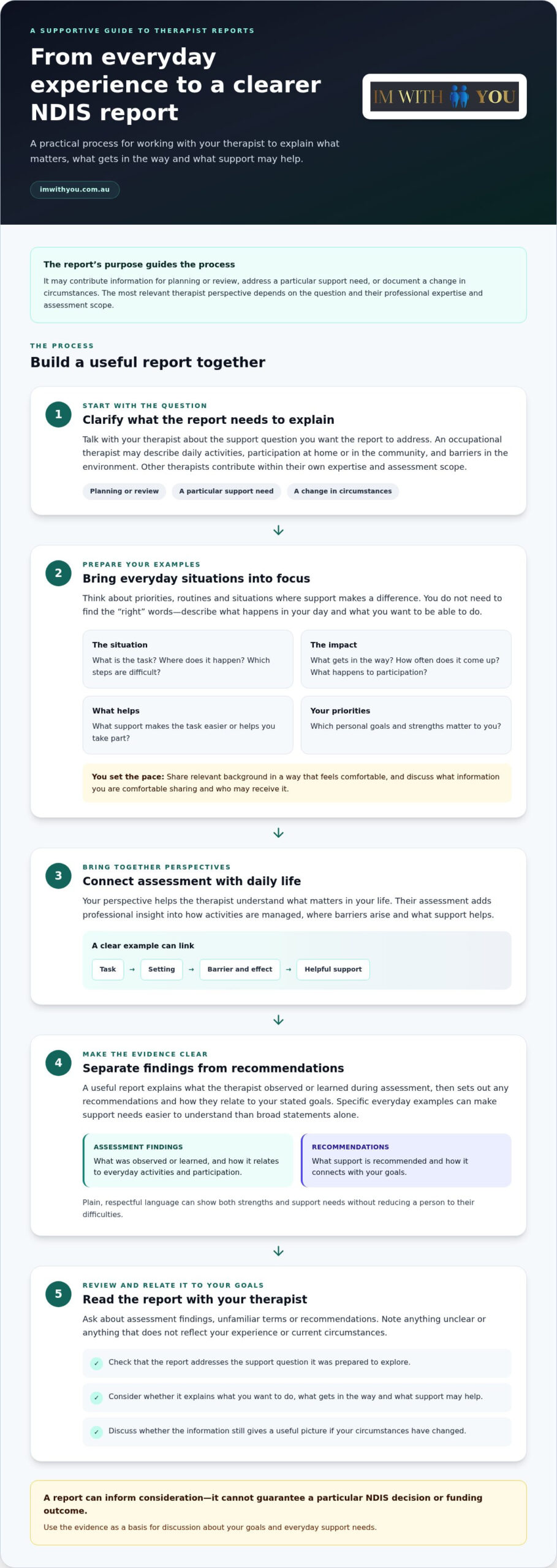
An occupational therapist may describe how a person manages daily activities, takes part at home or in the community, and encounters barriers in their environment. For example, a report might explain which parts of a daily routine are difficult, what happens in a particular setting, and what support helps the person participate. This can connect functional needs with meaningful goals, such as building independence in a routine.
Other therapists can provide information within their own professional expertise and assessment scope. The most relevant perspective depends on the support question, not a universal report format or discipline. Work with the therapist to clarify what the report is intended to explain, and refer to current NDIA guidance for information about evidence relevant to your circumstances.
What makes an NDIS therapist report clear, relevant and useful?
A useful report connects what the therapist observes, what the participant wants to work towards and what happens in everyday life. Instead of relying on broad statements, it can describe a specific situation: for example, how noise or a busy environment affects participation in a community activity, or what support helps someone follow a daily routine. Useful details include the task, the setting, the barrier, its effect on participation and what support makes a difference.
Clear evidence also separates findings from recommendations. The therapist can explain what they observed or learned during assessment, then set out any recommendations and how these relate to the participant’s stated goals. Plain, respectful language helps readers understand both the support need and the person’s strengths, without reducing them to difficulties. The NDIS guide to report writing offers further guidance on preparing reports.
Understanding what therapists can provide NDIS reports about can help you prepare examples that reflect your circumstances. You don’t need to find the “right” words or make assumptions about what the report should say. Focus on what happens in your day and what you want to be able to do.
How to prepare for a therapist assessment and report
Before an assessment, think about your priorities, routines and situations where support makes a difference. You might note what makes a task easier or harder, where it takes place, how often the difficulty comes up, and what support helps you take part. For instance, you could describe the steps involved in an activity and identify where you need assistance. Share relevant background with the therapist at a pace that feels comfortable. You can also discuss what information you’re comfortable sharing and who may receive it.
Preparation is a partnership. Your perspective helps the therapist understand what matters in your life, while their assessment brings professional insight to the picture. If you’re also considering how a provider’s approach fits your needs, our guide to choosing an NDIS provider offers a helpful place to reflect on what matters to you.
How to use a therapist’s NDIS report as a next step
Once you have the report, set aside time to read it with your therapist. Ask them to explain assessment findings, unfamiliar terms or recommendations, and discuss whether the report reflects your experiences accurately. As you read, note anything that feels unclear or doesn’t match your current circumstances. Check that the report describes the support question it was prepared to address.
Then consider how the evidence relates to your goals and everyday support needs. Does it describe what you want to do, what gets in the way and what support may help? A report can inform conversations and NDIS processes, but it can’t guarantee funding or a particular outcome. If your circumstances have changed, discuss with the therapist whether the information still gives a useful picture of your needs.
Turn report findings into a collaborative support conversation
A report can also be a starting point for planning practical steps. Occupational therapy and therapeutic supports can help explore how to build skills, take part in meaningful activities and work towards everyday goals. You remain central to that conversation: your priorities and preferences help shape what progress means for you.
If you’d like help understanding how report information fits into NDIS processes, support coordination or advocacy may help you consider possible next steps. The question of what therapists can provide NDIS reports about is only one part of the picture. Understanding how the information connects with your goals can help you decide what to discuss next. You can explore support with Im with you as you work through those questions.
Take your next step with confidence
A therapist’s report can help make everyday experiences, support needs and personal goals easier to understand. Knowing what therapists can provide NDIS reports about can help you work with your therapist to ensure the information reflects your circumstances and gives you a clearer basis for discussion. A report may inform NDIS consideration, but it can’t guarantee a particular decision.
Take time to review the findings and recommendations together, then consider how they relate to what matters in your life now. You don’t have to work through every question alone. Im with you provides occupational therapy and therapeutic supports to help connect functional needs with everyday goals, alongside support coordination and advocacy to help people understand NDIS processes.
If you’d like to explore a supportive next step, see how Im with you can walk alongside you. Your goals and perspective matter, and you can move forward one conversation at a time.
Frequently Asked Questions
Can any therapist provide an NDIS report?
A therapist can contribute a report about needs and findings within their professional expertise and assessment scope. The most appropriate therapist depends on the question the report needs to address. For example, an occupational therapist may focus on daily activities and participation, while another therapist may describe needs relevant to their area of practice. Consider the report’s purpose and current NDIA guidance on evidence.
What does an occupational therapist include in an NDIS report?
An occupational therapist may describe how a participant manages daily activities, takes part at home or in the community, and experiences barriers in their environment. The report may connect assessment findings with the participant’s goals and explain relevant support needs. Knowing what therapists can provide NDIS reports about can help you discuss which activities and circumstances the report should reflect.
Does an NDIS therapist report guarantee funding?
No. A therapist’s report can provide professional information to help explain functional needs and support recommendations, but it can’t guarantee funding or a particular NDIS decision. The report is one part of the information considered. Review its findings with the therapist and consider how they relate to your goals and current circumstances, without assuming a specific outcome.
How do I prepare for an NDIS therapy assessment?
Before the assessment, think about your priorities, everyday routines and situations where support makes a difference. You could jot down examples of tasks that feel easier or harder, the environments involved, and what helps you participate. Share relevant background at a pace that feels comfortable, and discuss your preferences about information sharing. Bringing questions can help you and the therapist work through the assessment together.