

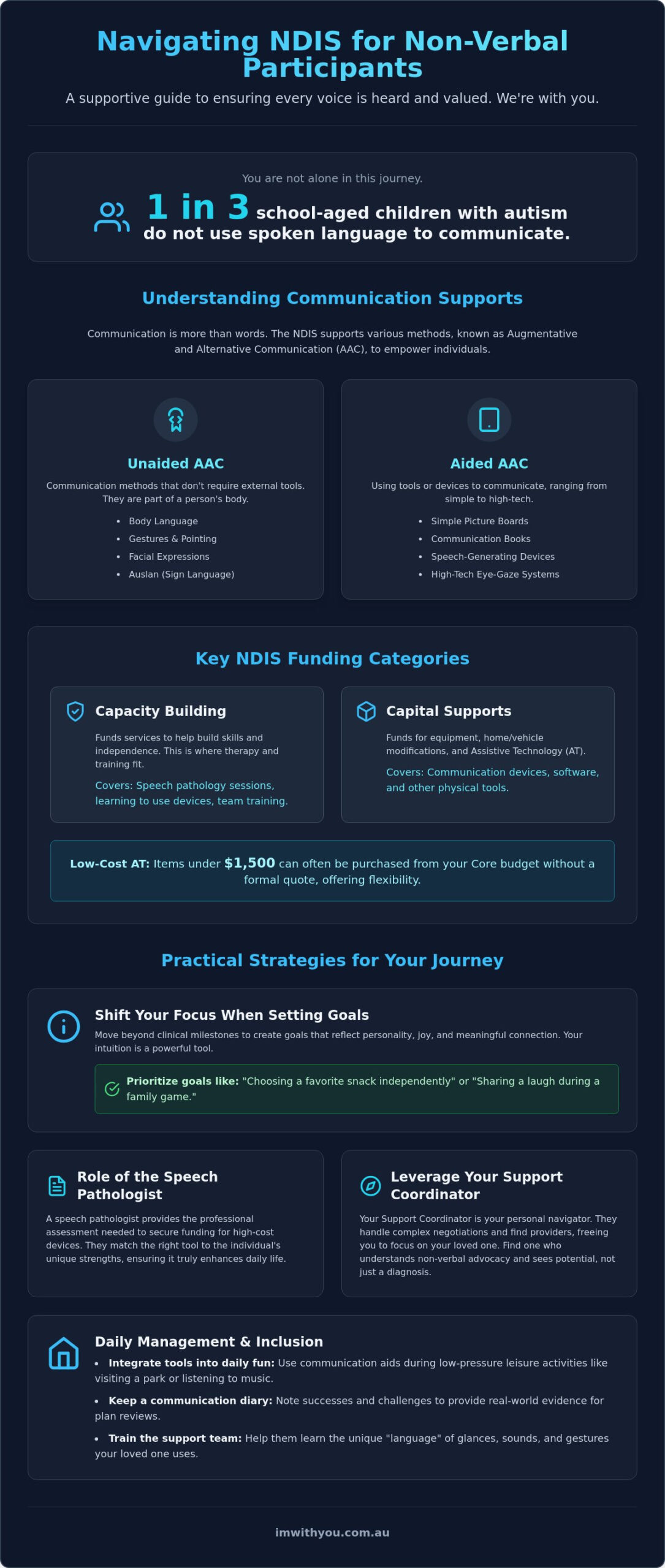
Imagine sitting in an NDIS planning meeting where the room is filled with talk about your future, yet the person most affected feels completely invisible because they don’t use spoken words. It’s a heavy, isolating experience for many families, but navigating ndis with a non-verbal participant doesn’t have to be a journey you take alone. I’m with you. With recent data showing that about one in three school-aged children with autism don’t communicate using spoken language, it’s clear that your family isn’t the only one looking for a better way to be heard and understood.
We both know that every person has something to say, regardless of how they say it. You deserve a clear roadmap to turn that belief into a reality. This guide will help you understand which funding categories cover essential communication devices and how to choose a support team that values partnership over clinical checklists. I’ll walk you through the practical strategies needed to empower non-verbal participants, ensuring their unique voice is respected and heard in every part of their daily life.
Key Takeaways
- Unlock the pathways to independence by understanding how AAC tools fit within your funding, moving beyond clinical definitions to real-world communication.
- Simplify navigating ndis with a non-verbal participant by reframing goals to focus on shared moments of joy and meaningful daily interaction.
- Learn how to coordinate a support network that treats every interaction as an opportunity for connection rather than just a task to be completed.
- Identify the qualities of a support team that truly hears your loved one, ensuring their dignity and personal preferences stay at the heart of their care.
- Feel empowered in your management journey with practical strategies that remind you that I’m with you every step of the way.
Understanding NDIS Communication Supports for Non-Verbal Participants
Communication is much more than the words we speak. Within the NDIS framework, non-verbal communication is recognized as a vital pathway to independence and social inclusion. Understanding Non-Verbal Communication helps us see that every gesture, facial expression, and sign is a meaningful contribution to a person’s story. When navigating ndis with a non-verbal participant, the goal is to ensure these expressions are heard and respected by everyone in their circle.
The primary vehicle for this support is Augmentative and Alternative Communication (AAC). This includes ‘Unaided’ methods like body language and Auslan, as well as ‘Aided’ tools ranging from simple picture boards to high-tech eye-gaze devices. I know the technical terms can feel overwhelming, but I’m with you. We can break these down together so they become tools for connection rather than barriers to understanding.
To better understand how assessment tools can support this journey, watch this helpful video:
Key NDIS Funding Categories for Communication
Funding typically sits in two specific places. ‘Capacity Building’ pays for the therapy hours needed to learn new skills, while ‘Capital Supports’ covers physical Assistive Technology (AT). For low-cost items under $1,500, you can usually purchase them from a Core budget without a formal quote. However, for high-tech devices, the NDIS requires detailed documentation. Using person first language in these reports ensures the focus stays on the individual’s strengths and dignity rather than their limitations.
The Role of the Speech Pathologist
A professional assessment from a speech pathologist is often the golden ticket for securing funding. They don’t just pick a device; they match the participant’s specific physical and cognitive strengths to the right tool. This ensures the technology actually improves daily life. Their expert voice provides the evidence the NDIS needs to approve high-cost communication supports, making the path to a clearer voice much smoother for your family.
Practical Strategies for Managing Your NDIS Plan and Goals
Managing an NDIS plan is about more than ticking boxes or managing budgets; it’s about creating a life filled with meaning and agency. When you’re navigating ndis with a non-verbal participant, the goals you set should reflect the person’s heart and individual personality. Instead of focusing solely on clinical milestones, I encourage you to prioritize goals centered on joy and connection. This might mean being able to choose a favorite snack independently or sharing a laugh during a family game. I’m with you in this process, and I want you to know that your intuition as a carer is your most powerful tool in these meetings.
Preparing for a plan review can feel stressful, especially when communication needs evolve over time. Perhaps a child is transitioning to school or an adult is exploring new community spaces that require different tools. To ensure the budget remains supportive, keep a simple “communication diary” of successes and challenges throughout the year. This evidence shows the NDIS how specific supports are working in real-world settings. You don’t need to be an expert in legislation to be an incredible advocate for the person you love.
Leveraging NDIS Support Coordination
A Support Coordinator acts as your personal navigator through the often confusing NDIS landscape. They handle the complex hurdles and provider negotiations so you can focus on being present with your loved one. Finding a coordinator who understands the nuances of non-verbal advocacy is essential for long-term success. They should see the participant’s potential and focus on what they can do, rather than just their diagnosis. If you’re currently looking for the right fit, our guide on how to choose an NDIS provider can help you find a partner who truly aligns with your values.
Daily Management and Inclusion Strategies
Integrating communication aids into everyday life makes them second nature for everyone involved. Try bringing these tools into leisure activities, like visiting a local park or listening to music, where the pressure to perform is low. It’s also vital to train your support team to recognize subtle cues; every participant has a unique “language” of glances, sounds, or gestures. Beyond individual tools, you can also access broader Government Support for Communication, such as the National Relay Service, to enhance safety and community access. If you need help coordinating these various supports, our team is here to help you build a plan that works for your family’s unique rhythm.
Building a Support Network That Truly Hears You
While technology provides the tools, the heart of successful support is always the relationship. Navigating ndis with a non-verbal participant requires a gentle shift in perspective. We must move beyond seeing a device as the final solution and start seeing it as a bridge to deeper connection. A speech-generating device or a picture board is only truly effective if the person on the other end is willing to listen with their whole heart. At “I’m with you,” we approach disability support with a human touch that prioritizes dignity. We believe every individual should lead their own journey, and their verbal status should never be a barrier to their agency or choice.
Building this network means choosing providers who value person-centered care over clinical checklists. When a support team sees the person before the disability, the atmosphere changes from one of management to one of partnership. This collaborative environment lowers stress for everyone involved, creating a safe space where the participant feels empowered to express themselves in their own way. I’m with you in this effort to ensure your loved one isn’t just supported, but truly understood.
Advocacy as a Form of Partnership
Being a ‘voice’ for someone who doesn’t use speech is a profound responsibility, but it’s a shared one. It’s about moving away from clinical management and toward what we call life-focused accompaniment. In all our NDIS interactions, we should use a strengths-based approach. Instead of focusing on what’s missing, we celebrate the participant’s unique ways of connecting. This partnership ensures that their preferences and personality stay at the center of every decision made in their plan.
Finding the Right Companion for the Journey
The right support network makes a world of difference in how a participant experiences the world. When you’re looking for support workers, prioritize patience and a genuine capacity for empathy. They should be eager to learn the participant’s specific non-verbal “language.” Premium disability support services offer a sense of security that comes from knowing your companion is a trusted advocate. You’re doing an incredible job managing these complex responsibilities. Please remember that you’re not alone; we’re here to walk beside you every step of the way.
Empowering Your Voice and Your Future
You’ve taken a significant step today by learning how to bridge the gap between technical NDIS requirements and the heart of meaningful connection. We’ve explored how the right AAC tools and person-centered goals can transform daily life from a series of tasks into a journey of shared joy. I know that navigating ndis with a non-verbal participant often feels like a heavy responsibility, but it’s one we can share.
At “I’m with you,” we’re proud to offer specialized NDIS Support Coordination and Advocacy that puts the individual first. Our commitment to compassionate care was recognized with the 2026 Award for Excellence in Disability Support, reflecting our dedication to walking alongside families like yours. You don’t have to be an expert in the system to ensure your loved one is heard and respected.
Let us walk this path with you—explore our NDIS Support Services today.
You’re doing an incredible job, and I’m with you every step of the way.
Frequently Asked Questions
Does the NDIS pay for iPads or tablets for non-verbal participants?
Yes, the NDIS can fund tablets if they are primarily used as a communication tool. To get this approved, you’ll need a speech pathologist to recommend it as a ‘reasonable and necessary’ support. They must explain why a tablet is better than other options for your specific needs. I’m with you in this process, ensuring your application focuses on how the device will help you connect with the world more independently every day.
What happens if a non-verbal participant’s communication device breaks?
When a communication device breaks, you can generally access funding for repairs or a replacement through your Capital budget. If the repair costs less than $1,500, you might even be able to use your Core budget for a faster solution. It’s a good idea to keep a record of the device’s importance for your daily safety. Your support coordinator can help you navigate these quick fixes so you’re never without your voice.
How do I prove a non-verbal participant needs more 1:1 support in their NDIS plan?
You can prove the need for more 1:1 support by providing detailed evidence of how communication barriers impact daily safety and independence. Navigating ndis with a non-verbal participant requires showing the NDIS exactly where spoken language gaps create risks. Using reports like Functional Capacity Assessments from your therapists is the best way to do this. These documents give the NDIS a clear picture of why constant, dedicated support is essential for your personal growth.
Can a non-verbal participant still achieve Supported Independent Living (SIL) goals?
Yes, non-verbal participants can absolutely achieve SIL goals by focusing on tailored communication strategies within their home. Success in independent living depends on having a support team that is fully trained in your specific non-verbal cues and tools. We focus on creating a home environment where your choices are the priority. It’s about ensuring you have the right people around you who listen with patience and respect your agency in every decision.