

What if your NDIS plan felt less like a list of administrative rules and more like a map to the life you have always wanted? Understanding how to build independence with ndis is about more than just checking boxes; it is about finding the confidence to lead your own journey. It’s natural to feel “managed” by a complex system that sometimes forgets you’re the person in the driver’s seat. You might feel anxious about trying a new bus route alone or confused about which funding categories actually help you learn new skills. I know these challenges can feel heavy, and I want you to know that I’m with you every step of the way.
This guide explores practical ways to turn your personal goals into a toolkit for daily life. You’ll discover how to use capacity building supports to gain the confidence you need to manage your own money, travel safely, and make choices that reflect who you are. We will walk through the specific pathways available to you and share gentle strategies to help you step into your autonomy. Together, we can find the right balance of support to help you live life on your own terms, one small victory at a time.
Key Takeaways
- Reframe independence as the power to make choices that align with your unique values and personal goals.
- Explore practical strategies for how to build independence with ndis by turning small daily tasks into meaningful “everyday wins.”
- Discover how Support Coordination serves as a bridge, providing the skills you need to eventually manage your plan with confidence.
- Learn to use advocacy to ensure your plan reflects your growth; I’m with you as you navigate these empowering steps.
Understanding Independence: Choice and Control in Your NDIS Plan
Independence often sounds like a lonely word, but in our partnership, it means something much warmer. It is the freedom to make choices that align with your heart, your values, and your personal goals. Within the National Disability Insurance Scheme, the principle of ‘Choice and Control’ is more than just a policy; it is a promise. This framework is designed to shift you from being a passive recipient of care to the active leader of your own life. It’s here that you truly discover how to build independence with ndis.
This transformation is a journey made of small, steady steps rather than a sudden change. You might start by choosing your own support workers or deciding how you want to spend your afternoon. These moments of agency build upon each other over time. I want you to know that I’m with you as you find your footing and explore what is possible. To see how these principles look in action, you might find this video helpful:
The Difference Between Care and Capacity Building
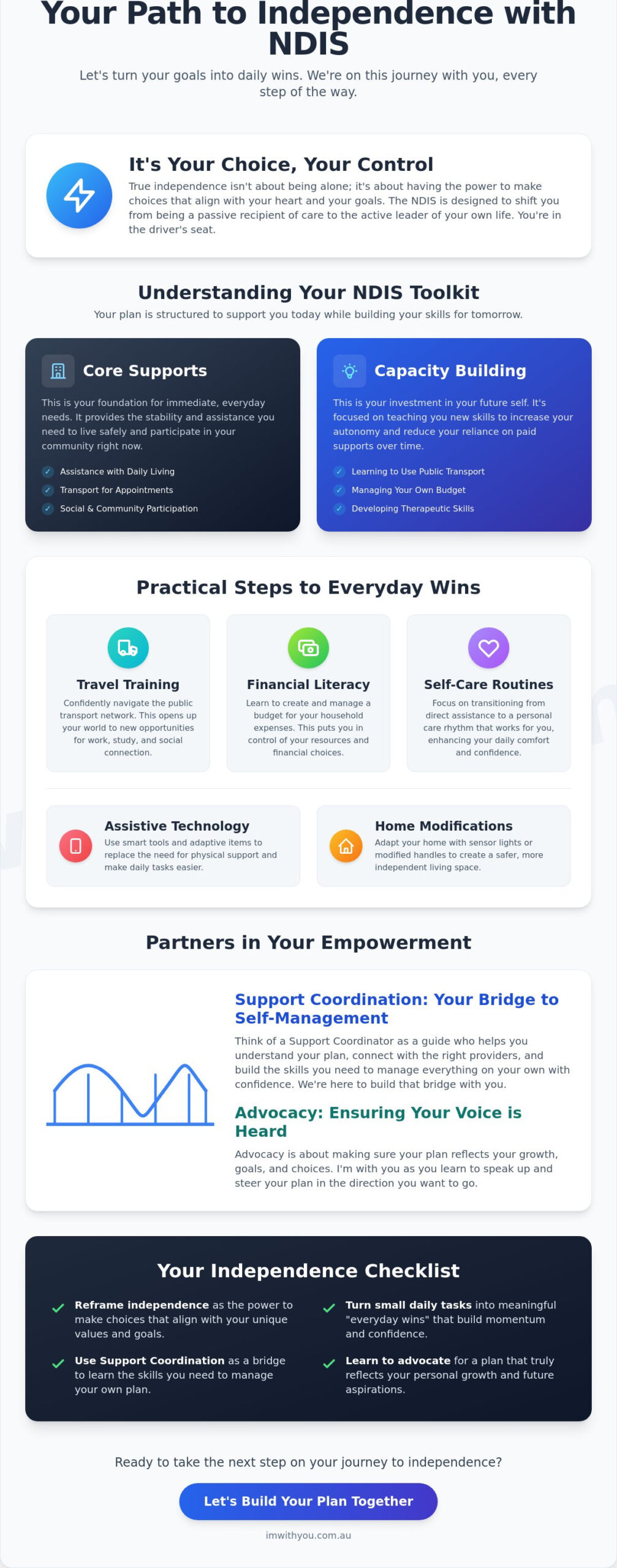
Understanding how to build independence with ndis starts with looking at how your funding is structured. Core Supports are the foundation that helps with your immediate needs today, such as assistance with daily living or transport. Capacity Building is your investment in your future self. It focuses on learning the skills that eventually give you more autonomy, like learning to use public transport or managing a budget.
It’s helpful to pause and ask if your current supports are fostering your growth or creating a cycle of reliance. True independence grows when you are supported to try new things in a safe, non-judgmental environment. By using person-first language, we shift the conversation away from what you can’t do and toward your unique strengths. This simple change in communication empowers you to see yourself as the capable individual you are.
Practical Strategies for Building Daily Living Skills
Building independence is about those quiet, steady moments that lead to a bigger life. I’m with you as we look at how to turn your plan into action. One of the most effective management strategies is identifying ‘Everyday Wins.’ These are the specific, reachable skills that give you immediate freedom. When you’re thinking about how to build independence with ndis, try setting SMART goals in your plan. This means making your goals specific and time-bound. For example, instead of a general goal, you might say, “I want to learn to make my own breakfast by December.” This focus ensures your providers are teaching you a skill rather than just doing the task for you.
Therapeutic Supports play a vital role in this process. A therapist can help you identify physical or cognitive barriers and create adaptive strategies to overcome them. Sometimes, accessing Individual advocacy services can also help you ensure these skill-building supports are properly funded in your plan. It is also essential to remember that finding joy in leisure activities isn’t just for fun; it builds the social confidence you need to connect with your community independently. If you need a partner to help you map out these steps, our Disability Support Services can walk alongside you.
Mastering the Fundamentals of Autonomy
- Travel Training: This involves moving from specialized transport to using the public network with confidence. It opens up your world significantly.
- Financial Literacy: You can use NDIS funding to learn budgeting. This helps you manage your own household expenses and feel in control of your resources.
Using Technology and Home Modifications
Assistive Technology (AT) can be a life-changing tool. Whether it’s a smart home system or a simple adaptive kitchen tool, these items can often replace the need for 24/7 physical support. Small home tweaks, like installing sensor lights or modified door handles, provide the safety you need to move through your day with true self-reliance. These changes allow your home to adapt to you, rather than the other way around.
How Support Coordination and Advocacy Empower Your Future
While a support worker might assist you with a meal today, NDIS Support Coordination acts as a bridge to help you manage your own kitchen tomorrow. It’s a specialized service designed to help you understand the complexities of your plan so you can eventually lead the process yourself. This is a crucial distinction when learning how to build independence with ndis. The landscape of the NDIS is shifting with significant reforms in 2026, making it even more important to have a guide who understands the new planning processes and support needs assessments. I’m with you as you learn how to choose an NDIS provider who values your long-term growth over simple billable hours.
I recommend a management strategy where you and your coordinator check-in on your progress every three months. These rhythmically scheduled conversations aren’t just about paperwork. They’re a chance to look at your wins and adjust your supports if they’ve become too restrictive. If a support is no longer helping you grow, it’s okay to change it. This proactive approach keeps the focus on your agency and prevents you from feeling stuck in a routine that no longer serves your goals.
Building the Confidence to Self-Advocate
Advocacy is your voice in action. Preparing for an NDIS planning meeting with an independence-focused mindset means looking at where you want to be in a year. Don’t be afraid to ask for specific ‘Capacity Building’ funding for decision-making and self-management skills. These funds are specifically there to help you become your own best advocate. Our Disability Advocacy Services can provide the tools you need to speak up for the life you want.
The ‘I’m With You’ Commitment to Your Growth
A premium provider shouldn’t just lead from the front; they should walk beside you as a steady companion. This partnership means we celebrate every small step toward your autonomy. When you feel ready for a larger shift, we can help you explore transitioning to Supported Independent Living (SIL). This move is a significant milestone in your journey, and we’ll ensure the transition feels safe, supported, and entirely on your terms.
Your Path to a More Autonomous Future
Your journey toward self-reliance is a series of brave, small steps that lead to a life defined by your own choices. We have explored how setting specific goals and focusing on capacity building can transform your daily experience. By understanding how to build independence with ndis, you move from simply receiving care to actively leading your own story. Whether it’s mastering a new travel route or gaining the confidence to manage your budget, every win belongs to you.
I’m with you as you navigate these changes, providing the steady companionship and specialized expertise you deserve. As specialists in capacity building and advocacy, we take a person-centered approach that always puts your unique goals first. Our commitment to your growth was recognized with the 2026 Award for Excellence in Quality Care, but our true reward is seeing you thrive. You have the inherent strength to reach your goals; you just need the right partners to walk beside you.
Let’s build your independence together; connect with our compassionate team at Im with you today. You are capable of incredible things, and we’re honored to support your path toward a life lived on your own terms.
Frequently Asked Questions
Can the NDIS help me move out of my family home and live on my own?
Yes, the NDIS provides several pathways to help you move out of your family home and live more autonomously. Options like Supported Independent Living (SIL) or Individualised Living Options (ILO) are designed to support your transition into your own space. These supports focus on building your confidence while ensuring you have the right assistance nearby. I’m with you as you navigate these choices; making sure your new living arrangement truly feels like home.
What exactly is ‘Capacity Building’ and how do I know if I have it in my plan?
Capacity Building is a funding category specifically for learning the skills you need to reach your long-term goals. You can identify it by looking for the “Capacity Building” section in your NDIS plan summary. This budget covers things like therapy, employment support, and training. It is the most important tool for learning how to build independence with ndis because it focuses on your growth rather than just your immediate daily care needs.
How do I tell my current support workers that I want to try doing things myself?
You can start this conversation by clearly explaining your goals to your team. Try saying, “I want to practice this skill myself today, so please just guide me if I get stuck.” This helps your support workers understand that their role is to empower you, not just complete tasks for you. It’s a collaborative process, and I’m with you as you set these new boundaries to reclaim your personal agency and confidence.
Can I use NDIS funding to learn how to use public transport safely?
Yes, you can certainly use your funding for Travel Training to learn how to use the public transport network safely. This support is usually funded under your Capacity Building budget. It allows you to practice catching buses or trains with a skilled worker until you feel ready to go alone. Gaining this skill is a major milestone in how to build independence with ndis; as it connects you to your community without needing specialized transport.