

What if the biggest hurdle in securing your parent’s future isn’t their health, but a single birthday? Many families feel a heavy weight of anxiety as they try to secure disability support for aging parents ndis while balancing the confusing overlap of the aged care system. You’ve likely spent years as their primary advocate and carer, so it’s natural to feel exhausted by the fear of a funding gap that might leave them without the help they need. We understand that you’re not just looking for a service provider; you’re looking for a partner who values your parent’s dignity as much as you do.
You don’t have to carry this burden alone. This guide provides a clear roadmap for the NDIS transition, explaining the critical 65 rule and how the new 2026 planning framework impacts your family’s budget. We’ll show you how to move from constant advocacy to a sustainable model of professional support. By the end, you’ll have the knowledge to protect your parent’s independence and the peace of mind that comes from knowing their future is secure.
Key Takeaways
- Understand the “65 rule” and why staying with the NDIS often provides the best disability-specific outcomes for your loved one as they age.
- Learn how to adapt Core Supports and Capacity Building skills to meet the evolving mobility and energy needs of an ageing participant.
- Discover the “Handover Strategy,” a compassionate way to transition from parental care to a professional support circle while protecting family bonds.
- Secure the right disability support for aging parents ndis by focusing on therapeutic goals that maintain independence and prevent functional decline.
- Gain peace of mind by choosing a partner who prioritizes companionship and walks alongside your family through every complex system change.
Understanding the NDIS and Ageing Parents: The 65-Year Milestone
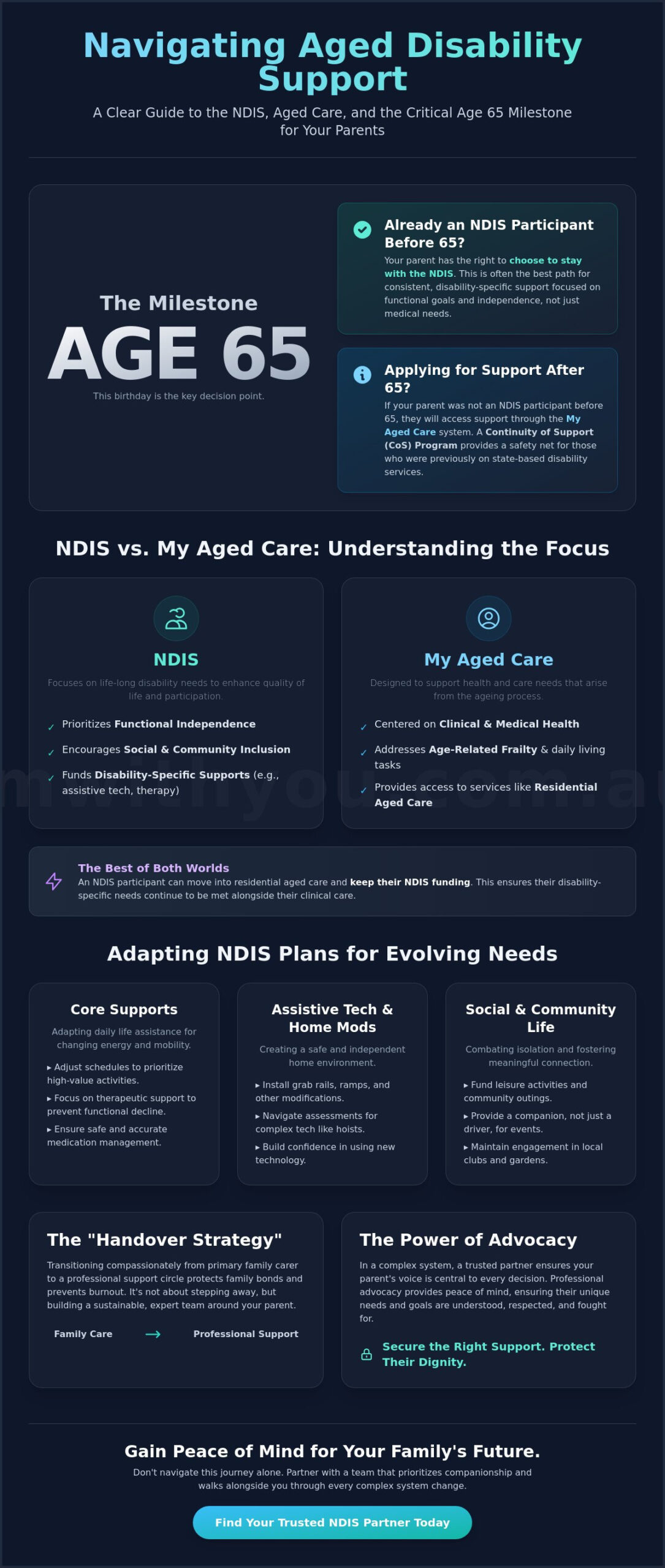
The transition into senior years often brings a wave of paperwork and policy questions. One of the most common concerns we hear involves the 65-year milestone. If your loved one is already a participant in the National Disability Insurance Scheme, reaching this age doesn’t mean they’re forced to switch systems. Staying with the NDIS is often the best way to secure consistent disability support for aging parents ndis, as it focuses on their functional goals rather than just medical needs. This choice at 65 acts as a fundamental right for NDIS participants to maintain their current support standards and live with dignity.
To better understand how these systems work together for families, watch this helpful video:
For those who weren’t eligible for the scheme before turning 65 but still require specialized care, the Continuity of Support (CoS) program provides a vital safety net. It ensures that individuals who were receiving certain state-based disability services can continue to access help that mirrors the NDIS model. We’ll help you explore these options so that no one is left without the companionship and care they deserve.
NDIS vs. My Aged Care: Which Path is Right?
The primary difference lies in the heart of the service. My Aged Care is designed around clinical health and age-related frailty. In contrast, the NDIS prioritizes functional independence and social inclusion. If your parent requires residential aged care, they can actually remain an NDIS participant. This allows them to keep their specialized disability support for aging parents ndis while receiving the clinical care provided by the facility. It’s about ensuring their specific disability needs aren’t overlooked as their healthcare requirements grow more complex.
The Role of Advocacy in the Transition
Planning for the future requires a steady hand and a clear voice. Finding a trusted NDIS provider ensures that your parent’s unique needs aren’t lost in administrative shifts. Our Disability Advocacy Services are here to walk alongside you, making sure your parent’s voice remains the central focus of every funding decision. We believe that professional support should feel like a partnership, providing you with the peace of mind that your loved one is truly heard and understood.
Maximising NDIS Support Categories for Older Participants
As our loved ones grow older, their needs naturally shift. Securing effective disability support for aging parents ndis means looking at their existing plan through a new lens. While the NDIS age requirements set the stage for eligibility, the real value lies in how we adapt each support category to match their changing reality. We focus on preserving their energy and dignity as they navigate this new chapter of life.
Core supports are the heartbeat of daily life. For an ageing parent, this assistance shouldn’t just be about completing tasks; it’s about adapting to changing mobility. If your parent finds they have less energy in the afternoons, we can adjust their support schedule to prioritize the activities that matter most to them. We also place a heavy emphasis on therapeutic supports. These are essential for maintaining safety at home, particularly regarding medication management and preventing functional decline. When health needs become more complex, NDIS Support Coordination provides a steady companion to help you manage these moving parts without feeling overwhelmed.
Assistive Technology and Home Modifications
Safety is the foundation of independence. NDIS-funded home modifications, such as grab rails or ramps, allow parents to age in place safely and comfortably. Navigating the assessment process for complex assistive technology like hoists or specialized beds can feel daunting. We walk alongside you during these assessments to ensure the equipment truly fits your parent’s lifestyle and home environment. If you’re unsure where to start, our team can help you explore capacity building skills that empower your parent to use new technology with confidence.
Social Connection and Community Participation
Isolation is a significant risk as mobility decreases, but it’s one we can tackle together. NDIS funding covers a variety of leisure activities that foster genuine connection. A support worker acts as more than just a driver; they’re a companion who facilitates meaningful community outings. Whether it’s a visit to a local garden or a regular social club, these interactions keep your parent engaged and remind them they’re a valued part of their community.
Planning for the Future: When Ageing Parents are the Primary Carers
For many families, the role of a primary carer is a lifelong commitment built on love and dedication. However, as you age, the concern about who will provide disability support for aging parents ndis once you’re no longer able to can become a source of deep anxiety. We believe that transitioning care isn’t an admission of defeat; it’s a strategic “handover” that ensures your loved one’s world remains stable and supported. Future planning is a gift of security for both the parent and the child with a disability.
Addressing carer fatigue is a vital part of this journey. Acknowledging that you need help is an act of love for your child, not a failure of your duty. The role of carers in the NDIS is changing, with a greater focus on creating a sustainable “Circle of Support.” This circle brings together siblings, close friends, and professional advocates to share the responsibility. It ensures your child has a community walking alongside them, providing a safety net that doesn’t rely solely on one person.
Exploring Supported Independent Living (SIL)
One of the most empowering steps in a handover strategy is exploring Supported Independent Living (SIL). This provides a long-term, stable home for adult children where they can build their own independence within a professional support framework. The transition process is handled with immense care, moving from the family home to a supported environment with dignity and respect for their existing routines. It allows you to return to the role of a parent while we provide the daily assistance they need.
Respite and Short-Term Accommodation
If the idea of a permanent move feels overwhelming, respite services can act as a gentle bridge. Short-term accommodation allows both you and your child to get used to professional support in a safe, unhurried way. These breaks provide the emotional space needed to recharge your family caregiving dynamic. If you’re ready to start building this circle of support, our team is here to help you explore our NDIS Support Coordination services to find the right path forward.
Why a Premium Care Partner Makes the Difference
Finding the right support isn’t just about ticking boxes on a government form. It’s about finding a companion who understands the history and heart of your family. My “Im with you” philosophy means we walk beside you through every stage of this journey, ensuring that your parent’s dignity remains the highest priority. I’m proud to share that our 2026 recognition for quality care reflects this deep commitment to excellence. When you choose a premium partner, you’re choosing to reduce the heavy administrative burden that often comes with securing disability support for aging parents ndis. I want you to feel empowered to step back from the role of a full-time coordinator and simply be a son or daughter again.
Our person-centered advocacy ensures that the specific needs of your loved one are never sidelined by their age. Whether they live with an intellectual disability or physical challenges, we fight for the funding and supports they deserve. We treat every participant as a unique individual with a lifetime of value, ensuring their voice stays at the center of their care plan.
Our Commitment to Quality and Connection
We believe that the best support comes from genuine connection. That’s why I take the time to match participants with companions who share their interests, whether that’s a love for local history or a passion for gardening. Maintaining dignity also means using person-first language in every interaction. This respectful communication style ensures that your parent is always seen as a person first, regardless of the support they require. It’s a simple yet profound way to honor their history and identity.
Taking the First Step Together
Securing a future of dignity starts with a simple, gentle conversation. I invite you to share your long-term goals and your parent’s unique wishes with us. We specialize in implementing disability support for aging parents ndis plans that specifically account for the unique challenges of ageing, ensuring that every transition is as smooth and unhurried as possible. Together, we’ll build a roadmap that provides security for today and profound peace of mind for tomorrow. You don’t have to navigate these complex systems alone, because I’m here to walk with you.
Building a Future of Dignity and Peace of Mind
Securing the right disability support for aging parents ndis is about more than just managing a plan. It’s about protecting the dignity and independence of the people who raised you. By understanding your rights at the 65-year milestone and implementing a thoughtful handover strategy, you can move away from the constant stress of advocacy. You’ve learned that professional support, whether through SIL or tailored community participation, isn’t a replacement for family care. Instead, it’s a way to strengthen those bonds while ensuring your loved one has a reliable circle of support for years to come.
As a national provider with a person-centered companionship model, I’m committed to walking this journey alongside you. Our 2026 Award for Excellence in NDIS Service Delivery reflects our deep expertise in complex support coordination and advocacy. We’re here to handle the administrative weight so you can focus on the moments that truly matter. Let us walk this path with you; contact our team for a gentle discussion about your family’s needs. You’re doing a wonderful job, and you don’t have to face these transitions alone.
Frequently Asked Questions
Can my parent keep their NDIS plan after they turn 65?
Yes, your parent can choose to stay with the NDIS for life if they were already a participant before their 65th birthday. They aren’t required to move to the aged care system just because of their age. This continuity allows them to keep their existing disability support for aging parents ndis and maintain the functional independence they’ve worked hard to build.
What is the difference between NDIS and My Aged Care for someone with a disability?
The primary difference is the focus of the care provided. The NDIS is designed to support functional capacity and social inclusion goals, while My Aged Care focuses on clinical health needs and age-related frailty. Families often find that the NDIS offers more flexibility for specialized therapies and community participation compared to the aged care system’s more clinical approach.
How do I apply for NDIS support for a parent who is already over 65?
You cannot apply for the NDIS for the first time once you have reached your 65th birthday. If your parent is not already a participant, they must seek support through the Australian aged care system, which includes Home Care Packages and the Commonwealth Home Support Programme. We suggest starting with a My Aged Care assessment to explore their available options for domestic and clinical help.
What happens if my parent is a carer for someone on the NDIS and can no longer cope?
When an ageing parent can no longer manage their caregiving role, the NDIS plan for the person they support can be reviewed to include more professional assistance. This transition often involves bringing in disability support services to create a sustainable circle of care. It’s a proactive step that protects the participant’s safety while allowing the parent to focus on their own health and well-being.
Can NDIS funds be used for nursing home costs?
NDIS funding does not cover accommodation, board, or the daily living expenses of a nursing home. However, if your parent is an NDIS participant living in residential aged care, their plan can still fund specialized disability supports that the facility is not responsible for providing. This ensures their unique disability needs are met even within a clinical setting, providing an extra layer of advocacy and care.