

What if the journey to your new home didn’t have to feel like a solo trek through a maze of complex paperwork and confusing “Home and Living” jargon? It’s completely natural to feel a sense of heavy anxiety when you’re stuck in a living arrangement that doesn’t fit your life, wondering if you’ll ever find a place where you truly belong. You’ve likely spent hours worrying about housemate matching or feeling overwhelmed by the technical side of funding. I understand how exhausting it is to feel like just another number in a system that should be about your dignity and your future.
I’m here to share how supported independent living support coordination ndis acts as the vital bridge between a complicated plan and a life of true independence. You don’t have to do this alone. In this guide, I’ll help you understand the SIL application steps with total clarity so you can feel confident in choosing a provider who respects your agency. We’ll explore how a dedicated coordinator serves as your advocate and steady companion, ensuring the move-in process feels like a celebration rather than a chore. By the time we’re done, you’ll see a clear path toward a home that finally feels like yours.
Key Takeaways
- Understand the vital difference between daily living support and specialized housing to ensure your NDIS plan reflects your unique vision for independence.
- Discover how supported independent living support coordination ndis transforms a complex administrative process into a gentle, supported journey toward your new front door.
- Learn how to look beyond simple vacancies to find a home environment where you feel safe, respected, and truly compatible with your housemates.
- Gain confidence in the moving process by exploring how a dedicated coordinator manages service agreements and supports you through your first 90 days.
Understanding the Link Between SIL and Support Coordination
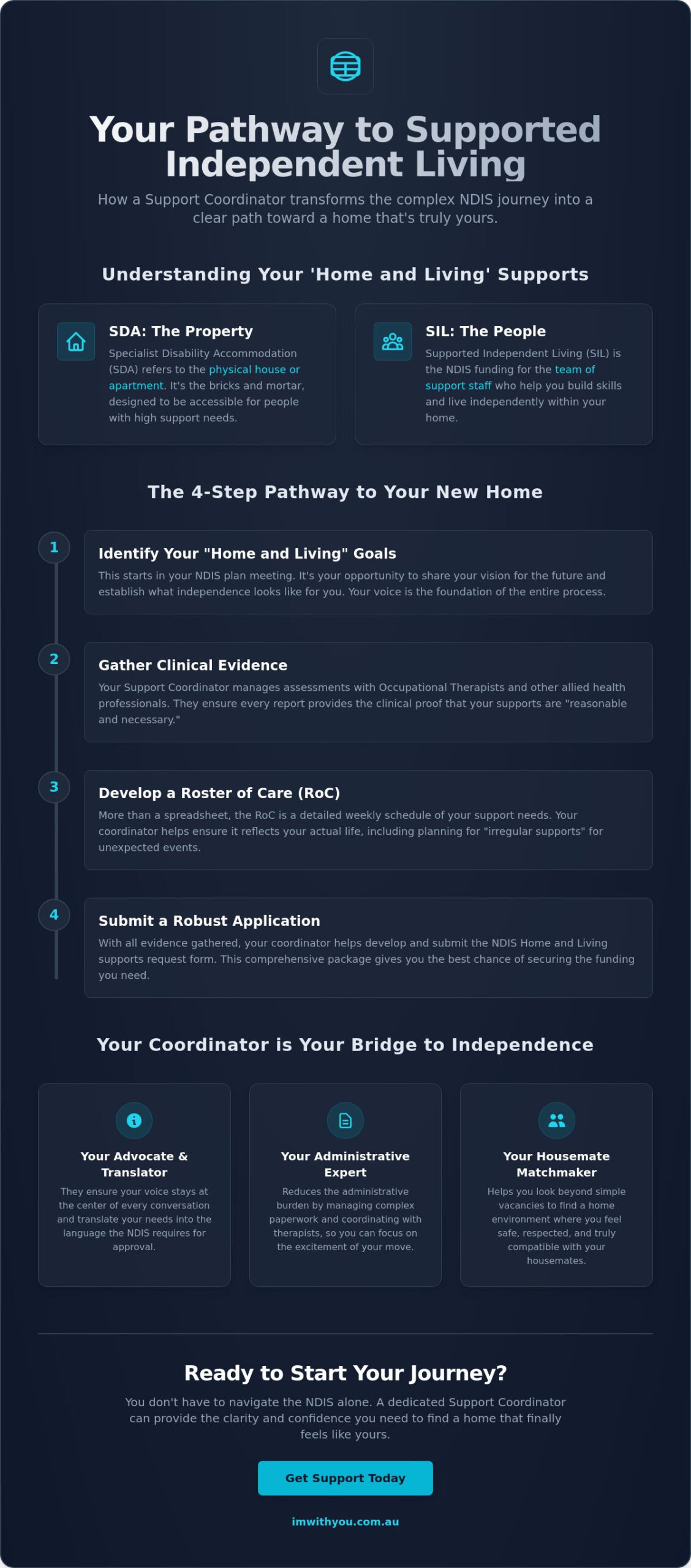
Finding a place to call home is about much more than a set of keys. Within the National Disability Insurance Scheme, Supported Independent Living (SIL) focuses on the human element of your home life. Specifically, Supported Independent Living (SIL) is the funding for support staff within a shared or individual home to help you build the skills needed for daily life. While it’s often confused with Specialist Disability Accommodation (SDA), the difference is simple: SDA is the physical house, while SIL is the team of people who support you inside it. Understanding how supported independent living support coordination ndis services work together is the first step toward a more empowered life.
To help you visualize how these supports come together, watch this brief explanation of the coordinator’s role:
The Heart of the NDIS: Choice, Control, and Connection
Your home should be a reflection of who you are, not just a service delivery point. This is where person-centered planning becomes your strongest tool. A dedicated coordinator ensures your voice stays at the center of every conversation about your “Home and Living” goals. They’ll help you avoid “cookie-cutter” solutions that don’t respect your personality or preferences. If you’re just starting to explore these options, you might find comfort in our gentle guide to supported independent living, which walks through the basics of the journey.
Why You Need a Specialist for the SIL Application
The path to securing funding is often paved with complex paperwork, specifically the NDIS Home and Living supports request form. It’s a detailed document that requires a clear connection between your daily needs and your long-term goals. Your coordinator acts as a specialist translator. They gather clinical evidence from therapists and doctors, aligning these professional insights with the NDIS “reasonable and necessary” criteria. Securing supported independent living support coordination ndis ensures that your application is robust and evidence-based. This partnership reduces the administrative burden on your shoulders, allowing you to focus on the excitement of your upcoming move.
Navigating the NDIS Pathway to SIL Funding
The journey toward your new home involves a few structured steps that we’ll walk through together. It starts with your NDIS plan meeting where we identify your “Home and Living” goals. This is your chance to share your vision for the future. Once those goals are set, engaging a specialist for supported independent living support coordination ndis ensures you have a partner to lead the evidence-gathering phase. I’ll take the lead on the technical requirements so you don’t have to manage the stress alone. We’ll work together to coordinate assessments from Occupational Therapists and allied health professionals. Finally, we develop and submit the Roster of Care (RoC) to the NDIA, which is the final piece of the puzzle.
Demystifying the Roster of Care (RoC)
A Roster of Care is more than just a spreadsheet; it’s a detailed schedule of your weekly support needs. While providers often draft these, I’ll review it with you to ensure it reflects your actual life. We don’t just look at basic safety. We look at the moments that matter to you. We also include “irregular supports” to plan for the unexpected, such as a sudden illness or a change in your routine. This ensures your funding is flexible enough to handle real life. If you’re ready to start this process, I’m here to help you navigate each step with care and expertise.
Securing the Right Evidence for Approval
Professional reports are the backbone of a successful application. They provide the clinical proof that your supports are reasonable and necessary. I know how draining it is to juggle multiple appointments. I’ll walk alongside you and your family to manage these assessments. We ensure every report uses person-first language. This keeps the focus on your strengths and goals rather than just your challenges. According to the NDIS definition of Supported Independent Living, these supports are all about helping you live as independently as possible. By gathering the right evidence early, we create a clear path toward the approval you need to begin your next chapter.
Finding the Right SIL Home: Choice and Control in Action
Finding a house is a matter of real estate, but finding a home is a matter of the heart. When we explore supported independent living support coordination ndis options, we’re looking for a space where you feel safe, respected, and truly yourself. Choice and control are not just industry terms; they mean you have the absolute right to decide who you live with and how your household functions. I’ll help you filter through vacancies across Australia to find options that align with your personality and social needs. We focus on finding a environment where housemate compatibility and social connection can flourish naturally.
Working with a support coordinator for SIL allows you to explore these possibilities without the pressure of doing it alone. We look for more than just a spare room; we look for a community where you can grow. I’ll walk beside you as we interview potential providers to ensure they meet your high standards for care and dignity.
Questions to Ask Potential SIL Providers
I encourage you to interview providers to see if they align with your values. Here are a few essential questions we can ask together during our search:
- How do you manage staff consistency so I can build trust with my support team?
- What’s your process for resolving conflicts or disagreements between housemates?
- How do you help me stay connected to leisure activities and community connection outside the home?
Evaluating the ‘Feel’ of a Home
Site visits are non-negotiable for you and your family. We’ll walk through potential homes together to look for signs of dignity, privacy, and personal expression. Does the living space feel like a clinical environment, or do you see photos on the walls and personal touches in the common areas? My role is to validate your intuition. If a place doesn’t feel right, we’ll keep looking until we find the one that does. Your sense of belonging is the most important metric of success. If you’re ready to find a space that feels like yours, reach out to us to begin your search with a trusted partner.
Transitioning to Independence with a Trusted Companion
Moving day is a beautiful milestone, but the weeks leading up to it can feel like a whirlwind. My role is to steady that pace by managing the intricate logistics of your transition. From finalizing service agreements to setting firm move-in dates, I’ll ensure every detail is handled with care. The first 90 days in a new home are often the most critical for settling in. During this time, I’ll stay close to ensure your support staff truly understand your unique daily needs. This includes vital safety protocols like safe medication administration, giving you and your family total peace of mind.
At ‘Im with you’, we believe in providing the unhurried guidance you deserve. We know that supported independent living support coordination ndis services are most effective when they feel like a partnership. I’m here to catch the falling leaves of administration so you can focus on the joy of decorating your new room and meeting your neighbors. It’s about more than just a change of address; it’s about the start of your new life.
Building Your New Routine
Life in a new home requires a fresh rhythm. We’ll work together to establish clear boundaries and communication channels with your support team right from the start. If you find that your needs change after you’ve moved in, don’t worry. I’ll help you adjust your NDIS plan to reflect your new reality. We don’t just facilitate a move; we celebrate the incredible personal growth that comes with your new independence. It’s a journey we’ll take together, one step at a time.
The ‘Im with you’ Difference in Support Coordination
We’ve built our service on a commitment to being a knowledgeable guide who walks beside you. We don’t lead from the front or direct from above; we listen first. Our excellence award in 2026 is a reflection of this deep empathy and industry expertise. It proves that a gentle, human touch can coexist with professional excellence. If you’re feeling overwhelmed by the possibilities, I invite you to reach out for a gentle conversation about your future. You aren’t alone in this, and I’d love to help you find the home where you truly belong.
Beginning Your New Chapter in a Home of Your Own
You’ve explored how the right partnership can turn a complex funding request into a doorway to independence. We’ve looked at how supported independent living support coordination ndis services provide the evidence and advocacy you need to secure a safe, welcoming space. From the initial goal-setting in your plan meeting to the joy of your first 90 days in a new home, you aren’t alone in this process. Our team brings deep expertise in complex NDIS advocacy to ensure your voice is always heard and your dignity is always respected.
We’re incredibly proud of our 2026 Award for Excellence in Disability Care, but we’re even more proud of the person-centered transitions we facilitate every day. We’d love to bring that same warmth and specialized knowledge to your journey. Let’s walk this path together—contact our friendly team for NDIS support coordination and start looking forward to a life of greater choice and connection. You deserve a home where you truly belong, and we’re ready to help you find it. Your future is bright, and we’re honored to walk alongside you as you step into it.
Frequently Asked Questions
Can I choose my own support coordinator for SIL?
Yes, you have the absolute right to choose a coordinator you feel comfortable with. It’s essential to find someone who understands your vision for a home and shares your values. If you’re exploring supported independent living support coordination ndis options, you can interview different providers to find the right fit. We believe this relationship is a partnership built on trust, so you should never feel forced into a specific service.
What happens if I don’t like the SIL home my coordinator finds?
You never have to settle for a living arrangement that doesn’t feel right. Choice and control are the foundations of the NDIS, meaning you make the final decision on where you live and who you live with. If a potential home doesn’t feel safe or welcoming, we’ll simply keep looking. I’ll listen to your feedback to refine our search until we find a space that truly feels like home.
How long does the NDIS take to approve SIL funding?
The timeline for approval varies depending on the complexity of your needs and the current processing times at the NDIA. While it often takes several weeks or even months to finalize, having a robust evidence-gathering phase helps prevent delays. I’ll stay in constant communication with the agency to track your application’s progress. We’ll work together to ensure every piece of paperwork is perfect to make the process as smooth as possible.
Does SIL funding cover my rent and groceries?
No, SIL funding is specifically for the support staff who help you with daily tasks. It doesn’t cover your rent, board, groceries, or utility bills. These are considered day-to-day living expenses that you typically pay from your own income or disability support pension. Understanding this distinction helps us plan your budget effectively. We’ll ensure your supported independent living support coordination ndis plan focuses on the high-quality care you need to live independently.
Can a support coordinator help me move from a group home to living alone?
Yes, I can certainly help you explore more independent living options if that’s your goal. We’ll start by identifying your desire for solo living in your NDIS plan and then gather the evidence to show how this change supports your growth. Whether it’s finding a self-contained unit or a different shared arrangement, I’m here to advocate for your choice. We’ll focus on building your capacity so you feel confident in your new environment.