

Last Tuesday, Sarah sat at her kitchen table in Melbourne, staring at a budget sheet that felt like a puzzle she couldn’t solve. It’s a heavy feeling when you look at your NDIS plan and wonder if you’re making the right choices for your future. You likely agree that the process often feels more like a test than a support system. Many participants share your anxiety about planning meetings or the fear that funding might be underutilised. We believe you deserve to feel empowered, not exhausted, by your plan. Understanding the common ndis mistakes to avoid is the first step toward reclaiming your sense of choice and control. We’ve gathered these insights to help you move from confusion to confidence, ensuring your budget reflects your actual life goals. This guide explores how to approach your funding with clarity and find a supportive partnership that makes you feel truly seen and heard.
Key Takeaways
- Prepare for your planning meeting with confidence by learning how to use impact statements and documented evidence to clearly communicate your unique needs.
- Discover how to move beyond broad goals to create specific, meaningful targets that ensure your NDIS funding truly supports your independence and well-being.
- Learn how to manage your budget effectively and identify common ndis mistakes to avoid, such as underutilising funds, which can impact your future support levels.
- Navigate the complexities of plan management options to find the path that offers you the most dignity, choice, and control over your daily life.
- Gain the tools to advocate for yourself during the review process and see how Support Coordination can help ‘unstick’ a plan that isn’t meeting your needs.
Understanding the NDIS Journey: Why Mistakes Are Common
The National Disability Insurance Scheme (NDIS) represents a historic shift in how Australia supports its citizens. It’s designed to empower you, yet the sheer scale of the system can feel overwhelming. We understand that administrative fatigue is a real challenge. When you’re managing constant appointments and complex paperwork, it’s easy to feel drained. This exhaustion is often the root cause of common NDIS mistakes to avoid, such as overlooking specific goals or failing to document how a support relates to your disability.
To better understand how to navigate these hurdles, watch this helpful video:
We view your NDIS plan as a living tool for capacity building rather than a static document stored in a drawer. It’s a roadmap for your growth. Shifting your focus from a deficit mindset, which focuses on limitations, to a strengths-based approach is vital. This perspective allows us to walk side-by-side with you to identify opportunities for independence and social inclusion. As of June 2023, over 610,000 Australians are supported by the scheme, and each journey is unique.
The Emotional Weight of Navigating Disability Services
Proving your disability to a government body is emotionally taxing. It’s a process that can feel clinical and cold. Many participants experience significant anxiety during planning meetings. This stress can lead to vague support requests that don’t fully capture your needs. We’re here to help you find your voice so your requests are heard clearly, reducing the risk of common NDIS mistakes to avoid during the assessment phase.
Choice and Control: Your Sacred Promise
At I’m With You, we believe Choice and Control is a sacred promise. This foundation starts with person first language, which respects your dignity and identity. When you understand your rights, you’re less likely to accept inadequate supports. Knowing you have the power to choose your providers ensures your journey remains truly yours. We stand beside you to ensure those choices lead to a life of purpose and dignity.
Common Pitfalls in NDIS Planning and Goal Setting
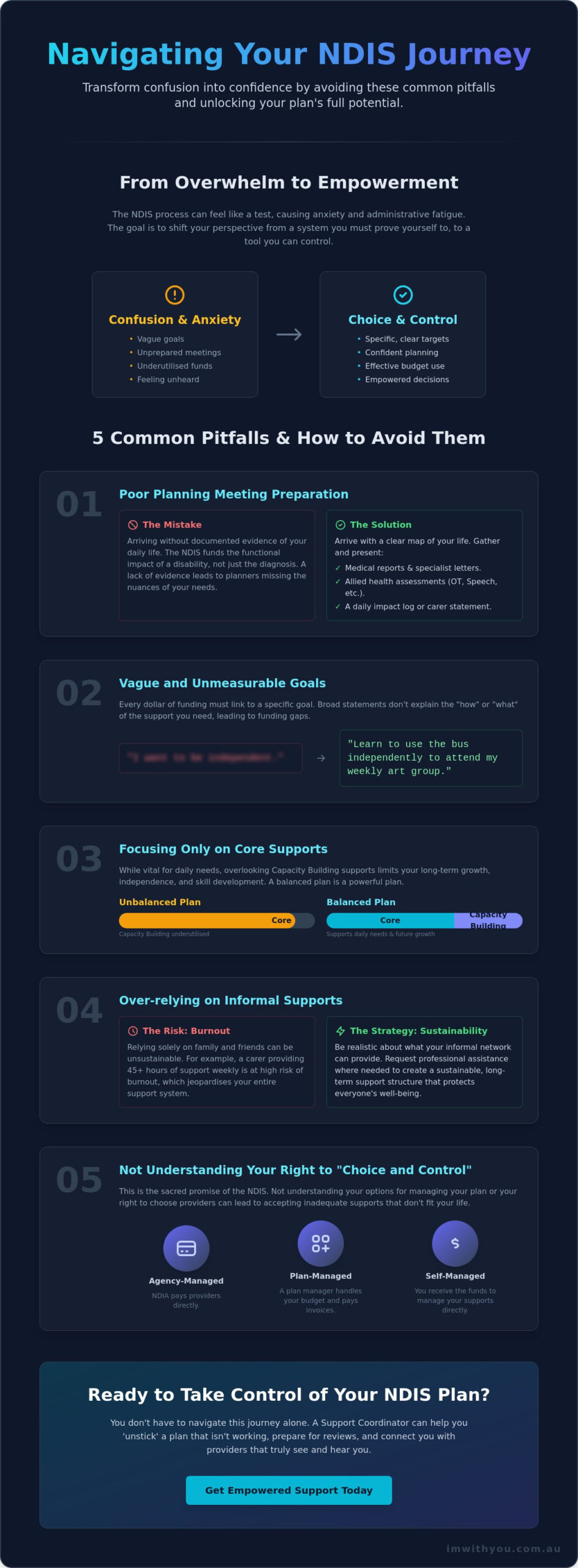
Planning for your future can feel like a heavy weight, but you don’t have to carry it alone. One of the most common ndis mistakes to avoid is arriving at your meeting without a clear map of your daily life. The NDIS doesn’t just fund a diagnosis; they fund the support needed for the functional impact of that diagnosis. If you enter a meeting without documented evidence or impact statements, the planner might miss the nuances of your lived experience.
We often see participants focus entirely on Core supports for immediate needs. While these are vital for daily living, overlooking Capacity Building supports can limit your long-term growth. Capacity Building is about learning new skills and gaining the confidence to lead a more autonomous life. You should also be realistic about your informal supports. While family and friends are wonderful, their support must be sustainable. If a carer provides 45 hours of support weekly, we must ensure they don’t burn out by requesting professional assistance where appropriate.
Preparing for Your Planning Meeting
Think of your planning meeting as a collaborative conversation where you’re the expert on your own life. To help the NDIS understand your world, gather these essential documents:
- Recent medical reports and specialist letters.
- Allied health assessments from OTs, speech pathologists, or psychologists.
- A daily impact log that tracks where you struggle during a typical week.
A carer statement is also a powerful tool. It provides a holistic view of your needs from the perspective of those who stand beside you every day, ensuring the NDIS sees the full picture. If you feel overwhelmed, we can walk through this preparation together.
Crafting Specific and Measurable Goals
Vague goals like “I want to be independent” often lead to funding gaps because they don’t explain what support you actually require. Every dollar requested must link directly to a specific goal. For example, a person with an intellectual disability might set a goal to “learn to use the bus independently to attend a weekly community group.” For psychosocial support, a goal could be “working with a recovery coach to develop a routine that helps me manage anxiety when leaving the house.” These clear targets ensure your plan truly reflects your individual journey and supports your choice and control.
Practical Guidance for Budget Management and Provider Choice
Managing your NDIS budget can feel like a heavy responsibility, but you don’t have to carry it alone. One of the most common ndis mistakes to avoid is “saving” your funds for a rainy day. While it’s natural to want to be frugal, the NDIA often views unspent funds as an indication that your support needs have decreased. For example, if you only utilize 65% of your allocated budget over a 12-month period, your next plan may be reduced to match that lower figure. We want to ensure you have every resource you need to thrive, so regular budget check-ins are vital. Monitoring your spending every 30 days prevents the stress of running out of funds too early or finding yourself with a massive surplus in the final weeks of your plan.
Evaluating Your Plan Management Options
Your management style dictates how much administrative weight you carry. Self-management offers the most “Choice and Control” but requires you to handle all invoices and audits yourself. NDIA-managed plans limit you to registered providers only, which can restrict your options. Many participants find that professional Plan Management is the ideal middle ground. It allows you to use both registered and non-registered providers while a professional handles the paperwork and record-keeping for you. If your current method feels overwhelming, you can request a plan variation to switch at any time. This change simplifies your journey and ensures your records are always audit-ready.
How to Choose an NDIS Provider You Can Trust
Selecting the wrong team is another of the common ndis mistakes to avoid when setting up your supports. It’s easy to choose the provider closest to your home, but proximity doesn’t always equal quality or specialist expertise. Look for partners who understand your specific diagnosis rather than generalists. Ask potential providers how they track progress toward your goals and if their values align with your own. For a deeper look at what to look for, read our guide on how to choose an NDIS provider. We are here to walk beside you as you build a team that truly sees you.
The Power of Advocacy: Moving Forward with Confidence
Receiving a decision from the NDIA that doesn’t align with your needs can feel like a heavy setback. One of the most common ndis mistakes to avoid is viewing a “no” as the final word on your journey. The NDIS framework includes clear pathways for when things don’t go as planned, such as requesting an Internal Review or seeking a hearing through the Administrative Appeals Tribunal (AAT). You don’t have to navigate these technical hurdles alone.
Support Coordination plays a vital role in “unsticking” a plan that feels stagnant. We work to ensure your funding translates into real-world support. A dedicated advocate stands beside you, making sure your voice remains the priority during every interaction with the NDIA. Beyond the paperwork, we focus on your holistic wellbeing. Engaging in leisure activities and community events isn’t just a luxury; it’s a fundamental part of building a life filled with connection and joy.
When to Request a Plan Variation or Review
Life changes, and your NDIS plan should evolve with you. You might need a plan variation if your living situation shifts or your health needs change. If a decision feels wrong, you have 90 days to request an Internal Review. We help you gather the right evidence so the process feels like a collaborative step toward your goals rather than a confrontation. This proactive approach helps you sidestep common ndis mistakes to avoid, ensuring your funding stays relevant to your daily life.
Finding a Steady Companion for Your Journey
At I’m With You, we provide a gentle, expert touch to support coordination and advocacy. Our award-winning care ensures you never feel like just another number in a system. Whether you’re exploring the possibilities of supported independent living ndis or simply need someone to walk side-by-side with you through a review, we’re here. We believe choice and control is a sacred promise. We’re committed to helping you exercise that right with confidence and dignity every day.
Embracing Your Future with Confidence and Clarity
Navigating the NDIS doesn’t have to feel like a solitary struggle. By refining your goal setting and staying mindful of your budget, you transform your plan into a tool for genuine independence. Understanding common ndis mistakes to avoid is the first step toward reclaiming your agency. It’s about more than just managing a folder of documents; it’s about supporting your life through every milestone. You have the right to feel empowered by your choices, rather than limited by the complexity of the system.
At I’m With You, we bring a person-centred approach that treats Choice and Control as a sacred promise to you. Our team was honored with the 2026 Award for Excellence in Disability Care, a recognition that reflects our dedication to expert support coordination and advocacy. We understand the intricacies of the Australian disability sector and work to ensure you never feel overwhelmed by the process. You deserve a partner who listens and acts with unwavering integrity. Together, we can navigate the challenges and celebrate your progress. We’re ready to help you move forward with the security of knowing you aren’t alone.
Let us walk beside you on your NDIS journey, discover our compassionate support services today.
Frequently Asked Questions
What happens if I don’t spend all my NDIS funding before my plan ends?
If you don’t spend all your funding, it returns to the NDIS rather than rolling over into your next budget. Most plans run for 12 or 24 months. Seeing unspent funds can feel stressful, but it’s a chance for us to look at your goals together. One of the common ndis mistakes to avoid is worrying that underspending automatically leads to a smaller budget. We’ll help you explain to the NDIA why supports weren’t used.
Can I change my NDIS provider if I am unhappy with their service?
You absolutely have the right to change providers if you feel they aren’t the right fit for your journey. This is a core part of your Choice and Control. You should check your service agreement first, as most providers require a notice period of 14 or 28 days before you move on. We’ll stand beside you during this transition to ensure your supports continue without a break, making sure you always feel safe.
Is it a mistake to self-manage my NDIS plan if I am not good with paperwork?
Choosing to self-manage when you find admin overwhelming can lead to stress, but it isn’t a mistake if you have the right help. Data from the June 2023 NDIS Quarterly Report shows that 30% of participants choose to manage their own funding. If the paperwork feels like too much, you might consider Plan Management instead. This option gives you flexibility without the burden of processing invoices or tracking every A$1 yourself.
How do I prepare for an NDIS planning meeting if my needs have changed?
Preparation starts with gathering fresh evidence that clearly documents how your life has changed. You should collect reports from your specialists that are dated within the last 6 months to provide a clear picture of your current needs. One of the common ndis mistakes to avoid is going into a meeting without specific examples of how your disability impacts your routine. We can help you organize these documents so you feel heard.
What should I do if the NDIS rejects a support I believe is ‘reasonable and necessary’?
You can lodge an Internal Review of a Decision, also known as a Section 100 review, if a support is knocked back. You must submit this request within 90 days of the date on your decision letter. It’s helpful to provide new information that proves the support meets the 6 specific criteria under the NDIS Act 2013. We’ll walk with you through this process, helping you gather the right words to advocate for your independence.