

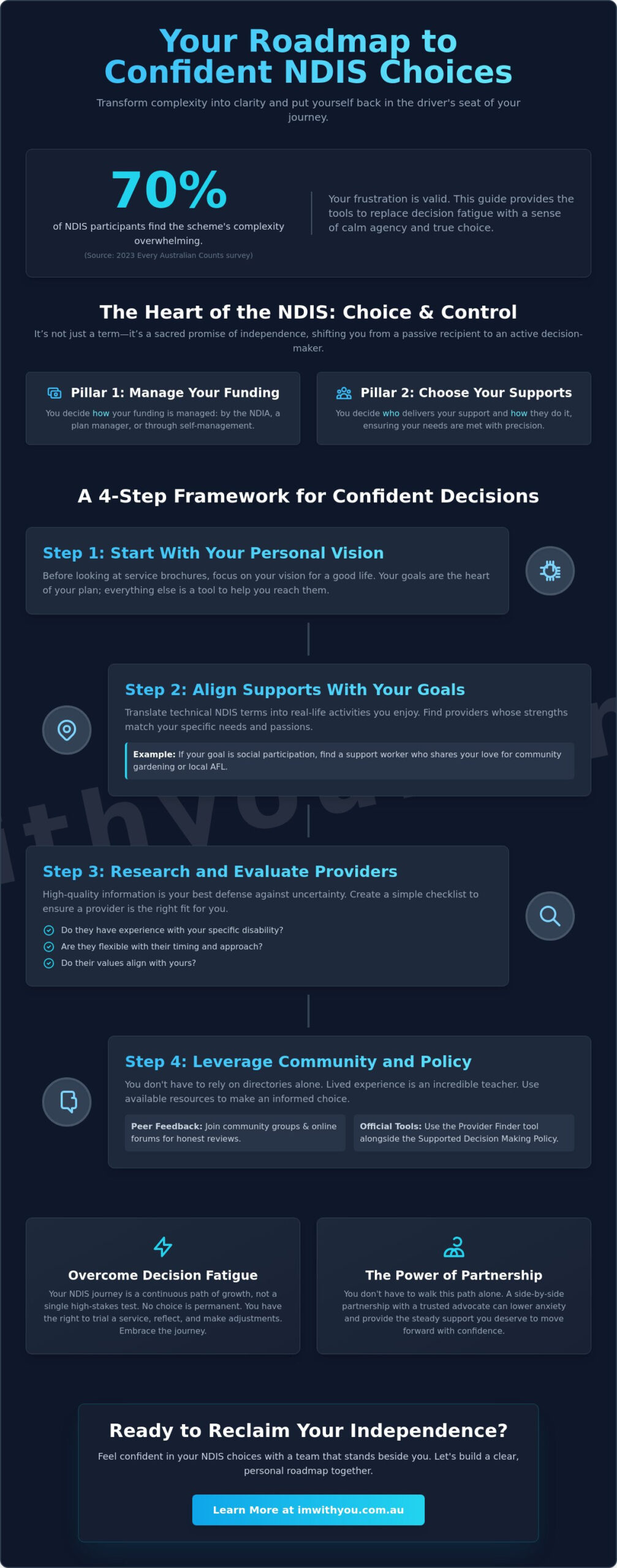
What if the NDIS wasn’t a puzzle to solve, but a bridge to the life you actually want? You’ve likely spent hours deciphering acronyms or feeling that knot in your stomach about “wasting” your budget. It’s exhausting to feel like you’re walking this path alone in a system that can often feel cold or clinical. Recent data from the 2023 Every Australian Counts survey shows that 70% of participants find the scheme’s complexity overwhelming, so please know that your frustration is valid.
We’re here to stand beside you and change that experience. You’ll learn how to feel confident in your ndis choices by transforming complex jargon into a clear, personal roadmap that puts you back in the driver’s seat of your own journey. We’ll provide a practical framework for evaluating service providers and show you how to blend professional expertise with your own powerful intuition. By the end of this guide, you’ll have the tools to replace decision fatigue with a sense of calm agency and true choice and control.
Key Takeaways
- Reclaim your independence by viewing “Choice and Control” as a sacred promise that puts you back in the driver’s seat of your own life and NDIS journey.
- Discover a step-by-step framework for how to feel confident in your ndis choices by focusing on your personal goals before ever looking at a service brochure.
- Learn how to identify providers who truly listen and offer the flexibility you need to ensure your support evolves alongside your changing aspirations.
- Overcome decision fatigue and the fear of making mistakes by understanding that your NDIS journey is a continuous path of growth rather than a single high-stakes choice.
- Find out how a side-by-side partnership with a trusted advocate can lower the barriers of anxiety and provide the steady support you deserve to move forward.
Understanding the Heart of Choice and Control in Your NDIS Journey
Choice and Control is not just a regulatory term found in a handbook; it is a sacred promise of independence and dignity. When the National Disability Insurance Scheme (NDIS) was established in July 2013, the goal was to move away from the rigid “one size fits all” care models of the past. This system was built to ensure that you are the one who decides what a good life looks like for you. If you feel overwhelmed by the weight of these decisions, please know that your feelings are a natural part of this transition. Moving from a system where others made choices for you to one where you hold the power is a significant shift.
To better understand this concept, watch this helpful video:
The framework of the NDIS rests on two essential pillars that define your autonomy. The first pillar is choosing how your funding is managed, whether you prefer the NDIA to handle it, use a plan manager, or take full control through self-management. The second pillar is deciding exactly who delivers your support and how they do it. This structure ensures that your individual needs are met with precision rather than compromise.
The Shift from Passive Recipient to Active Decision-Maker
Before the current system, the old block-funding model meant that government funds went directly to large organisations. Participants often had to accept whatever services were available in their local area, regardless of whether those services actually met their needs. Today, the person-centered approach ensures that you have the final say. Choice is the freedom to bring your NDIS plan to life your way. When you take an active role in these decisions, your long-term wellbeing improves because your supports are aligned with your personal identity and daily rhythms.
Why Confidence Matters for Your Long-Term Goals
Understanding how to feel confident in your ndis choices is a vital part of your journey toward independence. This confidence acts as a bridge between your current situation and your future aspirations. When you feel sure of your decisions, you experience less stress and build more honest, effective relationships with your providers. This clarity is essential for achieving capacity-building goals, such as gaining new skills or increasing community participation. Confidence is not something you are born with; it is a skill that grows when you have the right people standing side-by-side with you. As your certainty increases, you move from simply managing a plan to truly supporting a life filled with possibility.
A Step-by-Step Framework for Making Confident NDIS Decisions
Making decisions about your NDIS plan can feel like standing at a crossroads with too many signs. To understand how to feel confident in your ndis choices, you need a compass that points back to your own life. We believe that confidence grows when you move from a place of feeling pressured to choose toward a place of knowing why you’re choosing. This starts by looking past the service lists and returning to your personal vision of a good life. Your goals are the heart of your plan; everything else is just a tool to help you reach them.
Aligning Supports with Your Individual Goals
We want to help you translate technical terms like Core Supports into the daily activities you actually enjoy. If your goal is to increase social participation, a confident choice might look like hiring a support worker who shares your love for local AFL or community gardening. When you’re looking for the right fit, it helps to have a simple checklist. Ask yourself if the provider’s strengths match your specific needs. Do they have experience with your specific disability? Are they flexible with their timing? Understanding how to choose an NDIS provider is a foundational step in this journey, ensuring your team is built on a bedrock of trust and shared values.
The Power of Research and Peer Feedback
Gathering high-quality information is your best defense against uncertainty. We suggest looking for providers who have earned recognized standards, such as those nominated for disability service excellence awards in 2026. Lived experience is also an incredible teacher. Joining local community groups or online forums allows you to hear honest feedback from other participants who have walked this path before you. While the NDIS Provider Finder tool is a helpful directory, it works best when you use it alongside the Supported Decision Making Policy. This framework ensures you have the right help to weigh your options without losing your voice in the process. It’s about maintaining your Choice and Control as a sacred promise, not just a line in a handbook.
No choice you make today is permanent. You have the right to trial a service, reflect on how it feels, and make adjustments if it doesn’t align with your lifestyle. Sometimes, the weight of these decisions feels lighter when shared. Engaging a companion or a professional advocate can help you weigh the pros and cons logically. At I’m With You, we’re dedicated to standing beside you as you explore these options, ensuring you never have to navigate the complexities of the NDIS alone. When you have a steady partner to help you filter the noise, you can focus on what truly matters: your independence and your dignity.
Evaluating NDIS Providers: What to Look for Beyond the Brochure
When you first meet a potential provider, pay close attention to how they engage with you. Do they spend the whole time reciting their history, or do they practice active listening? You deserve a partner who asks about your aspirations before they mention their list of services. This initial connection is a vital step in learning how to feel confident in your ndis choices. If they’re truly with you, they’ll focus on your voice from the very first minute.
Look closely at service agreements before signing anything. Rigid contracts with long notice periods, sometimes up to 60 or 90 days, can feel restrictive. Aim for flexibility that allows your support to evolve as your life changes. If your goals include moving into your own home, ask specifically if they offer supported independent living ndis. High-quality providers have dedicated teams for these specialized needs rather than a one-size-fits-all approach. You want a team that has the expertise to support your independence safely and respectfully.
The Importance of Person-First Communication
The way a provider speaks about disability reveals their internal culture. Using person first language is a significant green flag. It shows they see you as an individual with a life, not just a set of requirements or a diagnosis. If a provider uses clinical labels or speaks over you during meetings, they aren’t prioritizing your agency. Respectful language fosters a safe, non-judgmental atmosphere where you can express your needs without fear of being misunderstood. It’s about recognizing your humanity first.
Transparency in Billing and Support Delivery
A trustworthy provider is open about the financial side of support. Ask for a clear breakdown of hourly rates and how they handle travel costs. Under current NDIS Pricing Arrangements, providers can claim for travel in specific circumstances, but they should explain these charges upfront so there are no surprises in your budget. You should also look for teams that provide regular, easy-to-read progress reports.
This transparency aligns with the NDIS Supported Decision Making Policy, ensuring you have the information needed to maintain Choice and Control. When a provider shows you exactly where your funding goes and how it’s helping you reach your goals, it builds the trust necessary to how to feel confident in your ndis choices. We believe that professional expertise should always be paired with a gentle, human touch to help you feel secure in your journey.
Overcoming Decision Fatigue and the Fear of ‘Getting it Wrong’
Sometimes, the “choice and control” we value so much in the NDIS starts to feel like a heavy weight. It is called decision fatigue. When you are faced with hundreds of different providers and complex service agreements, the pressure to make the “perfect” selection can lead to mental paralysis. You might worry that one wrong move will waste your funding or stall your progress. Let’s clear that up right now: your NDIS plan is a living document, not a stone carving. A single choice that does not work out won’t ruin your journey. In fact, learning what does not work is often the fastest way to discover what does. Understanding this flexibility is a key part of how to feel confident in your ndis choices.
The NDIS is designed to be iterative. If you hire a support worker and realize after three weeks that your personalities don’t click, you haven’t failed. You have simply gathered more data about what you need to thrive. We view every adjustment as a healthy sign of an active, empowered participant. You are allowed to change your mind, and you are allowed to seek better fit. We are standing beside you to ensure those transitions feel like progress, not setbacks.
Managing the Mental Load of NDIS Planning
Planning does not have to consume your entire life. To keep your energy levels high, it helps to set firm boundaries around when you “do” NDIS admin. You might decide that Tuesdays between 10 AM and 12 PM are for research, while the rest of the week is for living your life. This prevents the mental load from leaking into your rest time. If your plan includes Support Coordination, use it as a tool for delegation. A coordinator can do the heavy lifting by:
- Researching five local providers and checking their current availability.
- Presenting you with a shortlist of two options that match your specific goals.
- Reviewing service agreements to ensure the terms are fair and transparent.
This approach keeps you in the driver’s seat without requiring you to do the mechanical work of driving. There is no prize for rushing into a contract. Taking an extra fortnight to find a therapist who truly understands your psychosocial recovery goals is a wise investment of your time.
What to Do if a Support is Not the Right Fit
If a service is not meeting your needs, you have the power to change it. You can start with a “gentle conversation” with the provider. Often, a simple adjustment in communication or scheduling can fix the issue. You might say, “I value the work we are doing, but I feel we need a different approach to my community access sessions.” If things do not improve, you can exit the agreement professionally. Most standard NDIS service agreements include a notice period, typically 14 or 28 days, which allows you to transition safely to a new provider.
- Review your current service agreement for the “termination” or “notice” clause.
- Provide written notice to the provider, keeping a copy for your records.
- Contact your new preferred provider to arrange a start date that aligns with your exit.
Finding your “dream team” is a process of refinement rather than a one-time event. Every step you take, even the ones that lead to a change in direction, brings you closer to a life of genuine independence. If you want a partner who will walk this path with you, connect with our support team today to see how we can help you manage your choices with ease.
Finding Your Steady Companion: Why Partnership is the Key to Confidence
Confidence doesn’t grow in isolation. It flourishes when you have a provider who walks side-by-side with you. Navigating the NDIS often feels like deciphering a complex system while managing your daily life. A trusted advocate acts as a bridge. We lower your stress and anxiety by handling the technical complexities so you can focus on living your life. Empathy and warmth are just as vital as professional knowledge. When you feel heard and understood, your capacity to make decisions grows. This is exactly how to feel confident in your ndis choices; you build upon a foundation of mutual trust and person-centered care.
Our philosophy at I’m With You is built on the idea of genuine companionship. We don’t lead from the front or direct you from above. Instead, we provide the steady hand you need to explore your options safely. This partnership reduces the heavy emotional load often associated with disability services. It transforms a clinical process into a human journey where your voice is the most important one in the room. By focusing on your strengths rather than limitations, we help you see your NDIS plan as a tool for empowerment rather than a source of stress.
The Value of an Award-Winning Support Team
The 2026 award for excellence in service delivery serves as a benchmark for the quality you can expect from our team. This recognition highlights our commitment to consistent, high-standard support across Australia. However, professional expertise alone isn’t enough to foster true empowerment. We combine that high-level knowledge with a gentle, human touch to create a sense of absolute security. Reliability and patience are the cornerstones of our partnership. You won’t face clinical detachment or rushed appointments here. Instead, you find a support partner who values your time and honors your pace, ensuring your capacity building goals remain within reach.
Starting Your Next Chapter with Confidence
Your next chapter is about more than just managing a budget. It’s about living a life filled with dignity, independence, and choice. We invite you to reach out for a conversation, not just a service. We want to hear your story, understand your unique goals, and help you see the possibilities within your funding. You aren’t alone in facing these challenges. Our promise is simple: we stand beside you through every review, every choice, and every milestone. Understanding how to feel confident in your ndis choices starts with knowing you have a steady, capable guide. Let us walk beside you on your NDIS journey.
Embrace Your Power to Lead Your NDIS Journey
You’ve explored the tools needed to turn the NDIS from a complex system into a personal roadmap for success. You now understand that Choice and Control are sacred promises that belong to you, and that a structured framework is your best defense against decision fatigue. Learning how to feel confident in your ndis choices is a process of reclaiming your agency, one step at a time. It’s about looking past the shiny brochures to find providers who prioritize your dignity and individual goals.
At I’m With You, we provide the expert guidance and gentle, human touch you need to navigate these waters. Our dedication to a person-centered approach earned us the 2026 Award for Excellence in Disability Support, reflecting our commitment to standing beside every individual we serve. We’re here to ensure you never feel like just another case file. By partnering with a steady companion, you gain the security of knowing your decisions are backed by professional insight and genuine care.
Discover how we stand beside you in your NDIS journey and help you build the life you envision. You have the vision for your future, and we’re honored to walk with you as you make it happen.
Frequently Asked Questions
How do I know if a provider is actually giving me choice and control?
You know a provider respects your choice and control when they listen to your goals and offer flexible options instead of a one-size-fits-all service. A provider should respect your right to decide when, where, and how you receive support. According to the NDIS Quality and Safeguards Commission, providers must involve you in every decision about your care. If they’re making choices for you without consultation, it’s a sign they aren’t upholding these core values.
Can I change my NDIS provider if I am not happy with their service?
You can change your NDIS provider at any time if the service doesn’t meet your needs or align with your journey. Most service agreements include a notice period, often 14 or 28 days, which you’ll need to follow. We believe you should never feel stuck in a partnership that doesn’t empower you. Simply notify your current provider in writing and begin your new support transition whenever you’re ready to move forward.
What is the difference between a registered and unregistered NDIS provider?
The main difference is that registered providers are audited by the NDIS Commission to meet specific safety and quality standards, while unregistered providers aren’t. If you’re NDIA-managed, you must use registered providers. However, if you’re plan-managed or self-managed, you have the freedom to use both. This flexibility is a key part of learning how to feel confident in your ndis choices as it broadens your pool of potential support partners.
How much say do I have in who my individual support workers are?
You have a significant say in who supports you, and you can request specific staff members who align with your personality and culture. Providers should offer you the chance to meet and interview workers before they start. In 2023, NDIS guidelines reinforced that participant preference is a priority for person-centered care. If a worker isn’t the right fit, you have the right to ask for someone else who makes you feel safe and understood.
What should I do if I feel pressured by a provider to use more of my budget?
If a provider pressures you to spend your budget, you should contact the NDIS Quality and Safeguards Commission to report the behavior. Your NDIS funding belongs to you, and it’s designed to be used at a pace that suits your specific life goals. Providers are prohibited from upselling services you don’t need under the NDIS Code of Conduct. We stand beside you to ensure your funding is used ethically and only for supports that truly benefit your wellbeing.
How can I feel more confident during my NDIS plan review meeting?
You can feel more confident in your plan review by preparing a participant statement that clearly outlines your successes and remaining challenges from the past 12 months. Bring a trusted advocate or a family member to the meeting for emotional support. Having your evidence and reports ready at least 14 days before the meeting reduces stress. This preparation is a practical way to learn how to feel confident in your ndis choices when speaking with the NDIA.
Is it possible to manage my own NDIS funding to have more control?
You can choose to self-manage your funding to gain the highest level of control over your supports and providers. Self-management allows you to hire staff directly and negotiate prices, provided they don’t exceed the NDIS Price Guide limits. According to the 2023 NDIS Quarterly Report, approximately 30 percent of participants choose to self-manage or part-manage their plans. It’s a rewarding path that gives you total agency over your daily life and budget.
What role does a support coordinator play in helping me make choices?
A support coordinator acts as a knowledgeable guide who helps you understand your plan and connects you with the right services. They don’t make choices for you; instead, they build your capacity so you can make informed decisions yourself. Think of them as a partner who walks side-by-side with you to navigate the complex NDIS system. They ensure you have all the information needed to exercise your rights and reach your independence goals with ease.