

Last Tuesday, Sarah sat at her kitchen table in Melbourne, staring at a blank NDIS planning document while her two brothers argued over Zoom about which therapy their mother actually needed. It’s a scene familiar to many of the 2.65 million unpaid carers across Australia, where the pressure of getting family to agree on a care plan feels heavy enough to strain even the closest bonds. You likely feel the weight of this responsibility every day, balancing the anxiety of underutilising NDIS funding against the desire to keep the peace. It’s exhausting to feel caught in the middle of family rivalries when you just want the best for your loved one.
We believe that this process should be a journey of connection, not a source of conflict. You’re about to discover how to navigate these disagreements and build a collaborative strategy that honours your loved one’s choice and control as a sacred promise. We will walk you through the practical steps to facilitate a peaceful family meeting, providing you with a clear roadmap to restore harmony and create an actionable NDIS plan you can all trust for the future.
Key Takeaways
- Learn how to use the NDIS framework as a neutral foundation, shifting the focus from conflict to your loved one’s personal goals and aspirations.
- Discover compassionate strategies for getting family to agree on a care plan by balancing the “Dignity of Risk” with your family’s natural desire for safety.
- Master the “Mission Statement” technique to host family meetings that start with a shared vision of love, ensuring every voice is heard in a calm, supportive space.
- Understand how a professional Support Coordinator acts as a steady companion and mediator to bridge gaps and simplify complex NDIS decisions.
- Explore how centering “Choice and Control” as a sacred promise can resolve difficult disagreements while honouring your loved one’s independence and dignity.
Why Getting Family to Agree on a Care Plan Feels So Challenging
If you feel like you are walking a tightrope while managing your loved one’s NDIS journey, you aren’t alone. Transitioning into a more intensive support structure often triggers what we call a care crisis. This moment is thick with emotion, where the weight of responsibility meets the fear of the unknown. You might find yourself caught in the middle of heated debates about safety versus independence or how to manage A$ funds within an NDIS budget. It’s exhausting to feel like the primary advocate while others question your every move. We want you to know that these disagreements usually stem from a deep well of love, even if they feel like personal attacks.
To better understand the complexities of family support and how roles can shift, watch this helpful video:
The difficulty of getting family to agree on a care plan often lies in the invisible history of your household. While you are trying to implement practical advance care planning, others might still be seeing the person through the lens of who they were ten years ago. Bridging this gap requires patience and a shared commitment to the individual’s dignity.
The Psychology of Family Care Disputes
Decision-making often drags old sibling dynamics into the light. If one person was always the responsible child, they might feel an unfair burden, while a sibling who moved away feels sidelined or guilty. A common friction point is the Distance vs. Proximity conflict. The primary carer sees the daily struggles, the sleepless nights, and the subtle declines. Family members living further away often see the best version of the person during short visits. This gap leads to a lack of validation for the primary carer. Grief and denial also play huge roles. It’s hard to accept that a parent or sibling needs high-level support. Sometimes, saying no to a plan is just a way of saying I am not ready for this to be happening.
When “Knowing Best” Becomes a Barrier
Conflict often arises when family members confuse protection with restriction. In the NDIS world, we champion Choice and Control, but family members might fear that giving a loved one independence is too risky. This clash of perceptions can stall the process of getting family to agree on a care plan. One person might see a disability as a set of limitations to be managed, while you see it as a life to be lived with the right empowerment. Additionally, carer burnout is a very real factor. According to data from Carers Australia in 2022, nearly half of all primary carers live with their own chronic health conditions. If you are reaching your limit, your push for a more robust care plan isn’t about giving up; it’s about creating a sustainable future for everyone involved.
The NDIS Framework: Your Neutral Ground for Agreement
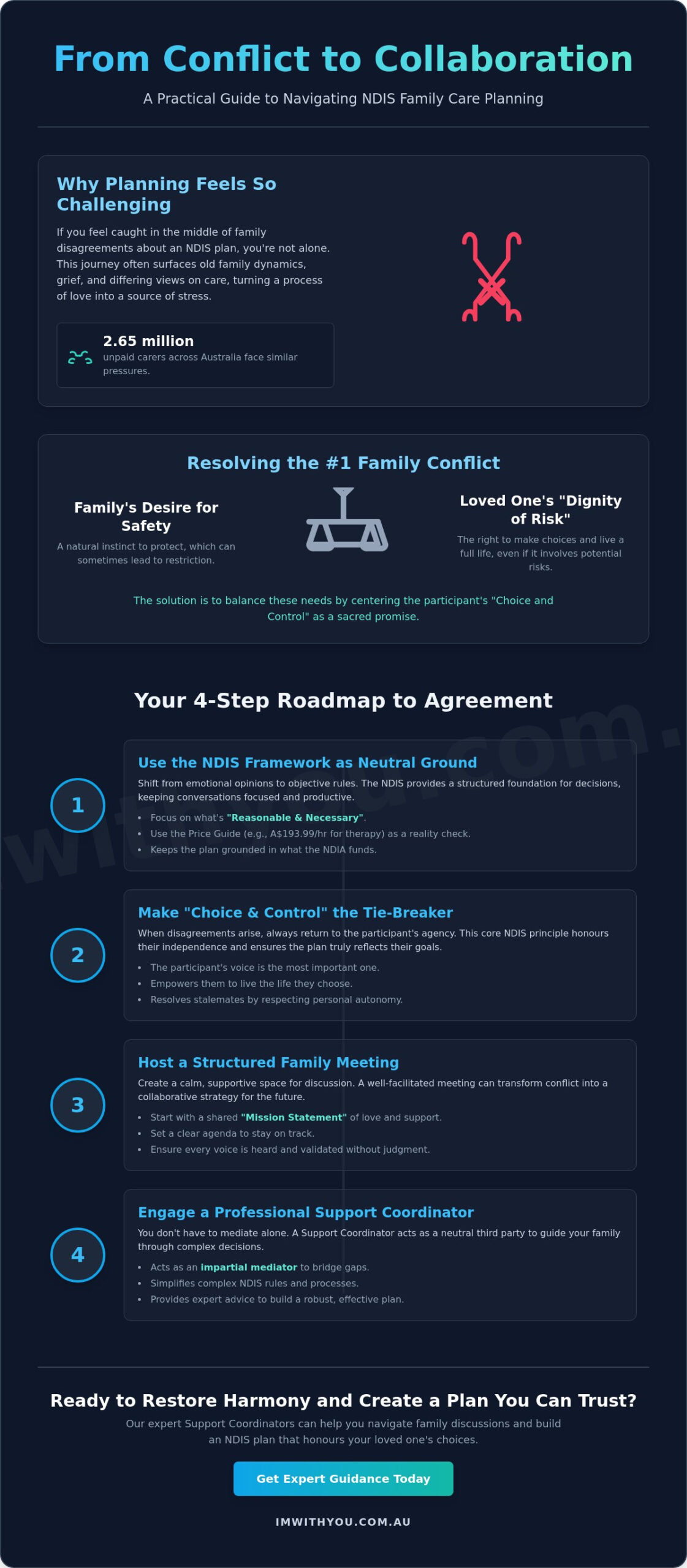
The NDIS isn’t just a funding system; it’s a structured way to resolve family disputes that often arise during care planning. When you’re struggling with getting family to agree on a care plan, the NDIS provides a set of rules that keep everyone grounded in reality. This framework shifts the focus from personal opinions to what the National Disability Insurance Agency (NDIA) actually funds. By using the NDIS Price Guide, which sets clear price caps for supports like A$193.99 per hour for therapy in the 2023-24 period, families can stop arguing about “what if” and start looking at “what is.”
We see “Choice and Control” as a sacred promise. It serves as the ultimate tie-breaker. If siblings or parents have conflicting ideas, we always return to the participant’s agency. The NDIS framework requires that supports are “reasonable and necessary.” This objective standard helps families move past emotional stalemates by asking: “Does this support help the participant reach their specific goals?” It’s a living document that adapts as needs change, ensuring the plan remains a tool for empowerment rather than a source of friction.
Centering the Participant’s Voice
We encourage families to use person-first language to keep the individual at the heart of every conversation. For participants with high support needs or those who are non-verbal, we use communication boards, visual aids, or observation-based feedback to ensure their voice isn’t lost. It’s helpful to separate the participant’s “wants” from the family’s “worries.” While a mother might worry about safety, the participant might want more social time. Both are valid, but the NDIS framework prioritizes the participant’s vision for their own life. This clarity helps in getting family to agree on a care plan by making the participant’s preference the primary compass.
Goal-Based Planning vs. Task-Based Planning
Instead of arguing over daily chores, the NDIS asks us to focus on “increasing independence.” This shift changes the energy of the room. When you link a daily task to a broader goal, it creates a roadmap that everyone can follow objectively. For example, linking a goal of living more autonomously to supported independent living ndis provides a clear, funded pathway. This structure removes the guesswork. Since the NDIA requires goals to be specific and measurable, the family can track progress together without needing to micromanage each other. If you feel overwhelmed by these categories, we can stand beside you to help translate these goals into a plan that works for everyone.
Safety vs. Independence: Resolving the #1 Family Conflict
Families often split into two distinct camps when discussing support. One side focuses on protection, worrying that it’s too dangerous for their loved one to live alone or access the community without constant supervision. The other side pushes for autonomy and growth. This tension is the most frequent hurdle when getting family to agree on a care plan. It’s important to recognize that both sides usually come from a place of deep love and concern. We see this daily, and we’re here to help you bridge that gap through a person-centered approach.
The Dignity of Risk in the NDIS
The NDIS framework is built on a concept known as the Dignity of Risk. This principle suggests that the right to make choices, take risks, and even make mistakes is essential for personal growth. For people living with an intellectual disability, being overprotected can lead to a loss of skills and a decrease in self-esteem. Balancing a duty of care with the right to independence is a delicate process, but it’s vital for capacity building.
Consider the example of a participant who wanted to catch the bus to a local community hub. Their family was paralyzed by the “what if” scenarios. By breaking this goal into small, manageable steps, the participant started by traveling with a support worker. Eventually, they progressed to traveling alone while being tracked via a smartphone app. This small risk resulted in a 40% increase in the participant’s self-reported feelings of independence and social connection. Small, supported risks lead to significant life changes.
Using Professional Evidence to Settle Debates
When family meetings become emotional, objective data serves as a calming force. A Functional Capacity Assessment (FCA) completed by an Occupational Therapist or Physiotherapist provides a clear, evidence-based map of a person’s actual abilities. It moves the conversation away from “I think they can’t” to “the assessment shows they can.” This data-driven approach is essential when getting family to agree on a care plan because it removes the burden of “taking sides” from family members.
Engaging a third-party ndis provider can also act as a vital buffer. We provide a neutral space where professional expertise guides the discussion. To lower the anxiety levels of protective family members, we implement detailed contingency plans. These plans include:
- Emergency contact protocols for when things don’t go as expected.
- Smart technology solutions like fall detectors or GPS-enabled devices.
- Step-by-step instructions for the participant to follow in a crisis.
By focusing on facts and creating a safety net, we help families feel secure enough to let their loved ones explore their potential. We stand beside you to ensure that safety and independence work together rather than against each other.
A Step-by-Step Guide to Hosting a Family Care Meeting
Hosting a meeting to discuss NDIS supports isn’t about winning an argument. It’s about finding a path forward together. We suggest choosing a neutral, quiet location like a local library meeting room or a quiet café. Avoid the family home if it holds too many emotional triggers. Set a clear 60-minute time limit. This creates a container for the conversation, ensuring it stays focused and doesn’t spiral into exhaustion.
Start the session with a “Mission Statement” technique. This is a short, shared vision rooted in love. You might say, “We are here because we all care for Sarah and want her to have the best possible life.” This simple act shifts the focus from individual grievances to a collective goal. It reminds everyone that you are on the same team, walking side-by-side with the person you all love. Establishing ground rules is essential for getting family to agree on a care plan without conflict. We recommend these three basics:
- No interrupting: Everyone gets a turn to speak while others listen.
- Active listening: Repeat back what you heard to ensure understanding.
- “I” statements: Say “I feel concerned about the budget” instead of “You are spending too much.”
Preparation: The Cheat Sheet Method
Success begins before the meeting starts. Ask every family member to arrive with a “Cheat Sheet” featuring three recent observations and one primary goal for the upcoming months. Review the current NDIS plan together so everyone understands the specific funding in categories like Core Supports or Capacity Building. We also suggest preparing a “participant profile” that highlights three recent wins, such as a successful community outing or a new skill mastered. This keeps the conversation focused on strengths rather than deficits.
Facilitation: Keeping the Peace
If the conversation drifts toward old family arguments, use the “Parking Lot” technique. Write the off-topic grievance on a separate piece of paper and promise to address it at another time. This keeps the current session productive. When emotions run high, apply the “Pause and Breathe” rule. A simple five-minute break can reset the energy of the room. If tensions remain high, it might be time to bring in an external facilitator or your Support Coordinator. They provide an objective perspective that helps maintain the participant’s Choice and Control.
Before you finish, document everything. Create three lists: Agreed, Disagreed, and Pending. This clarity ensures no one leaves with a different version of the truth. If you need a steady companion to help facilitate these complex NDIS conversations, we are here to support your family’s journey. Contact our compassionate team today to learn how we can help you find common ground.
How Professional Support Coordination Bridges the Gap
Sometimes, the emotional weight of getting family to agree on a care plan feels too heavy for one person to carry alone. This is where a Support Coordinator becomes an essential companion. We act as a professional mediator, bringing a neutral, calm perspective to family meetings. Our role is to help your family move from a place of potential conflict to a space of professional, person-centered support. We listen to every voice, but we always keep the participant’s goals at the very center of the conversation.
At I’m With You, we understand that these discussions aren’t just about logistics; they’re about love, safety, and the future. We stand beside you during the planning journey, offering a steady hand when the path feels uncertain. Our presence allows you to step out of the “manager” role and return to being a daughter, son, or parent. We’re here to ensure the journey is collaborative rather than confrontational, making sure everyone feels heard and respected.
The Benefits of an External Advocate
An external advocate takes the pressure off the primary family decision-maker. It’s common for one person to feel they’re doing all the heavy lifting, which can lead to exhaustion and resentment. We step in to ensure the care plan is fully compliant and maximises every cent of your NDIS funding. This professional oversight provides a necessary buffer for complex or sensitive topics. For instance, we can facilitate clear, objective discussions about the six rights of medication administration to ensure safety standards are met without causing family friction. Our expertise turns technical requirements into manageable, everyday routines that protect your loved one.
Next Steps: From Discussion to Action
Once your family reaches a shared understanding, the next step is turning those words into reality. We help you update the NDIS plan to reflect your new agreements. This might involve submitting a change of circumstances or preparing for a scheduled review with the NDIA. We don’t just set the plan and walk away. We help you establish a review date, often every three to six months, to see how the plan feels in practice. This gives everyone peace of mind that the plan can grow and change as your needs do.
Remember that getting family to agree on a care plan is a process, not a one-time event. It takes patience and a willingness to adapt, but you don’t have to do it by yourself. If you’re finding it hard to find common ground, we invite you to connect with I’m With You for a gentle consultation. We’ll walk with you every step of the way to ensure your loved one receives the support they deserve while keeping your family bonds strong and healthy.
Moving Forward Together with Peace of Mind
Navigating the NDIS can feel like a heavy weight. It’s especially tough when loved ones have different visions for the future. You’ve learned that using the NDIS framework as neutral ground helps shift the focus back to the participant’s goals. By balancing safety with the sacred promise of independence, you can turn conflict into a shared roadmap. The process of getting family to agree on a care plan doesn’t have to be a solo journey or a battleground.
At I’m With You, we specialize in advocacy and person-centered support to ensure every voice is heard. As a provider awarded for excellence in care 2026, we offer national coverage with a gentle, human touch that simplifies complex decisions. We understand that choice and control is more than a policy; it’s about supporting a life lived with dignity. You don’t have to carry the emotional load of coordination alone. Let us walk beside you; contact I’m With You for supportive NDIS coordination today.
Your family’s harmony is within reach, and we’re ready to help you find it.
Frequently Asked Questions
What do I do if one family member completely refuses to cooperate?
You should focus your energy on the participant’s immediate needs and goals rather than the conflict itself. Research from the Australian Institute of Family Studies indicates that professional mediation can resolve up to 70 percent of family disputes by providing a neutral space for discussion. If a family member remains unwilling to engage, you can proceed with the planning process alongside those who are supportive. We’ll stand beside you to ensure the participant’s progress isn’t stalled by one person’s hesitation.
Can the NDIS participant make a care plan without family consent?
Yes, an NDIS participant has the legal right to create and implement their care plan without family consent if they have the capacity to make their own decisions. The NDIS Act 2013 is built on the principle of choice and control, which prioritizes the individual’s voice above all others. While involving family is often helpful, it’s not a legal requirement for the plan to move forward. We’re here to empower the participant to lead their own journey with confidence.
How often should a family review a care plan once it is agreed upon?
You should review your care plan at least every 12 months or whenever a major life transition occurs. NDIS plans are typically scheduled for a formal review annually to ensure the A$ funding and supports still align with the participant’s evolving goals. Conducting smaller family check-ins every 3 months can help you catch issues early. This regular rhythm makes getting family to agree on a care plan much easier because you’re making small, manageable adjustments together.
Who has the final legal say in an NDIS care plan if there is no agreement?
The participant has the final legal say unless the person has a legally appointed guardian or a nominee designated by the NDIA. Under the NDIS Act 2013, the participant’s preferences must be the primary consideration in all decision-making processes. If family members can’t reach a consensus, the NDIA will always look to the participant’s expressed wishes first. We’ll help you navigate these legal structures so that the participant’s rights remain protected at every step.
Is it okay to use NDIS funding for a professional mediator or facilitator?
You can sometimes use NDIS funding for professional facilitation if it’s included in the plan under “Capacity Building” or “Support Coordination.” While the NDIS doesn’t typically fund general family therapy, they may cover Specialist Support Coordination to help resolve complex barriers to plan implementation. You should check your “Improved Life Choices” budget for specific line items that might support these services. We can help you review your plan to see what resources are available for your family.
What if the family agrees, but the NDIS participant disagrees with the plan?
The participant’s disagreement takes precedence because the NDIS is designed to be a person-centered scheme. If the participant isn’t comfortable with the proposed supports, the plan must be adjusted to reflect their personal choices and dignity. Forcing a plan that the participant doesn’t want goes against the core NDIS principle of autonomy. We’ll walk with you to facilitate a conversation where the participant’s voice is the loudest one in the room.
How do we handle disagreements about which NDIS provider to use?
You can handle provider disagreements by establishing a 30 day trial period with a specific service to evaluate its effectiveness objectively. Using the NDIS Quality and Safeguards Commission standards as a benchmark allows you to compare providers based on safety and quality rather than personal opinion. This data-driven approach removes the emotional weight from the decision. Getting family to agree on a care plan is much smoother when everyone focuses on the evidence of what works best for the participant.
What is the difference between a family agreement and an NDIS service agreement?
A family agreement is an informal, non-legal understanding between relatives, while an NDIS service agreement is a formal contract between the participant and their provider. The service agreement is a vital document that outlines the A$ costs, the frequency of supports, and the terms for ending the service. It provides the participant with legal protections and clear expectations for their care. We’ll help you understand these documents so you feel secure and informed about the services you’re receiving.