

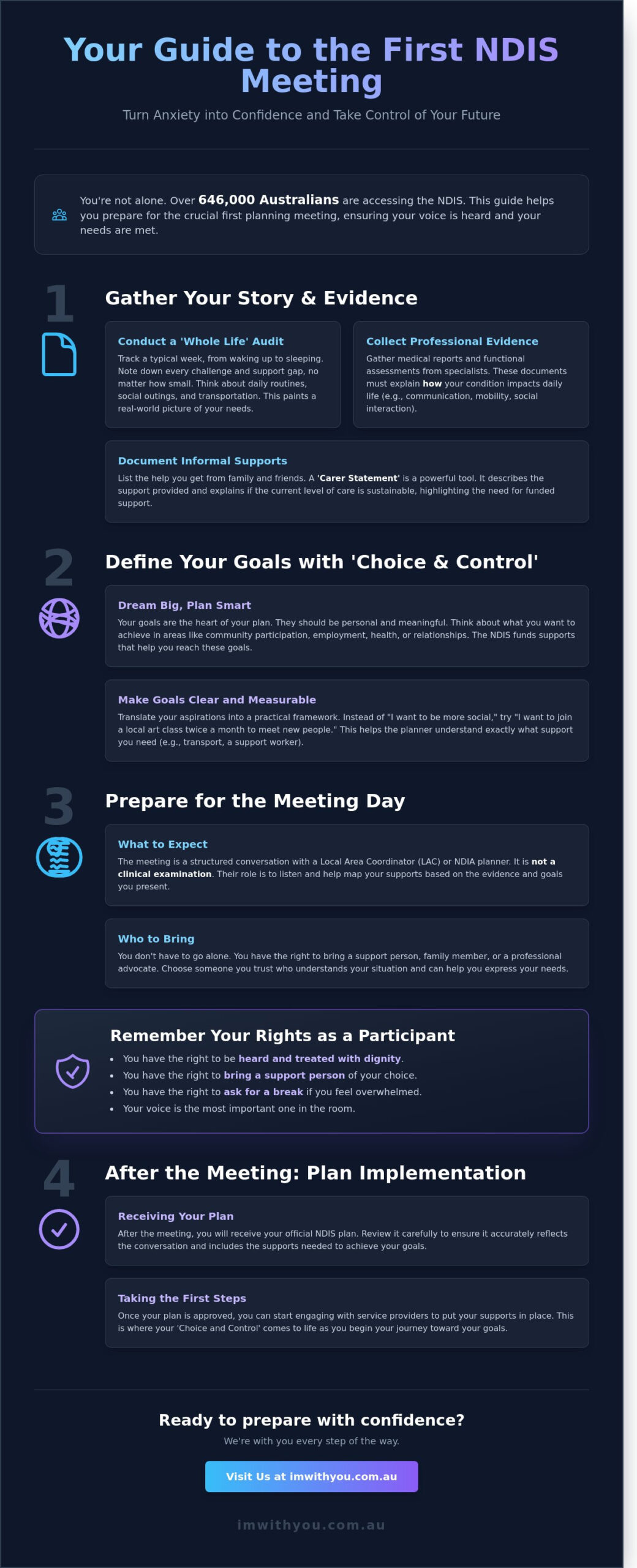
Last Wednesday, Sarah sat at her kitchen table surrounded by folders, feeling like she was studying for a final exam rather than a meeting about her own life. You might feel that same knot in your stomach today. It’s common to worry about performing for a planner or forgetting a vital detail that could impact your future support. According to the NDIS 2023-2024 Q2 report, over 646,000 Australians are accessing this scheme, yet many still find the initial planning phase deeply overwhelming. We understand that this isn’t just about paperwork; it’s about your dignity and your future.
We want to help you replace that anxiety with a sense of quiet readiness. This guide explains how to prepare for your first ndis meeting by focusing on your lived experience, ensuring you feel heard and empowered throughout the process. We’re with you as you learn to translate your daily challenges into the right language while keeping your personal goals at the heart of every conversation. We’ll explore how to gather your evidence and define your needs, giving you the confidence to exercise your Choice and Control from the very first moment.
Key Takeaways
- Understand the vital role of the planning meeting and how to conduct a “whole life” audit to ensure your daily needs are fully captured.
- Learn how to prepare for your first ndis meeting by aligning your personal dreams with clear, measurable goals that honor your choice and control.
- Identify the essential documentation and specialist reports you’ll need to stand beside you as powerful evidence for your support journey.
- Discover how to choose the right support person and manage meeting logistics so you can focus on sharing your story with confidence.
- Gain a clear roadmap for what happens after the meeting, from receiving your plan to taking those first steps toward implementation.
What is an NDIS Planning Meeting and Why Does it Matter?
Your first planning meeting is a milestone that marks the bridge between qualifying for the National Disability Insurance Scheme and receiving the actual funding that helps you thrive. We understand that this step can feel heavy with expectation, but it’s really a partnership. It’s a structured conversation about your life, your needs, and your dreams. When you learn how to prepare for your first ndis meeting, you’re essentially learning how to advocate for the life you want to lead.
To better understand this concept and see how the process unfolds, watch this helpful video:
During this meeting, you’ll sit down with a Local Area Coordinator (LAC) or an NDIA planner. These individuals aren’t there to judge you or perform a clinical medical examination. Instead, they act as facilitators. Their job is to listen and help you map out a path forward. This entire process is built on the foundation of Choice and Control. This isn’t just a regulatory term; it’s a promise that you remain the architect of your own journey. You decide what supports matter most to you.
The Goal of the Conversation
The primary objective is to build a clear, holistic picture of your daily life. We’ll look at the specific ways your disability impacts your routine and identify the supports that will help you live as independently as possible. This is the moment where your personal aspirations turn into funded goals. Whether you want to improve your physical mobility or join a local community group, the meeting translates these human desires into the practical framework of the scheme. It’s about moving away from managing a case and toward supporting a life.
Your Rights as a Participant
You have the right to be heard and treated with absolute dignity throughout every minute of the process. You don’t have to do this alone. You have the right to bring a support person, a family member, or a professional advocate to sit beside you. If the discussion feels overwhelming or you need a moment to collect your thoughts, you have the right to ask for a break. As you discover how to prepare for your first ndis meeting, remember that your voice is the most important one in the room. We’re here to ensure you feel safe, understood, and empowered to speak your truth.
Gathering Your Story: Documentation and Evidence
We start this part of the journey together by looking at the big picture. When you think about how to prepare for your first NDIS meeting, it helps to see your life as a whole story rather than a list of symptoms. Begin with a ‘Whole Life’ audit. We suggest tracking a typical week from Monday through Sunday. Look at your routine from the time you wake up at 6:30 AM until you sleep. Notice where the gaps are. Are there moments where you struggle to get dressed, or perhaps social outings you miss because transport is too difficult? This audit helps us identify the support you need to live the life you choose.
Professional evidence acts as the foundation of your plan. You’ll need medical reports and functional assessments from your specialists or therapists. These documents shouldn’t just list a diagnosis; they need to explain how your condition impacts your daily activities like communication, social interaction, or mobility. If you’re supporting a younger family member, the Association for Children with Disability offers excellent tips for your child’s first NDIS planning meeting that emphasize the value of this clinical evidence.
We also want to highlight your ‘informal supports.’ These are the friends, family members, and community groups who help you every day. It’s vital to document this because the NDIS needs to know if these arrangements are sustainable. A ‘carer statement’ is a powerful tool here. It allows your loved ones to describe the support they provide and, honestly, how much pressure they’re under. If a primary carer is providing 40 hours of support a week, the NDIS needs to understand what happens if that person becomes unwell or needs a break.
Documenting the ‘Bad Days’ and the ‘Good Days’
It feels natural to want to show your best self, but for this meeting, we need to talk about the ‘bad days.’ Describing your most challenging moments ensures your funding covers you when things go wrong. Ask yourself: What support is missing when I’m at my lowest? Balance this by sharing your ‘Good Day’ vision. What does a successful, empowered day look like for you? We want to fund the bridge that gets you from a bad day to a good one.
Organising Your Paperwork
Keeping everything in one place reduces stress. We recommend creating a dedicated folder for your NDIS journey. If you feel overwhelmed by the volume of information, we can stand beside you as you sort through these details to ensure nothing is missed. Include these items:
- Copies of specialist reports and functional assessments dated within the last 12 months.
- A clear list of current medications and any assistive technology you use, such as wheelchairs or communication apps.
- A one-page summary of your story. This prevents you from having to repeat your history multiple times to different people.
By gathering this evidence early, you’re not just filling out forms. You’re building a clear, evidence-based case for the life you want to lead. We’re here to help you find your voice during this process.
Defining Your Goals: Dreaming Big with Choice and Control
When you think about how to prepare for your first ndis meeting, try to view your goals as the compass for your entire journey. The NDIS isn’t designed to just provide basic support. It’s a framework built to help you flourish. Every piece of funding in your plan must link directly to a specific, measurable goal you want to achieve. This is where your Choice and Control truly begin. We encourage you to look past simply maintaining your current situation. Instead, we’ll help you focus on thriving and building a life that feels genuinely meaningful to you.
You’ll need to identify both short-term and long-term aspirations. Short-term goals usually cover the next 12 months. Medium-to-long-term goals might look 3 to 5 years into the future. These goals often center on capacity building. This involves developing the skills and confidence you need to do more things on your own. As your capacity grows, your independence increases. This transition from needing help to leading your own way is the heart of the NDIS mission. We’re here to walk beside you as you define what that independence looks like.
Examples of Meaningful NDIS Goals
- Social goals: You might want to join a local gardening club or explore leisure activities to build genuine community connections and reduce isolation.
- Independence goals: This could involve learning to use the bus system independently or exploring options for supported independent living ndis so you can move into a home of your own.
- Health goals: You may aim to manage your medications safely or work with a physiotherapist to improve your mobility by 20 percent over the next year.
The ‘Reasonable and Necessary’ Test
The National Disability Insurance Agency (NDIA) uses specific criteria to decide which supports they’ll fund. They call this the “reasonable and necessary” test. To pass this test, your support must relate directly to your disability. It can’t be an everyday cost that everyone pays. For example, the NDIS won’t pay for your weekly groceries, rent, or movie tickets. These are considered standard living expenses.
The NDIA also looks for value for money. They check if the support is likely to be effective and if it’s the most cost-effective way to help you reach your goal. Understanding these rules is a vital part of how to prepare for your first ndis meeting. It helps you advocate for the supports that matter most to you. We’ll stand with you to ensure your goals are framed in a way that the NDIA understands, making sure your voice is the one that leads the conversation.
Preparing for the Day: What to Expect and Who to Bring
The day of your first meeting is a significant milestone in your journey toward independence. It’s natural to feel a mix of excitement and nerves. Knowing exactly how the day will unfold helps you stay centered. First, confirm the logistics. Check your calendar or confirmation email to see if the meeting is in-person, over the phone, or via a video link. According to the NDIA 2022-2023 Annual Report, a large percentage of participants now choose remote meetings for comfort, but you have the right to request a face-to-face conversation if that feels more supportive for you.
You don’t have to do this alone. We strongly encourage you to bring a support person, whether that is a family member, a trusted friend, or a professional advocate. This person acts as your second set of ears. They can take notes while you talk, remind you of points you wanted to raise, and provide emotional grounding. Learning how to prepare for your first ndis meeting also involves packing a physical “meeting kit.” Bring a bottle of water, a few light snacks, a notebook, and all your printed documents. Having these items within reach creates a sense of security and ensures you aren’t scrambling for information when you need it most.
The Flow of the Meeting
The conversation follows a predictable, steady rhythm. The planner or Local Area Coordinator (LAC) will start by confirming your personal details and eligibility. Next, you’ll discuss your “Statement of Participant Supports.” This is a holistic look at your current life, including the help you get from family or community groups. Finally, you will move into goal setting. Here, you’ll describe what you want to achieve over the next 12 months. This isn’t a test; it’s a collaborative way to ensure your plan reflects your true aspirations.
Managing Anxiety During the Conversation
If the clinical nature of some questions feels intrusive, take a breath. You are in control of the pace. If you feel overwhelmed, it’s perfectly okay to ask for a five-minute break to stretch or have some water. When the planner uses technical jargon that sounds like another language, ask them to explain it in plain English. Your choice and control start the moment the meeting begins.
It’s vital to be honest rather than “brave” about your daily life. While it’s natural to want to focus on your strengths, your plan needs to be based on your hardest days to ensure you receive the right level of funding. After the meeting ends, the mental effort can leave you feeling drained. Plan for a quiet afternoon with no major chores or appointments. Give yourself the space to decompress and acknowledge the big step you just took. We are here to walk this path with you, ensuring you never feel lost in the process.
If you would like a companion to help you navigate your NDIS journey with confidence and care, reach out to our team at I’m With You today.
After the Meeting: Moving Toward Plan Implementation
The moment you finish your conversation with the planner, you might feel a mix of relief and anticipation. You’ve done the hard work of reflecting on your life and goals. While the wait for your physical document begins, the NDIA works behind the scenes to finalize your funding. Under the current Participant Service Guarantee, the NDIA aims to approve your first plan within 21 days of your planning meeting. You can track this progress through the myplace portal, where your plan will appear as a digital version before the paper copy arrives in your mailbox.
When you first open your plan, the way your funding is managed is a vital detail to check. There are three primary ways to handle your budget:
- Self-managed: You have the highest level of flexibility to hire any provider, but you’re responsible for paying invoices and keeping records.
- Plan-managed: A dedicated provider handles the financial administration for you, allowing you to use both registered and non-registered services without the paperwork stress.
- NDIA-managed: The Agency pays your providers directly, though you’re limited to using only NDIS-registered providers.
If your plan includes support coordination, you’ll have a professional guide to help you understand these budgets. They act as a bridge, helping you find the right services and ensuring your plan implementation stays true to the goals you identified when learning how to prepare for your first ndis meeting.
Choosing Your Support Team
Once your plan is approved, the focus shifts to building a circle of support that respects your autonomy. The next step is finding an ndis provider who aligns with your personal values and long-term vision. We recommend looking for teams that consistently use person first language, as this reflects a deep respect for your agency and identity. At I’m With You, we stand beside you during this transition, ensuring you never feel like just another case number in a system.
Starting Your Journey with ‘I’m With You’
We help you implement your plan by turning those written goals into tangible daily support. Our team acts as a steady companion, walking with you as you explore your new choice and control. We focus on creating a holistic environment where you feel heard and empowered. Our commitment to providing award-winning care in 2026 ensures your peace of mind as we help you build a life of dignity and purpose. Understanding how to prepare for your first ndis meeting was your first step, and we’re honored to be with you for every step that follows.
Embracing Your New Journey with Confidence
Preparing for your first planning session doesn’t have to feel like a climb up a steep mountain. By gathering your clinical evidence early and clearly defining your personal goals, you’re already building a solid foundation for a life of independence. This meeting is your opportunity to advocate for your needs and exercise your right to choice and control. Understanding how to prepare for your first ndis meeting is the first step toward a future where you feel heard, valued, and supported. You don’t have to navigate these administrative complexities by yourself.
At I’m With You, we believe in supporting a life rather than just managing a case. As the recipient of the 2026 Award for Excellence in Disability Care, our team provides expert NDIS support coordination and compassionate, person-centered advocacy. We’re here to ensure your voice remains at the heart of your plan implementation. Let us walk beside you on your NDIS journey; contact I’m With You today. You’ve got the strength to dream big, and we’ve got the expertise to help you reach those goals. We’re with you every step of the way.
Frequently Asked Questions
How long does a first NDIS planning meeting usually take?
A first NDIS planning meeting typically lasts between 60 and 90 minutes. This timeframe allows enough space for you to share your story and discuss your goals without feeling rushed. We recommend blocking out 2 hours in your calendar just in case you need a little more time to feel heard. If you feel overwhelmed, you can always ask for a 10 minute break to catch your breath and reset.
Can I change my NDIS goals after the meeting is finished?
You can update your goals at any time after your plan is approved. While your initial meeting sets the foundation, your life and aspirations may evolve. You don’t have to wait for your next scheduled review to make a change. You can request a plan variation through the NDIS participant portal or by contacting your Local Area Coordinator. This ensures your plan always reflects your current journey and personal growth.
What should I do if I disagree with the funding in my NDIS plan?
If the funding doesn’t feel right, you have 90 days from the date of your plan approval to request an Internal Review of a Decision. You’ll need to fill out a specific form from the NDIS website or write a letter explaining why the decision doesn’t meet your needs. We’re here to walk beside you through this process. Providing 2 or 3 additional therapist reports can often help clarify why certain supports are essential for your independence.
Do I need to bring my child or the person with disability to the meeting?
You aren’t legally required to have your child or the person with disability present, but the NDIA encourages their participation. About 70 percent of participants find that being present helps them feel more in control of their own lives and choices. If the meeting environment feels too stressful for them, they can attend for just the first 15 minutes. This ensures their voice is heard while protecting their comfort and emotional well-being.
What is the difference between a Local Area Coordinator and an NDIA Planner?
A Local Area Coordinator (LAC) is your main point of contact who helps you understand how to prepare for your first NDIS meeting and implement your supports. An NDIA Planner is a government employee who makes the final decision on your funding levels based on the NDIS Act 2013. While you’ll likely meet with an LAC, they don’t have the power to approve the budget. They advocate for you by submitting your information to the Planner for final approval.
Can I request an in-person meeting if I don’t like phone calls?
You absolutely have the right to choose an in-person meeting at a location where you feel safe and comfortable. The NDIS Service Charter guarantees your right to Choice and Control in how you interact with the agency. If a phone call feels too clinical or distant, simply tell your LAC you prefer a face-to-face conversation. They can meet you at their local office or sometimes at a community hub within your local 10 kilometer radius.
What happens if I forget to mention a support I need during the meeting?
Don’t worry if you forget something, because you can send additional information to your LAC within 24 to 48 hours after your meeting. It’s common to remember a specific detail once the pressure of the conversation has passed. If your plan is already finalized, you can apply for a plan variation under the 2022 NDIS guidelines. This allows for small adjustments to be made without needing a full, formal plan reassessment from scratch.
How often will I have these planning meetings in the future?
Most participants now have their plans reviewed every 12 months to 3 years, depending on their individual circumstances and stability. If your situation is consistent, the NDIA may offer a longer plan to give you more continuity and peace of mind. However, you can always ask for a review sooner if your support needs change significantly. We’ll be standing beside you for every one of these milestones to ensure you’re never navigating the system alone.