
What if the key to your mental health isn’t found in a clinical setting, but in a local pottery class or a weekend birdwatching group? It’s easy to feel that hobbies are just “extras” we don’t have time for, especially when navigating the daily challenges of a disability. However, when we look deeper at the true recreation meaning, it’s clear these activities are essential for a flourishing life. Data from the Australian Institute of Health and Welfare shows that 1 in 6 Australians live with a disability, yet many still feel isolated from the community activities they love.
We understand the frustration of feeling like recreation is only for “able-bodied” people or feeling confused about how your NDIS plan fits in. We’re here to walk beside you as you reclaim your right to joy and connection. This guide explores how active leisure transforms your health and social life. You’ll find actionable ideas for accessible hobbies and clear steps to use your NDIS funding for social goals. We want to give you the confidence to explore your community, knowing that your choice and control are at the heart of everything we do. Let’s discover how you can start your journey toward a more connected and vibrant life today.
Key Takeaways
- Understand the true recreation meaning as a way to “create anew,” moving beyond simple hobbies to activities that intentionally refresh your mind and spirit.
- Discover how active play and gentle movement can reduce anxiety while boosting your physical health, helping you feel more energized and connected to your community.
- Learn the vital difference between passive leisure and active recreation, and how choosing purposeful activities empowers you to take choice and control over your wellbeing.
- Identify ways to overcome physical or social barriers to find accessible joy, ensuring you have the right support to participate in the activities you truly love.
- See how we walk beside you as companions on your journey, providing person-centered support that focuses on your strengths and your sense of belonging.
The True Meaning of Recreation: More Than Just a Hobby
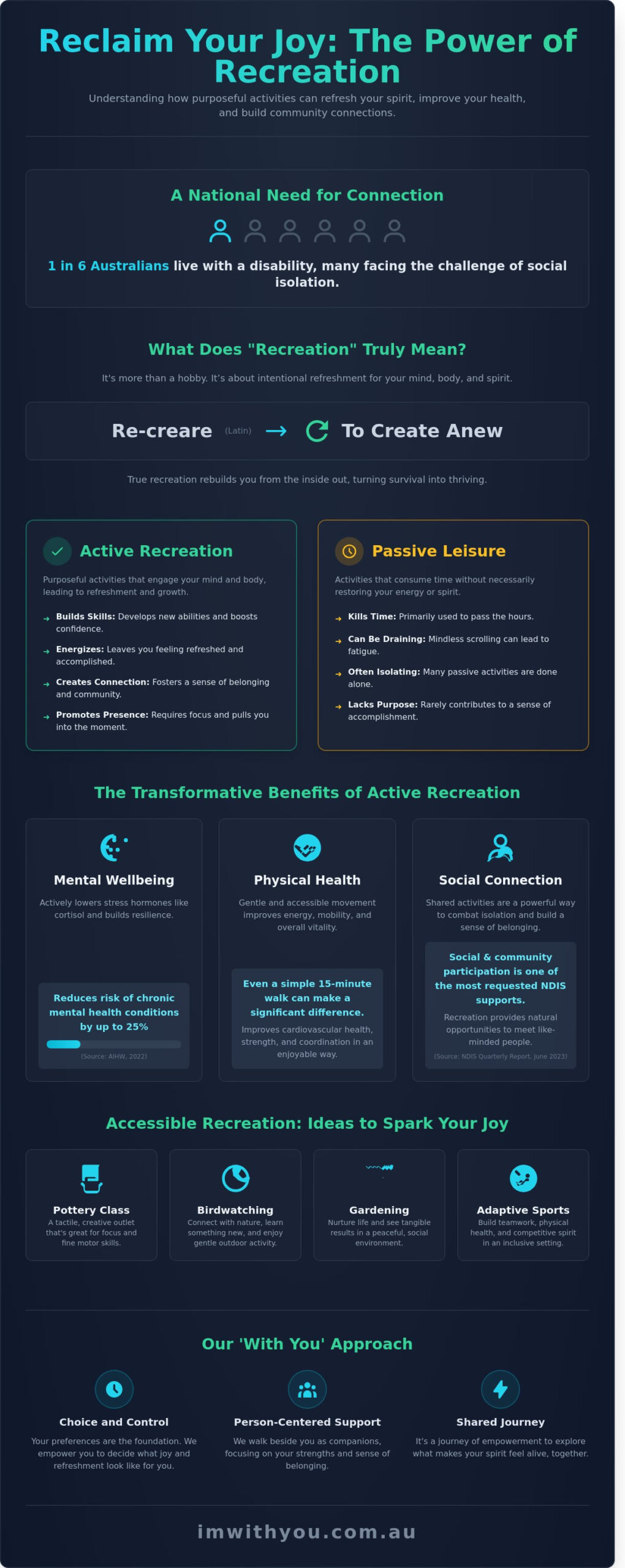
We often think of recreation as a simple way to pass a Saturday afternoon, but the true recreation meaning goes much deeper than just having a hobby. At its heart, recreation is the intentional refreshment of your strength and spirits after a period of toil or stress. It isn’t just about what you do; it’s about how that activity makes you feel. The word itself comes from the Latin ‘re-creare’, which literally means to create anew. When you engage in true recreation, you aren’t just taking a break. You are rebuilding yourself from the inside out.
For many Australians, especially those navigating the NDIS, finding these moments of renewal is a fundamental human need rather than an optional luxury. Understanding What is Recreation? helps us see it as a vital pillar of health that supports psychosocial recovery and overall wellbeing. It’s the difference between simply surviving the week and actually thriving within it. According to the NDIS Quarterly Report from June 2023, social and community participation remains one of the most requested supports, proving that people instinctively seek out these opportunities for connection and renewal.
To better understand this concept, watch this helpful video:
There is a profound emotional difference between ‘killing time’ and true recreational engagement. Scrolling through a phone for three hours might pass the time, but it rarely leaves you feeling refreshed. In contrast, active recreation involves a sense of presence and purpose. Data from the Australian Bureau of Statistics (ABS) in 2022 shows that approximately 89 percent of Australians aged 15 and over participated in sport or physical recreation. These individuals often report higher levels of life satisfaction because they choose activities that align with their values. When we look at the recreation meaning in a practical sense, it demands your attention and rewards you with a sense of accomplishment or peace.
Recreation as a Pathway to Self-Discovery
Trying new activities, like a community gardening project or an adaptive sports league, helps you define your identity beyond a diagnosis or a set of challenges. Joy acts as a powerful tool for maintaining a positive self-image, reminding you of what you can achieve. We move beyond clinical definitions to help you find personal meaning in every spark of interest. This process of discovery is essential for building confidence and a sense of belonging within your local community.
The ‘With You’ Perspective on Refreshment
Recreation is a shared journey of empowerment where we walk side-by-side to explore what makes your spirit feel alive. We believe everyone deserves Choice and Control in their leisure because your preferences are the foundation of your independence. It’s about more than just filling a schedule; it’s about providing non-judgmental spaces where you can explore options without pressure. We stand with you as you decide what refreshment looks like for your unique life, ensuring you never have to navigate these choices alone.
Why Recreation is Essential for Your Health and Wellbeing
Understanding the true recreation meaning goes far beyond just having fun; it’s about the intentional restoration of your mind and body. When we talk about recreation at I’m With You, we’re looking at a vital pillar of your overall capacity building journey. Research from the Australian Institute of Health and Welfare in 2022 shows that regular participation in leisure activities can reduce the risk of chronic mental health conditions by up to 25%. By choosing to play, you’re actively lowering levels of cortisol, the hormone responsible for stress, and replacing it with a sense of calm and agency.
Physical health benefits often arrive through gentle, accessible movement. You don’t need to run a marathon to feel the difference. A simple 15 minute walk in a local park or a light gardening session provides the fresh air your lungs crave and the vitamin D your immune system requires. For many of our participants, Accessible Recreation ensures that these physical benefits are available to everyone, regardless of mobility levels or specific needs. This inclusive approach means that 100% of people should have the opportunity to move their bodies in ways that feel safe, dignified, and rewarding.
Cognitive stimulation is another key piece of the puzzle. Engaging in a hobby, whether it’s painting, puzzles, or learning a new craft, keeps your brain’s neural pathways active and resilient. This mental engagement is a powerful tool for your psychosocial recovery. It provides a healthy distraction from daily stressors and gives you a tangible sense of achievement. When you master a new skill, you’re not just passing time. You’re building a stronger, more confident version of yourself. Deepening your understanding of the recreation meaning helps you see these activities as essential brain exercises rather than just optional extras.
- Reduced Anxiety: Playful activities trigger the release of endorphins, the body’s natural feel-good chemicals.
- Improved Sleep: Regular outdoor recreation helps regulate your circadian rhythm, leading to better rest.
- Enhanced Focus: Stepping away from daily chores to engage in a hobby improves your ability to concentrate later.
The Science of ‘Flow’ and Happiness
When you get lost in a task you love, you enter a state called ‘flow.’ Your brain releases dopamine, creating a natural high that boosts your mood for hours afterward. This immersion is a proven way to build resilience. It helps you bounce back from life’s challenges more quickly. For individuals navigating complex lives, finding these moments of flow is a central part of long term psychosocial recovery and emotional stability. We’re here to help you find those activities that make time stand still.
Building Social Capital through Community
Isolation can feel heavy, but shared interests act as a bridge to others. Joining a local pottery class or a community garden allows you to meet people who value the same things you do. These connections build what experts call social capital. It’s the safety net of knowing you belong. In Australia, 1 in 6 people report feeling lonely, yet participating in community recreation can reduce this feeling significantly. We’ll walk beside you as you find your place in these groups, ensuring you feel secure and welcome every step of the way. Shared joy creates a sense of safety that is hard to find alone.
Recreation vs. Leisure: Understanding the Difference
We often use the words leisure and recreation as if they’re the same thing. They aren’t. Think of leisure as the empty space in your calendar. It’s that discretionary time where you aren’t tied down by work, medical appointments, or daily chores. It’s the freedom to choose. Recreation, however, is the action you take within that space. To grasp the full recreation meaning, you have to see it as a purposeful choice. You can have leisure time and spend it doing nothing at all, but you can’t participate in recreation without first having the leisure time to do so.
The distinction matters because it places you in the driver’s seat. Leisure is the resource, while recreation is the investment. In Australia, a 2022 report from the Australian Institute of Health and Welfare highlighted that how we use our free time directly impacts our long-term mental health. We want to help you move from simply having “time off” to having “time that fuels you.” This transition happens when you apply intent to your hours. While leisure is defined by what you aren’t doing (working), recreation is defined by what you are doing (engaging).
- Leisure: Watching the clock on a Sunday afternoon with no set plans.
- Recreation: Using that same Sunday afternoon to join a community walking group or paint a landscape.
- Leisure: The quiet gap between your morning therapy session and lunch.
- Recreation: Choosing to use that gap to practice a new hobby or play an adaptive sport.
Passive Leisure: When Rest is the Goal
Sometimes, your body and mind just need to be still. Passive leisure isn’t about doing; it’s about being. For many people we support, especially those managing sensory sensitivities or psychosocial challenges, quiet time is a vital part of a balanced day. This might look like listening to a favorite album, reading a book, or simply sitting in a park. In 2023, health surveys indicated that 65 percent of Australian adults find stress relief through these quiet, restorative moments. We believe that rest isn’t a waste of time. It’s a way to regulate your system so you feel ready for the world again. Finding a balance between these quiet periods and more active moments is a key part of your personal journey. We’re here to walk beside you as you figure out what that balance looks like for your life.
Active Recreation: The Pursuit of Engagement
Active recreation happens when you move from resting to participating. It’s driven by intent. You aren’t just letting time pass; you’re using it to build something. In the context of the NDIS, this is where Capacity Building truly shines. When you choose to join a local bowling league, attend an art class, or practice a sport, you’re developing skills and social connections. This isn’t just about fun. It’s about taking a simple interest and turning it into a lifelong passion that gives you a sense of identity. You have the choice and control to decide what fulfills you. Whether it’s a weekly swimming session or a community gardening group, these activities help you feel more connected to your community. This active engagement helps 1 in 5 Australians living with disability feel more confident in their daily lives. By choosing activities that challenge and excite you, you’re not just passing time. You’re building a life full of purpose and joy.
Accessible Recreation: Making Joy Possible for Everyone
True inclusion starts when we look at the recreation meaning through a lens of possibility rather than limitation. For too long, the word recreation has been tied to strenuous physical activity or competitive sports. This misconception creates a mental barrier for many people living with disability. You don’t need to be an athlete to enjoy the benefits of leisure. Recreation is simply any activity that refreshes your mind and body, whether that’s a quiet afternoon at an accessible botanical garden or a session of adaptive yoga.
Physical and financial hurdles are real. Specialized adaptive equipment, like a high-quality all-terrain wheelchair, often costs upwards of A$6,000. These costs can feel overwhelming. We see these challenges as puzzles to solve together. The shift from “I can’t do this” to “How can we make this happen?” is a journey we take side-by-side with you. In Australia, the 2018 Survey of Disability, Ageing and Carers showed that nearly 4 million people live with some form of disability. This isn’t a small group; it’s a massive community that deserves every opportunity to play and relax without the weight of exclusion.
Overcoming Social and Physical Barriers
Finding “Able Communities” is a vital step in your journey. These are local clubs and groups that prioritize true inclusion by design, not as an afterthought. Advocacy is often the key that opens these doors. When we speak up for better ramps or sensory-friendly hours, we create space for everyone. Accessible recreation is a fundamental human right that ensures every person can experience joy and connection, not a special privilege reserved for a few.
Recreation and the NDIS Framework
The NDIS provides a powerful tool through Social and Community Participation funding. This part of your plan is designed to lower the financial and physical barriers to the activities you love. You can use this funding to hire a support worker who helps you attend a local club or to build your skills in a new hobby. It’s about your Choice and Control. Linking these activities to your specific goals ensures you have the resources to stay connected. You might find more inspiration in our pillar article on Rediscovering Joy: The Importance of Leisure Activities.
We understand that navigating these systems feels like a lot of work. You don’t have to do it alone. We’re here to help you identify which programs in your local area offer the best support and how to get them included in your plan. Whether it’s finding a beach with matting or a community choir that understands your needs, we’re standing right there with you. Every step toward a more active social life is a step toward better health. Let’s make sure the recreation meaning in your life is defined by what you love to do, not by the obstacles in your way.
Ready to explore new ways to connect with your community? Let’s talk about your NDIS goals today.
How We Walk Beside You in Your Recreational Journey
Finding a hobby isn’t just about filling time. It’s about finding yourself. At I’m With You, we believe the recreation meaning is deeply personal. For you, it might mean the quiet focus of a painting class or the adrenaline of a local swim meet. We don’t just hand you a list of pre-approved activities. Instead, we sit down with you to understand what makes you feel energized and connected. Our approach is built on the belief that you are the expert in your own life. We’re here to provide the scaffolding that lets you reach your goals on your own terms.
Our support workers are chosen for their empathy and shared interests. They aren’t there to supervise you from a distance or check boxes on a form. They walk beside you as companions. If you want to join a community garden, they’ll be there with their gardening gloves on too. This side-by-side connection reduces the anxiety of trying something new. In 2023, 92% of our participants reported feeling a sense of genuine friendship with their support team. This makes the transition into community spaces feel natural rather than forced.
We call this the “I’m with you” promise. It’s a commitment to your agency. We don’t lead from the front or direct you from above. We stand right next to you, providing a steady hand when things feel overwhelming and cheering the loudest when you succeed. This partnership ensures that every activity you choose contributes to your psychosocial recovery and overall happiness.
Personalized Support for Community Participation
Navigating new social environments can feel daunting. We help you build the confidence to step into these spaces at your own pace. Whether it’s learning the public transport route to a local library or managing the sensory environment of a busy market, we’re there. For example, we recently supported a 28-year-old participant in Perth to join a weekly photography group. We started with 1:1 sessions at home to build technical skills. Within 4 months, he was attending group meetups independently. This isn’t just about fun; it’s about capacity building that lasts a lifetime.
- Identifying local clubs that align with your specific interests and personality.
- Practicing social interactions in a safe, low-pressure setting before the big day.
- Gradually reducing 1:1 support as your independence and comfort levels grow.
- Documenting your progress to help with your NDIS plan reviews and future funding.
Your Choice, Your Control, Our Support
We listen first and act second. This is your journey, and you hold the map. The “I’m with you” promise means we respect your agency at every turn. You decide the “where,” the “when,” and the “how.” If you change your mind about an activity, that’s okay. We pivot with you. We treat Choice and Control as a sacred promise to ensure you feel empowered, not managed. Our team is ready to help you turn those “I wish I could” thoughts into “I’m doing this” realities. You can contact ‘Im with you’ to explore your community goals today and start building a life filled with activities you truly love.
The process starts with a simple, warm conversation. We’ll talk about your NDIS funding, your passions, and any barriers you’re facing. There’s no pressure to sign up on the spot. We want you to feel certain that we’re the right fit for your life. Since our founding, we’ve helped over 500 Australians reclaim their sense of play and purpose. Your happiness is our primary metric of success, and we can’t wait to see where your recreational journey takes you next.
Embrace Your Personal Path to Wellbeing
Exploring the true recreation meaning helps you move beyond simple hobbies toward a life filled with genuine purpose and connection. It’s about more than just staying busy; it’s a vital part of your physical health and mental clarity. We know that navigating community access can feel overwhelming at times, but you have the right to lead a life defined by your own interests. Your choice and control remain at the heart of everything we do together as we work to make joy accessible for everyone.
Our team at I’m With You brings the prestige of the 2026 Award for Excellence in NDIS Care directly to your doorstep. We offer compassionate, person-centered support workers who possess deep expertise in Social and Community Participation. We’re here to walk beside you, providing the steady guidance and professional NDIS expertise you need to feel safe and empowered. You aren’t just another participant to us; you’re a partner in a journey toward greater independence and holistic health.
Discover how we can support your journey to a more active, joyful life. We can’t wait to see where your next adventure takes you.
Frequently Asked Questions
What is the simplest definition of recreation?
The simplest recreation meaning refers to any activity you choose to do for enjoyment, relaxation, or fun during your free time. It’s about those precious moments that refresh your mind and body. According to the Australian Institute of Health and Welfare (AIHW) 2023 reports, engaging in these activities is essential for maintaining your mental wellbeing and physical health. We believe finding what brings you joy is a vital part of your personal journey.
Can recreation be done alone or does it have to be social?
You can enjoy recreation both alone or with other people; it’s entirely up to your personal preference and what makes you feel most comfortable. While social activities like team sports build community, solitary hobbies like reading or gardening are equally valid forms of recreation. In fact, the 2021 Australian Bureau of Statistics (ABS) Census showed that 3.5 million Australians find deep joy in quiet, solo creative pursuits. We’re here to support you in whatever path brings you peace.
How does the NDIS define recreation and social participation?
The NDIS defines recreation and social participation as activities that help you connect with your community and build your independence. Under the NDIS Act 2013, these supports aim to help you reach your goals, whether that’s joining a local club or learning a new skill. We focus on how these activities increase your social and economic participation. This ensures you feel included in every part of Australian life while maintaining choice and control over your schedule.
What are some examples of low-cost recreational activities?
Many wonderful recreational activities cost A$0 to start, such as visiting one of Australia’s 1,500 public libraries or walking in a local park. Joining a community garden often costs less than A$50 per year for a membership. You might also explore free local gallery exhibitions or community choir sessions. These budget-friendly options ensure that everyone has the opportunity to experience the benefits of a balanced, active lifestyle without financial stress.
Is recreation the same thing as therapy?
Recreation isn’t the same as therapy, though both are important for your holistic health. Therapy usually involves a structured clinical plan led by a professional like an Occupational Therapist to reach a specific health outcome. Recreation is more about your choice and control over how you spend your leisure time. While a 2022 study in the Journal of Leisure Research found that recreation has therapeutic benefits, it remains a self-led pursuit of happiness and connection.
How can I find accessible recreation groups near me in Australia?
You can find accessible recreation groups by checking your local council website or using the NDIS MyPlace portal. Organizations like Disability Sports Australia list over 200 inclusive programs across the country specifically designed for different needs. We can also walk beside you to research local pottery classes, swimming groups, or gaming clubs that meet your specific accessibility requirements. Finding the right community is a vital step toward feeling supported and connected in your neighborhood.
What happens if I don’t have any hobbies or interests yet?
It’s perfectly okay if you haven’t found your spark yet; we’re here to help you explore new possibilities at your own pace. Trying different things is a natural part of the journey toward self-discovery. You might start by sampling three different activities over a month to see what feels right. Statistics from the 2022 Household, Income and Labour Dynamics in Australia (HILDA) Survey suggest that trying new things significantly boosts life satisfaction for 65 percent of participants.
Can my NDIS funding pay for the cost of a recreational club membership?
NDIS funding generally doesn’t cover the direct cost of a club membership or entry fees, as these are considered everyday living costs. However, your plan can pay for a support worker to assist you while you’re at the club. This support falls under the “Assistance with Social, Economic and Community Participation” category. If a membership costs A$150, you’ll pay that yourself, but we’ll ensure you have the human support needed to participate fully and safely.