

You are so much more than a diagnosis. We know that when you’re living with the day-to-day impacts of a mental health condition, the last thing you need is to feel like just another case file. The NDIS application process can feel overwhelming, a confusing maze of clinical terms and paperwork that can leave anyone feeling anxious and alone. This is precisely why a clear, heart-centered approach to understanding psychosocial disability NDIS support is so essential-one that sees you, the whole person, at the centre of your own journey.
In this compassionate guide for 2026, we will walk beside you, step-by-step. We’ll gently demystify NDIS eligibility, clarify the difference between clinical treatment and the functional, recovery-focused support the NDIS can fund, and show you how to build a life of independence and purpose. Our promise is to replace confusion with clarity and anxiety with a genuine sense of hope. You deserve to feel supported, not just processed, and we’re here to ensure your voice is heard.
Key Takeaways
- Learn how the NDIS looks beyond clinical labels, focusing instead on how your mental health journey impacts your daily life and independence.
- Gain the confidence you need for your NDIS journey by understanding psychosocial disability ndis criteria and how to communicate your needs effectively.
- Clearly see the difference between clinical treatments and the practical, recovery-focused supports the NDIS is designed to fund.
- Discover how a specialist Psychosocial Recovery Coach can walk beside you, helping you navigate your plan and take charge of your recovery path.
What is Psychosocial Disability in the Context of the NDIS?
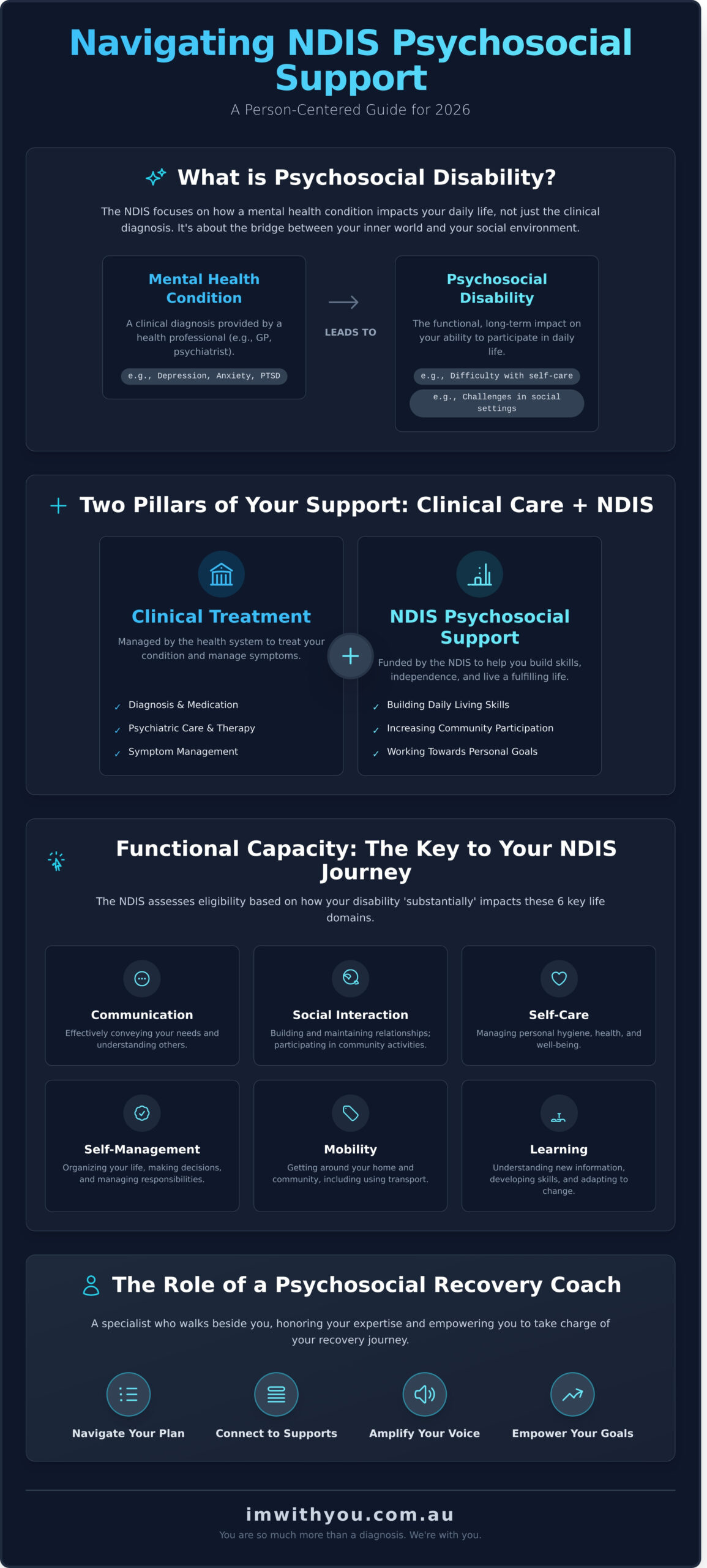
Navigating the world of the NDIS can feel overwhelming, especially when you encounter terms like ‘psychosocial disability’. We want you to know that we are here to walk this path with you, making everything as clear and gentle as possible. In its simplest form, a psychosocial disability is the term the NDIS uses to describe the functional impact of a mental health condition. It’s not about the diagnosis itself, but about how your experiences affect your ability to participate in life and connect with your community.
The term ‘Psychosocial’ itself refers to the powerful connection between your inner world (psycho) and your social environment (social). The NDIS adopted this language to shift the focus from a purely clinical label to a holistic view of you as a person. This change acknowledges that your recovery journey is deeply personal and is about so much more than just managing symptoms. For anyone seeking to access support, understanding psychosocial disability NDIS principles is the first step toward empowerment.
The Difference Between Mental Health and Psychosocial Disability
While many Australians experience mental health challenges, not all of these lead to a psychosocial disability. The key difference lies in the severity and permanence of the impact. The NDIS considers a condition ‘permanent or likely to be permanent’ when it significantly affects your ability to function in daily life over the long term. It’s also vital to know that the NDIS complements, rather than replaces, your clinical mental health care. Your GP, psychiatrist, or psychologist provides treatment, while the NDIS funds supports to help you build skills, independence, and community connection.
Why Language Matters: A Person-Centered Approach
The language we use shapes our reality. The shift toward ‘psychosocial support’ represents a move away from the old, clinical model of ‘case management’ and toward a future of walking side-by-side with you. It places your ‘Choice and Control’ at the very heart of your recovery, treating it not as a buzzword, but as a sacred promise of dignity and self-determination. For us, this framework is a true reflection of our name. When we say we’re with you, it means we are committed to being your partner on this journey, honouring your expertise in your own life every step of the way.
Functional Capacity: The Key to Your NDIS Journey
When you start your NDIS application, you’ll hear the term ‘functional capacity’ a lot. It might sound clinical, but it’s simply about how your psychosocial disability impacts your ability to manage daily life tasks and participate in your community. The NDIS focuses less on your diagnosis and more on what you can or cannot do because of it. This shift from ‘feeling’ to ‘doing’ is a central part of understanding psychosocial disability NDIS requirements. We know that your journey can fluctuate, with good days and tougher ones, and we are with you to help paint a clear and honest picture of this reality.
The Six Domains of Functional Impact Explained
The NDIS looks at how your life is affected across six key areas. Thinking about these domains can help you and your support team gather the right evidence for your application:
- Communication & Social Interaction: This is about your ability to build relationships, connect with friends, or engage with people in your community.
- Self-Care & Self-Management: This covers managing daily personal routines, taking medication, attending appointments, and looking after your health.
- Mobility & Learning: This domain relates to getting around your community, using public transport, and your capacity to learn new skills or adapt to change.
Proving ‘Substantial’ Functional Impact
To be eligible for the NDIS, the impact on your functional capacity must be ‘substantial’ and ‘permanent’. This means your support team, GP, or psychiatrist needs to provide evidence that clearly links your disability to specific challenges in those six domains. It’s important to describe how you manage on your most difficult days, as this gives the NDIS a true understanding of the support you need. This isn’t about focusing on deficits; it’s about being honest so you can get the right support to build on your strengths. As the system evolves and conversations around the Future of Psychosocial Supports highlight the need for clearer pathways, your lived experience remains the most powerful evidence.
Functional capacity is the bridge between the goals you have for your life and the day-to-day reality of your journey.
Clinical Treatment vs. NDIS Psychosocial Supports
Navigating where the health system ends and the NDIS begins can feel confusing, but we are right here with you on this journey. A key step in understanding psychosocial disability NDIS funding is knowing that the NDIS is not a health service. Instead, it works side-by-side with your clinical care team, creating a holistic circle of support designed around you.
Think of it this way: your clinical team focuses on treating your mental health condition, while your NDIS supports focus on building your capacity to live a full and independent life with that condition. The goal of the NDIS is not to ‘cure’ you, but to empower you by reducing the functional impact of your disability on your day-to-day life.
What the NDIS Will Not Fund
The NDIS is designed to complement, not replace, other mainstream services. This means it doesn’t fund supports that are considered part of the clinical health system or are available to all Australians. These typically include:
- Services from a psychiatrist, psychologist, or GP for clinical treatment or diagnosis.
- Medication and pharmaceutical treatments.
- In-patient hospital care or acute mental health crisis intervention.
- General living costs like rent, groceries, or income support, which are covered by other systems like Centrelink.
What the NDIS Will Fund
Your NDIS plan is built to give you greater choice and control over your life. It funds reasonable and necessary supports that help you pursue your goals, increase your independence, and participate in your community. Common examples for psychosocial disability include:
- A support worker to assist with daily living tasks, attend appointments, or help you connect with social groups.
- Capacity building therapies from an Occupational Therapist or counsellor to develop social skills, emotional regulation, or independence.
- A dedicated Psychosocial Recovery Coach to walk beside you, helping you navigate your recovery and get the most from your NDIS plan.
Together, your clinical team and NDIS supports form a powerful partnership. While your doctor provides essential treatment, your NDIS team helps you apply those recovery strategies in the real world, empowering you to build routines, relationships, and a life that you value.
The Role of a Psychosocial Recovery Coach
Navigating your NDIS plan can feel overwhelming, but you don’t have to do it alone. A Psychosocial Recovery Coach is a specialist support funded by the NDIS, designed to walk alongside you on your recovery journey. They are more than just a coordinator; they are a partner who brings a unique depth of understanding to your situation, often drawing from their own lived experience with mental health challenges. This relationship is central to understanding psychosocial disability NDIS supports and using them to build a life you love.
A Recovery Coach differs from a Support Coordinator in their focus. While a Support Coordinator helps you connect with services and implement your plan, a Recovery Coach works with you on a deeper level. They help you build your personal capacity, resilience, and skills to live more independently. Their role is to empower you to take the lead in your own life. While their focus is specialised, it can be helpful to see how it complements other roles. You can learn more in our guide to Understanding NDIS Support Coordination in Melbourne.
Building a Recovery-Oriented Framework
Your coach helps you create a framework for recovery that is entirely your own. This isn’t about just managing symptoms; it’s about discovering what a full and meaningful life looks like for you. Together, you will co-design a recovery plan that honours your personal values, builds on your strengths, and sets achievable goals that truly matter to you. It’s a collaborative process where you are always in the driver’s seat.
Finding the Right Coach for You
Finding the right person is about feeling a genuine connection and sense of trust. When you speak with a potential coach, it’s important to find someone who understands the journey and can champion your empowerment. Consider asking questions like:
- What is your own lived or learned experience with psychosocial disability?
- How do you help people identify and work towards their own recovery goals?
- How will you support my right to ‘Choice and Control’ within my plan?
A great coach is someone who helps you feel seen, heard, and truly capable of leading your own recovery. At I’m With You, we are committed to helping you find that perfect match.
Walking the Path Together: How ‘Im with you’ Supports You
We believe your recovery journey is uniquely yours, but you never have to walk it alone. We know that understanding psychosocial disability NDIS requirements can feel complex and isolating, and that’s where our promise begins. At ‘Im with you’, our entire approach is built on being a steady, compassionate companion. We stand beside you as you navigate your options, celebrate your progress, and build a life that is rich with meaning and connection. We are more than a service provider; we are your dedicated advocates and partners for the long haul.
For us, the NDIS principle of ‘Choice and Control’ is a sacred promise, not just a guideline. It means you are always in the driver’s seat. You choose your support workers, you set the schedule for your support, and most importantly, you define what recovery and a good life look like for you. Our role is to provide the expert guidance and resources to make your vision a reality. This unwavering commitment to putting you first is at the heart of our service, recognised with our award for excellence in care for 2026.
A Holistic Approach to Your Life
Your life is so much more than an NDIS plan. We look at the whole picture-your goals, your relationships, and your place in the community. We work with you to build social connections, explore hobbies, or pursue education and work opportunities. Our support also extends to your family and carers, as we know that a strong network is vital. By focusing on your unique strengths and possibilities, we help build a foundation for lasting wellbeing.
Your Next Steps Toward Empowerment
Taking that first step is an act of courage, and we are here to make it feel safe and simple. We invite you to a gentle, no-obligation conversation about your needs and goals. Whether you need help with plan implementation-turning your NDIS funding into real-world action-or want to focus on capacity building to develop new skills and confidence, our team is ready to listen. Your journey to empowerment starts with a simple chat. Connect with our compassionate team today and discover how we can walk this path with you.
Your Path Forward: We’re With You, Every Step
Navigating the NDIS can feel overwhelming, but your path to empowerment begins with clarity. Remember that your NDIS journey is centered on your unique functional capacity, not just a diagnosis. It’s about accessing practical, life-enhancing supports-like those provided by a Psychosocial Recovery Coach-that exist alongside your clinical treatment. Gaining a clear perspective is the first step, and our comprehensive guide to understanding psychosocial disability NDIS support is designed to light the way.
You don’t have to walk this path alone. At I’m With You, our person-centered, advocate-led approach is at the heart of everything we do. As specialists in Psychosocial Recovery Coaching and proud recipients of the Award for Excellence in Disability Support 2026, we are committed to honouring your choice and control. We are here to listen, to guide, and to support you in building a life you love. Let us walk beside you on your NDIS journey. Contact our team for gentle, expert support.
Frequently Asked Questions About Psychosocial Disability and the NDIS
Is depression or anxiety considered a psychosocial disability by the NDIS?
While a diagnosis of depression or anxiety isn’t an automatic entry, it can be if the impact is severe and permanent. The NDIS focuses on how a condition affects your daily life. If your mental health condition substantially reduces your ability to manage daily tasks, socialise, or work on a long-term basis, you may be eligible for support. It’s about the functional impact, not just the diagnosis itself.
What evidence do I need to provide for a psychosocial disability access request?
You’ll need strong evidence from a qualified professional, like your psychiatrist, psychologist, or GP. The key document is often an NDIS Evidence of Disability form. This report must clearly state that your condition is permanent and detail how it significantly impacts different areas of your life, such as social interaction, self-care, and learning. We can help you understand what information is needed to best present your case.
Can I have both a Support Coordinator and a Psychosocial Recovery Coach?
Yes, you absolutely can, and it’s quite common. Your NDIS plan must simply show that they have distinct roles. A Support Coordinator helps you connect with a broad range of services and implement your overall plan. A Psychosocial Recovery Coach provides specialised, hands-on support focused on your personal recovery journey, helping you build resilience and live a life you define. They work together, side-by-side with you.
What happens if my mental health improves? Will I lose my NDIS funding?
We know that recovery is not a straight line, and the NDIS understands this, too. Improvement is a wonderful goal, and it doesn’t automatically mean your funding will stop. Your support is there to help you maintain your wellbeing and manage the fluctuating nature of mental health. At your plan review, your funding may be adjusted to reflect your new goals and capacity, ensuring support remains when you need it.
How does the NDIS define ‘recovery’ compared to the medical system?
This is a beautiful question. While the medical system often views recovery as being ‘cured’ or free of symptoms, the NDIS embraces a more personal definition. NDIS-funded recovery is about you living a meaningful and fulfilling life with or without symptoms. It is a journey you lead, focused on your strengths, goals, and what “a good life” looks like to you, putting choice and control firmly in your hands.
Can the NDIS help me find a job if I have a psychosocial disability?
Yes, employment is a goal the NDIS can definitely support. A key part of understanding psychosocial disability NDIS support is knowing it can help you build skills for work. Your plan can include funding for things like developing your resume, practicing interview skills, or even getting on-the-job support from a mentor as you settle into a new role. It’s all about building your capacity and confidence to achieve your goals.
What if my NDIS application is rejected based on my mental health condition?
Receiving a rejection is disheartening, but please don’t lose hope-it is not the end of the road. You have the right to request an internal review of the decision, where you can provide new or more detailed evidence. If that is unsuccessful, you can appeal to the Administrative Appeals Tribunal (AAT). You don’t have to navigate this process alone; we are with you every step of the way.
How much choice do I have over who my recovery coach is?
You have 100% choice and control. This is a core promise of the NDIS that we hold sacred. Finding a Psychosocial Recovery Coach you connect with and trust is essential for your journey. You have the right to research, meet, and interview different coaches until you find someone who feels like the right fit for you. This decision is entirely yours, and we are here to support you in that process.