
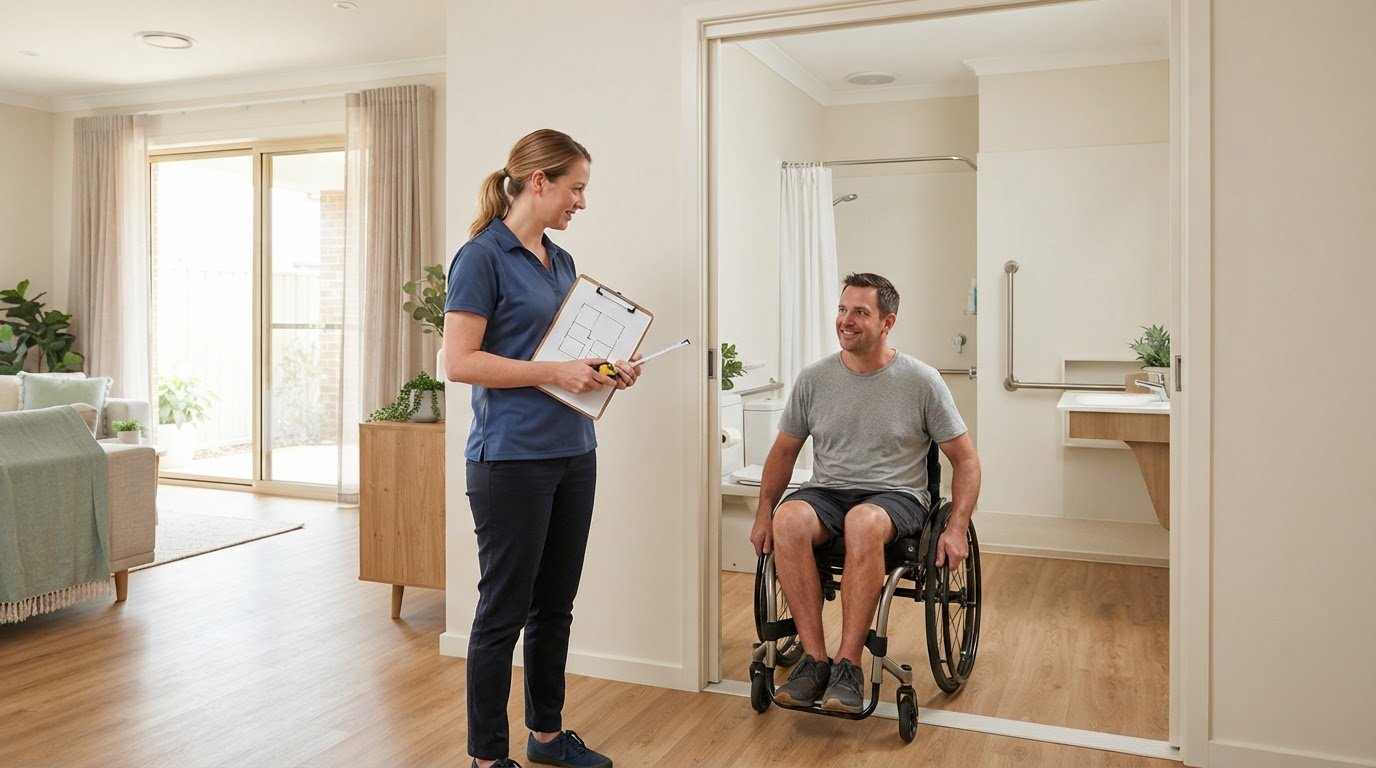
The NDIS home modification process usually begins with an occupational therapist assessing how your disability affects everyday activities at home and recommending suitable changes. Their report explains why the work is needed, while builders’ quotes help support the proposed costs. Wait for formal NDIS approval before work begins.
Organising a home modification can feel like a lot, especially when you’re working out which changes could make daily routines safer or easier. An occupational therapy assessment connects practical changes to your needs and goals, helping you plan based on evidence rather than guesswork.
This guide explains why the assessment matters, how an occupational therapist develops recommendations, and which disability-related changes may be considered, from access improvements to bathroom adaptations. You’ll also learn the key steps, so you can plan with a clearer idea of what to expect.
Key Takeaways
- Start by identifying the everyday tasks at home that feel difficult, so the assessment can focus on changes linked to your disability-related needs.
- An occupational therapist’s recommendations help explain how proposed modifications could support your safety, access and independence.
- Builder involvement and quotes help shape the proposed work, while formal NDIS approval should come before modifications begin.
- Explore practical options such as access, bathroom or fixture changes, then consider support coordination or advocacy if you need help managing the process.
What Is an NDIS Home Modification Assessment and Why Is It Required?
An occupational therapist’s assessment links a proposed change to your disability-related needs and everyday activities. In the NDIS home modification process, the report, builders’ evidence and formal approval help show why the work is suitable and reasonable.
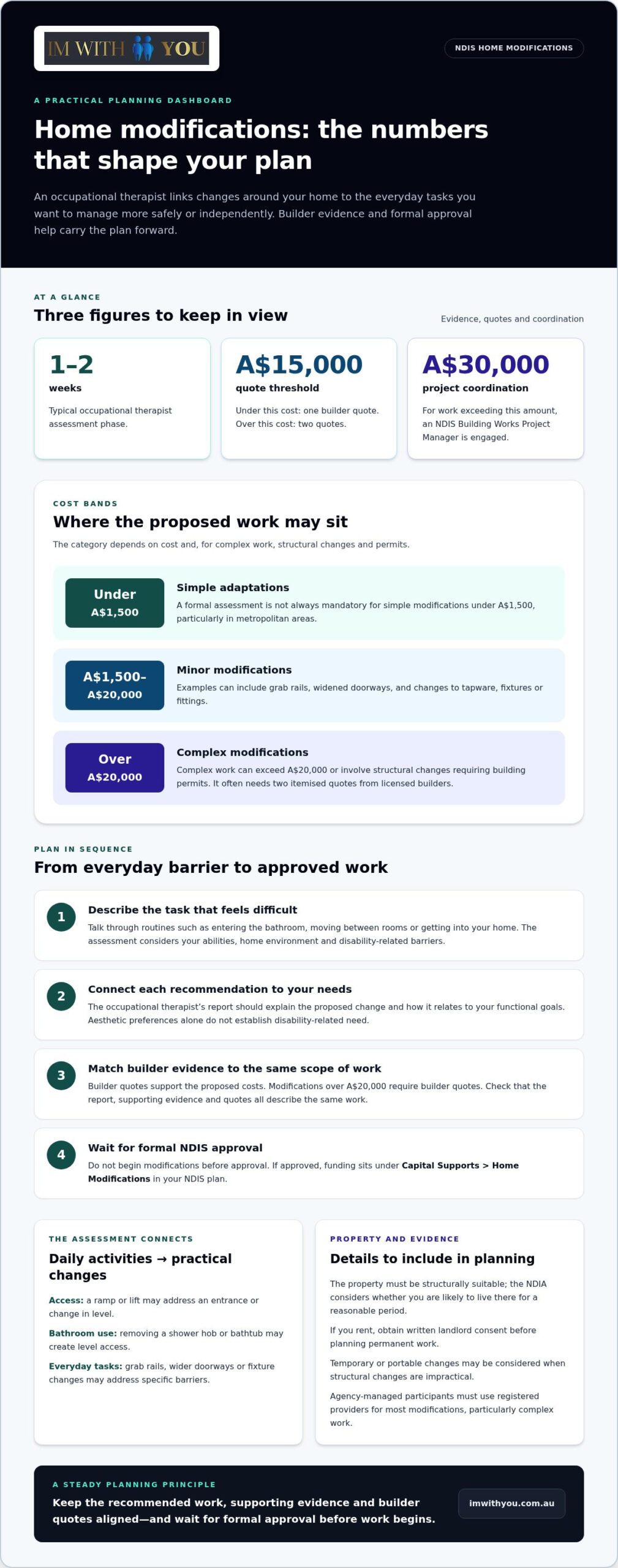
- Document the home and your needs. Ask the occupational therapist to assess how your home affects functional tasks, such as entering the bathroom or moving between rooms. Their report should explain the recommended change and how it relates to your living needs. The property must be structurally suitable, and the NDIA considers whether you are likely to live there for a reasonable period.
- Match builder evidence to the proposed work. A builder’s quote sets out the work and supports the assessment. One quote is required for a home modification costing under A$15,000, and two quotes are required for one costing over A$15,000. Complex modifications often need two itemised quotes from licensed builders. Modifications over A$20,000 require builder quotes.
- Coordinate structural work and approvals. Complex modifications exceed A$20,000 or involve structural changes requiring building permits. For work exceeding A$30,000, an NDIS Building Works Project Manager is engaged to coordinate the project. Do not begin work before formal NDIS approval; if approved, funding sits under Capital Supports > Home Modifications in your ndis plan.
- Understand the cost and responsibilities. Simple adaptations cost under A$1,500, while minor modifications range from A$1,500 to A$20,000; complex work exceeds A$20,000 or requires structural changes and permits. The participant needs to provide supporting evidence and secure a structurally suitable property. Agency-managed participants must use registered providers for most modifications, particularly complex work.
Occupational therapist assessments and recommendations
An occupational therapist connects your everyday support needs with practical changes to your home. Their assessment helps build the evidence for NDIS funding and explains how each recommendation relates to the participant’s functional goals.
-
Conduct the Occupational Therapist Assessment
Describe the tasks you want to manage more safely or independently, such as using the bathroom or entering your home. The occupational therapist assesses your abilities, routines and home environment, then considers how a modification could address disability-related barriers. An assessment phase typically takes one to two weeks. The therapist may use the Assessment of Motor and Process Skills or the Canadian Occupational Performance Measure to understand daily activities and priorities.
-
Document Recommendations Using NDIA Templates
Ask the occupational therapist to explain each recommendation in clear, practical terms. The report should link the proposed work, such as grab rails, to your functional needs and explain why it is disability-related. Use relevant NDIA templates to organise supporting information where applicable. Check that the report, other evidence and builders’ documentation all describe the same work.
- Connect recommendations to funding criteria. NDIS supports must meet the reasonable and necessary criteria in Section 34 of the NDIS Act 2013. Aesthetic preferences alone don’t establish disability-related need. For example, the report should explain how a bathroom modification addresses a specific access or daily-living barrier.
- Follow the evidence through approval. Share the completed assessment and supporting documents for consideration against your NDIS plan and funding criteria. An occupational therapist must prescribe the home modification. A formal assessment isn’t always mandatory for simple modifications under A$1,500, particularly in metropolitan areas. Don’t begin work before formal approval.
Examples of disability-related home modifications
Start with the activity you want to make easier, then link each proposed change to the disability-related need. The examples below range from small adjustments to complex home modifications.
- Map the route into and through your home. A ramp or lift may address an entrance or change in level that limits access. Structural work may require a different scope of work and builders’ evidence from simpler access adjustments.
- Identify bathroom barriers. Removing a shower hob or bathtub to create level access may make it easier to enter and use the space. The occupational therapist’s recommendations should explain how the change relates to your daily activities, not just its appearance.
- List smaller changes room by room. Minor home modifications may include grab rails, widened doorways, or changes to tapware, fixtures and fittings. These can support specific tasks without the broader work involved in complex modifications. Ask your occupational therapist to describe the task each recommended change addresses.
- Plan around the property and evidence. If you rent, obtain written landlord consent before planning permanent work. If structural changes are impractical, temporary or portable modifications may be considered. Keep the occupational therapist’s recommendations consistent with builders’ quotes, and ask your support coordinator to help organise documents. The NDIS does not fund aesthetic upgrades or unrelated routine repairs.
If you’d like help organising disability-related supports alongside your planning, explore NDIS support coordination.
Im with you: Disability Support Services
Im with you offers Disability Support Services, including NDIS Support Coordination and Disability Advocacy Services, to support people through their home modification journey. A support coordinator can help organise conversations and documents, while advocacy can help you express your priorities and understand your options.
These supports may be useful when planning changes feels difficult to manage alone or you’d like support as you work through the ndis home modification process. Community Participation Support can also help you stay connected with activities that matter to you. Im with you works alongside you with a person-centred approach that keeps your goals and choices at the centre.
If you’d like to explore support, visit Im with you.
Take your next step with confidence
As you continue the NDIS home modification process, keep your priorities at the centre. Choose a daily routine you’d like to manage more comfortably, then note what makes it difficult and what an accessible space could help you do. These notes can help you explain what matters and take part in planning conversations.
You don’t have to work through every decision at once. Choose a manageable next step, whether that’s gathering your thoughts, discussing your goals with someone you trust, or exploring support options. I’m With You can walk alongside you as you consider what support fits your needs.
Contact Im with you to start a conversation. Your goals can guide the way forward, one step at a time.
Frequently Asked Questions
Do I need an occupational therapist for simple home modifications under A$1,500?
A formal occupational therapy assessment isn’t always mandatory for simple modifications under A$1,500, particularly in metropolitan areas. However, an occupational therapist must prescribe an NDIS home modification. The distinction is between needing a full assessment and needing professional prescription. For example, a grab rail may be a simple adaptation, but its recommended position should relate to your disability-related needs.
What Will the NDIS Fund?
The NDIS may fund home changes that address disability-related needs and meet the reasonable and necessary criteria. It does not fund aesthetic upgrades, unrelated routine repairs, or the cost of buying or relocating to a home. When describing a proposed change, explain the practical barrier it addresses, such as difficulty using a doorway, rather than focusing on appearance or general renovation.
What happens if my landlord refuses to approve home modifications?
Written landlord consent is required for home modifications in a rental property, so permanent work cannot proceed without it. Discuss the specific change and its purpose with your landlord. If structural work is impractical, temporary or portable modifications may be considered. NDIS funding does not cover a landlord’s obligations, such as routine property maintenance.
Who Is Eligible?
Home modification support is relevant to NDIS participants whose disability creates a need for changes to their home. The proposed modification must relate to that need and meet the reasonable and necessary criteria. For example, evidence could explain how a feature of the home affects a daily activity and how a specific adaptation could address the barrier. Funding is generally restricted to the participant’s primary residence.
What home modifications does the NDIS fund?
Possible changes include grab rails, widened doorways, modified tapware and accessible bathroom adaptations when they address disability-related needs. More involved options may include ramps, lifts, or structural changes to bathrooms and kitchens. A modification is not funded simply because it improves a home; the recommendation must connect the proposed work to the participant’s functional needs.