
Imagine the frustration of standing in your own kitchen, surrounded by familiar tools, yet feeling like a stranger to the simple act of making a cup of tea. It’s exhausting when your home feels like a clinical ward and you’re treated more like a medical case than a person. You want your independence back, but the confusion over ndis occupational therapy for stroke recovery often adds more stress than support. I’m with you in this journey.
I’ll show you how a person-centered approach can be a gentle bridge back to the life you love, focusing on your strengths rather than your limitations. We’ll explore practical strategies for daily tasks like dressing and cooking; we’ll also explain how to use your NDIS plan to find a partner who truly walks alongside you. Together, we’ll turn your recovery goals into a reality that feels manageable and personal.
Key Takeaways
- Reclaiming your daily rhythm starts with focusing on your strengths rather than your limitations; this helps build a bridge toward your personal goals.
- Learn practical, gentle ways to manage memory changes and relearn self-care routines like dressing and cooking with confidence.
- Discover how a Functional Capacity Assessment for ndis occupational therapy for stroke recovery helps secure the specific support you need to thrive.
- Find out how a supportive partner can manage the complexities of NDIS plan reviews and advocate for therapy hours that align with your progress.
How NDIS Occupational Therapy Transforms Your Stroke Recovery Journey
Recovery after a stroke isn’t just about medical appointments; it’s about finding your way back to the things that make you feel like yourself. NDIS Occupational Therapy serves as a vital capacity-building support designed to help you reclaim your daily rhythm. It’s more than just physical exercises. It’s a bridge between where you are now and the personal goals you want to achieve. I’m with you as a steady companion, ensuring that our ndis occupational therapy for stroke recovery focuses on your agency and your unique story.
Our therapists act as allies who truly understand the emotional weight of this transition. By choosing a person-centered approach, we prioritize your long-term dignity and social inclusion. We don’t just look at a clinical checklist of tasks; we look at the person behind the recovery. As a 2026 award-winning provider, we believe that professional expertise should always be delivered with a gentle, human touch that lowers stress and builds immediate trust. This partnership creates a safe, non-judgmental space where you can explore new ways of moving and living.
The Power of a Strengths-Based Approach in Rebuilding Skills
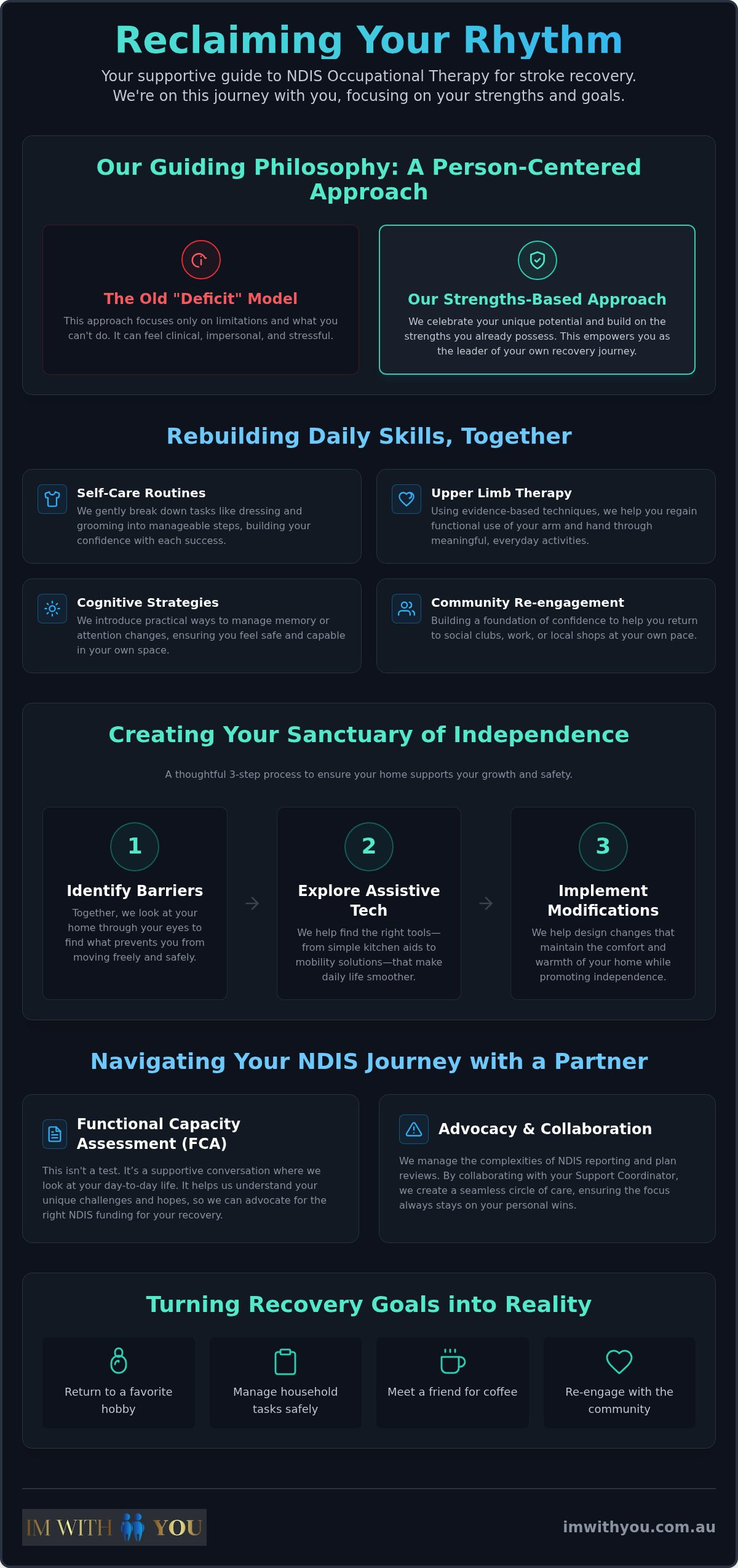
We intentionally move away from a cold “deficit” model that focuses only on what you can’t do. Instead, we celebrate your unique potential and the strengths you already possess. We use person-first language to ensure you always remain the leader of your own journey. This tailored ndis occupational therapy for stroke recovery ensures that every strategy we develop together is practical and meaningful. We focus on SMART goals that bring genuine joy to your life, such as:
- Returning to a favorite hobby like gardening, painting, or woodworking.
- Gaining the confidence to meet a friend for coffee independently.
- Re-engaging with local community groups or volunteer activities.
- Managing household tasks in a way that feels safe and rewarding.
Practical Strategies: Reclaiming Your Daily Independence After a Stroke
Relearning self-care routines like dressing, grooming, and meal preparation is a deeply personal journey we take together. With gentle guidance, ndis occupational therapy for stroke recovery focuses on breaking these tasks into manageable, successful steps that celebrate your progress. We don’t just look at the physical movement; we also introduce cognitive and perceptual strategies. These practical ways to manage memory or attention changes ensure you feel safe and capable in your own space while reducing the anxiety of daily life.
Evidence-based upper limb therapy, aligned with the 2026 Stroke Clinical Care Standard, helps you regain functional use of your arm and hand through meaningful activities. I’m with you as we practice these techniques, ensuring every session feels like a rhythmic step toward your autonomy. Returning to social clubs, the workplace, or the local shops becomes much easier when we’ve built a solid foundation of confidence. If you’re looking for a steady companion to help you navigate these choices, our occupational therapy services provide the expert support you deserve.
Adapting Your Environment for Safety and Ease
Creating a sanctuary of independence starts with a thoughtful three-step process to ensure your home supports your growth:
- Step 1: Identifying barriers. We look at your home through your eyes to find what prevents you from moving freely and safely.
- Step 2: Exploring Assistive Technology (AT). We find the right tools, from simple kitchen aids to advanced mobility solutions, that make life smoother.
- Step 3: Implementing modifications. We help you design supported independent living environments that maintain the comfort and warmth of your home.
Navigating Your NDIS Journey with a Supportive Partner
The NDIS can sometimes feel like a vast, impersonal system, but it doesn’t have to be that way. I’m with you to ensure your experience is defined by partnership rather than paperwork. Our journey often begins with a Functional Capacity Assessment (FCA). This is a gentle, comprehensive look at how you move through your day. It isn’t a clinical test to pass or fail; it’s a supportive conversation that helps us secure the right funding for your ndis occupational therapy for stroke recovery. By understanding your specific challenges and hopes, we can advocate for a plan that matches your actual recovery pace.
We collaborate deeply with your NDIS Support Coordination to create a seamless circle of care. This teamwork ensures that your therapy goals align with your broader support network, making your recovery journey feel like a unified effort. Having a steady guide provides the continuity you need, transforming the NDIS from a complex system into a reliable source of strength. We’re here to manage the complexity so you can focus on what matters most: your health and your family.
From Initial Assessment to Long-Term Advocacy
Your sessions are funded through the ‘Capacity Building’ category, which is dedicated to helping you rebuild skills and confidence through ndis occupational therapy for stroke recovery. We handle the technical reporting the NDIS requires, but we always make sure the focus stays on your personal wins and your unique recovery path. Our advocacy ensures your dignity is preserved and your voice is respected throughout every single interaction you have with the NDIS.
Embracing Your Path to Renewed Independence
Recovery isn’t just about physical progress; it’s about reclaiming the small moments that make life feel whole again. We’ve explored how a strengths-based approach to ndis occupational therapy for stroke recovery focuses on what’s possible, from adapting your home to relearning the skills that bring you joy. As a 2026 Award for Excellence recipient, we’re dedicated to providing specialist national support coordination that simplifies the NDIS so you can focus on healing. You don’t have to navigate these complex systems alone. I’m with you as a steady companion, ensuring your dignity and personal goals always remain at the heart of your care. Let us walk alongside you on your recovery journey; contact our supportive team today. Your future is full of potential, and we’re honored to help you reach it.
Frequently Asked Questions
How much NDIS funding can I get for stroke occupational therapy?
NDIS funding for ndis occupational therapy for stroke recovery is usually found under your “Capacity Building – Improved Daily Living” budget. The amount you receive is based on your individual goals and what the NDIS considers “reasonable and necessary” to help you regain independence. We’ll walk alongside you to provide the professional evidence needed to ensure your plan reflects the true level of support required for your journey.
Can an occupational therapist help if I have trouble speaking or swallowing after a stroke?
Occupational therapists focus on the functional side of mealtimes, like using cutlery or preparing food safely. If you have trouble speaking or swallowing, we’ll collaborate closely with a speech pathologist to create a unified plan. While they handle the mechanics of swallowing, we’ll help you adapt your kitchen and routines. This partnership ensures you can enjoy mealtimes with confidence and maintain your social connections.
What is a Functional Capacity Assessment and why do I need one for my stroke recovery?
This assessment is a detailed but gentle look at how you navigate your daily life at home and in the community. It’s a vital tool for your recovery because it translates your personal challenges into the technical evidence the NDIS requires for funding. By documenting your needs clearly, we help you secure the resources necessary to build your skills and improve your overall quality of life.
How soon should I start occupational therapy after being discharged from the hospital?
It’s best to start ndis occupational therapy for stroke recovery as soon as you are discharged. The 2026 Stroke Clinical Care Standard emphasizes that early, consistent rehabilitation is crucial for the best possible recovery. Starting quickly helps you apply your hospital progress to your real-world environment. We’ll help you set up your home and routines immediately so you feel supported from the very first day.