

The journey to finding a true home-a place of safety, independence, and comfort-can feel overwhelming, especially when navigating the complexities of the NDIS. If you’re feeling anxious about the process or confused by the different types of funding, please know you are not alone. That’s why we’re here to walk beside you and gently unpack one of the most empowering options available. Understanding what is supported independent living ndis funding is the first step towards turning that vision of home into a beautiful reality, where your independence is celebrated and supported.
In this guide, we’re with you every step of the way. We’ll move beyond the clinical jargon to explore how SIL empowers you to live life on your terms, in a home you love. Together, we will clarify the crucial difference between SIL and Specialist Disability Accommodation (SDA), show you what dedicated, person-centered support truly looks like, and provide a clear pathway for getting SIL included in your NDIS plan. Your right to ‘Choice and Control’ is our guiding principle, and our goal is to help you find a place where you can truly thrive.
Key Takeaways
- Understand that Supported Independent Living is more than just support; it’s a dedicated NDIS funding stream designed to help you build skills and live life on your own terms.
- Discover the crucial difference between SIL (the compassionate people who support you) and SDA (the physical home you live in), and why you don’t always need one to have the other.
- Answering what is supported independent living ndis means looking beyond the four walls of a house and focusing on finding a provider who champions your goals with empathy and reliability.
- We walk you through the essential steps to secure SIL in your NDIS plan, from gathering the right evidence to understanding your functional capacity assessment.
Defining Supported Independent Living (SIL) within the NDIS
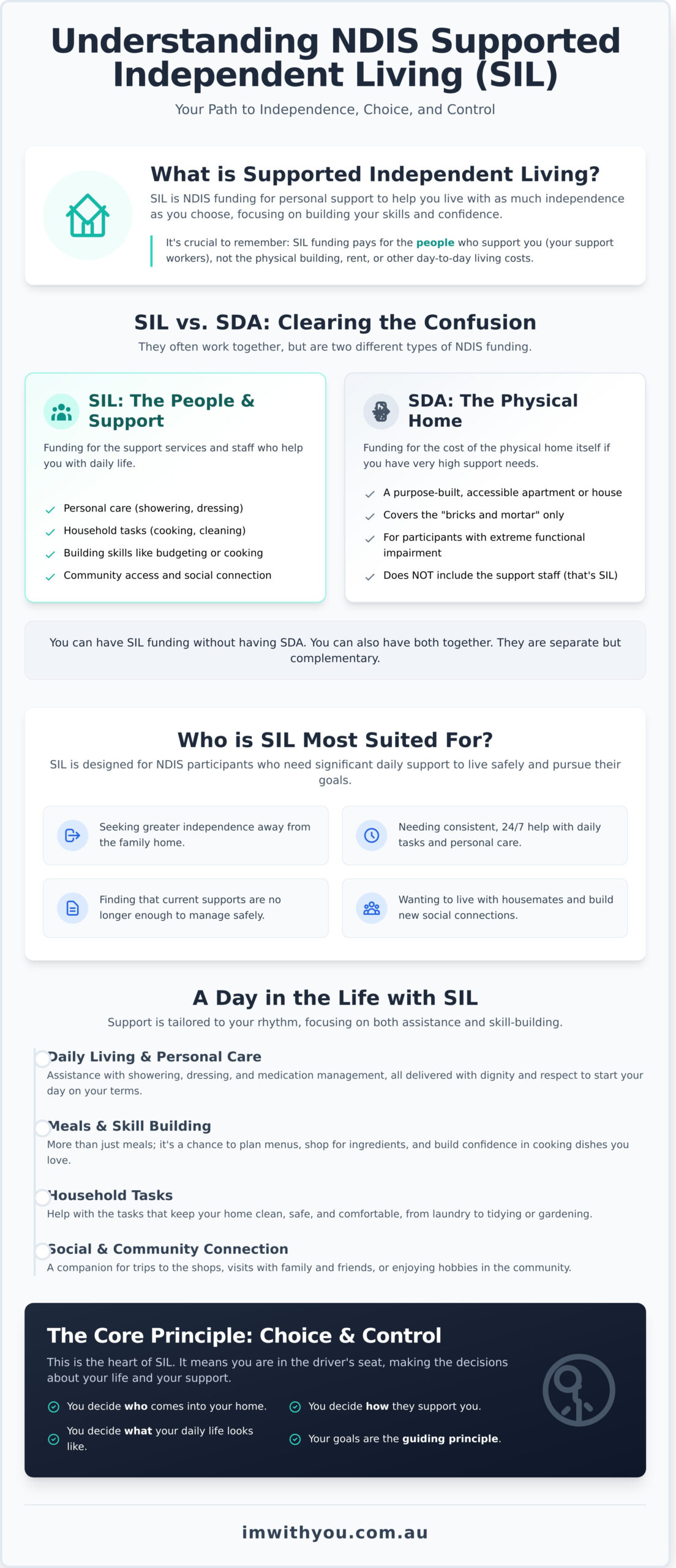
When you’re trying to understand what is supported independent living ndis, it can feel like navigating a complex maze. At Im with you, we’re here to walk you through it, step by step. In simple terms, Supported Independent Living (SIL) is NDIS funding that provides you with personal support for daily tasks, helping you live with as much independence as you choose. It’s a form of supported living that is less about completing tasks for you, and more about empowering you on your journey towards greater autonomy.
This support can be delivered in your own home or, more commonly, in a shared home with a small number of housemates. A crucial point to remember is that SIL funding pays for the people who support you-your dedicated support workers-not for the physical building, rent, or other day-to-day costs. The goal is always to build your capacity, helping you grow your skills and confidence so you can embrace a full and meaningful life.
The Core Purpose: Choice and Control
At its very core, SIL is a powerful tool for bringing the NDIS promise of ‘Choice and Control’ to life. This isn’t just a regulatory term for us; it’s a sacred commitment to your dignity and self-determination. It means you are in the driver’s seat. You decide who comes into your home, how they support you, and what your daily life looks like. We’ve wholeheartedly moved away from the outdated model of ‘care-taking’ and embraced a partnership focused on ‘capacity building’. Our role is to stand with you, helping you develop the skills you need for the life you choose.
Who is SIL Most Suited For?
SIL is designed for NDIS participants who need a significant level of support throughout their day, often including overnight or 24/7 assistance to live safely and pursue their goals. It’s a holistic support that can be life-changing for people with a wide range of physical, intellectual, or psychosocial disabilities who require high-intensity daily assistance.
It might be time to explore SIL options if you or a loved one are:
- Seeking greater independence away from the family home.
- Finding that current supports are no longer enough to manage daily life safely.
- Needing consistent, round-the-clock help with personal care, medication, or household tasks.
- Wanting to live with housemates and build new social connections in a supportive setting.
A Day in the Life: What SIL Support Actually Looks Like
When people ask, “what is supported independent living ndis funding provides?”, it’s easy to imagine a rigid, clinical schedule. We want to gently replace that image with one of warmth, companionship, and genuine choice. The reality of high-quality SIL is not about fitting into a pre-made mould; it’s about building a life that feels right for you, with support that moves at your own rhythm. It’s the shared morning coffee, the encouragement to try a new recipe, or simply having a trusted person by your side. This support is designed to empower you, honouring the official NDIS guidelines for Supported Independent Living while focusing on your personal journey.
Daily Living and Personal Care
Your day begins on your terms. Support with daily living is delivered with the utmost dignity and respect, whether it’s assistance with showering and dressing or help with your morning routine. We are with you to ensure medication is managed safely and that you feel prepared for any health appointments. In the kitchen, this support transforms into skill-building. It’s about more than just meals; it’s a chance to plan a weekly menu together, shop for your favourite ingredients, and build confidence in cooking dishes you love.
Household Tasks and Social Connection
A comfortable home is a happy home. Our support extends to helping with the tasks that keep your space clean, safe, and beautiful-from doing the laundry to tidying up or tending to a garden. But a fulfilling life happens both inside and outside the home. Your support worker is a steady companion, ready to facilitate social connections and community access. This could mean a trip to the local shops, an afternoon at the movies, or visiting family and friends. It’s about having someone there to share experiences with, turning a service into a true partnership.
Every one of these daily activities is a reflection of your goals and preferences. This is where the careful planning from your NDIS Support Coordination team truly comes to life. They work side-by-side with you to structure your SIL funding, ensuring your support roster is tailored to your unique needs and helps you live the independent, empowered life you choose.
SIL vs. SDA: Clearing the Confusion
Navigating the NDIS can sometimes feel like learning a new language, and two terms that often cause confusion are Supported Independent Living (SIL) and Specialist Disability Accommodation (SDA). We’re here to walk beside you and make it simple. Think of it this way: SIL is about the support-the dedicated people who help you with daily tasks-while SDA is about the accommodation-the physical house or apartment you live in. Understanding this difference is central to knowing what is supported independent living ndis funding truly provides.
While you can have SIL funding without living in an SDA property, the two can also work together to create a wonderful, holistic living solution. At I’m With You, our entire focus is on delivering the ‘people’ part of the equation-the premium SIL supports that empower you to live your life, your way.
Understanding Specialist Disability Accommodation (SDA)
Specialist Disability Accommodation (SDA) refers to purpose-built housing designed for participants with extreme functional impairment or very high support needs. It’s not the support itself, but the bricks-and-mortar home with special features that enhance your independence and safety. The NDIS has four categories of SDA design:
- Improved Liveability: For participants with sensory, intellectual, or cognitive impairment.
- Robust: Resilient housing for participants who may pose a safety risk to themselves or others.
- Fully Accessible: Designed for participants with significant physical challenges.
- High Physical Support: For participants who require a high level of personal support and structural provisions like ceiling hoists.
While the right house is important, the people inside are what make it a home. That’s why finding your trusted SIL provider is often the most important first step on your journey.
Can You Get SIL in Your Own Private Rental?
Absolutely. Your right to Choice and Control means you are not required to live in an SDA-certified property to receive SIL funding. You can receive SIL supports in your own home, a private rental, or a shared house with friends. This flexibility empowers you to choose a living situation that feels right for you.
In a shared home, you and your housemates will have a ‘Roster of Care’. This is a schedule that ensures support workers are available for shared tasks and individual needs throughout the day and night. Understanding how Supported Independent Living works through this shared model is key, as it promotes both community and cost-effectiveness. While shared living offers companionship, an individual arrangement provides more privacy. We are here to help you explore which path best suits your goals.
How to Secure SIL Funding in Your NDIS Plan
The journey to securing Supported Independent Living (SIL) funding can feel complex, but we want you to know you are not alone. It’s a step-by-step process focused on showing how SIL will empower you to live with more independence and achieve your personal goals. The NDIS needs to see that this support is ‘reasonable and necessary’ for your unique situation, and preparing the right evidence is the key to a successful outcome.
Your application is built on strong evidence. This includes reports from allied health professionals, most importantly a Functional Capacity Assessment (FCA) from an Occupational Therapist. This report provides a clear picture of your daily support needs and abilities. It helps answer the core question behind what is supported independent living ndis funding is for: how will it help you build your skills and live the life you choose?
The Roster of Care (ROC) Process
Think of the Roster of Care (ROC) as the blueprint for your weekly support. It’s a detailed, 7-day schedule that breaks down exactly what supports you need and when. Your chosen SIL provider will work side-by-side with you to create this document, calculating the shared and individual support hours required. For 24/7 care, the ROC will also outline ‘sleepover’ shifts or active overnight support, ensuring your safety and well-being around the clock.
Working with Your Support Coordinator
Navigating the SIL application is much easier with a trusted guide. Your Support Coordinator is your advocate, helping you gather the necessary reports, find a compatible SIL provider, and submit a comprehensive application. They champion your needs to ensure the funding reflects what’s required for your safety and quality of life. If your request is declined or underfunded, your Support Coordinator will stand with you to navigate the NDIS review process.
Preparing for your planning meeting with this information will give you confidence. Remember, you are the expert in your own life. If you need a partner to help you bring it all together, the team at I’m With You is here to walk beside you.
Choosing a SIL Partner: Why the ‘Who’ Matters More Than the ‘Where’
When you begin exploring Supported Independent Living, it’s natural to focus on the physical house-the location, the rooms, the garden. But the true foundation of a successful SIL journey isn’t the bricks and mortar; it’s the people who provide your support. Shifting your focus from the ‘where’ to the ‘who’ is the most empowering step you can take. The right partner transforms a house into a home and a support plan into a life of genuine connection and independence.
A premium SIL provider invests in relationships, not just facilities. They understand that empathy, reliability, and trust are the cornerstones of exceptional care. Their team isn’t just trained in tasks; they are skilled in human connection, ready to listen, adapt, and advocate for your goals. This is the difference between simply receiving services and building a partnership for your future. Understanding what is supported independent living ndis means recognising that the quality of your support team is everything.
Questions to Ask Potential SIL Providers
When you meet with a provider, their answers to these questions will reveal their true values and commitment to you:
- How do you match support workers to my personality, interests, and communication style to build genuine rapport?
- What is your practical, day-to-day approach to ensuring my ‘Choice and Control’ is respected in a shared home?
- How do you respond to emergencies or sudden changes in my support needs to ensure I always feel safe and heard?
The Im With You Commitment
We believe that you deserve a partner who is deeply and personally committed to your journey. Our person-centered philosophy embodies excellence in care standards, a testament to our unwavering dedication. For us, this isn’t just a philosophy; it’s a promise that we will always stand side-by-side with you, acting as your steadfast advocate and champion.
Your path towards greater independence should begin with a conversation, not a contract. We invite you to envision a future where you feel truly supported, respected, and empowered in your own home. Let’s explore what that could look like together, in a gentle, no-pressure chat about your goals and aspirations.
Connect with our compassionate team today and take the first step towards a life defined by your choices.
Your Journey to Independence: We’re With You Every Step
Embarking on the path to greater autonomy can feel complex, but understanding what is supported independent living ndis is the empowering first step. As we’ve explored, SIL focuses on the personalised, human support that helps you build skills and confidence in your own home-distinguishing it from SDA, which is about the physical building. The most crucial takeaway is that choosing your SIL provider is a deeply personal decision; it’s about finding a partner who genuinely respects your ‘Choice and Control’ and is committed to your unique goals.
At I’m With You, we live that partnership promise every day. Our unwavering commitment to a person-centered approach has been recognised with the 2026 Award for Excellence in Disability Care. With dedicated local teams across Australia, we combine national expertise with a familiar, community-focused touch, ensuring you feel heard and supported no matter where you are. Your vision for an independent life is within reach, and we are here to walk beside you. Let’s start your journey toward independence together-contact Im With You today.
Your Supported Independent Living Questions, Answered
Is Supported Independent Living the same as a nursing home?
No, they are very different. A nursing home, or aged care facility, typically provides clinical, 24/7 medical care. Supported Independent Living (SIL) is centered on helping you live with more independence in the community. It focuses on building your skills for daily life, like cooking or managing your home, empowering you to live a life you choose. We see it as support for your journey toward greater autonomy, not just clinical care.
Can I choose my own housemates in a SIL home?
Absolutely. Your comfort and happiness are at the heart of everything we do, and the NDIS principle of “Choice and Control” is our promise to you. Finding the right housemates is vital for a positive and safe home environment. We will support you through a careful matching process, where you can meet potential housemates and decide together if you feel it’s a good fit. It’s your home, and you should always feel it belongs to you.
What happens if I don’t get along with my SIL support worker?
Your relationship with your support worker is built on trust, so it’s essential that you feel comfortable and respected. If you ever feel that a support worker is not the right fit for you, we want you to tell us. We are with you on this journey and will listen without judgment. Together, we will work to understand the issue and find a new support worker who better matches your personality and support needs. Your wellbeing is our first priority.
Does SIL funding cover my rent and groceries?
A key part of understanding what is supported independent living ndis provides is knowing that SIL funding is for your support services. This includes help with personal care, cooking, and other daily tasks in your home. It does not cover everyday living expenses like rent, utilities, transport, or groceries. These costs are typically paid for from other sources of income, such as the Disability Support Pension (DSP).
Can I still access the community if I receive SIL support?
Yes, of course! A core goal of SIL is to help you build skills and confidence to be an active part of your community, not to isolate you from it. Your SIL support focuses on building your independence at home. To get out and about for appointments or social activities, you would typically use funding from another part of your NDIS plan, such as ‘Access Community, Social and Recreational Activities’ under your Core Supports budget.
How long does it take for the NDIS to approve SIL funding?
The timeline for NDIS approval can vary for each person, as the NDIA needs to be sure that SIL is a reasonable and necessary support for your specific situation. The process can take anywhere from a few weeks to several months and involves submitting detailed assessments and reports. We stand beside you throughout this entire process, helping to gather the right evidence to make your application as clear and strong as possible.
What is the difference between SIL and ILO (Individualised Living Options)?
While both are designed to support you to live more independently, they work in different ways. SIL (Supported Independent Living) generally involves paid personal supports, often in a shared home with two or more people. It’s typically for participants with higher support needs. ILO (Individualised Living Options) is a more flexible package that explores different ways for you to live, like co-residency or living with a host, creating a unique support arrangement just for you.
Can I change my SIL provider if I am not happy with the service?
Yes, you always have the right to change your SIL provider. Your “Choice and Control” is a fundamental right within the NDIS, and it is incredibly important that you are happy and feel well-supported. If your current provider isn’t meeting your needs, you can find a new one. This usually involves providing notice based on your service agreement. We can help you understand this process, ensuring a smooth and supportive transition to a provider who is right for you.