

If you or someone you love lives with Tourette’s Syndrome, you understand the daily realities that others don’t see. The constant management of tics, the social anxiety, the sheer exhaustion—it’s a journey that can leave you feeling misunderstood and wondering where to turn for help. It’s natural to ask the big question: is Tourette’s a disability in the eyes of those who can provide support? The word itself can feel heavy, and the line between a medical diagnosis and a legal definition often seems blurry.
We see you, and we’re here to bring clarity and comfort to this conversation. In this guide, we will gently walk you through how Tourette’s Syndrome is viewed as a disability in Australia, especially by the NDIS. We’re with you as we explore what this means for accessing practical assistance, empowering you with the knowledge and confidence to take the next step on your journey. You are not alone in asking this, and we’re here to find the answers, together.
Key Takeaways
- The answer to is tourettes a disability in Australia focuses less on the diagnosis and more on how it substantially impacts a person’s life, which is the key to unlocking support.
- Learn how Australia’s legal framework, including the NDIS, defines disability based on functional capacity rather than just a medical label.
- Discover the specific types of NDIS support that can empower you on your journey, helping to build skills and increase community participation.
- Equip yourself with the facts to confidently address common myths about Tourette Syndrome, helping to build a more understanding community around you.
The Simple Answer: Yes, Tourette’s Can Be a Disability
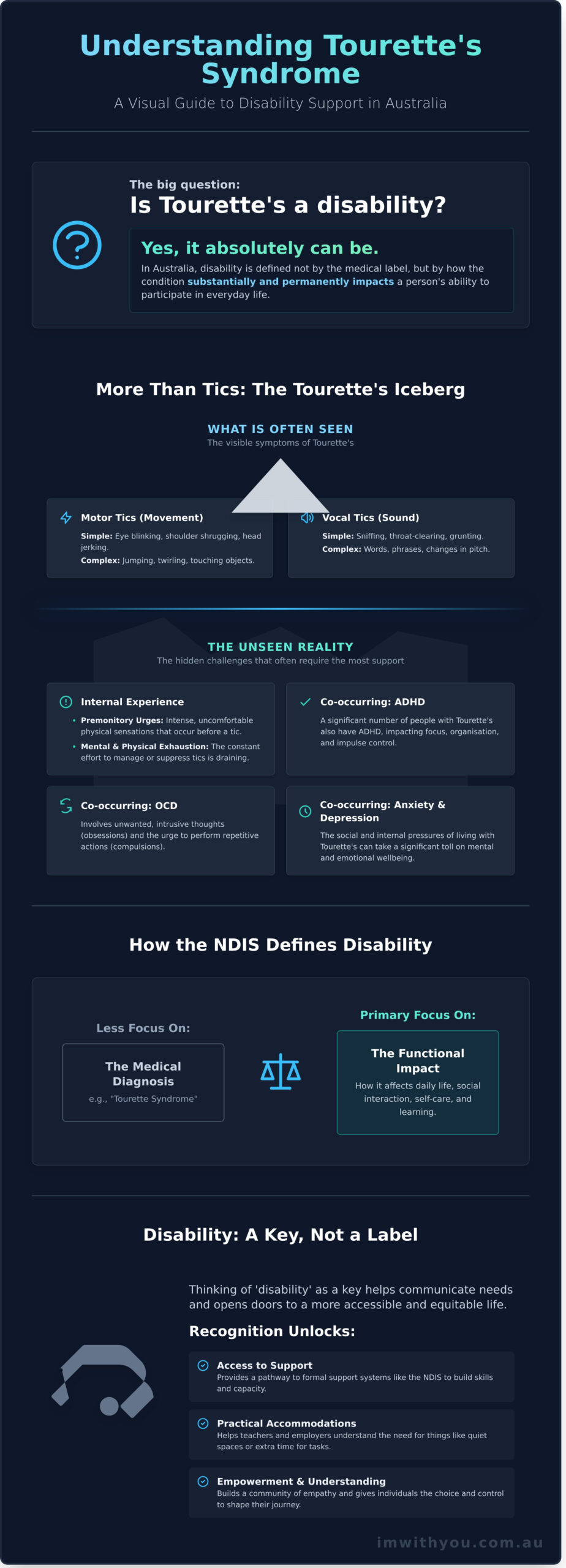
When you’re asking, “is tourettes a disability?” the simple and reassuring answer is yes, it absolutely can be. In Australia, a condition is considered a disability when it has a significant impact on your ability to participate in everyday life. It’s not about the diagnosis itself, but about how the condition affects you personally, day in and day out.
Tourette Syndrome is often called an ‘invisible disability’ because the challenges go far deeper than the motor or vocal tics that people see. Understanding this is the first step toward finding the right support. Viewing Tourette’s through this lens isn’t about focusing on limitations; it’s about opening doors to accommodations, empathy, and the resources you need to live a full and empowered life. We’re here to walk that path with you.
Why It’s About More Than Just Tics
While tics are the most recognised symptom, they are truly just the tip of the iceberg. Living with Tourette’s involves a constant, unseen internal experience. Many people feel an intense, uncomfortable sensation known as a ‘premonitory urge’ before a tic occurs. The effort to suppress these tics can be mentally and physically exhausting, draining energy that could be used for school, work, or connecting with loved ones. This internal battle, combined with the fear of judgment, can often lead to social anxiety and isolation. A deeper Understanding Tourette Syndrome reveals just how complex this condition is beyond what is visible on the surface.
Understanding ‘Disability’ in a Supportive Way
We believe the word ‘disability’ shouldn’t feel like a restrictive label. Instead, think of it as a key. It is a way to unlock the support and tools that make life more accessible and equitable. When Tourette Syndrome is recognised as a disability, it provides a clear language to communicate your needs. It helps teachers, employers, and friends understand why you might need accommodations, like a quiet space to decompress or extra time for tasks. It’s a powerful step toward gaining a sense of choice and control over your journey.
Understanding Tourette Syndrome: The Full Picture
To truly understand Tourette Syndrome (TS), we need to look beyond what we see on the surface. It’s a complex neurological condition, and while many people associate it with tics, that is only one part of a much bigger story. It’s so important to know from the start that TS has absolutely no bearing on a person’s intelligence or their character.
A gentle way to think of it is like an iceberg. The tics are the visible tip, but a much larger, more impactful reality lies just beneath the water. Understanding this full picture helps answer the question, is Tourette’s a disability?, with far more compassion and accuracy.
The Reality of Tics
Tics are the most well-known feature of TS. They are sudden, involuntary movements or sounds that happen because of an irresistible neurological urge—they are not a choice or a ‘bad habit’. Tics can be:
- Motor Tics: These involve movement. Simple motor tics might be eye blinking or a shoulder shrug. Complex motor tics are more coordinated, like jumping, twirling, or touching an object.
- Vocal Tics: These involve sound. Simple vocal tics can be sniffing, throat-clearing, or grunting. Complex vocal tics can involve specific words or phrases.
It’s also common for tics to ‘wax and wane,’ meaning they can increase or decrease in frequency and intensity over time, often in response to stress, excitement, or fatigue.
Common Co-occurring Conditions (The Iceberg’s Base)
This is the hidden part of the iceberg, and it’s often where the greatest need for support lies. For many individuals, these co-occurring conditions can be more disabling than the tics themselves. The most common include:
- Attention-Deficit/Hyperactivity Disorder (ADHD): Research shows that a significant number of people with TS also have ADHD, which can impact focus, impulse control, and organisation.
- Obsessive-Compulsive Disorder (OCD): This involves unwanted, intrusive thoughts (obsessions) and the urge to perform repetitive behaviours (compulsions) that can significantly disrupt daily life.
- Anxiety and Depression: The social and internal pressures of living with TS and its related conditions can take a toll on mental and emotional wellbeing.
When you see this holistic picture, it becomes clear why a person’s support needs can be so complex. The Tourette Syndrome Association of Australia provides excellent resources for families navigating this journey. Understanding these interconnected challenges is the first step toward finding the right support and empowering a person to live a full life, with choice and control.
How Australia Defines Disability: The NDIS Perspective
When we look at disability through an Australian legal lens, the focus shifts from a purely medical diagnosis to a functional one. The Disability Discrimination Act 1992 set the foundation, defining disability broadly to protect people from unfair treatment. This means when we ask, is Tourette’s a disability, the answer depends less on the label and more on how the condition impacts a person’s ability to participate fully in life.
The National Disability Insurance Scheme (NDIS) builds on this perspective. To access the scheme, a person must have a ‘permanent and significant disability’. The core of this definition lies in whether the condition ‘substantially reduces’ your functional capacity in key areas of life. It’s about understanding the real-world effect of Tourette Syndrome (TS) and any co-occurring conditions, not just the diagnosis itself.
What Does ‘Substantially Reduced Capacity’ Mean?
This is where your personal journey becomes the focus. For a person with Tourette’s, a substantially reduced capacity might look like:
- Social Interaction: Facing challenges forming relationships or feeling comfortable in social settings due to complex motor or vocal tics, or the anxiety that can accompany them.
- Learning and Employment: Finding it difficult to concentrate in a classroom or maintain employment because of the energy required to manage tics or navigate workplace environments.
- Self-Care and Independence: Needing support with daily routines or living independently due to the severity of tics or the impact of co-occurring conditions like OCD or ADHD.
Gathering Evidence for the NDIS
To show the NDIS how TS affects your life, building a clear picture with the right evidence is essential. This journey involves a few key steps:
- A formal diagnosis from a specialist, such as a neurologist or paediatrician, is the starting point.
- Reports from allied health professionals are vital. An Occupational Therapist (OT) or psychologist can provide a functional assessment that details how TS impacts your daily activities.
- Documenting your lived experience helps connect the dots. Personal statements and carer statements can powerfully illustrate the day-to-day challenges and support needs.
Navigating this can feel overwhelming. We’re with you.
Finding Support: How the NDIS Can Help Your Journey
Understanding how Tourette Syndrome (TS) is classified is the first step. The next is discovering the warm, practical support available to you. When the answer to the question “is tourettes a disability?” is ‘yes’ due to its impact on daily life, the National Disability Insurance Scheme (NDIS) can be a powerful partner on your journey.
The goal of the NDIS is not to “fix” you, but to walk alongside you, providing the resources you need to build your independence, participate in your community, and live a life you love. Your NDIS plan is a deeply personal roadmap, designed around your unique strengths, challenges, and goals. It’s all about empowering you with genuine choice and control.
Therapeutic and Behavioural Supports
Your NDIS funding can open doors to specialised therapies that help you build skills and manage the daily realities of TS. This support is focused on improving your wellbeing and is tailored to what matters most to you. It can include:
- Occupational Therapy (OT): To help develop strategies for managing sensory sensitivities, create calming daily routines, and adapt tasks at school, home, or work.
- Psychology Support: A safe space to build emotional resilience, manage co-occurring conditions like anxiety or OCD, and develop social skills for confident communication.
- Tic Management Therapies: Funding for evidence-based approaches like Habit Reversal Therapy (HRT) to help you gain a greater sense of control over your tics.
Capacity Building and Community Supports
Beyond therapy, the NDIS is about building your capacity to engage with the world on your own terms. It’s about creating connections and developing life skills for a fulfilling future. This can look like:
- Support Workers: A friendly companion to help you access community activities, join a hobby group, or even just get to appointments, reducing feelings of isolation.
- Support Coordination: A knowledgeable guide to help you understand your NDIS plan, connect with the right providers, and ensure your funding is working for you. We help you navigate the system so you can focus on your life.
- Developing Life Skills: Funding to learn practical skills for greater independence, from mastering public transport and budgeting to preparing for your first job.
The journey with Tourette Syndrome is unique to you, and your support should be too. An NDIS plan provides a foundation for you to grow, connect, and thrive. Navigating it can feel complex, but you are not alone. We are here to stand with you, every step of the way. If you’d like to explore your options with a team that truly cares, you can learn more about how we can help.
Busting Myths and Building a Community of Understanding
Part of navigating the journey with Tourette Syndrome involves facing common and often hurtful misconceptions. When we challenge these myths with facts and empathy, we build a more inclusive and supportive world for everyone. Understanding the reality behind the condition is a vital step in answering the question, is Tourettes a disability that requires our collective support? We believe the answer is a resounding yes.
Myth: Tourette’s is the ‘swearing disease’.
Reality: This is one of the most persistent myths, largely due to how Tourette’s is sensationalised in media. The tic of involuntary swearing, known as coprolalia, affects only about 10-15% of people with Tourette Syndrome. The vast majority of tics are physical movements (like blinking or shoulder shrugging) and simple vocal sounds (like throat-clearing, sniffing, or grunting).
Myth: People with Tourette’s can stop their tics if they try hard enough.
Reality: Tics are involuntary neurological urges. While some people can suppress them for a short time, it takes immense physical and mental energy. Imagine trying not to blink or holding back a sneeze for hours—it’s exhausting and often makes the tic more intense when it finally emerges. A calm, accepting environment reduces the stress that can worsen tics, making support far more effective than pressure.
How You Can Be an Ally
Your compassion can make a profound difference. Being an ally means choosing understanding over judgment and creating a safe space for people to be themselves. Here are a few simple ways you can stand with someone who has Tourette’s:
- Listen and Learn: Don’t make assumptions. Ask the person what support looks like for them. A simple, “Is there anything I can do to make this more comfortable for you?” shows you care.
- Focus on the Person, Not the Tics: Continue your conversation and maintain eye contact. Reacting to a tic can cause stress and anxiety, which may increase their frequency. Your calm presence is a powerful gift.
- Educate Gently: If you hear others sharing misinformation, you can be a voice for truth. Gently correcting a myth helps build wider community understanding.
- Offer Understanding, Not Pity: See the whole person—their strengths, personality, and contributions. Empathy connects us, while pity creates distance.
Building a community of true support is a journey we are on together. If you are exploring what support looks like for you or a loved one, know that we are always here to walk that path with you. Discover our gentle approach to NDIS support coordination at imwithyou.com.au.
Your Journey Forward: Understanding and Support
Throughout this guide, we’ve seen that the answer to is tourettes a disability is deeply personal. While it is a neurological condition, it becomes a disability when it significantly impacts a person’s ability to participate in daily life. The most important takeaway is that this recognition opens the door to meaningful support through frameworks like the NDIS, empowering you to manage challenges and build on your strengths.
Navigating this path is a journey you don’t have to take alone. As an award-winning NDIS service provider (2026), our expertise in handling complex support needs is matched only by our compassion. Our person-centered approach ensures that your plan is built around your goals, giving you genuine choice and control over your life.
We are here to walk alongside you, offering a steady hand and a listening ear. If you’re ready to explore your NDIS options, let’s talk. We’re with you every step of the way.
Frequently Asked Questions
Can you get NDIS funding for Tourette Syndrome in Australia?
Yes, it is possible to access NDIS funding for Tourette Syndrome. The NDIS focuses on the functional impact of a condition, not just the diagnosis. When looking at whether Tourette’s is a disability that meets their criteria, the NDIS will assess if it causes a ‘permanent and significant’ impact on your daily life. We understand this can feel like a complex journey, and we are right here with you to help you gather the evidence needed to tell your story.
Is Tourette Syndrome considered a neurological or psychosocial disability?
Tourette Syndrome is primarily classified as a neurological condition, as it originates in the brain and nervous system. However, the lived experience can have significant psychosocial impacts, such as social anxiety or challenges at school or work. We believe in a holistic approach, recognising that true support means looking at every aspect of your wellbeing. We’re here to support the whole person, not just the diagnosis.
Does Tourette Syndrome go away or is it a lifelong condition?
Tourette Syndrome is generally a lifelong condition. For many individuals, tics often become less severe and frequent as they move from their teenage years into adulthood. While the condition may not disappear entirely, learning effective management strategies can empower you to live a full and wonderful life. It’s a journey of adaptation and strength, and you never have to walk it alone.
At what age is Tourette’s usually diagnosed?
The onset of Tourette’s typically happens during childhood. Most diagnoses are made between the ages of two and 15, with the average age for tics to first appear being around six years old. Receiving a diagnosis is an important first step toward understanding and finding the right support. It opens the door to resources and strategies that can help your child thrive, and we are here to help you navigate what comes next.
What’s the difference between a tic and a stim (stimming)?
This is a great question, as they can sometimes look similar. A tic is an involuntary movement or sound driven by an irresistible neurological urge, and performing it provides a brief feeling of relief. Stimming, or self-stimulatory behaviour, is more often a voluntary or semi-voluntary action used to self-regulate. It can help a person manage sensory overload, calm anxiety, or express a strong emotion. Understanding the ‘why’ helps provide the right support.
How can I explain Tourette’s to my child’s school?
Explaining Tourette’s to the school is a powerful way to advocate for your child. We suggest arranging a meeting with their teachers and providing them with clear, simple information. You can explain that tics are involuntary and not a behavioural issue. Working together, you can create a supportive classroom plan that focuses on your child’s strengths and includes simple accommodations, ensuring they feel safe and understood. We are with you in this important partnership.