

A disability care plan should grow and change with the person it supports. Effective long term disability care planning reflects their needs, preferences and goals, then adjusts as their circumstances change.
Planning long term disability care can feel difficult when support needs change over time. You don’t have to navigate these changes alone. A useful plan connects a person’s daily routines, preferences and goals with practical supports, then sets out how those supports will be reviewed. We’ll work through how to plan for changing needs and keep NDIS supports aligned with the person’s approved plan.
Key Takeaways
- Work together to shape a care plan around the person’s preferences, daily routines, communication needs and goals, not just their support requirements.
- Make planned supports clear by noting what is needed, when it will happen and who will help put each strategy into practice.
- Revisit the plan together when needs, goals or circumstances change, and keep a record of updates and how reviews will happen.
- NDIS Support Coordination and Disability Advocacy Services can help you and the person work through support arrangements and ensure their needs and choices are heard.
Individualising plans for different needs
A useful disability care plan reflects the person’s preferences, strengths and everyday routines. Together, we can connect those details to practical supports and personal goals.
Begin with the person’s priorities: how they communicate, what they enjoy and where they want more independence. We can explore these priorities together. For example, someone who enjoys cooking might want support to practise preparing meals rather than having meals prepared for them.
Record useful details together, including daily routines, interests, social connections, communication preferences, nutrition requirements and environmental risks. We can set out short-term and long-term goals, along with the strategies and timeframe for working towards each one.
For each planned support, clarify together what is needed, when it will happen, how it will be provided and who will deliver it. In an NDIS plan, we can connect supports to the participant’s goals and needs. The NDIS provides funding and resources that support personalised care planning and its implementation.
Individualised Budgets and Care Costs
An individualised budget connects planned supports with available funding and expected expenses. It helps the person and their supporters understand how proposed services fit their circumstances.
There is no single cost for long-term disability care in Australia. Costs depend on the supports needed, how often they are provided and the funding available. To understand possible out-of-pocket expenses, we can list each support separately, distinguish support costs from household expenses, and identify any personal contribution before making decisions.
Housing and Daily Support Planning
Housing and daily support planning connects a person’s living arrangements with their routines, access needs and goals. Together, we can clarify how the home environment and everyday assistance can support their choices.
Consider the person’s preferred living setting, home access, daily tasks, transport needs and use of assistive technology. Then, together, we can note which provider will deliver each support, when it is needed and how it supports the person’s choices. For example, a plan might link travel assistance with attending a community activity.
Legal and Financial Arrangements
Legal and financial arrangements set out how decisions, assets and future wishes may be managed. Considering guardianship, wills and trusts can help families identify different planning questions and discuss them clearly.
Keep these arrangements separate from the care plan: the plan describes needs, goals and supports, while legal and financial documents address other matters. Together, we can note decisions that may need support, the person’s stated wishes and questions about guardianship, wills or trusts to discuss with an adviser.
Involve the participant, family members and support workers in planning. For people receiving Support at Home services in Australia, care partners prepare an individualised budget alongside the care plan, aligned with the participant’s needs and budget.
Monitoring and reevaluating care plans
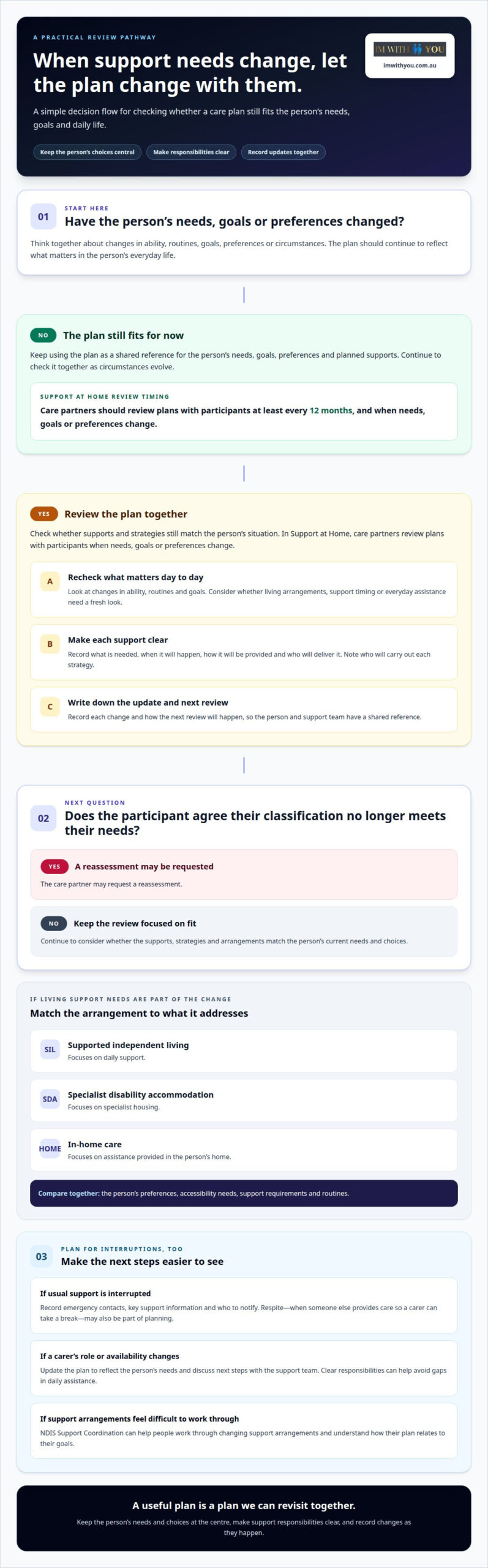
A care plan should remain useful as a person’s needs, goals and circumstances change. Regular reviews help us check together whether the supports still fit their daily life.
A plan gives the participant and support team a shared reference for needs, goals, preferences and planned services. In Australia’s Support at Home program, care partners prepare plans with participants, their carers or registered supporters, in line with the Notice of Decision and support plan.
Reviewing and Updating Care Plans
Reviewing a care plan means checking whether its supports and strategies still match the person’s situation. We can use these reviews to make sure the plan reflects changes in ability, routines or goals.
Support at Home care partners should review plans with participants at least every 12 months, and when needs, goals or preferences change. Together, record each update and how the next review will happen. If a participant agrees their classification no longer meets their needs, their care partner may request a reassessment.
When comparing supported independent living, specialist disability accommodation and in-home care, consider what each arrangement addresses: SIL focuses on daily support, SDA on specialist housing, and in-home care on assistance provided in the person’s home. We can weigh these options together against the person’s preferences, accessibility needs, support requirements and routines.
Planning ahead also means considering what happens if usual support is interrupted. Record emergency contacts, key support information and who to notify. Respite, where someone else provides care so a carer can take a break, may also be part of planning for changing circumstances.
Reducing Risks from Inadequate Planning
Without clear planning, needs, responsibilities and changes in support can be left unclear. This may create gaps in daily assistance or leave carers unsure how to respond when circumstances change. You don’t have to work through this alone: we can make responsibilities and next steps clearer together.
Reduce these risks by recording who will carry out each strategy, noting changes as they occur and explaining how reviews will happen. For example, if a carer can no longer provide usual support, update the plan to reflect the person’s needs and discuss next steps with their support team.
Some changes may affect more than one part of a plan. A move, a new daily routine or a change in the carer’s role can prompt a fresh look at living arrangements, support timing and the person’s goals. NDIS Support Coordination can help people work through changing support arrangements and understand how their plan relates to their goals.
Personalised care plans should be monitored and reevaluated regularly, with adjustments made when an individual’s needs or circumstances change. A disability care plan should record updates and changes and explain how the plan will be reviewed. Regular reviews can help keep a care plan aligned with changing needs and circumstances. Together, we can plan for the possibility that a person with an illness or disability may need more care in the future, or their carer may become unable to continue caring for them.
Im with you
Im with you can help you plan around changing support needs and keep the person’s goals at the centre. NDIS Support Coordination can help connect supports with plan goals, while Disability Advocacy Services can help people have their choices and needs heard. Disability Support Services and Community Participation Support can assist with everyday needs and participation in community life.
Consider reaching out when a change in circumstances makes existing supports harder to coordinate, or when you want support to reflect the person’s preferences more clearly. We’ll walk alongside you as you explore practical next steps. Contact Im with you to talk about support for your situation.
Take the next step with confidence
The next step does not have to answer every question about the future. Start with the change that matters most now, whether that is making daily routines easier, strengthening community connections or coordinating support around new goals. Talk with I’m With You about what feels manageable and which supports may fit your circumstances.
Long term disability care planning is an ongoing process, shaped by the person’s choices and the life they want to lead. You can revisit decisions as circumstances evolve, keeping the person’s voice at the centre. Im with you is here to walk alongside you as you consider what comes next. Contact Im with you to talk through your support needs. Each step can help create a clearer path forward, at your pace.
Frequently Asked Questions
What does long-term disability care planning involve in Australia?
Long term disability care planning means organising ongoing supports around a person’s life, choices and changing circumstances. For example, someone returning home after a hospital stay may need to reconsider their support arrangements alongside new daily routines. Planning can also clarify the roles of family members and support workers, help them share relevant information and keep the person involved in decisions about their future. You can take these steps at your own pace, with support.
What disability support services and funding are available through the NDIS?
The NDIS can fund supports included in a participant’s approved plan, with categories such as Core Supports and Capacity Building. Depending on the plan, supports may include help with daily tasks, community participation or support coordination. The plan’s goals and approved supports guide how funding can be used; a service being available does not mean it is funded for every participant. We can work through the plan one step at a time.
What are the costs of long-term disability care in Australia, including out-of-pocket expenses?
There is no single cost for long-term disability care in Australia. Costs depend on the supports needed, how often they are provided and the funding available. To understand possible out-of-pocket expenses, list each support separately, distinguish support costs from household expenses and identify any personal contribution. You can take this planning step at a pace that feels manageable.