

The NDIS price guide isn’t one fixed price for every support. Here’s the NDIS price guide for 2026, explained: the 2026-27 NDIS Pricing Schedule applies from 1 July 2026, and price limits vary by support and when it’s delivered. For many participants, understanding the figures is only part of the picture; how a plan is managed also matters.
It’s understandable if changing prices feel difficult to navigate, especially when you’re planning support. This guide explains how plan management affects price limits, what can shape prices for support coordination and recovery coaching, and how providers should communicate proposed changes. You’ll also learn what to consider when a new price affects your service agreement, so you can approach the conversation with greater clarity and make informed decisions about your plan.
Key Takeaways
- Learn how the pricing rules and Support Catalogue serve different purposes when you’re understanding a funded support.
- See why plan management can affect which providers you can use and whether price limits apply.
- Understand what shapes pricing for support coordination and psychosocial recovery coaching, without assuming every support has the same rate.
- Prepare for price-change conversations by knowing what should be discussed and agreed before a change applies to your service agreement.
How does plan management affect the price guide?
Plan management affects which NDIS price limits apply, while the support type determines the relevant item. The NDIS price guide for 2026, explained in context, can help you see how those pieces fit together. Download the official 2026-27 pricing arrangements and Support Catalogue from the NDIS website’s pricing documents section.
Pricing Arrangements and Support Catalogue
The Pricing Arrangements and Price Limits explain price ceilings and claiming rules; the Support Catalogue identifies support items and their categories. This distinction helps you match the support delivered to the correct item and understand its pricing conditions. The 2026-27 NDIS Pricing Schedule applies from 1 July 2026. The 2025-26 Pricing Arrangements and Price Limits became effective on 1 July 2025, with version 1.1 taking effect on 24 November 2025. For claims under that year’s arrangements, providers are directed to use the 2025-26 document. Together, the two documents make it easier to understand pricing rules and identify the support item that applies.
Price Limits and Provider Negotiations
Where price limits apply, they set the maximum registered providers can charge for a support. Providers may charge at or below that limit, so the maximum is not automatically the agreed price. Participants and providers can discuss the rate and record their agreement in the service agreement. Self-managed participants aren’t subject to price limits and can use registered or unregistered providers. Your plan management type affects how limits apply, while the agreed support and service terms still matter.
A separate proposed change concerns unregistered providers delivering social, community and civic participation supports. From 1 January 2027, their proposed price limit would be 10% lower. It is a proposal, not a current price limit, so distinguish it from the arrangements already in effect. For accommodation or other supports, use the relevant catalogue item and applicable pricing rules rather than assuming one limit covers every service.
Psychosocial recovery coaching and support coordination prices
Hourly limits for other supports depend on the relevant support item, delivery details and applicable pricing arrangements. The correct item matters: a rate for one service cannot be assumed to apply to recovery coaching or support coordination.
Psychosocial recovery coaching and support coordination help participants work towards their goals, but serve different purposes. Recovery coaching focuses on psychosocial recovery goals, while support coordination helps participants understand and use their NDIS funding. The plan’s funded supports and the service delivered determine which item applies. A support item number identifies that service in the Support Catalogue.
To estimate a price, identify the relevant support item, then consider the delivery type and any applicable regional rate. The national figure is a reference point, not a universal amount for every circumstance. Plan management is separate: its monthly fee covers plan-management services, not coaching or coordination hours.
The 2025-26 Annual Pricing Review consultation ran until 11:59pm AEDT on 8 February 2026. The review considers claims data, research and feedback from participants and providers. It assesses whether pricing arrangements support good outcomes, fair access and a sustainable market. These priorities inform annual pricing decisions, rather than setting one rate for every disability or community support.
To connect funding with personal goals, participants can discuss how coordination supports the outcomes in their plan. NDIS Support Coordination can help make those connections clearer and support informed choices.
There is no single hourly price limit for all NDIS support items. For coaching or coordination, the applicable limit depends on the identified service item, delivery type and any regional pricing variation.
Communicating price changes to participants
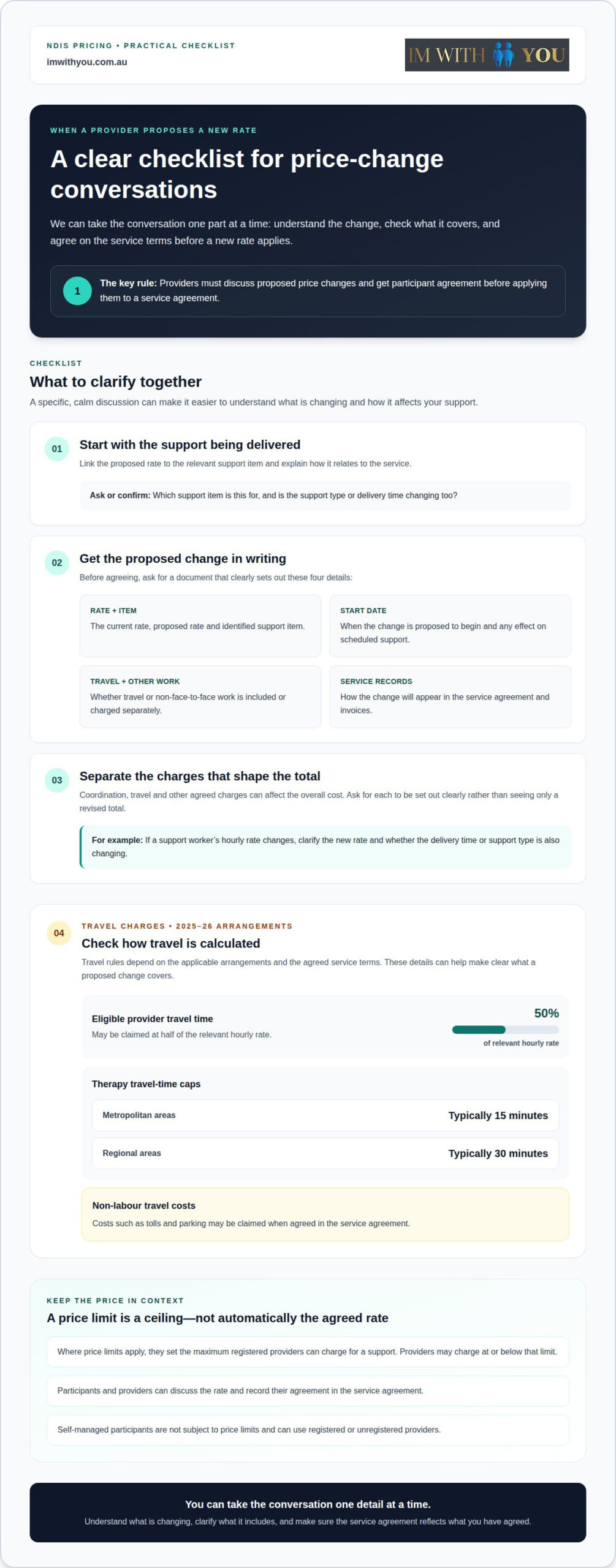
A price change can affect how often support is delivered and how funding is used. NDIS providers must discuss proposed changes with participants and obtain agreement before applying them to a service agreement. The conversation should explain what is changing, when it would take effect and how it relates to the support delivered.
A useful discussion links the proposed rate to the relevant support item and official pricing arrangements. For example, if a support worker’s hourly rate changes, explain the new rate and whether the delivery time or support type is also changing. Coordination, travel and other agreed charges can affect the overall cost, so set them out separately.
Before agreeing to a change, participants can ask for a document that sets out:
- The current and proposed rate, with the support item identified.
- The proposed start date and any effect on scheduled support.
- Whether travel or non-face-to-face work is included or charged separately.
- How the change will be reflected in the service agreement and invoices.
Travel rules also deserve a clear explanation. Under the 2025-26 arrangements, eligible providers may claim travel time at 50% of the relevant hourly rate. Therapy travel-time caps are typically 15 minutes in metropolitan areas and 30 minutes in regional areas. Non-labour travel costs, such as tolls and parking, may be claimed when agreed in the service agreement. These details help participants understand what a proposed change covers, rather than seeing only a revised total.
A calm, specific conversation helps participants make an informed choice. For support with NDIS decisions, connect with a supportive team.
Im with you
Im with you can help connect your NDIS funding and support choices with the goals that matter in daily life. If pricing changes leave you unsure how support fits your plan, we can work alongside you through NDIS Support Coordination, Disability Support Services, Community Participation Support and Disability Advocacy Services.
Our role is to help you understand your options, feel more confident in conversations about support, and make informed choices that reflect your priorities. You remain at the centre of decisions about your supports, and we’re here to walk beside you as you consider what comes next.
If you’d like support with your NDIS questions, contact Im with you for a conversation.
Choose your next step with confidence
Having the NDIS price guide for 2026 explained in plain language can make it easier to bring pricing conversations back to what matters: support that fits your goals and everyday life. As you consider what comes next, think about which outcomes you want your supports to help you work towards. You can then carry those priorities into discussions about services and funding, and ask for explanations that help you make informed choices.
You don’t have to work through those decisions alone. Im with you offers Disability Support Services, Community Participation Support and NDIS Support Coordination, with support shaped around your needs and priorities. If you’d like to talk through your next steps, contact Im with you for support. We’re here to walk alongside you as you make choices that feel right for you.
Frequently Asked Questions
What is the NDIS Price Guide 2026?
The NDIS Price Guide is the pricing and claiming reference for supports funded through the scheme. For 2026-27, the schedule applies from 1 July 2026. Use it alongside the Support Catalogue: the schedule explains pricing rules, while catalogue entries help identify the support item. This distinction is useful when a service includes different activities or delivery times.
Can a provider charge more than the price limit?
For supports with applicable price limits, registered providers can’t charge above the relevant maximum. Self-managed participants aren’t subject to those limits and may use registered or unregistered providers. For example, a self-managed participant can discuss a rate directly with a provider, while participants using other management arrangements need to consider the limits that apply to that support.
Can providers charge for cancellations and travel?
They may claim these costs only under the applicable pricing arrangements and service agreement. For 2026-27, short-notice cancellation periods differ: two business days apply to supports not delivered by disability support workers; support-worker short notice means less than seven days, with claims up to 100% of the agreed fee. Eligible travel time may also be claimed under the relevant rules.
Do I need to tell participants your pricing is changing?
Yes. Providers must discuss proposed price changes with participants and obtain agreement before applying them to a service agreement. For clarity, explain which support is affected, the proposed rate and start date, and any change to scheduled delivery. A written summary can help both parties understand what they’ve agreed to and avoid confusion when invoices reflect the updated terms.
Do prices differ by state?
The NDIS has national price limits rather than separate state price guides. However, the applicable amount can depend on the support item and delivery circumstances. For example, therapy travel-time caps distinguish metropolitan and regional areas. Check the relevant item and pricing conditions for the support being delivered, rather than assuming every rate is identical everywhere.