

You’ve spent the day helping with meals, appointments and times when extra supervision was needed. But on paper, those familiar tasks can be surprisingly hard to explain. If you’re finding writing a strong carer statement for ndis difficult, you’re not alone. It can feel uncomfortable to describe personal circumstances or the impact of caring without sounding overly negative. Clear, specific examples can help show what support looks like in everyday life.
Your perspective matters, and you don’t need dramatic language to make it count. This guide will help you describe your caring role in your own words, with practical examples that are honest, respectful and easy to understand. We’ll look at what support to include, how to explain the effect of caring on you and your family, and how your statement can complement other information about the participant.
Key Takeaways
- Understand how your personal observations can add context to other information about the participant.
- Use a simple four-stage approach to writing a strong carer statement for ndis: describe your role, give examples, explain impacts and review your words.
- Make examples useful by explaining what happened and what support you provided, while separating observations from assumptions.
- Review the statement for clarity and respect, and invite the participant to contribute where appropriate, guided by their choices and privacy.
What an NDIS carer statement explains, and why your perspective matters
An NDIS carer statement is your account of the support you provide and how it shapes everyday life for you and the participant. It can describe practical tasks, routines and the effects of caring, adding lived experience to other information about the person’s support needs. Your observations matter, but they sit alongside the participant’s own perspective and information from professionals. They don’t replace either.
The National Disability Insurance Scheme (NDIS) provides the broader context for the supports being discussed. In your statement, stay close to what you know first-hand: what you do, what you observe and how the caring role affects daily life. Writing a strong carer statement for ndis isn’t about dramatic language or predicting what decision-makers should do. It’s about giving an honest, balanced account without promising a particular NDIS outcome.
Whose experience belongs in a carer statement?
Carers can be parents, partners, adult children, siblings, friends or other unpaid supporters. What matters is the person’s actual role in the participant’s support, not their relationship label. Describe your own observations separately from what the participant says they want or value. For example, you might explain that you give reminders before appointments, while noting that the participant wants to attend independently. This recognises both your contribution and their capability, dignity and choice.
Where it feels appropriate, the participant can share their preferences and goals in their own words. Keep your statement focused on your experience, and avoid speaking for them or making assumptions about what they can do. This distinction helps keep everyone’s perspective visible.
How to write a strong NDIS carer statement with clear examples
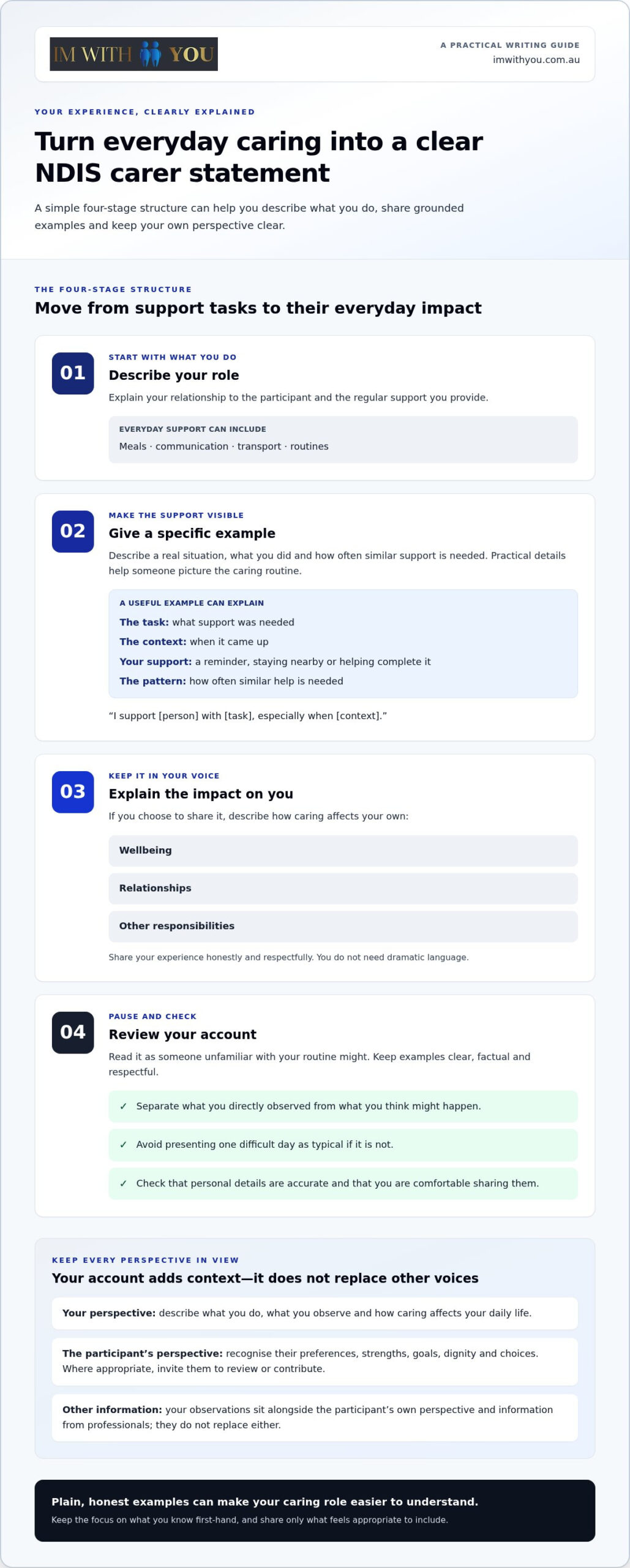
A clear structure can make writing feel more manageable when writing a strong carer statement for ndis. Move from what you do to what that support means in daily life. Keep examples grounded in what you’ve seen, and remember that support needs can vary from day to day.
- Describe your role. Explain your relationship to the participant and the regular support you provide, such as help with meals, communication, transport or routines.
- Give a specific example. Describe a real situation, what you did and how often similar support is needed. Practical details are more informative than broad claims.
- Explain the impact. If you choose to share it, describe how caring affects your wellbeing, relationships or other responsibilities. Keep the focus on your own experience.
- Review your account. Check that each example is clear and factual. Separate what you directly observed from what you think might happen, and avoid presenting one difficult day as typical if it isn’t.
What examples make a caring role easier to understand?
Choose details that help someone picture the support: the task, how often it comes up, the kind of prompting or assistance you provide, and what happens when you can’t provide it. For instance, explain whether you give a reminder, stay nearby or help complete a task. This prompt can help you get started: “I support [person] with [task], especially when [context].” Include only details you’re comfortable sharing.
Support needs may vary. You might explain that a task is usually manageable with a reminder but takes more support when plans change. Describe what you’ve observed rather than predicting what will always happen. The NDIS guidance for families and carers offers broader context as you consider how your account fits alongside other perspectives.
If organising support information feels overwhelming, Im with you provides NDIS support coordination and advocacy. These services can support you as you work through information and next steps.
Review and share your NDIS carer statement with confidence
Before sharing your statement, pause and read it as someone unfamiliar with your caring routine might. Does it explain what you do and what you’ve personally observed? Is the language respectful and in your own voice? A careful review can make your account clear without making it sound more formal or forceful than it needs to be.
What should you check before sharing the statement?
Check names, details and examples for accuracy. Remove anything you don’t want to share, including private information that isn’t needed to explain your experience. Make sure the statement adds personal context alongside other information, rather than presenting your observations as clinical evidence.
- Make sure each example reflects what happened, not an assumption about what might happen.
- Use wording that recognises the participant’s preferences, strengths and choices.
- Check that you’re comfortable with the personal details included.
If it feels appropriate, invite the participant to review or contribute to the statement. They may want to clarify a detail, share a goal or ask you to leave something out. Give them room to decide what they’re comfortable sharing, and don’t treat their review as a formality. Their privacy and choices matter.
Once you’re happy with the wording, sharing it can be a practical next step. NDIA processes and instructions can change, so check current guidance about where and how to provide supporting information before sending it. A carer statement can make your perspective easier to understand, but it can’t guarantee a particular decision or outcome.
I’m With You provides support coordination and disability advocacy to help you work through support information and next steps.
Take your next step with support alongside you
Your statement can be a starting point for a conversation, not a measure of how well you care. Give yourself permission to write plainly, pause when you need to, and return to your words with fresh eyes. The aim of writing a strong carer statement for ndis is to make your lived experience easier to understand while keeping the participant’s dignity and choices in view.
You don’t need every detail perfectly arranged before taking the next step. A thoughtful, honest account is a meaningful contribution, and your perspective deserves space. I’m With You provides NDIS support coordination and disability advocacy, and received the 2026 Australian Enterprise Award for Excellence in Disability Support and Advocacy. Explore how I’m With You can support you with support coordination and advocacy.
Frequently Asked Questions
What is an NDIS carer statement?
An NDIS carer statement is a written account of unpaid support from someone involved in a participant’s life. It may also be called an impact statement. There’s no specific NDIA template, so you can use a letter or another clear format. For example, describe how support fits around a regular weekly routine and what helps make that routine manageable.
Who can write a carer statement for the NDIS?
A person who provides unpaid support can write one. This could be a parent, partner, adult child, sibling, friend or another carer, depending on the participant’s circumstances. Focus on your own involvement and experiences. If several people support the participant, each person can describe their own perspective rather than trying to speak for everyone.
Does an NDIS carer statement guarantee more funding?
No. A carer statement can provide relevant supporting evidence, but it can’t guarantee increased funding, eligibility or a particular plan outcome. Its purpose is to help explain the informal support being provided and its effects. Keep the account accurate and grounded in your experience, and avoid wording that presents a particular funding decision as certain or promised.
How long should an NDIS carer statement be?
There’s no official page limit or required length for a carer statement. Include enough detail to explain your role and give examples, while keeping each point focused. Short paragraphs or headings can make different parts easier to follow. A concise account with relevant details is more helpful than adding information that doesn’t clarify your experience.