

What if the very team you’ve trusted to support your independence is actually the one making your world feel smaller? It’s completely natural to feel a sense of worry when you start noticing small things that don’t feel quite right. You might feel like just another number in a large system, or perhaps you’re anxious that your funding isn’t being managed with the genuine care it deserves. I’m with you in these moments of doubt, and I want you to know that your feelings are a valid part of staying in the driver’s seat of your own life.
Recognizing ndis provider red flags is the first step toward ensuring your supports truly align with your goals. In this guide, you’ll learn how to identify warning signs in your support services and gain practical strategies to manage your care with confidence. We’ll look at how the latest safeguards from the 2026 NDIS integrity reforms can help you and provide a clear path for you to protect your choice and control without the fear of conflict.
Key Takeaways
- Identify subtle ndis provider red flags like clinical detachment or funding gaps that may be affecting your peace of mind.
- Discover how to use NDIS Practice Standards as a gentle tool for documenting and addressing service issues with clarity.
- Learn how to initiate a collaborative check-in meeting to express your needs and seek a partnership-based solution.
- Understand that I’m with you as you use your choice and control to find a provider who acts as a steady companion on your journey.
Recognising NDIS Provider Red Flags in Care and Communication
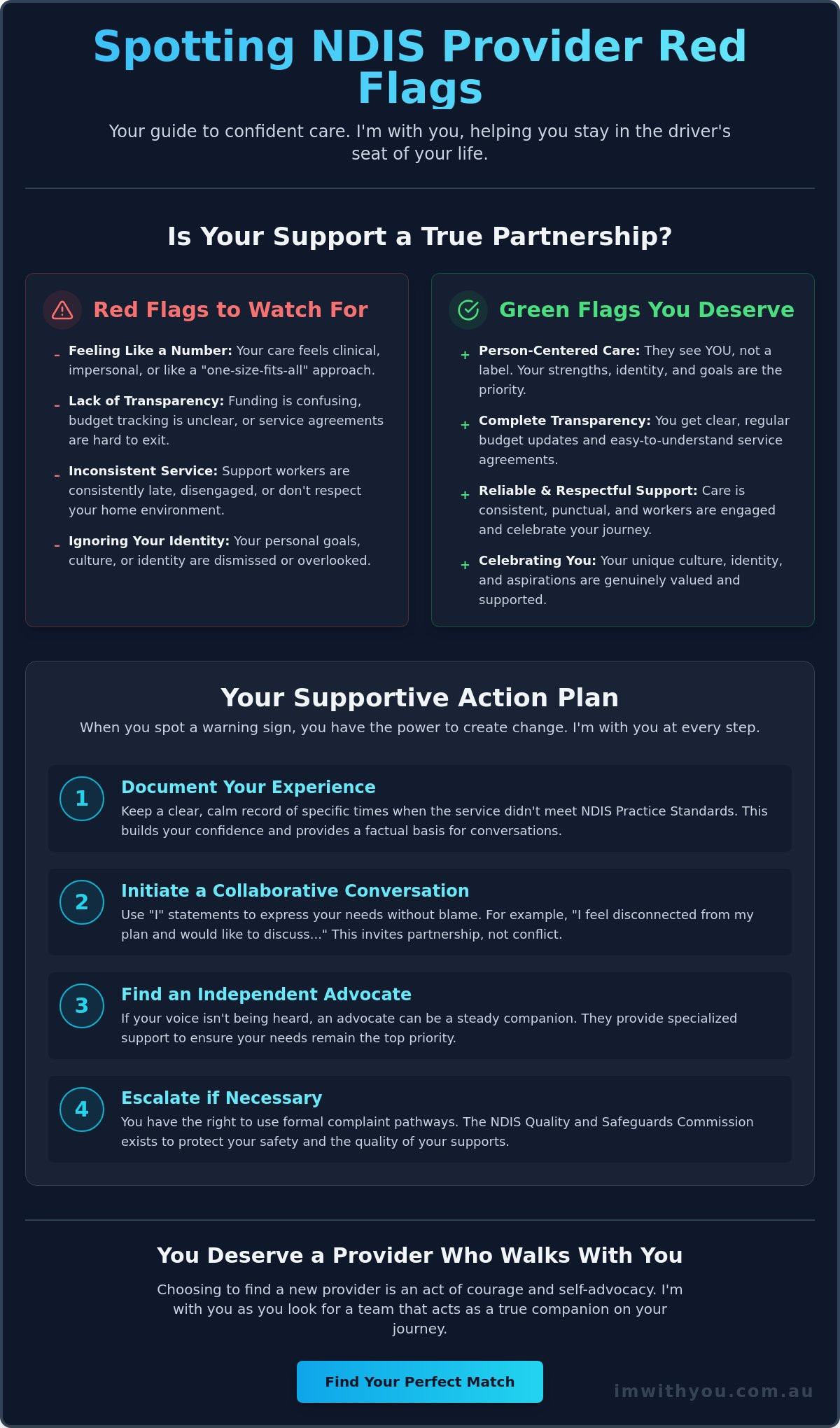
Your journey with the NDIS should always feel like a partnership where your voice is the loudest in the room. When communication starts to feel clinical or your personal goals are treated as mere administrative tasks, it’s a sign that the connection has shifted. You deserve support that celebrates your aspirations rather than dismissing them as inconvenient. I’m with you in believing that your care should be as unique as you are, never reduced to a “one-size-fits-all” checklist.
It’s also vital to watch for practical ndis provider red flags in your daily life. This might look like support workers who consistently arrive late, seem disengaged during your sessions, or fail to respect the unique rhythm of your home environment. When a provider ignores your culture or identity, they aren’t just missing a detail; they’re failing to provide the comprehensive care you’re entitled to receive.
To better understand how these issues can impact the wider system and your own experience, watch this helpful video:
The “Number” Treatment vs. Person-Centered Care
A provider who fails to use person first language is often showing you a major warning sign. When a team uses clinical labels instead of seeing the person, they’ve prioritized administrative efficiency over your daily personal wellbeing. Person-centered care is a non-negotiable standard for NDIS providers in 2026 that ensures every support is built around your individual strengths, identity, and life goals. If you feel like a number on a spreadsheet, it’s time to seek a team that sees the human being first.
Transparency and Your Right to Know
You have every right to understand exactly where your funding goes each month. Warning signs often hide in service agreements that feel coercive, overly complex, or intentionally difficult to exit. If you can’t easily access clear, regular budget tracking, it becomes much harder to maintain your independence. The NDIS Quality and Safeguards Commission provides the regulatory framework to uphold these rights, ensuring you’re never left in the dark about your own care and financial resources. Trustworthy providers will always welcome your questions about transparency.
Practical Management Strategies: What to Do When You Spot a Warning Sign
Spotting ndis provider red flags can feel like a heavy weight, but you don’t have to carry it alone. I’m with you as you navigate these challenges; there are clear, gentle steps you can take to reclaim your sense of control. Start by documenting specific times when the service hasn’t met the NDIS Practice Standards. This isn’t about being difficult. It’s about having a clear record of your experience so you can speak from a place of facts and confidence. Your rights under the NDIS Code of Conduct are a powerful tool for self-advocacy, ensuring you’re treated with respect and integrity at every turn.
Sometimes, even with your best efforts, you might feel like your voice isn’t being heard. In these moments, it’s helpful to Find an independent advocate who can provide specialized support. These professionals act as a steady companion to help you navigate complex conversations and ensure your needs remain the priority throughout the process.
Initiating a Collaborative Conversation
Before making a final decision, you might choose to offer your provider a chance to grow. Using “I” statements is a wonderful way to express your needs clearly without escalating conflict. For example, you might say to a manager: “I’ve felt a bit disconnected from my support plan lately, and I’d like to discuss how we can better align your disability support services with my personal goals.” This approach sets clear expectations and invites the provider to step back into a true partnership with you.
Utilising Feedback and Complaint Pathways
A high-quality provider sees your feedback as a gift. They should welcome your insights as an opportunity to improve their service and strengthen your relationship. If a collaborative approach doesn’t lead to change, you have the right to use formal complaint pathways. You can escalate serious concerns to the NDIS Quality and Safeguards Commission, which exists to protect your safety and the quality of your supports. If you’re looking for a team that truly values your feedback, our Disability Advocacy Services can help you find your voice again.
Moving Forward: Finding an NDIS Provider Who Walks With You
Finding a new path after noticing ndis provider red flags is an act of courage and self-advocacy. It shows you’re prioritizing your dignity and your future. I’m with you as you look for a team that doesn’t just manage your plan but truly walks alongside you. The principle of “Choice and Control” isn’t just a regulatory term; it’s your right to feel safe, heard, and respected every single day. When you meet a potential new partner, trust your intuition. An award-winning standard of care isn’t about accolades. It’s about a provider’s commitment to seeing you as a whole person with unique dreams.
Evaluating Potential New Partners
When interviewing a new team, look for those who offer comprehensive support coordination. This role is vital for helping you navigate the complexities of your plan with ease. Ask questions that test for empathy, flexibility, and industry expertise during your first meeting:
- How do you tailor your supports to match my specific cultural identity and preferences?
- Can you share how you’ve helped other participants achieve active community participation?
- What is your process if I feel a support worker isn’t the right fit for my home?
A genuine commitment to social inclusion should be evident in every answer they provide. If they speak with warmth and show a real interest in your life beyond your funding, you’ve likely found a true partner.
A Seamless Transition Process
Moving to a new provider shouldn’t feel like an overwhelming task. I’m with you in making this transition as smooth as possible. Managing notice periods in your current service agreement can feel awkward, but a professional new provider often handles the administrative heavy lifting for you. They can coordinate with your existing team to ensure there’s no gap in your essential care. This allows you to focus on your personal growth while your new partner manages the paperwork. By leaving behind the ndis provider red flags of the past, you’re opening the door to a supportive relationship built on trust and mutual respect.
Stepping Into a Future of Empowered Care
Taking the time to recognize ndis provider red flags is a powerful way to honor your own needs and aspirations. You’ve learned how to spot the signs of clinical detachment and how to use collaborative strategies to address concerns with confidence. Whether you’re documenting service gaps or initiating a check-in meeting, remember that these actions are about protecting your right to a life lived on your own terms. I’m with you as you move from feeling like a number to being the true leader of your support team.
Your journey deserves a companion who offers more than just management; you deserve a partner who celebrates your growth. Our team is proud to have received the 2026 Award for Excellence in Disability Support, a reflection of our deep commitment to walking alongside every participant. Through person-centered advocacy and expert support coordination, we make the transition to better care feel safe and simple. Discover how a supportive partner can transform your NDIS journey. You have the strength to choose a path that feels right, and I’m right here to support you in every step forward.
Common Questions About Your NDIS Rights
Can I change my NDIS provider at any time if I am unhappy?
You absolutely have the right to change your provider if the support no longer feels like a true partnership. This is the heart of choice and control. I’m with you in prioritizing your wellbeing, so don’t feel guilty about seeking a team that better aligns with your goals. Simply check your current service agreement for any notice requirements to begin your transition to a more supportive environment.
What is the standard notice period for ending an NDIS service agreement in 2026?
Notice periods are typically 14 to 28 days, though you should always check your specific service agreement for the exact terms. If you’ve identified ndis provider red flags, you can begin planning your move today. A supportive new partner can often help you handle the administrative side of this change, ensuring your daily care continues without any stressful interruptions or gaps in service.
Do I need to tell the NDIS directly if I am unhappy with my provider?
You aren’t required to tell the NDIS directly to switch providers, but you should contact the NDIS Quality and Safeguards Commission if you have a formal complaint. Reporting your experience helps maintain high standards for everyone in the scheme. I’m with you in navigating this process; sharing your feedback is a brave step toward ensuring every participant receives the respectful, high-quality care they deserve.
What should I do if I feel unsafe or exploited by a support worker?
You should contact the NDIS Quality and Safeguards Commission immediately if you ever feel unsafe, pressured, or exploited. Your physical and emotional safety are non-negotiable. The 2026 Integrity and Safeguarding Act has expanded the Commission’s powers to deal with misconduct more effectively. I’m with you in these difficult moments, and there are independent advocates who can provide a safe space for you to be heard and protected.