

What if your next NDIS plan meeting felt less like a clinical assessment and more like a supportive conversation about your future? It’s completely normal to feel like just another number in a massive system, especially when you’re trying to translate your deepest dreams into technical language. I’ve heard from so many people who feel anxious that saying the “wrong” thing might mean missing out on the essential support they deserve. I’m with you in this process, and I want you to know that your voice is the most important part of this journey.
This guide is designed to help you transform your personal aspirations into powerful, fundable ndis plan goals examples that the NDIA truly understands. We’ll explore how the 2026 framework planning shifts the focus toward your daily life and strengths rather than just functional limitations. You’ll discover clear, actionable examples that bridge the gap between your vision for 2026 and the specific support services you need to get there. Together, we’ll build your confidence so you can step into your next meeting feeling heard, prepared, and empowered.
Key Takeaways
- Understand how your personal vision serves as the essential foundation for a plan that honors your dignity and independence.
- Explore practical ndis plan goals examples for daily living and community participation that help you communicate your vision to the NDIA.
- I’m with you in this process, and we’ll look at how the SMART framework helps you manage your goals with clarity and purpose.
- Discover how partnering with a support coordinator can simplify the 2026 framework changes and help you access the right services.
- Gain the practical tools and confidence you need to ensure your voice remains at the heart of every decision in your NDIS journey.
What Are NDIS Plan Goals and Why Is Your Vision Essential?
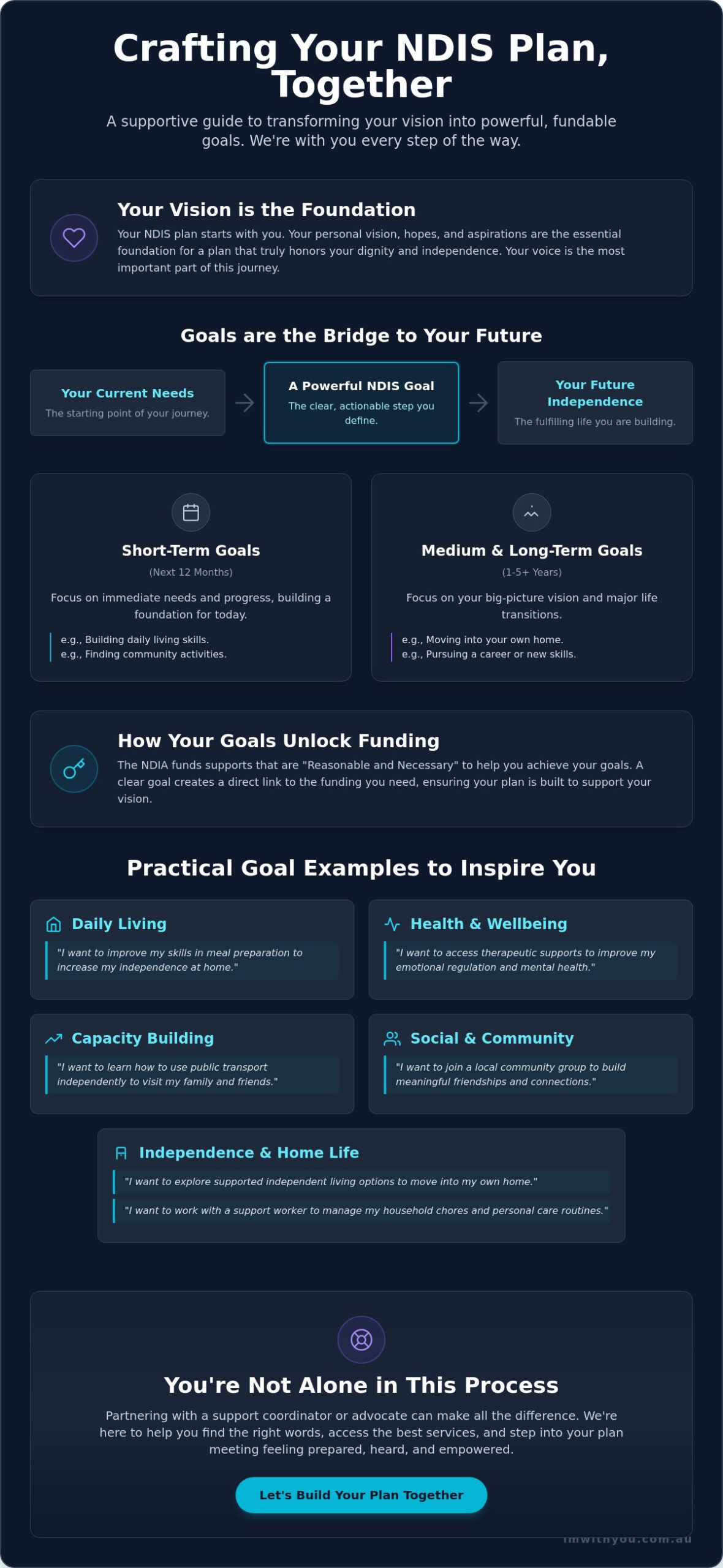
NDIS goals are much more than administrative boxes to check. They’re personal objectives that describe the meaningful changes you want to see in your life. Within the National Disability Insurance Scheme (NDIS), your goals act as the essential key that unlocks funding for specific support categories. When you share a clear vision with us, it helps providers like those of us in disability support services walk beside you more effectively. An NDIS goal is a sturdy bridge that connects your current needs to your future independence.
To help you visualize how to frame these aspirations, watch this helpful video:
Short-Term vs. Medium-Term Goals
Your plan should be a living document that looks at both your immediate world and your long-term dreams. Short-term goals usually cover the next 12 months, focusing on immediate needs like building daily living skills or finding community participation support. Medium to long-term goals focus on bigger life transitions, such as moving into supported living or pursuing a career. Having a mix of both ensures your plan stays balanced. It keeps you grounded in today’s progress while staying forward-looking toward your ultimate vision. Using specific ndis plan goals examples can help you articulate these different timelines clearly.
The Link Between Goals and “Reasonable and Necessary” Funding
The NDIA uses your goals to determine if a support is “reasonable and necessary.” They look for a direct link between what you want to achieve and the funding you’re requesting. For instance, if you want to be more active in your neighborhood, you’ll need goals that support social participation. I’m with you in ensuring your voice is respected throughout this process. This includes using person first language when describing your aspirations. This approach focuses on your identity and strengths, making it easier for the NDIA to see the human being behind the application. Exploring various ndis plan goals examples can give you the language needed to secure the right therapeutic supports for your journey.
Practical NDIS Plan Goals Examples for 2026
Writing goals can feel heavy. Seeing practical ndis plan goals examples can lighten that load significantly. I’m with you in this process of translating your life’s hopes into specific, fundable words. For daily living, you might say, “I want to improve my skills in meal preparation to increase my independence at home.” If mental health is a priority, you could state, “I want to access therapeutic supports to improve my emotional regulation.” For those focusing on capacity building skills, a goal like, “I want to learn how to use public transport independently to visit my family,” provides a clear path for growth. These phrases aren’t just administrative requirements; they’re the roadmap to your autonomy.
Examples for Social and Community Connection
Meaningful connection is at the heart of a fulfilling life. You might find it helpful to say, “I want to join a local community group to build meaningful friendships and connections.” This helps the NDIA understand your need for social participation. You could also choose a goal like, “I want to participate in leisure activities to reduce my social isolation.” If you’re looking for more guidance, VALID provides excellent tips for NDIS goals that focus on adult advocacy. Another strong example is: “I want to build my confidence in social settings so I can volunteer in my local community.” These goals directly link to community participation support, ensuring you have a companion while you explore new spaces.
Examples for Independence and Home Life
Your home should be your sanctuary. If you’re thinking about your living situation, you could write, “I want to explore supported independent living ndis options to move into my own home.” This goal opens the door for a deeper conversation about your future environment. For those who need help with the rhythm of the day, you might say, “I want to work with a support worker to manage my household chores and personal care routines.” This ensures you receive the practical help needed to maintain your dignity and comfort. If you feel overwhelmed by these choices, our disability advocacy services can help you find the right words to express your needs. We believe that every individual deserves a plan that truly reflects their unique spirit.
How to Manage and Refine Your Goals with a Trusted Advocate
Creating your vision is a beautiful first step, but managing those aspirations over time is where real growth happens. I’m with you in this journey. We’ll handle the administrative complexities together so you can focus on your personal progress. To keep your plan on track, we use the SMART framework. This means ensuring your goals are Specific, Measurable, Achievable, Relevant, and Time-bound. When we look at ndis plan goals examples through this lens, they stop being just words on a page and start being a practical management strategy for your daily life.
The Role of Support Coordination in Goal Success
NDIS support coordination is designed to bridge the gap between your plan and your reality. A coordinator helps you understand technical details, like how your “Improved Daily Living” budget can be used to fund the therapeutic supports you need. They also do the heavy lifting of connecting you with the right ndis provider who aligns with your personal values and dignity. This partnership ensures that the ndis plan goals examples you’ve chosen are actually being implemented by people who care about your success.
Preparing for Your Plan Review
As your plan review approaches, it’s time to reflect on how far you’ve come. We’ll work together to collect evidence and reports from your therapists that show your progress. If you’ve achieved a goal or if your circumstances have changed, we’ll update your vision to reflect new challenges or higher levels of independence. I recommend keeping a “success diary” to record small wins throughout the year, which will provide powerful evidence for your next NDIS meeting. If you ever feel your voice isn’t being heard mid-plan, our disability advocacy services are here to ensure your rights and choices remain the priority. You are never alone in managing your future.
Step Into Your 2026 Vision With Confidence
Your journey toward a more independent and connected life is uniquely yours, but you don’t have to navigate the technical path alone. We have explored how setting a clear vision turns your personal aspirations into fundable supports. By using these ndis plan goals examples as your foundation, you can approach your next planning meeting with clarity and purpose. I’m with you in this process; I’ll ensure that your goals reflect your strengths and your dreams for the future.
As a 2026 Excellence in Care Award Winner, we provide compassionate, advocacy-led support designed to lower your stress. Our team offers nationwide expert support coordination and capacity building skills to help you manage your plan effectively. We handle the administrative complexities so you can focus on your personal growth and community connection. Let us walk beside you; contact Im with you for expert NDIS support and advocacy today.
You have the inner strength to build the life you want. We’re honored to be your steady companion as you turn your vision for 2026 into a beautiful reality.
Frequently Asked Questions
How many goals should I have in my NDIS plan?
You typically want to include between two and five goals in your plan. It’s often better to focus on a few meaningful outcomes rather than a long list of minor tasks. Having a balanced mix of short-term and medium-term aspirations ensures your funding covers both immediate daily living needs and your bigger dreams for the future. I’m with you in finding that perfect balance so your plan remains manageable and focused on your growth.
Can I change my NDIS goals once my plan has started?
Yes, you can absolutely update your goals if your life circumstances change before your next scheduled review. Life is dynamic, and your plan should be flexible enough to grow with you. If you discover new interests or your support needs shift, you can request a plan variation or review. Using various ndis plan goals examples can help you rephrase your new vision clearly for the NDIA. We’re here to help you navigate this administrative process so your voice is always heard.
What happens if I don’t meet my NDIS goals?
There are no penalties if you don’t achieve a specific goal within your plan’s timeframe. The NDIS is about progress, not perfection. If you haven’t reached a milestone, we’ll simply look at why and adjust your strategies or supports for the next period. It might be that the goal was too ambitious or that your priorities shifted. This reflection is a vital part of your personal growth and helps us refine your ndis plan goals examples for the future.
Do my goals have to be related to my disability?
Your goals should focus on the life you want to lead, but the supports you receive must be directly related to your disability. For example, your goal might be to join a local art class to build friendships. While the goal is about social connection, the NDIS provides funding for a support worker to help you attend because of the barriers your disability creates. This ensures the funding meets the reasonable and necessary criteria while keeping the focus on your personal aspirations.