

What if the secret to a better NDIS plan isn’t found in a high-pressure meeting, but in the quiet, daily moments of your life that often go unrecorded? I understand how heavy the weight of administrative exhaustion can feel, especially when you’re trying to decode the “reasonable and necessary” criteria while feeling unheard by the NDIA. It’s a lot to carry on your own. Im with you, and I want to help you discover how to advocate for more ndis funding in a way that feels sustainable rather than draining. You deserve a plan that truly mirrors your life, and I’m here to walk alongside you as we make that happen.
This guide offers a compassionate approach to managing your advocacy through practical, evidence-based steps. I’ll share management strategies that help you gather the right reports without the usual burnout, ensuring your voice is central as you navigate the 1 July 2026 Pricing Schedule changes. We’ll look at how to build a case that reflects your genuine needs, giving you the confidence to lead your own journey. You’ll finish this article with a clear plan and the reassurance that you have the steady support of a partner who values your independence and dignity above all else.
Key Takeaways
- Discover how to view advocacy as a bridge to your future goals by understanding the “reasonable and necessary” criteria in simple, supportive language.
- Learn how to use a management mindset to track functional impacts and “near misses” in a diary, giving you the clear evidence needed for a stronger case.
- Master the practical steps of how to advocate for more ndis funding; I’m with you in this journey to ensure you feel empowered and never alone.
- Build your confidence for planning meetings by practicing your key messages with a trusted companion who walks alongside you.
- Gain clarity on the NDIS system by learning the vital differences between a Plan Variation and a full Plan Reassessment so you can choose the best path forward.
Understanding the Foundations of NDIS Advocacy
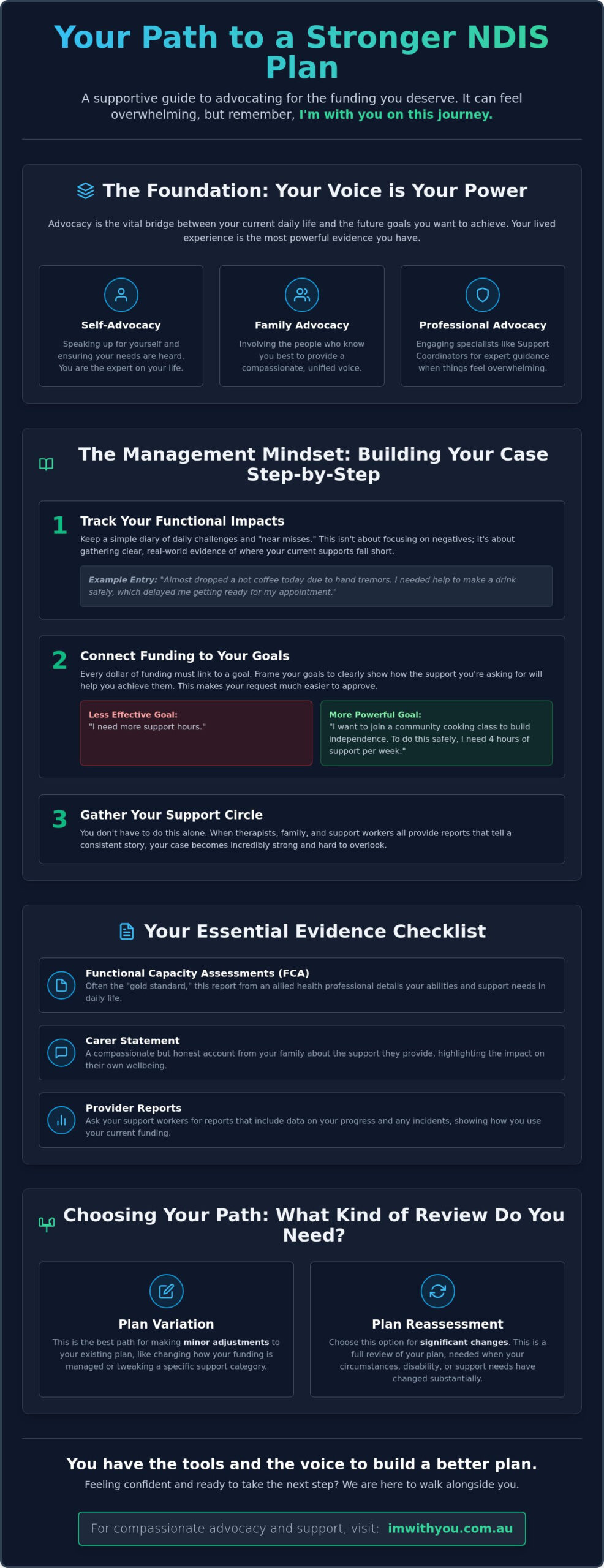
Advocacy is the vital bridge between your current daily life and the future goals you want to achieve. When you’re navigating the National Disability Insurance Scheme (NDIS), it’s easy to feel like just another number in a complex system. Im with you believes your voice is the most important part of the entire scheme because you’re the expert on your own lived experience. Learning how to advocate for more ndis funding starts with the recognition that your perspective is the most powerful evidence available to secure the support you deserve.
To better understand how different types of funding work together to support your journey, watch this helpful video:
The foundation of any successful funding request lies in the “Reasonable and Necessary” criteria. Think of this not as a clinical hurdle, but as a supportive framework to explain what you need to live a typical, fulfilling life. While self-advocacy involves speaking up for yourself, family advocacy brings in the people who know you best. If the process feels overwhelming, professional NDIS Support Coordination or Disability Advocacy Services can provide specialized expertise. Im with you in this process, ensuring you have a steady companion to help navigate these distinctions.
The Role of Personal Goals in Funding
Every dollar of funding must link back to a specific goal in your plan. If your current supports aren’t meeting your needs, we often need to look at how your goals are phrased. For example, instead of just stating a need for more hours, you might phrase a goal as: “I want to join a community cooking class to build my independence in the kitchen.” This clearly shows that the funding is a necessary tool for your personal growth and social inclusion, making it easier to justify increased support.
Why Your Voice Matters in 2026
In the current NDIS landscape, clear and person-centered communication is more important than ever. I encourage you to use person-first language when describing your needs. This keeps the focus on you as an individual with strengths and possibilities, rather than just a set of limitations. By mastering how to advocate for more ndis funding through clear communication, you ensure the system respects your dignity and supports your unique journey toward independence.
Practical Strategies for Building a Strong Funding Case
Advocacy is more than just sharing a medical diagnosis. It’s about painting a clear picture of the functional impact your disability has on your daily life. I’ve found that the most successful cases are built on real-world examples rather than clinical labels. By adopting a “management mindset,” you can track the specific times when your current funding doesn’t meet your needs. I recommend keeping a simple diary of “near misses” or moments when you lacked the support to participate in your community. These records provide the concrete evidence needed when you’re learning how to advocate for more ndis funding.
You shouldn’t feel like you’re carrying this burden by yourself. Im with you in this process, and we can work together to gather a “support circle” of therapists, family members, and providers. When everyone speaks with a unified voice, your request becomes much harder to overlook. Your efforts today are truly the building blocks for your future independence. If you need a hand organizing these thoughts, our team can provide compassionate advocacy support tailored to your journey.
The Essential Evidence Checklist
Gathering the right documents is a key part of your management strategy. Functional Capacity Assessments (FCA) are often considered the “gold standard” because they detail exactly what you can do and where you need help. Don’t forget the power of a Carer Statement; this is a compassionate but honest account from your family about the support they provide. You should also ask your support workers for provider reports that include data on your progress. For a deeper look at the formal process, the NDIS Guide to Decision Reviews offers a helpful roadmap for these submissions.
Connecting Advocacy to Specific Supports
When you’re seeking specific services, your advocacy needs to be precise. If you are looking into supported independent living ndis, you’ll need to clearly explain why 24/7 care is necessary for your safety and well-being. Similarly, if you’re justifying funding for community participation, focus on how social connection reduces isolation and builds your skills. This direct link between your goals and the requested support is a vital part of how to advocate for more ndis funding effectively.
Navigating Plan Reviews and Appeals with Confidence
Approaching a plan review can feel like a daunting milestone, but I want you to view it as an opportunity to realign your supports with your actual life. Preparation is your greatest tool for managing this stress. I suggest practicing your “key messages” with a trusted friend before the meeting. This helps you speak clearly about your needs without feeling rushed. It’s also vital to understand the difference between a Plan Variation, which handles minor adjustments, and a full Plan Reassessment, which is a complete look at your situation. Knowing which path to take is a fundamental step in how to advocate for more ndis funding effectively.
Sometimes, despite your best efforts, the initial answer might be “no.” If this happens, please don’t lose heart. You have the right to request an Internal Review, often called an S100. As noted by People with Disability Australia on NDIS Issues, navigating these hurdles requires persistence and a clear understanding of your rights. Choosing the right ndis provider means having a partner who supports your advocacy through every step of this formal process.
Working with Your Support Coordinator
Your support coordinator is there to manage the heavy lifting of evidence collection. They help bridge the gap between your daily experiences and the technical language the NDIA requires. We focus on collaborative planning, ensuring that every report from your therapists aligns with your primary goals. This team-based approach takes the administrative pressure off your shoulders, allowing you to focus on your personal growth and well-being. Together, we make the process of how to advocate for more ndis funding feel like a shared mission rather than a solo battle.
Maintaining Positivity During the Wait
Waiting for a decision from the NDIA is often the hardest part of the journey. During this time, I encourage you to focus on small, daily wins and maintain your routine. Stress management is a key part of your overall management strategy. I’m with you during the quiet weeks of waiting, just as much as during the busy weeks of planning. This partnership is our commitment to your journey. We believe in your right to a plan that supports your dignity, and we’ll continue walking alongside you until you feel truly heard.
Building Your Future with Confidence and Support
Navigating the complexities of the NDIS doesn’t have to feel like a solitary struggle. By focusing on your personal goals and maintaining a clear record of your daily needs, you’ve already taken the most important steps toward a more supportive plan. We’ve seen how a management mindset and a strong support circle can transform the way you approach your funding journey. Your voice is the most vital part of this system; it’s the bridge to the life you deserve.
As you move forward, knowing how to advocate for more ndis funding becomes easier when you have a dedicated guide by your side. At I’m with you, we’re proud to offer national coverage and specialized expertise in advocacy and support coordination. Our commitment to person-centered care was recognized with the 2026 Award for Excellence in Disability Care, but our true reward is seeing you thrive with the independence you’ve worked so hard to achieve. I’m with you every step of the way, providing the steady support you need to feel heard and understood.
Start your journey with a partner who cares—contact I’m with you today. You have the strength and the tools to build a brighter future, and I’m honored to walk that path alongside you.
Frequently Asked Questions
What is the most important piece of evidence for more NDIS funding?
A Functional Capacity Assessment (FCA) is the most vital piece of evidence because it provides a professional, objective view of how your disability affects your daily life. It explains the specific support you need to achieve your goals rather than just listing a diagnosis. By showing the gap between your current situation and your aspirations, an FCA makes a strong case for why more funding is reasonable. I’m with you in ensuring your reports are clear and impactful.
Can I ask for more funding in the middle of my NDIS plan?
You can certainly request a review if your circumstances change before your plan’s end date. This is typically managed through a Plan Variation for minor adjustments or a full Plan Reassessment for significant shifts in your needs. I’m with you as you prepare this request, ensuring you have the evidence to show why your current funding is no longer sufficient. It’s a proactive way to manage your supports as your life evolves and your needs change.
What should I do if my NDIS funding request is denied?
If your request is denied, your next step is to request an Internal Review of a Decision, known as a Section 100 review. You must submit this request within three months of receiving the decision letter. I understand this can feel discouraging, but it’s a common part of learning how to advocate for more ndis funding. We can refine your evidence together to address the specific reasons the NDIA provided for the initial refusal.
How do I explain that I need more 1:1 support to the NDIA?
To justify increased 1:1 support, focus on how this individual attention directly improves your safety, independence, or community participation. Provide concrete examples of moments where you lacked the support to participate safely. Explaining how to advocate for more ndis funding in this context involves showing that 1:1 support is the most effective way to build your capacity. It’s about demonstrating that this investment leads to a more dignified and independent life for you.