

What if a smaller NDIS budget wasn’t a barrier to your independence, but a prompt to discover more creative, community-connected ways to live your best life? I know how heavy it feels when you look at your plan and worry about making those funds stretch until your next review. It’s completely natural to feel a sense of anxiety when you’re trying to figure out how to get the most from a small ndis budget while facing new quarterly funding releases and shifting price limits. I’m with you in this journey, and I want you to know that your goals are still within reach. We can work through the complexity together.
You deserve to feel confident and empowered in every spending decision you make. In this gentle guide, I’ll share practical and compassionate strategies to help you prioritize your needs and use your funding with total clarity. We’ll explore how to balance flexible core supports with your specific goals, navigate the latest 2026 pricing updates, and build a sustainable plan that supports your dignity and choice for the full cycle. Let’s find a way to make every dollar work harder for your future, ensuring you have the support you need to thrive every single day.
Key Takeaways
- Embrace the natural flexibility of your Core Supports budget to ensure your funding flows exactly where you need it most each day.
- Discover how to get the most from a small ndis budget by prioritizing the capacity-building goals that truly empower your long-term independence.
- Explore how group-based community participation provides a wonderful way to stay socially connected while being gentle on your financial resources.
- Learn how having a trusted support coordinator or advocate by your side can help you find the best value and prepare for future plan reviews with confidence.
Understanding Your NDIS Budget: The Power of Flexibility
Receiving a plan that feels smaller than you expected can be incredibly daunting. It’s natural to feel a sense of worry about how you’ll make everything work, but I want you to know that I’m with you in this. We can look at the numbers together and find the hidden opportunities within your funding. Understanding the structure of the National Disability Insurance Scheme is your first step toward empowerment. When you know how the system is built, you can start to see how to get the most from a small ndis budget without sacrificing the quality of your care or your independence.
To help you visualize how your funding is structured, I’ve found a helpful video that explains the basics of budget management:
The most important concept to master is “Flexible Funding.” In the 2026 NDIS landscape, your Core budget is designed to be adaptable. This means you aren’t stuck with a rigid schedule that doesn’t fit your life. If you need more help with daily personal activities one week but want to prioritize social community participation the next, you have the agency to move those funds around. This flexibility is a powerful tool because it allows your budget to breathe and change alongside your daily needs.
The 2026 NDIS Budget Categories
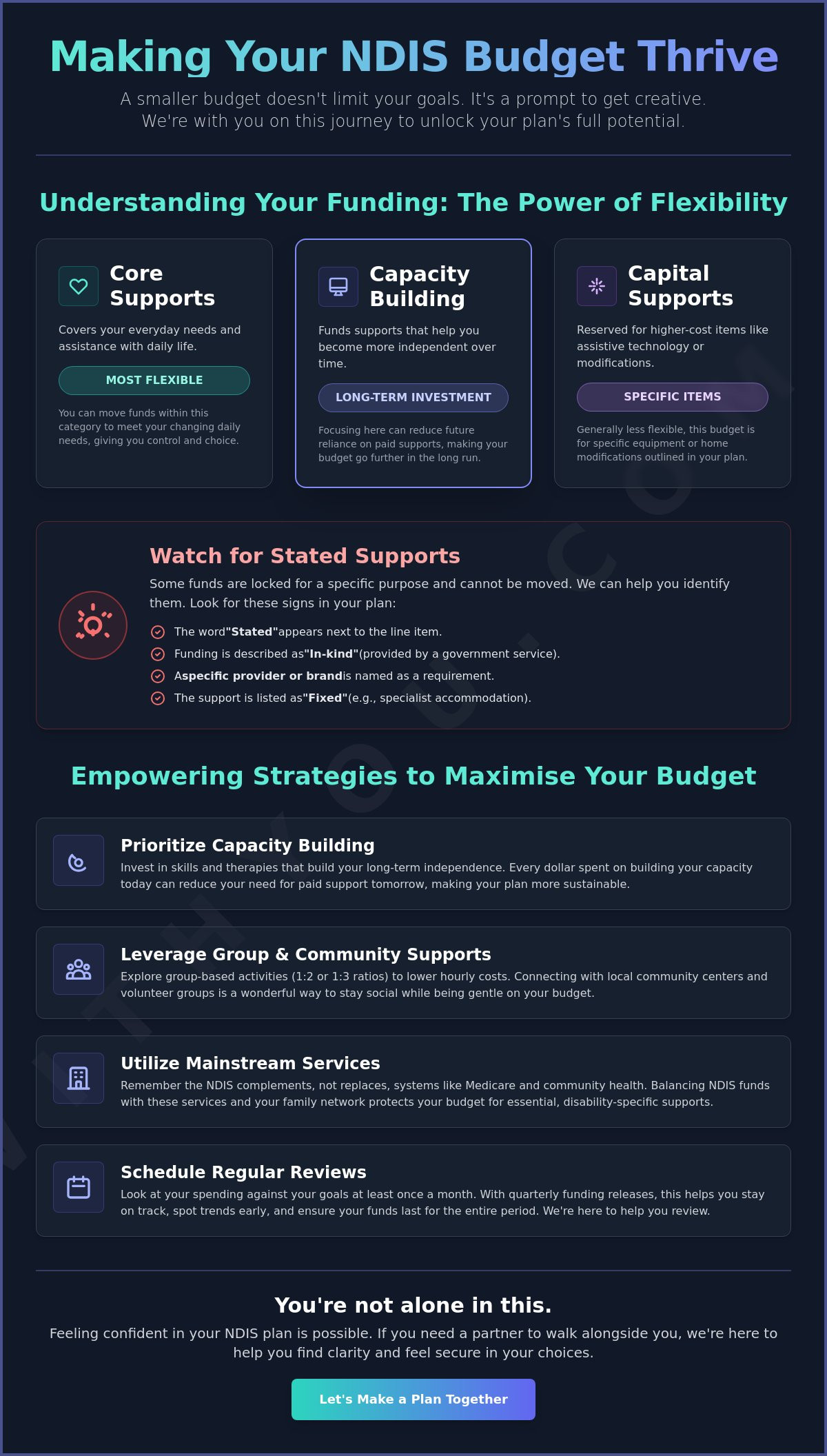
Your plan is typically divided into three main buckets. Core Supports is the most flexible, covering everyday needs like assistance with daily life. Capacity Building is a vital long-term investment; it funds things like therapeutic supports or skills training that help you become more independent over time. Capital is reserved for higher-cost items like equipment or home modifications. Even if your total funding feels tight, focusing on Capacity Building can eventually reduce your reliance on paid supports, making your budget more sustainable in the long run.
Identifying Stated Supports
While flexibility is the goal, some funds are “stated,” meaning they’re locked for a specific purpose and can’t be moved to other categories. Knowing the difference prevents accidental overspending that could leave you short later in the year. You can identify these by looking for specific markers in your plan:
- The word “Stated” appears next to the support line item.
- The funding is described as “In-kind,” which means it’s provided by a specific government service.
- A specific provider or brand of equipment is named as a requirement for that funding.
- The support is listed as “Fixed,” often seen in specialist disability accommodation or complex home mods.
5 Strategies to Maximise a Small NDIS Budget
Managing your funding isn’t just about balancing a spreadsheet; it’s about making sure your life feels full and supported. When you are learning how to get the most from a small ndis budget, the shift from survival to strategy makes all the difference. I’m with you in this process, helping you look at your plan through a lens of possibility. By focusing on high-impact goals that build your independence, you can actually reduce your long-term reliance on paid care. This capacity-building approach turns every dollar into an investment in your future self, creating more freedom for you over time.
Leveraging Group Supports and Community
One of the most effective ways to stretch your funding is by exploring group-based supports. Instead of one-on-one care for every outing, consider a 1:2 or 1:3 support ratio. This often lowers the hourly cost significantly while offering a wonderful chance for social connection. You might also look at what are leisure activities and how they can be integrated into your life using local community centers or volunteer groups. These spaces often provide joy and connection at a fraction of the cost of specialized services, leaving more of your budget for essential therapeutic needs.
The Role of Mainstream Services
It’s helpful to remember that the NDIS isn’t designed to replace every service in your life. Mainstream systems like Medicare and community networks continue to play a vital role. By balancing your NDIS supports with these existing services and family networks, you protect your budget for the things only the NDIS can provide. Regular check-ins are essential here. With the quarterly funding periods that rolled out in 2025, reviewing your spending every three months ensures you don’t run out of funds before your next block is released. If you’re feeling unsure about where to start, our team at imwithyou.com.au is here to walk alongside you, offering the guidance you need to feel secure in your choices.
- Schedule monthly reviews: Look at your spending against your goals to spot trends early.
- Prioritize independence: Spend on skills today to reduce care hours tomorrow.
- Mix your supports: Use a blend of paid, community, and family supports.
- Ask for help: Connect with advocates if you feel your funding doesn’t meet your basic needs.
Collaborative Support: How Advocacy and Coordination Protect Your Budget
Managing an NDIS plan can feel like a full-time job, especially when you’re trying to make every cent count. You don’t have to carry that weight alone. Support Coordination is a powerful tool designed to act as your strategic partner. Instead of just looking at invoices, a dedicated coordinator helps you find providers who align with your values and offer the best possible value for your funding. They understand the 2026 pricing limits and can help you negotiate service agreements that protect your interests. Knowing how to get the most from a small ndis budget becomes much easier when you have an expert navigator by your side.
Disability Advocacy is another essential layer of protection for your independence. If you feel your funding is fundamentally insufficient to meet your basic needs, an advocate stands by you to ensure your voice is heard. They help you navigate the complexities of the system, ensuring that your rights are respected and your dignity remains the top priority. Together, these supports create a safety net that allows you to focus on living your life rather than just managing an administrative budget.
When a Small Budget Is Not Enough
There are times when even the most careful management isn’t enough to cover essential supports. If your life situation changes, or if you find that your current funding prevents you from achieving your goals, you have the right to request a plan reassessment. This process involves gathering evidence from therapists and specialists to demonstrate that your requested supports meet the “reasonable and necessary” criteria. It’s about showing the NDIA exactly how specific funding will impact your daily independence. I’ll be right there to help you organize this documentation and prepare for those important conversations.
Finding the Right Partner
Your journey is unique, and you deserve a partner who treats your budget with the same care and respect that you do. Knowing how to choose an ndis provider is the first step in building a support team that truly listens. I invite you to connect with us for a gentle consultation where we can map out your goals and look at your budget together. We’ll find a path that feels safe, sustainable, and empowering for you. Managing your plan is a partnership, and I want you to feel certain that I’m with you every step of the way.
Moving Forward With Clarity and Support
Navigating your plan shouldn’t feel like a solo journey through a complex maze. By embracing the flexibility of your Core budget and exploring the social benefits of group-based supports, you’ve already begun the process of reclaiming your agency. You now have a clearer understanding of how to get the most from a small ndis budget by focusing on capacity-building goals that foster long-term independence. These strategies aren’t just about managing numbers; they’re about ensuring your dignity and choice remain at the heart of your support system.
As the recipient of the 2026 Award for Excellence in Disability Support, our team provides expert NDIS Support Coordination and a compassionate, advocacy-led approach that puts you first. We believe that every person deserves a partner who listens deeply and acts with integrity. Let us help you navigate your NDIS journey with care and expertise; reach out to Im with you today. You have the strength to achieve your goals, and I’m with you every step of the way as we turn your plan into a pathway for a vibrant, connected life.
Frequently Asked Questions
Can I move money between my NDIS budget categories?
You can generally move funds flexibly within your Core Supports budget, but Capacity Building and Capital budgets are typically fixed. This flexibility in Core allows you to use your funding for what you need most on any given day, whether that’s help at home or getting out into the community. If you’re unsure about a specific line item, checking your plan for “stated supports” is a good first step because those funds are locked for a specific purpose and cannot be moved.
What happens if I run out of NDIS funding before my plan ends?
If you’re at risk of exhausting your funds early, you should contact the NDIA or your support coordinator as soon as possible to discuss a plan reassessment. The quarterly funding periods introduced in 2025 are designed to help prevent this, but life happens and needs change. I’m with you in these moments; we can gather the evidence needed to show that your circumstances have changed and that additional support is reasonable and necessary for your safety and independence.
Does a small NDIS budget mean I have to use cheaper providers?
A smaller budget doesn’t mean you have to compromise on the quality of your care or settle for providers that don’t feel like a good fit. Learning how to get the most from a small ndis budget is more about strategy than finding the lowest price. You can maximize your hours by utilizing group-based community participation or focusing on capacity-building supports that increase your skills. This approach ensures your funding goes toward high-impact services that truly support your long-term goals.
Is support coordination worth it if my budget is limited?
Support coordination is often one of the smartest investments you can make when your budget feels tight. A skilled coordinator acts as your advocate and guide, helping you find high-value providers and identifying creative ways to meet your goals without overspending. They understand the 2026 pricing arrangements deeply and ensure you don’t miss out on essential services. Having that expert partner by your side provides the peace of mind that you’re using every dollar effectively.