

What if the most empowering choice you can make for your NDIS journey isn’t to struggle through it alone, but to secure a professional partner who understands the system? Many participants feel that asking for help might signal a lack of independence, but the truth is quite the opposite. Successfully justifying support coordination in ndis plan isn’t about proving what you can’t do; it’s about demonstrating a strategic path toward the life you want to lead. I know how overwhelming the jargon can feel and how much anxiety a plan review can cause. I’m with you in this process, and I want to help you feel steady and secure.
In this guide, you’ll learn how to effectively advocate for support coordination funding by aligning your unique needs with the current NDIS criteria. We’ll walk through the recent 2026 reforms, including how the new I-CAN assessment tool impacts your budget. By focusing on how a coordinator builds your capacity and manages complex provider networks, you can enter your next meeting feeling empowered. You don’t have to carry the weight of administrative management by yourself when there’s a clear way to find a trusted companion for the road ahead.
Key Takeaways
- View support coordination as a vital capacity-building support that helps you regain control and leads to greater long-term independence.
- Master the “Reasonable and Necessary” criteria for justifying support coordination in ndis plan discussions to demonstrate its true value to the NDIA.
- Gather powerful evidence of need from your current therapists and providers to strengthen your case before your planning meeting begins.
- Create a simple management log to document the time you spend coordinating services, showing exactly why professional help is a necessary investment.
- Gain the confidence to advocate for yourself knowing I’m with you to help simplify the jargon and manage these complex systems together.
Why Support Coordination is a Vital Investment in Your Independence
Support coordination is more than just a service; it’s a specialized capacity-building support designed to help you lead your own life with confidence. While some might view it as administrative help, it actually serves as a vital investment in your long-term independence. By National Disability Insurance Scheme (NDIS) standards, this support helps you build the skills required to understand and implement your plan effectively. Managing these systems can feel like a full-time job, and I’m with you in recognizing that asking for a partner isn’t a sign of weakness. It’s a proactive management strategy that ensures you aren’t left behind.
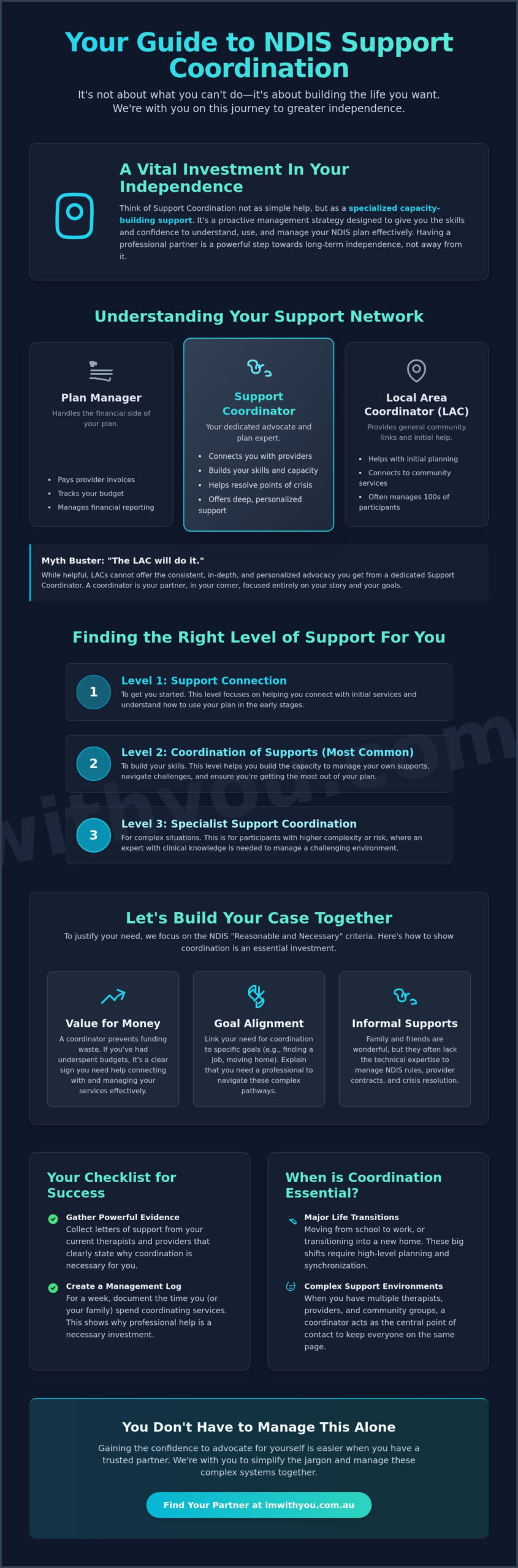
It’s helpful to understand how this role differs from other people in your circle. Plan management focuses strictly on the financial side, like paying invoices and tracking budgets. Local Area Coordinators (LACs) provide general community links and help with the initial planning process. A support coordinator, however, is your dedicated advocate. They work closely with you to find the right providers and resolve points of crisis. We believe you shouldn’t have to be an expert in every regulation just to receive great care. To better understand this concept, watch this helpful video:
The Three Levels of Support Coordination
The NDIA funds three distinct levels depending on your current life stage and needs. Level 1, Support Connection, focuses on helping you start your journey by finding initial services. Level 2, Coordination of Supports, is the most common and focuses on building your capacity to manage your own supports over time. Level 3, Specialist Support Coordination, is reserved for situations with higher complexity or risk where expert clinical support is needed to manage a volatile environment. Matching your request to the right level is a key part of justifying support coordination in ndis plan reviews.
Moving Beyond the “LAC Will Do It” Myth
A common hurdle during plan reviews is the suggestion that an LAC can provide the same assistance. While LACs are helpful, they often manage hundreds of participants and cannot offer the deep, personalized attention you deserve. A dedicated coordinator knows your personal story, your goals, and your specific challenges. This consistency is what allows for true growth. Having a partner who is always in your corner provides a level of security and advocacy that general community services simply cannot replicate.
Building Your Case: How to Justify Support Coordination to the NDIA
The “Reasonable and Necessary” test, found in Section 34 of the NDIS Act, is your most powerful tool when justifying support coordination in ndis plan reviews. I’m with you in this process, and I want you to feel like a partner with the NDIA rather than someone asking for a favor. When we frame your request through this lens, we show that a coordinator isn’t a luxury. It’s an essential bridge that makes the rest of your plan work. Using person-first language to describe your goals ensures the focus remains on your identity and aspirations, which helps the NDIA see the human impact of their funding decisions.
The 6 Pillars of a Strong Justification
To build a compelling case, we focus on specific criteria the NDIA uses to measure “value for money” and “effective and beneficial” outcomes. These pillars help translate your daily struggles into the language the system understands.
- Value for Money: A coordinator prevents funding from going to waste by ensuring you actually use the supports in your plan. If you’ve had underspent budgets in the past, this is a clear sign you need help managing your services.
- Goal Alignment: Link your need for coordination to specific outcomes, like finding a job or joining a local sports club. Explain that you need a professional to navigate these complex community pathways.
- Informal Supports: Be honest about your family and friends. While they love you, they often lack the technical expertise to manage NDIS compliance and provider contracts.
Practical Scenarios That Trigger Funding
Certain life events naturally highlight the need for how to get support coordination included in your budget. If you are moving from school into the workforce or transitioning into a new home, these major shifts require high-level synchronization that goes beyond daily care. Complex environments with multiple therapists and community groups also demand a central point of contact to ensure everyone is working toward the same goal. Justification is the bridge between your current challenges and your future independence. If you feel like you’re drowning in paperwork, it’s time to explore how professional support coordination services can help you breathe easier.
Preparing for Your Planning Meeting: Management Strategies for Success
Success in your planning meeting starts long before you sit down with your planner. I’m with you in this preparation phase, helping you turn your daily experiences into clear, actionable evidence. One of the best ways of justifying support coordination in ndis plan meetings is to gather letters of support from your current therapists or providers. These professionals can explain how a coordinator will enhance the effectiveness of your other treatments. I also suggest keeping a management log for two weeks. Write down every phone call, email, and schedule clash you handle. This log provides concrete proof of the administrative burden you are currently carrying alone.
It’s also vital to remember that you don’t have to go to this meeting by yourself. You have the right to bring a support person, a family member, or a professional advocate to stand by your side. Having a friendly face in the room can lower your anxiety and ensure your voice is heard clearly. We want you to feel empowered during this conversation, knowing that your request is backed by real-world data and a clear vision for your future.
Crafting Your Impact Statement
When you speak to your planner, try to describe the ripple effect that coordination has on your whole life. If you’re constantly exhausted by managing multiple providers, it inevitably impacts your mental health and family stability. Focus your language on capacity building rather than just crisis management. You are seeking a partner to help you build the skills to lead your own life, not just someone to fix problems when they arise. This approach aligns perfectly with the NDIS reasonable and necessary criteria, which prioritize long-term growth and social inclusion.
Next Steps: Working with a Trusted Advocate
The difference a premium provider makes in the quality of your coordination is profound. A dedicated partner doesn’t just manage a plan; they invest in your personal growth and dignity. If you’re currently self-managing and feel overwhelmed, transitioning to a coordinated plan can feel like a weight lifting off your shoulders. I’m here to help you choose an NDIS provider that mirrors your values and treats your journey with the respect it deserves. You’ve done the hard work of advocating for your needs; now let a steady companion walk beside you to make those goals a reality.
Take Control of Your NDIS Future Today
You now have the tools to approach your next plan review with a sense of calm and confidence. By framing your request through the lens of long-term independence and using concrete evidence like a management log, you’ve turned a stressful task into a strategic plan for growth. Successfully justifying support coordination in ndis plan meetings is about showing the NDIA how a professional partner helps you achieve your specific life goals. You don’t have to be the expert when you have a dedicated guide to navigate the system’s complexities for you.
I’m with you in this journey, and our team is ready to provide the steady companionship you deserve. As a nationwide NDIS registered provider awarded for excellence in 2026, we specialize in advocacy and capacity building that puts your needs first. We believe in your potential and want to help you lower the barriers of stress so you can focus on living your life. We’re here to walk alongside you—contact Im with you for expert support coordination today. You have the strength to lead; we have the expertise to support you every step of the way.
Frequently Asked Questions
What is the most important factor in justifying support coordination?
The most important factor is demonstrating that the support is “reasonable and necessary” to help you achieve your personal goals. You must show that a coordinator will build your capacity to lead an independent life rather than just managing administrative tasks. I’m with you in this effort; focus on how this support acts as a bridge between your current challenges and the future you want to create.
Can I get support coordination if I already have a Plan Manager?
You can definitely have both a plan manager and a support coordinator because they serve very different purposes. A plan manager handles your financial claims, while a support coordinator focuses on the practical side of finding and connecting with the right providers. When justifying support coordination in ndis plan discussions, explain that you need specialized help with service implementation that goes beyond simple bill paying.
What happens if the NDIA refuses to fund support coordination in my plan?
If the NDIA declines your request, you can ask for an internal review of the decision within three months. This isn’t a dead end; it’s a chance to submit more detailed evidence or a management log that clearly shows your need. I’m with you through these hurdles, and I suggest seeking help from a disability advocacy service to ensure your voice is heard during the appeal.
How many hours of support coordination is considered “average” in 2026?
Most participants find that 24 to 72 hours per year is a standard range, though this depends entirely on your personal situation and complexity. With the 2026 NDIS reforms bringing more scrutiny to intermediary funding, being precise about your needs is essential. Showing exactly how many hours you currently spend managing multiple providers will help the NDIA understand why professional support is a vital investment in your stability.